


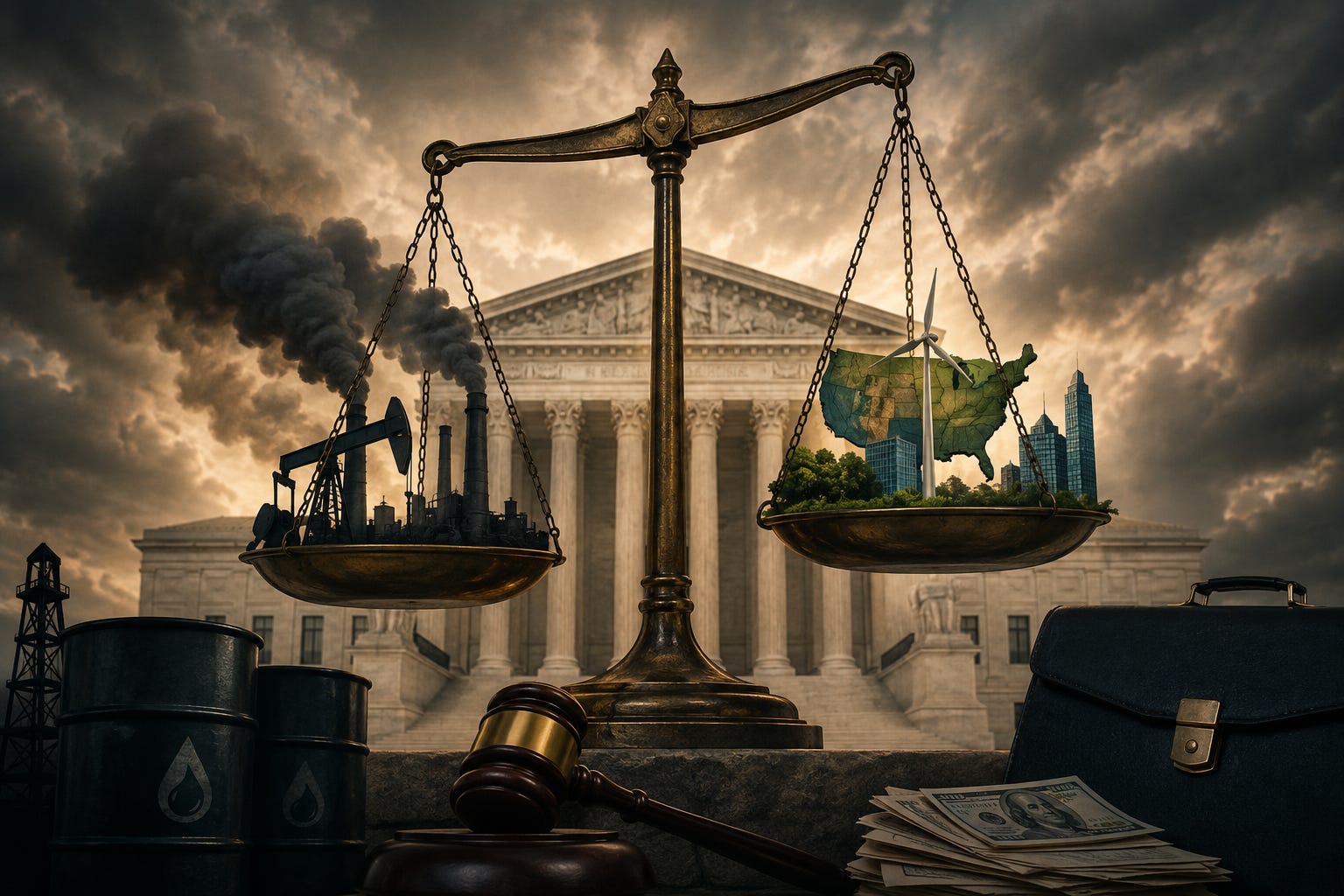
When the Supreme Court agreed to hear Boulder County’s climate accountability lawsuit against ExxonMobil and Suncor Energy, it placed one Colorado case at the center of a much larger national fight.
On paper, the justices are being asked a legal question about whether federal law bars state-level climate-damages claims. In practice, the case lands at the intersection of four of the most volatile issues in American politics: federal deregulation, state-led corporate accountability, the selective use of states’ rights rhetoric, and the financial conflicts that continue to shadow public power.
That is why the case matters beyond Boulder, beyond Exxon, and even beyond climate policy.
This Community Is Powered by You
What started as a small circle has grown into something much bigger, and it’s all because of readers like you.
Every time you forward this email, post it on socials, or bring someone new into the fold, you’re helping build one of the most passionate, independent political communities out there.
Want to keep the momentum going?
Share this newsletter with someone who should be part of this conversation.
Thank you for being here. It means everything.
The Colorado Case Before the Court
The lawsuit was originally filed in 2018 by Boulder County, San Miguel County, and the City of Boulder, Colorado. The plaintiffs accuse ExxonMobil and Suncor Energy of helping drive climate change while allegedly misleading the public about the dangers associated with fossil fuel emissions.
The local governments argue that climate change has already imposed major financial burdens on their communities. Wildfire mitigation costs have increased. Water systems and infrastructure require adaptation. Extreme weather and heat events have strained public resources. The plaintiffs contend that fossil fuel companies knowingly contributed to those harms while publicly minimizing or disputing the risks for decades.
Importantly, the lawsuit is not asking the courts to regulate emissions directly. Instead, Boulder’s claims are rooted in state-law causes of action, such as public nuisance, failure to warn, and deceptive trade practices. The legal theory resembles earlier waves of litigation against industries like tobacco manufacturers and opioid companies, where plaintiffs argued that corporate deception amplified public harm.
For years, the litigation has revolved less around the underlying climate science and more around procedure. Exxon and Suncor have argued that climate change is inherently a national and global issue that cannot be governed through state-level tort law. They maintain that allowing individual states or municipalities to impose liability through local courts would interfere with federal energy policy and foreign affairs.
Colorado courts repeatedly allowed the lawsuit to proceed under state law. Now the Supreme Court has agreed to weigh in.
The central question before the justices is whether federal law preempts these kinds of state-law climate accountability claims. The answer could determine the future not only of Boulder’s case, but of dozens of similar lawsuits filed by states and municipalities across the country.
Previous Cases
The Supreme Court has brushed against similar climate accountability lawsuits before without fully stepping in. In January 2025, the justices declined to hear a related case brought by the city of Honolulu against several major fossil fuel companies, allowing the lawsuit to continue in state court.
At the time, the Court’s refusal to intervene was viewed by many legal observers as a temporary victory for state and local governments pursuing climate damages claims.
The Boulder case feels different. By agreeing to hear the Colorado dispute, the Court now appears prepared to directly address the broader legal question underlying many of these lawsuits: whether state-level climate accountability claims are preempted by federal authority over energy and emissions policy.
Federal Deregulation and the Search for Accountability
The timing of the case matters enormously.
The second Trump administration has accelerated efforts to roll back climate-related regulations and weaken the authority of federal agencies. The Environmental Protection Agency has moved aggressively against the greenhouse gas “endangerment finding,” the legal framework that has underpinned much of modern federal climate regulation since 2009, formally rescinding it on February 12, 2026. More broadly, the administration has embraced a deregulatory philosophy that treats many environmental and corporate oversight rules as barriers to economic growth.
For supporters of those policies, this represents a correction against what they see as federal overreach and excessive bureaucracy.
For critics, it creates a different problem. If federal agencies retreat from enforcement and regulation, where does accountability go?
That question helps explain the rise of state and local climate lawsuits over the past several years. Municipalities and state attorneys general increasingly view litigation as one of the few remaining tools available when federal action stalls or reverses. Instead of relying on Washington, they have turned to state consumer protection laws, public nuisance claims, fraud allegations, and damage suits to pursue accountability in court.
The strategy extends beyond climate. Across multiple industries, states have begun using litigation to address issues they believe federal regulators are unwilling or unable to confront aggressively. Climate cases are simply among the most politically charged examples.
The Boulder lawsuit, therefore, sits inside a much larger debate about governance in modern America. If the federal government chooses not to regulate aggressively, can states and localities step in themselves? Or does federal withdrawal effectively become a shield against accountability?
The Federal Government Is Not Just Retreating. It Is Pushing Back.
The second Trump administration has not merely weakened federal climate regulation. It has also tried to stop states from building their own climate accountability systems.
On April 8, 2025, Trump signed Executive Order 14260, titled “Protecting American Energy From State Overreach.” The order directed the attorney general to identify and challenge state laws and lawsuits that the administration viewed as burdening domestic energy production. The White House specifically criticized New York and Vermont’s climate superfund laws, which seek payments from major fossil fuel companies for climate adaptation costs.
The Department of Justice followed by suing Hawaii, Michigan, New York, and Vermont over state climate actions. New York and Vermont were targeted over climate superfund laws. Hawaii and Michigan were targeted over efforts to sue fossil fuel companies for climate damages. DOJ argued that those state actions interfere with federal authority, national energy policy, and the Environmental Protection Agency’s role under the Clean Air Act.
The administration is actively trying to preempt state-level climate accountability while also weakening federal climate regulation. In plain English, the federal government is saying states cannot do this because climate change belongs to Washington, even as Washington is simultaneously choosing to do less.
The New Federalism Divide
That question has exposed one of the more striking political reversals of recent years.
For decades, Republicans frequently framed themselves as defenders of states’ rights against centralized federal power. Conservatives argued that local governments and state legislatures were better positioned to reflect the values and priorities of their citizens. Democrats, meanwhile, often emphasized federal authority as necessary to protect civil rights, labor protections, environmental standards, and public welfare.
Today, those alignments are far less consistent.
In the climate arena, Republican officials and fossil fuel companies increasingly argue that states should not be allowed to pursue aggressive climate accountability measures because such actions interfere with national policy. The Trump Justice Department has challenged or opposed climate-related initiatives in several states, arguing that energy regulation and emissions policy belong primarily within federal jurisdiction.
At the same time, Democratic-led states and municipalities are invoking state authority to justify more aggressive action when Washington declines to act.
The shift does not necessarily mean either side has abandoned its core philosophy entirely. Federalism has always involved tension between national uniformity and local autonomy. However, the Boulder case highlights how often “states’ rights” now functions as a politically flexible principle rather than a fixed constitutional commitment.
When conservative states resist federal education standards, gun regulations, or public health mandates, the language of local control remains central. When liberal states pursue climate liability cases or stricter environmental rules, the emphasis often shifts toward federal supremacy and national consistency.
That inconsistency is one reason these climate lawsuits have become such potent political symbols. The fight is no longer only about emissions or energy policy. It is also about who gets to govern when state priorities diverge sharply from federal priorities.
The Ethics Question Hovering Over the Case
Then there is the issue that has made the optics surrounding this case especially combustible.
Justice Samuel Alito previously recused himself due to financial entanglements from a related climate liability matter involving Honolulu. However, reporting indicates that he participated in the Supreme Court’s decision to grant review in the Boulder case despite ongoing scrutiny of energy-sector investments and financial relationships tied to fossil-fuel interests.
To be clear, there is no public evidence that Alito owns stock directly in ExxonMobil or Suncor Energy. The Supreme Court has reportedly stated that no direct financial conflict requiring recusal exists in this case.
However, that narrow legal distinction has done little to quiet broader concerns about appearance and public trust.
Critics argue that a justice with substantial investments connected to the energy sector should avoid participating in a case that could reshape legal exposure for the fossil fuel industry as a whole. Supporters counter that recusal standards cannot reasonably extend to every judge with broad market investments or sector exposure.
The larger issue reaches well beyond Alito.
Americans increasingly live in a political system where lawmakers trade stocks while regulating industries, where regulators oversee sectors connected to their own investments, and where public officials routinely make decisions that can influence corporate value. In many cases, no law is necessarily broken. The problem is often one of perception and trust rather than provable corruption.
The concern is not simply insider trading or explicit quid pro quo corruption. It is whether powerful officials should hold assets that could benefit from decisions they shape, influence, or learn about before the public does. Even when no improper conduct occurs, the appearance of intertwined financial and political interests can erode confidence in institutions.
The Boulder case brings those anxieties into unusually sharp focus. A justice with reported energy-sector financial exposure may help determine whether states can pursue climate-damages claims against the fossil-fuel industry at the very moment the federal government is weakening climate oversight.
For many Americans, that combination feels less like an isolated ethics question and more like a broader portrait of modern governance.
Why This Case Matters Beyond Climate
In another political era, Boulder’s lawsuit might have been viewed primarily as a niche environmental dispute. Today, it looks more like a mirror reflecting several of the country’s deepest institutional tensions all at once.
How much power should federal agencies have? What happens when those agencies retreat from enforcement? Can states fill the gap when Washington refuses to act? Are principles like federalism being applied consistently, or selectively? And can the public trust major decisions when officials themselves maintain financial ties to industries affected by those decisions?
The Supreme Court is not formally being asked to answer all of those questions. Legally, the case is narrower than the political conversation surrounding it.
Politically, the stakes are much larger.
The justices may ultimately decide whether climate accountability lawsuits belong in state court. The public, meanwhile, is watching a much broader argument unfold about power, accountability, and who gets protected when government and industry become deeply intertwined.
If you value reporting and analysis that connects the dots beyond the daily headlines, consider subscribing to support our work. Independent commentary matters most when the political stories shaping the country are larger, deeper, and more interconnected than they first appear.
Sources:
Reuters, “US Supreme Court to hear bid by oil companies to toss Boulder’s climate suit,” February 23, 2026
Supreme Court of the United States, “Suncor Energy (U.S.A.) Inc., et al. v. County Commissioners of Boulder County, et al.,” Docketed August 12, 2025
Climate Case Chart, “Suncor Energy (U.S.A.) Inc. v. County Commissioners of Boulder County.”
Reuters, “Colorado top court allows Boulder to sue Exxon, Suncor over climate change,” May 12, 2025
Associated Press, “Supreme Court agrees to hear from oil and gas companies trying to block climate change lawsuits,” February 23, 2026
EPA, “Final Rule: Rescission of Greenhouse Gas Endangerment Finding,” February 18, 2026
U.S. Department of Justice, “Justice Department Files Complaints Against Hawaii, Michigan, New York and Vermont Over Unconstitutional Climate Actions,” May 1, 2025
The White House, “Protecting American Energy From State Overreach,” April 8, 2025.
Reuters, “US Supreme Court rejects bid by oil companies to toss Honolulu’s climate suit,” January 13, 2025
Climate Case Chart, “Sunoco LP v. City & County of Honolulu.”
The Guardian, “Watchdog groups urge Senate to investigate Samuel Alito over oil stock conflicts,” May 14, 2026
E&E News, “Alito’s recusal is not required in climate case, Supreme Court spokesperson says,” May 15, 2026
Brennan Center for Justice, “Congressional Stock Trading, Explained,” September 4, 2025
Supreme Court of the United States, “Code of Conduct for Justices of the Supreme Court of the United States,” November 13, 2023
Reuters, “US Supreme Court adopts new technology to help identify conflicts of interest,” February 17, 2026
Yep the big oil thing. Same during previous Republican administrations dating back to Lyndon Johnson. Yeah we pay big bucks for that war time jet fuel so much so they are shorting us now hoping we will cry uncle.