


The Twenty-Dollar Donor
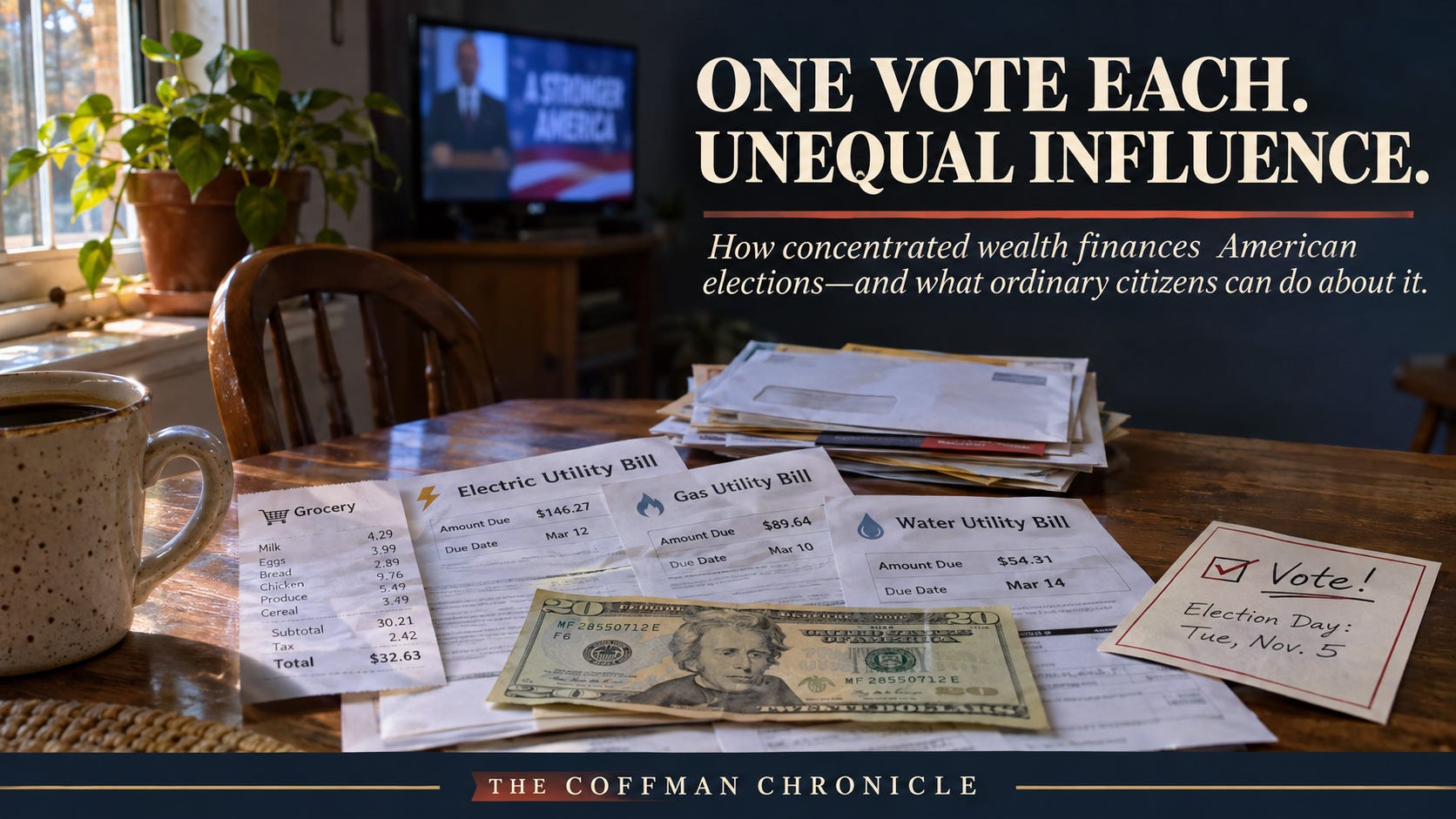
The bills are spread across the kitchen table. The electric bill is higher than expected, groceries cost more than they did a year ago, and the car needs repairs that cannot be put off much longer. After working all week and paying what is due, there isn’t much left.
An election is approaching, and one candidate is asking for donations. Twenty dollars doesn’t sound like much until it has to come out of a household budget already stretched thin. That money could buy gas for the car or a few groceries. Still, the person sitting at that table believes their voice should count, and twenty dollars is what they can afford.
Somewhere else in America, another citizen can contribute twenty million dollars to a political organization without worrying about the electric bill, groceries, or the cost of getting to work. That money can help finance ads that reach millions of voters, political organizing, and messages repeated across television screens and phones.
Both Americans will walk into a voting booth with one ballot, but long before either gets there, their money has given them very different opportunities to influence what everyone else hears.
This Community Is Powered by You
What started as a small circle has grown into something much bigger, and it’s all because of readers like you.
Every time you forward this email, post it on socials, or bring someone new into the fold, you’re helping build one of the most passionate, independent communities out there.
Want to keep the momentum going?
Share this newsletter with someone who should be part of this conversation.
Thank you for being here. It means everything.
One Vote. Very Different Resources.
American elections operate on a simple principle: wealth does not determine the value of a citizen’s ballot. A person earning minimum wage has the same legal voting power as someone whose fortune is measured in billions. Neither can walk into a polling place and purchase an additional vote.
But elections do not begin when the polls open. Months before Americans cast their ballots, candidates and political organizations spend money trying to influence what voters see, hear, and believe. Television advertisements, digital campaigns, mailers, and voter outreach all require financial resources. More funding can expand how many people a political organization reaches, how often it can send messages, and the operations it can maintain.
For most working Americans, political participation competes with the ordinary costs of living. A fifty-dollar contribution might require a sacrifice. For someone possessing billions, contributing millions may represent only a small fraction of their wealth. The difference is not in their constitutional rights, but in the financial opportunities available to exercise those rights.
Ordinary Americans are not powerless. They can organize, volunteer, speak publicly, and combine their efforts to influence elections. Collective action has repeatedly accomplished what money alone could not, but those opportunities do not erase the financial advantage enjoyed by someone who can finance political operations that reach millions of people.
The ballot carries equal legal weight. The resources available to influence the election surrounding that ballot do not.
Elon Musk’s $474 Million Election
Elon Musk provides a remarkable example of how much money one American can bring into an election. According to a November 2nd analysis by The New York Times, Musk contributed approximately $474 million to federal and state political organizations during the 2026 midterm cycle. The total included disclosed giving since January 2025, and the available records did not capture every possible contribution made before Election Day.
Approximately $216 million went to his own America PAC, $168 million to the Republican-aligned Senate Leadership Fund, and $30 million to the Congressional Leadership Fund. Additional contributions supported other Republican candidates and political organizations. These were contributions intended to finance political activity, not purchases of additional ballots.
Then Americans voted on November 3rd. Despite the enormous financial resources supporting Republican candidates, Democrats won control of the House and Senate. In Texas, Republican Senate candidate Ken Paxton lost to Democrat James Talarico, even after Musk directed substantial financial support toward efforts benefiting Paxton.
Those results demonstrate an important limitation of political spending. Hundreds of millions of dollars can finance advertising, voter outreach, and campaign operations, but they cannot guarantee electoral victory. Voters can reject the candidates and messages promoted by wealthy donors.
That does not establish that the spending had no effect. Political money can influence which messages reach voters, which candidates receive organizational support, and how campaigns operate, even when those candidates lose. Nor can we calculate from election results alone how many votes Musk’s spending changed.
What remains clear is the financial opportunity itself. Musk could finance political activities on a scale unavailable to almost every other American, regardless of which candidates ultimately won.
This Is Not Just a Republican Problem
Focusing exclusively on Musk would produce an incomplete understanding of how American elections are financed. Extraordinary wealth enters the political process through organizations supporting both major parties.
According to OpenSecrets estimates through October 30th, conservative-aligned outside organizations had spent approximately $2.03 billion during the 2026 election cycle. Liberal-aligned organizations had spent approximately $1.67 billion. Together, that represented roughly $3.7 billion in outside political expenditures before Election Day.
These were expenditures by outside organizations, not direct contributions to Republican or Democratic Party committees. They also don't represent every dollar spent on elections. Candidate campaigns and party organizations also raise and spend money through other channels.
A political organization can spend heavily to support a candidate without transferring money directly to that candidate’s campaign. Under federal law, genuinely independent expenditures are treated differently from direct campaign contributions.
A wealthy donor financing organizations that support Democrats has the same legal opportunities for enormous independent political spending as a similarly wealthy donor supporting Republicans. Their preferred candidates and policies may differ entirely, but the financial advantages available to major contributors exist on both sides.
A serious examination of concentrated political financing therefore cannot begin and end with the party that lost an election. Changing which party benefits from extraordinary private fortunes does not, by itself, change the financing system.
A Small Circle Writing Enormous Checks
Much of the money financing major outside political organizations comes from a relatively small group of extraordinarily large contributors. An October 2026 analysis by Public Citizen examined Federal Election Commission records and identified 515 individuals and organizations that had contributed at least $1 million each to super PACs during the election cycle. Together, they supplied approximately $4.2 billion, accounting for 73 percent of the contributions examined. Nearly three out of every four dollars came from contributors who gave $1 million or more.
Among Republican-aligned organizations, the Senate Leadership Fund received $496 million from 61 million-dollar contributors, representing 94% of its receipts. MAGA Inc. received $405 million from 102 such contributors, accounting for 90%. The Congressional Leadership Fund received $231 million from 53 contributors, representing 89%.
The pattern was also visible among Democratic-aligned organizations. Senate Majority PAC received $244 million from 44 million-dollar contributors, representing 80% of its receipts. House Majority PAC received $183 million from 31 such contributors, accounting for 62%.
These figures describe donors meeting a contribution threshold, not necessarily people whose personal net worth has been independently established. Contributors include individuals, corporations, and nonprofit organizations. Some organizations do not publicly identify all the people or entities supplying their original funding.
The percentages also describe these particular super PACs, not the entirety of either party’s campaign financing. Ordinary citizens contribute directly to campaigns and political committees through other channels.
Nevertheless, the concentration is substantial. A limited number of contributors supplied most of the reported receipts for several of the nation’s major political organizations. Republican and Democratic candidates benefited from organizations operating within that same financial structure.
What Does the Ordinary Citizen Have?
According to an October 28th Washington Post analysis of federal fundraising records, Democratic House and Senate campaigns raised approximately $574 million from donors who cumulatively contributed less than $200 during the election cycle. Those contributions represented 31 percent of Democratic congressional campaign funds. Republican congressional campaigns raised approximately $143 million from comparable small-dollar donors, representing 16 percent.
Those figures demonstrate that ordinary citizens collectively provide substantial financial support to candidates. Millions of modest contributions can help campaigns purchase advertising, organize volunteers, contact voters, and compete for public office.
However, these contributions operate within a different legal structure from super PAC financing. Federal law limits how much an individual may contribute directly to a candidate. Super PACs, by contrast, may accept unlimited contributions for independent political expenditures, subject to applicable rules and restrictions.
A working American contributing twenty dollars and a billionaire contributing twenty million dollars to an outside organization may support the same candidate. Both are participating in political expression, but the resources they can individually bring to that effort are radically different.
No one should confuse limited personal wealth with limited civic responsibility or commitment. A volunteer knocking on doors, a neighbor organizing a community meeting, and a voter carefully studying the candidates all contribute to democratic life. Yet campaigns depend on financial resources, and personal wealth can create opportunities for political participation that most citizens cannot afford on their own.
Imagine What That Money Could Have Built
Now consider the economic opportunity represented by Musk’s reported $474 million— not as campaign advertisements or political mailers, but as resources available to families and communities.
According to the Department of Agriculture, the average SNAP participant received approximately $187.94 per month in fiscal year 2025. At that benchmark, $474 million represents roughly one year of food assistance for 210,000 people. Alternatively, the same money could provide 47,400 households with $10,000 each in housing assistance to help address overdue rent, relocation expenses, or other housing emergencies.
Another alternative would be 47,400 education or workforce-training grants worth $10,000 each. Using the basic federal reimbursement rate of $4.76 per free school lunch for the 2026–27 school year, the money would equal approximately 99.6 million lunches.
These are separate illustrations of the purchasing power of $474 million, not programs that could all be financed simultaneously. The housing and education examples use hypothetical grant amounts, while the food comparisons use government benchmarks. Actual program delivery would involve administrative requirements and potentially additional costs.
Imagine what sustained investment in housing stability, community colleges, apprenticeship programs, and local institutions might accomplish. Such investments can create economic opportunities that continue benefiting communities beyond the original expenditure.
Political participation can also serve legitimate public purposes. Citizens may believe the candidates or causes they support will improve the country. But financial choices still involve opportunity costs. Money devoted to political operations cannot simultaneously finance housing, education, or other community investments.
That raises a question of stewardship as much as economics: what public benefits might different uses of extraordinary wealth create?
While Working Families Face Less
The comparison becomes more immediate when considering changes to federal programs that help Americans afford food and healthcare. While enormous sums circulate through political organizations, households across the country are preparing for changes that could affect their eligibility for assistance.
The One Big Beautiful Bill, signed into law in July 2025, changed provisions governing Medicaid and the Supplemental Nutrition Assistance Program. States generally must implement new Medicaid community-engagement requirements by January 1, 2027, affecting certain adults who must demonstrate qualifying work, education, community service, or other activities, subject to statutory exemptions. SNAP work-requirement and eligibility changes follow separate implementation schedules, some of which are already underway.
Supporters maintain that these policies encourage employment, strengthen program accountability, and protect public resources. Critics warn that additional verification requirements can create barriers for eligible households, particularly when maintaining benefits requires navigating complicated administrative processes.
The legislation was enacted before the 2026 midterms, so Musk’s later contributions did not cause its passage. And $474 million could not replace the national funding involved in Medicaid or SNAP. The comparison concerns something narrower: the enormous financial resources available for political influence alongside the economic insecurity many citizens experience because of government decisions.
The Constitution Protects Speech. Who Protects Representation?
The First Amendment protects political expression, including advocacy for candidates and criticism of government. Any examination of campaign-finance reform must begin by recognizing that constitutional protection.
In 1976, the Supreme Court decided Buckley v. Valeo, upholding certain limits on direct contributions to federal candidates while striking down limits on independent political expenditures. The Court reasoned that restricting expenditures could substantially restrict political expression because communicating political ideas often requires spending money.
In 2010, Citizens United v. Federal Election Commission held that corporations and labor unions possess First Amendment protections for independent political expenditures. Together with subsequent campaign-finance decisions, these precedents helped establish the legal framework for super PACs.
Direct contributions to candidates remain regulated. Communications coordinated with a candidate may count as contributions under applicable rules. However, under current Supreme Court precedent, genuinely independent expenditures generally cannot be capped.
Supporters of this framework argue that government should not decide how much money citizens and organizations may devote to expressing political views. They warn that expenditure limits can allow officials to restrict speech critical of those already holding power.
Critics argue that unlimited independent spending provides wealthy individuals and organizations with financial advantages in political communication, raising questions about unequal access, accountability, and the practical influence of concentrated fortunes.
The constitutional tension cannot be resolved simply by declaring political spending equivalent to purchasing votes. It is not. Nor does recognizing First Amendment protection settle every question about whether the current financing system serves representative government.
The Constitution protects political expression. Congress must work within that protection when considering how elections are financed.
The Square New Deal: Two Responsibilities
The Square New Deal does not condemn Americans for building successful businesses or accumulating wealth. Good Steward Capitalism recognizes that private enterprise, investment, and innovation can create jobs, strengthen communities, and improve living standards. However, extraordinary wealth also provides extraordinary choices about how to use resources.
A billionaire can invest in businesses, expand economic opportunities, support community institutions, or finance political organizations. Those choices carry different consequences for the country. Citizen stewardship asks people with substantial resources to consider whether their decisions strengthen the communities and institutions that made their prosperity possible.
Government has a different responsibility. Congress cannot depend on the generosity or good intentions of wealthy individuals to maintain representative government. Its constitutional obligation is to establish lawful rules, provide oversight, and maintain public institutions accountable to the people rather than dependent on a privileged circle of financial supporters.
That responsibility does not disappear because wealthy Americans exercise constitutionally protected political rights. Nor does it justify disregarding those rights in pursuit of reform. The Constitution must sit just above our ideology, including when examining a system we believe needs repair.
Stewardship is the goal. Solidarity is the means. Neither should require an ordinary American to possess a fortune to participate meaningfully in the republic.
Congress Must Confront Big Money
Congress cannot make every American equally wealthy. But it can examine whether the rules governing federal elections allow concentrated private fortunes to dominate financing in ways that reduce practical opportunities for ordinary citizens.
Transparency is one available tool. Disclosure requirements can help voters identify major financial interests supporting political organizations, including situations where money passes through intermediary entities. That information can make political financing easier to scrutinize. But transparency alone does not reduce the financial advantages wealthy donors enjoy.
Congress also has existing contribution and coordination rules to oversee and enforce. Super PACs may receive unlimited contributions for genuinely independent political activity, but communications coordinated with candidates can constitute regulated contributions. Enforcing these boundaries requires consistent application of the law, regardless of which political party benefits.
Another approach is voluntary small-donor public financing. New York City already operates an eight-to-one public matching program for qualifying small contributions to participating municipal candidates. Under such a system, an eligible $20 contribution can generate $160 in public matching funds, giving the participating campaign $180 in combined support. Eligibility requirements, spending limits, and other program rules apply.
A federal program could offer similar incentives for candidates to seek broad support from ordinary citizens rather than relying predominantly on exceptionally wealthy contributors. Such arrangements must respect First Amendment requirements, including Supreme Court restrictions on public-financing systems that penalize independent political spending.
Broader restrictions on independent expenditures face greater constitutional obstacles. Under Citizens United and related precedent, Congress generally cannot impose spending caps simply through ordinary legislation. Proposals to change that constitutional framework therefore include amendments under Article V, which requires substantial congressional and state agreement.
These approaches are not interchangeable. Disclosure reveals financing sources. Enforcement maintains existing legal boundaries. Public financing can offer candidates alternative sources of support. If adopted, constitutional amendments could change the legal framework governing expenditure limits.
No reform would eliminate the need to finance elections. Political organizing, public communication, and voter education all require resources. The issue is whether campaigns and political organizations must remain so dependent on a relatively small circle of major financiers.
Article I gives Congress legislative responsibilities within constitutional boundaries. Congress cannot simply transfer responsibility for the rules of representative government to billionaires, political parties, or outside organizations. Citizens elect lawmakers to exercise judgment, conduct oversight, and maintain the institutions through which Americans govern themselves.
The Same Ballot
Return to the kitchen table. The bills still need paying, the groceries still need buying, and twenty dollars remains a meaningful sacrifice for someone trying to make ends meet. Across the country, another citizen can contribute millions to political organizations without confronting those same household choices.
Both citizens receive one ballot. Neither possesses a greater constitutional claim to the government those ballots elect. Yet the resources available to shape the political conversation before Election Day remain profoundly unequal.
A republic cannot promise that every citizen will possess the same wealth or command the same audience. It can protect their rights, examine the rules governing political financing, and hold its institutions accountable to the people who authorize them.
When the worker leaves the voting booth, the bills will still be waiting at home. The billionaire will still possess a fortune. But the representative they helped elect will have sworn the same constitutional oath, regardless of which citizen funded the campaign.
That office belongs to the people. It does not belong to the largest contributor.
Support Independent Media
Support The Coffman Chronicle
The Constitution gives every eligible American one vote. But when a handful of wealthy donors can pour billions into our elections, ordinary citizens deserve to know whose money is shaping the political conversation—and what Congress is doing about it.
At The Coffman Chronicle, we follow the money, examine the laws, and hold both political parties to the same constitutional standard. Our work is guided by the Square New Deal and a simple principle: government belongs to the people, not the donors who finance political campaigns.
If you believe independent journalism should answer to readers rather than wealthy political interests, subscribe to The Coffman Chronicle, share this article, and consider becoming a paid subscriber. Your support helps us continue investigating the decisions that affect working Americans.
The Constitution must sit just above your ideology. And the people must remain above the money.
Sources
Associated Press. “Democrats Win the US House and Senate as Voters Deliver a Strong Rebuke to Trump and Republicans.” November 4, 2026. Read the article.
Associated Press. “Democrats Deliver a Stunning Rout in Texas to Retake Power for the First Time in Decades.” November 4, 2026. Read the article.
Centers for Medicare & Medicaid Services. “Community Engagement.” Medicaid.gov. Accessed November 5, 2026. Read the federal guidance.
Federal Election Commission. “Buckley v. Valeo.” January 30, 1976. Read the case summary.
Federal Election Commission. “Citizens United v. Federal Election Commission.” January 21, 2010. Read the case summary.
Federal Election Commission. “Understanding Independent Expenditures.” Accessed November 5, 2026. Read the FEC guidance.
Glavin, Brendan, Andrew Mayersohn, Doug Weber, and Jackie Mitchell. “OpenSecrets Predicts Record $12 Billion in Midterm Election Spending.” OpenSecrets, October 30, 2026. Read the analysis.
Merica, Dan. “The Sharp Divide in How Democrats and Republicans Get Campaign Cash.” The Washington Post, October 28, 2026. Read the article.
New York City Campaign Finance Board. “Limits & Thresholds: 2025 Citywide Elections.” Accessed November 5, 2026. Read the matching-funds rules.
Schleifer, Theodore. “Elon Musk Tests What Nearly Half a Billion Dollars Can Buy in the Midterms.” The New York Times, November 2, 2026. Read the article, republished by The Philadelphia Inquirer.
Tanglis, Mike. “Millionaires and Billionaires Fuel 2026 Super PAC Spending.” Public Citizen, October 27, 2026. Read the investigation.
U.S. Department of Agriculture, Economic Research Service. “Supplemental Nutrition Assistance Program (SNAP): Key Statistics and Research.” Updated August 31, 2026. Read the USDA statistics.
U.S. Department of Agriculture, Food and Nutrition Service. “One Big Beautiful Bill Act of 2025.” Accessed November 5, 2026. Read the SNAP implementation guidance.
U.S. Department of Agriculture, Food and Nutrition Service. “School Meals Reimbursement Rates.” Updated July 16, 2026. Read the reimbursement information.
Excellent article, information and great analysis of the issues and guidance!!! Thank you!!!