


On Wednesday, February 11, 2026, Attorney General Pam Bondi appeared before the House Judiciary Committee to answer questions about the Department of Justice’s handling of documents related to Jeffrey Epstein. The hearing, convened amid ongoing controversy over the scope and timing of file releases under the bipartisan Epstein Files Transparency Act, was expected to provide clarity on process and compliance.
Instead, it offered something else, a vivid snapshot of how oversight, executive authority, and public trust now intersect in a highly performative political environment.
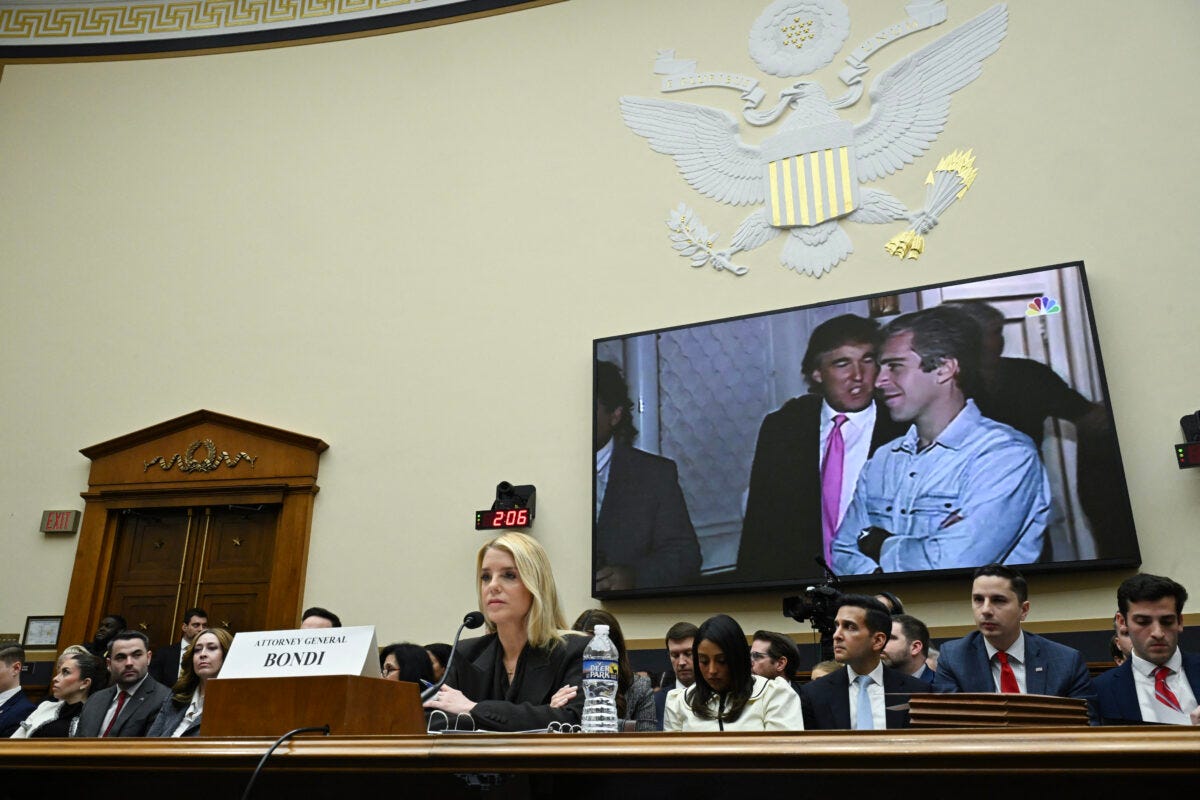
(Photo by ROBERTO SCHMIDT / AFP)
This Community Is Powered by You
What started as a small circle has grown into something much bigger, and it’s all because of readers like you.
Every time you forward this email, post it on socials, or bring someone new into the fold, you’re helping build one of the most passionate, independent political communities out there.
Want to keep the momentum going?
Share this newsletter with someone who should be part of this conversation.
Thank you for being here. It means everything.
What the Hearing Was About
The Epstein Files Transparency Act, passed by Congress in November 2025 with overwhelming bipartisan support, required the Justice Department to release materials connected to Epstein’s case, subject to limited redactions for privacy and ongoing investigative concerns. Lawmakers from both parties had reviewed unredacted documents in secure settings earlier this month and subsequently raised questions about whether the public releases met the statute’s intent.
At Wednesday’s hearing, members pressed Bondi on several core issues, specifically whether the Department had met the statutory deadline, how redactions were determined, why certain names were initially withheld and later revealed, and whether any additional disclosures were forthcoming.
Ranking Member Rep. Jamie Raskin (D-Md.) argued that the Department’s redactions appeared broader than necessary and suggested that the handling of the files shielded powerful associates from public scrutiny. Rep. Thomas Massie (R-Ky.), one of the bill’s sponsors, also expressed concern that initial redactions undermined the transparency Congress had intended. In one exchange, Massie accused the Department of a “massive failure” in its release process, stating that one name was unredacted only after he sounded the alarm.
Bondi maintained that the Department had released millions of pages and followed internal redaction protocols designed to protect victims and comply with legal constraints. She emphasized the scale of the review effort and defended the Department’s judgment in balancing transparency with statutory limitations. She did not explain why the DOJ did not alert Congress of the need for more time prior to the deadline.
Substantively, however, the hearing yielded little new factual information about the files themselves. The dispute centered less on new revelations and more on process, compliance, and interpretation due to the nature of the committee. Even that focus revealed little.
When the Tone Shifted
To say the hearing was combative would be an understatement. Heated oversight hearings are not new in American politics. Executive officials and members of Congress have clashed sharply before. What made this hearing notable was not the existence of disagreement, but how quickly it escalated.
As questioning intensified, exchanges between Bondi and several Democratic members became increasingly combative. Interruptions, pointed remarks about political motives, and rhetorical pivots to broader partisan themes began to overshadow procedural discussion. Notably, Bondi consulted a binder several times to reference notable crime statistics and other issues, apparently organized by committee member. At one point, when Rep. Pramila Jayapal (D-Wash.) asked Bondi to address survivors in attendance and apologize for what they described as harmful disclosures in earlier releases, Bondi declined, characterizing the request as “theatrics.”
The shift from procedural clarification to personal sparring became one of the defining features of the session. Bondi questioned the credentials of several members and called Massie a failed politician after one tense exchange. Multiple calls to reclaim time were requested as responses veered off course.
Executive Authority and Oversight
Beyond the immediate back-and-forth, the hearing illuminated a broader structural tension.
Congress’s oversight power is a core constitutional function. When lawmakers pass a nearly unanimous transparency measure and later question how it was implemented, they are exercising a central check on executive authority. The Justice Department, in turn, retains discretion in interpreting statutory requirements, protecting privacy, and managing prosecutorial materials.
That friction is not new. Similar confrontations have occurred across administrations of both parties. However, in today’s political climate, marked by heightened distrust and aggressive rhetorical posture on all sides, oversight hearings increasingly resemble public contests rather than restrained institutional dialogues.
Wednesday’s session did not represent a constitutional rupture, though it did put on display an increasing erosion of professional norms. Congress retains subpoena power and control over appropriations. Courts remain available to adjudicate disputes. However, the visible strain between branches, especially when expressed through personal attacks and defensive posture, reinforces a perception that oversight is less about shared institutional responsibility and more about partisan combat.
That perception matters, and echoes concerns about executive overreach and degradation of coequal powers.
Public Trust and Legitimacy
If the executive-legislative tension speaks to constitutional structure, the Epstein case speaks to legitimacy.
The case carries unusual symbolic weight. It involves allegations of human trafficking, exploitation of minors, and powerful individuals whose associations have long fueled public suspicion about elite accountability. For many Americans, the transparency act was not just procedural, but moral. It represented a demand that institutions demonstrate seriousness and impartiality in addressing wrongdoing connected to influence and power.
In that context, tone becomes more than stylistic. It becomes communicative.
Even if the Department believes it met its legal obligations, public trust depends on more than statutory compliance. It depends on clarity, restraint, and visible attentiveness to harm. When hearings produce little new substantive information and are dominated by sharp exchanges, they are unlikely to reassure those who are already skeptical.
Trust erodes not solely because conflict exists, but because conflict can obscure substance. When the focus shifts from explaining process to defending against political attacks, the opportunity to rebuild confidence narrows. Asserting procedural adherence and outright defensiveness may inhabit a narrow line, but Bondi’s performance did little to suggest humility, transparency, or victim-centered professionalism. Instead, it signaled to many that her DOJ does not feel obligated to provide any justification for its actions.
Not Unprecedented But Notable
It would be inaccurate to describe Wednesday’s hearing as historically unprecedented. Contentious oversight sessions have long been part of American governance. Nor did the hearing reveal evidence that constitutional checks have disappeared.
Yet it would also be incomplete to dismiss it as routine.
In a period when institutional trust is already fragile, and when the underlying case involves vulnerable victims and allegations of elite misconduct, visible professionalism and procedural clarity carry heightened importance. For observers seeking reassurance that transparency is being pursued diligently and impartially, the hearing likely offered limited comfort.
What Comes Next
The path forward remains open.
Congress can continue oversight efforts, including additional hearings or funding conditions tied to reporting requirements in the future. Courts may weigh in if disputes over disclosure advance to litigation. The Department could provide further explanation of its redaction standards or release additional materials.
Public confidence will depend less on rhetorical victories and more on sustained procedural transparency.
Oversight hearings are designed to test institutions. The question now is whether the next phase of this process will emphasize clarity over confrontation, and whether leaders across branches recognize that, in cases like this, tone and substance are inseparable in the public mind.
In moments of strain, democratic systems are measured not by the absence of conflict, but by how they handle it. Wednesday’s hearing underscored how much that handling matters.
Accountability-Focused
Oversight, transparency, and the rule of law deserve sustained attention — not just viral moments. Subscribe for measured reporting that keeps institutions, not personalities, at the center.
Sources and further reading:
Bondi sidesteps Epstein questions in tense Judiciary Committee hearing — PBS (Feb. 11, 2026)
Insults, personal attacks and Epstein pivots at Bondi hearing — WABI (Feb. 12, 2026)
Rep. Jamie Raskin accuses Trump’s AG of ‘Epstein cover-up’ in stormy House hearing — The Times of Israel (Feb. 11, 2026)
Bondi faces heated questions on handling of Epstein files at House hearing — CBS News (Feb. 11, 2026)
Pam Bondi Declines to Directly Apologize to Epstein Victims During Capitol Hill Testimony — Time (Feb. 11, 2026)
‘You’re a washed‑up loser lawyer’: Pam Bondi taunts Democrats over Epstein — The Guardian (Feb. 11, 2026)
Democratic lawmakers accuse US attorney general of Epstein file cover‑up — Inquirer (Feb. 11, 2026)
US lawmakers accuse Bondi of hiding names of Epstein associates — Reuters (Feb. 11, 2026)
Fiery exchanges dominate Pam Bondi appearance before House Judiciary Committee — The Hill (Feb. 11, 2026)
Bondi came across as Trumps campaign manager. Worthless in her duty.