


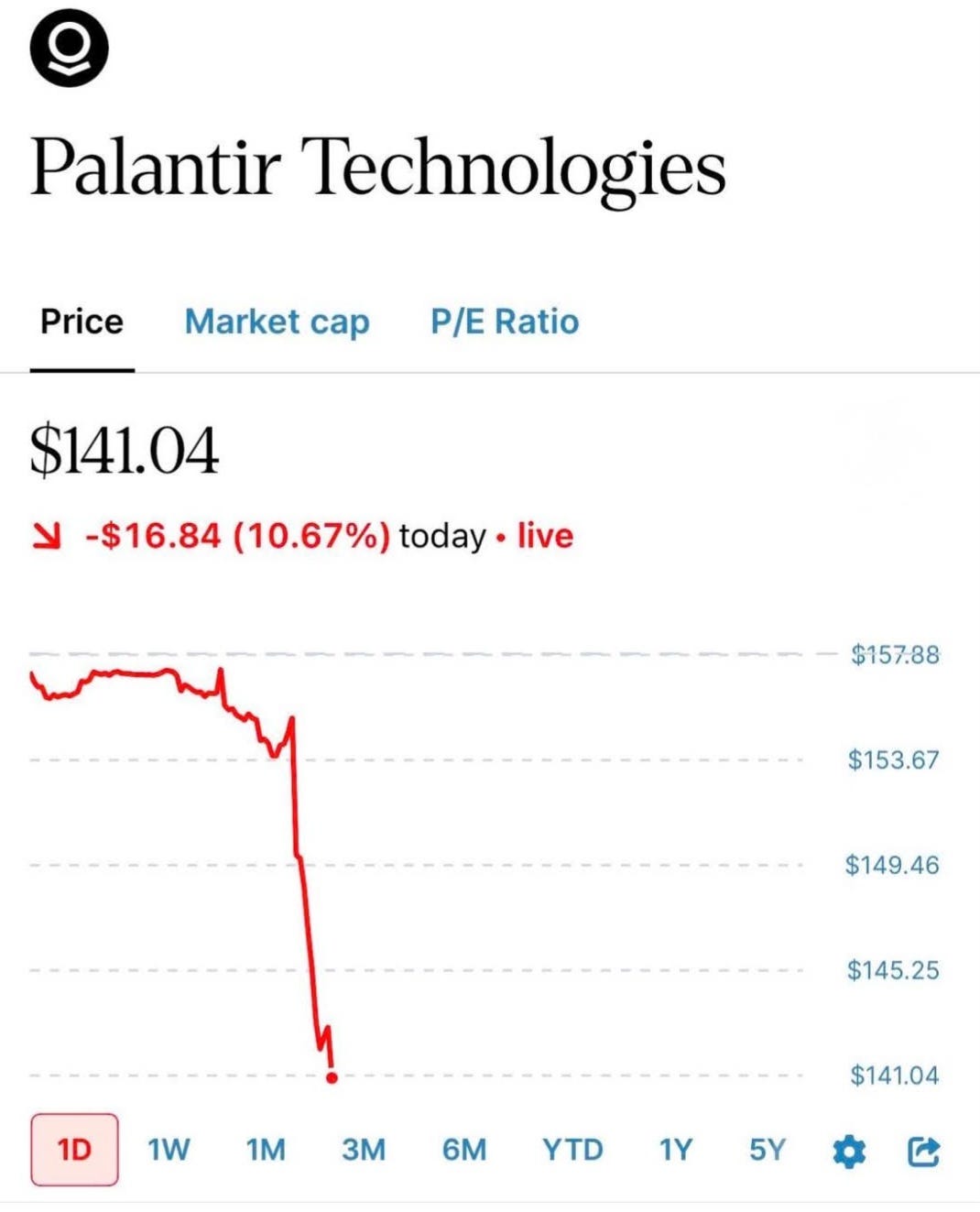
On February 4, Palantir Technologies lost more than $40 billion in market value. It happened fast. The company’s stock, which had risen steadily in recent months on the back of AI optimism and strong federal contracts, plunged nearly 12% in a single day.
There was no scandal, surprise loss, or policy announcement, and yet, investors fled.
In a different world, it might look like justice. Here is a company at the center of government surveillance, predictive policing, and immigration enforcement, suddenly humbled. Palantir has long been a symbol of state-aligned tech power: opaque, profitable, and built for control. Its sudden collapse raised an obvious question for those of us watching the intersection of politics and technology: Was this finally a public reckoning with surveillance capitalism?
The answer, it turns out, is more complicated, and possibly, more telling.
This Community Is Powered by You
What started as a small circle has grown into something much bigger, and it’s all because of readers like you.
Every time you forward this email, post it on socials, or bring someone new into the fold, you’re helping build one of the most passionate, independent political communities out there.
Want to keep the momentum going?
Share this newsletter with someone who should be part of this conversation.
Thank you for being here. It means everything.
What Is Palantir?
Palantir is not like other software companies. It doesn’t make apps, sell ads, or offer tools for consumers. It builds platforms for governments and militaries, specifically products designed to ingest and analyze massive amounts of data, including criminal records, financial transactions, visa applications, social media activity, battlefield logistics, and more.
The company is best known for its work with U.S. federal agencies, particularly Immigration and Customs Enforcement (ICE), where it has provided tools used in detention and deportation operations. It has contracts with the Department of Defense, the Department of Homeland Security, the FBI, the CDC, and local police departments. Its software has also been used by NATO, foreign governments, and private intelligence clients.
Palantir’s tools aren’t just technical. They are deeply political. They encode decisions about what kinds of behavior get flagged, tracked, and punished. They operationalize power.
They are also wildly profitable. In 2025, Palantir reported $4.475 billion in total revenue, more than 50% higher than the previous year. U.S. government revenue alone grew 66% year-over-year in the fourth quarter. The company is expanding, not contracting.
The Man Behind the Machine
Peter Thiel, Palantir’s co-founder and ideological backbone, is as significant to the company’s identity as its software. Thiel’s politics are well documented. He has expressed open skepticism of democracy, supported authoritarian-leaning candidates in the U.S. and abroad, and funneled millions into hard-right think tanks and campaigns.
He is not an executive at Palantir today, but his vision still defines it, a vision in which the state is not restrained by public accountability, but empowered by data to enforce order. As Chairman of the Board, he remains one of the largest individual shareholders and retains significant influence through that position and the company’s dual‑class share structure, which gives founders outsized voting power. Thiel was an early supporter of Donald Trump and played an informal role in the 2016 transition. In the lead-up to the 2024 election, he once again surfaced as a quiet architect of Trump-aligned policy infrastructure, particularly around immigration and national security. While he does hold a formal role in the administration, Thiel’s powerful network and influence continue to shape policy, both with Trump and through his mentor-like relationship and financial support of Vice President J.D. Vance.
See our earlier reporting on Peter Thiel and Palantir here:
Note: Articles over 45 days old move into our archive over time. Become a paid subscriber for full access to our extensive archive.


Palantir, in many ways, remains a vessel for that worldview. When it wins contracts with ICE or the Pentagon, it is not simply growing. It is deepening its ties to a particular model of governance: centralized, militarized, and data-driven.
Not an Ethical Reckoning
Given that backdrop, it’s tempting to read Palantir’s market crash as a sign of ideological rejection, that investors or institutions were finally reckoning with the company’s role in state violence and surveillance.
However, the broader market tells a different story.
Palantir was not alone in its drop. Other major tech companies, including AMD, Snowflake, Datadog, and even Google parent Alphabet, saw sharp declines over the last week. The Nasdaq slid. Software stocks across the board fell. Even companies with no ties to government surveillance lost billions.
This was not a political divestment. Investors are moved by profits, not ideology. It was, instead, a sector-wide correction.
Palantir may be controversial, but its stock fell for the same reason as other high-growth tech stocks. The market had reached a saturation point. After months of AI-driven enthusiasm, valuations were stretched, investors were looking for a peak, and once they saw it, they ran quickly.
The decline was accelerated by automated trading systems, which triggered large-scale selling once certain price thresholds were crossed. There were no buyers waiting at the bottom. The result looked dramatic because it was a rapid, algorithm-driven exit across the AI and software landscape.
What Was Building Beneath the Surface
The sell-off didn’t come out of nowhere. There were signs.
For weeks, analysts had warned of a looming correction in the AI sector. Many have warned of a possible AI bubble. Software stocks had shown weakness. Capital has been quietly rotating out of tech and into more defensive investments. Hedge funds began exiting crowded positions.
At the same time, Europe is escalating its scrutiny of generative AI. In late January, French prosecutors raided the Paris office of Musk’s social platform X as part of a growing investigation into Grok, xAI’s chatbot. Regulators are probing whether Grok’s outputs, including sexually explicit deepfakes involving minors, violated EU digital safety laws. Days later, the EU launched a broader investigation into xAI’s content moderation and data practices.
Then, right in the middle of it all, Elon Musk announced a trillion-dollar merger, folding his companies xAI, SpaceX, and X into one AI-and-aerospace superstructure. The plan includes launching data centers into orbit. Speculators took notice. The story shifted.
If you’re a hedge fund holding AI software stocks, this is the moment where you rethink your portfolio. A new hype cycle is forming. Musk is absorbing attention, and potentially capital, and all of it is happening while regulators tighten their grip and the technical charts start blinking red.
That’s not politics. That’s a convergence.
A Correction, Not a Reckoning
Palantir didn’t fall because the public rose up. It fell as the hype slowed. The AI boom has not collapsed, but it definitely flinched. Investors who rode the wave to the top started looking for safer ground. Automated trades accelerated the exit. Musk’s orbital ambition reshaped the storyline, and Grok’s legal scrutiny made regulators look twice. Suddenly, everything tilted at once.
This was not a public rejection of surveillance capitalism. It was a recalibration of tech speculation, a sign that even the most powerful stories and the most government-entrenched platforms are not immune to market psychology.
Still, moments like this matter. They create cracks, shift narratives, and reveal how thin the line is between untouchable and overvalued.
What Happens Now
Palantir’s role in the architecture of state power has not diminished. Its contracts remain. Its influence deepens. However, the market has shown that its story, like that of many AI firms, may be less invincible than it once seemed.
The real reckoning hasn’t come yet, but we may have just heard the warning shot.
If you value reporting that connects power, policy, and the architecture behind the headlines, subscribe to stay with us.
We cover the systems shaping democracy and the people building tools to control it.
Sources:
Wall Street ends sharply down as AI worries weigh (Reuters, Feb 5, 2026)
Wall Street falls as AI stock concerns hit tech shares (Coloradobiz/Reuters, Feb 4, 2026)
Major Indexes Fall as Tech Shares Dive; Dow Hits All‑Time High Before Pulling Back (Investopedia, Feb 3, 2026)
Dow, Nasdaq, S&P 500 sink as tech falters amid earnings (Yahoo Finance, Feb 3, 2026)
Software stocks fall for an eighth straight day with wide roster of decliners (MarketWatch, Feb 5, 2026)
Palantir stock extends two‑day slide after hours as AI disruption fears keep traders defensive (TS2, Feb 5, 2026)
Palantir stock drops further amid AI jitters and valuation doubts (TS2, Feb 5, 2026)
Palantir Stock Drops 14% as AI and Software Pull Back. It’s Having a Terrible 2026 (Barron’s, Feb 4, 2026)
Hedge funds hit by AI sell‑off, Goldman Sachs says (Reuters, Feb 5, 2026)
Oracle’s Larry Ellison is down an unmatched $49 billion amid software stock plunge (Business Insider, Feb 5, 2026)
AI mega‑bull Dan Ives calls downturn ‘software armageddon’, urges buying dips (Business Insider, Feb 5, 2026)
Wall Street ends down as AI worries slam tech stocks (Reuters, Feb 4, 2026)
Tech stocks go into free fall as it dawns on traders that AI may cut revenues (Yahoo Finance, Feb 3, 2026)
Thiel's pervasive presence in the Epstein files may have had something to do with it. That's the kind of scandal that will turn people away forever.
It is still one of the most dangerous pieces of software in the world.