


The Alabama House of Representatives recently approved a bill mandating that all public schools install panic button systems by 2030. Alabama joins a growing list of states—including Texas, Florida, and New Jersey—grappling with school shootings by installing high-tech panic buttons meant to alert law enforcement during emergencies instantly. But this technological quick fix is a mirage, a desperate attempt to address school violence without addressing its true causes.
Panic buttons may speed up response times, but they are reactive tools designed to minimize casualties once violence erupts. They do nothing to prevent these tragedies in the first place. As lawmakers continue to throw money at gadgets instead of solutions, the real issues—underfunded mental health services, unchecked gun access, and lack of early intervention—remain unaddressed. America is in a vicious cycle where genuine reform is traded for the false comfort of high-tech band-aids.
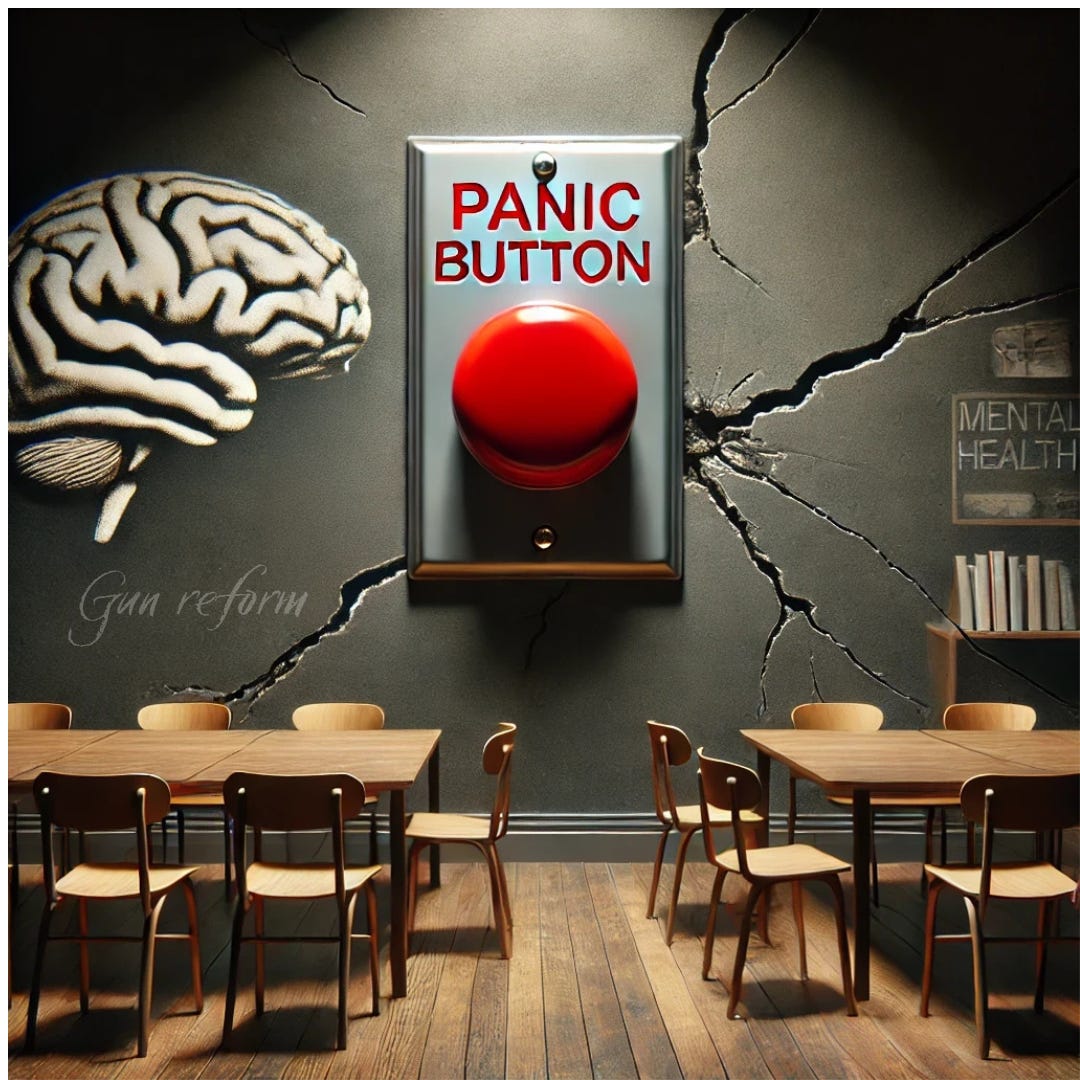
The False Sense of Security: Panic Buttons as a Band-Aid Solution
The push for panic button systems creates a dangerous illusion of safety. By focusing solely on rapid response, these measures imply that technology alone can protect students. Panic buttons and other high-security measures, like metal detectors and surveillance cameras, do little to stop determined attackers.
Consider this: According to an FBI report, 77% of school shooters planned their attacks for at least a week, with nearly half planning for more than a month. They know the police will come. They expect it. Yet, they proceed regardless. The 2012 Sandy Hook shooting and the 2022 Uvalde massacre are chilling reminders that law enforcement’s mere presence isn't enough to deter attackers.
Panic buttons may save some lives during an incident, but they do nothing to address why these attacks occur in the first place. They are a stopgap measure, not a solution.
What We’re Missing: Root Causes of School Violence
Instead of focusing on reactive gadgets, we need to confront the systemic issues fueling school violence. And that starts with addressing three primary factors:
Mental Health Gaps in Schools
America's schools are woefully unequipped to handle the mental health crisis brewing among young people. The American School Counselor Association recommends a student-to-counselor ratio of 250:1. The national average is almost double that. In underfunded districts, it’s even worse, sometimes exceeding 1,000:1.According to a 2022 report by the Harvard T.H. Chan School of Public Health, 80% of U.S. public schools lack adequate mental health resources. Until we provide comprehensive mental health services—counselors, early intervention, trauma-informed care—we will continue to fail our kids.
Easy Access to Firearms
Nearly 75% of school shooters obtained their guns from home or relatives. But despite this horrifying statistic, federal gun reform remains stalled. Research from the Johns Hopkins Center for Gun Violence Solutions found that safe storage laws alone could reduce youth deaths by up to 32%. We need universal background checks, safe storage requirements, and red flag laws, measures that the vast majority of Americans support but are continually blocked by lawmakers more loyal to the gun lobby than to our children.Neglect of Early Intervention and Threat Assessment
The National Threat Assessment Center reports that 94% of school shooters show concerning behavior before their attacks, but only 41% receive any intervention. We must fund mentorship programs, restorative justice initiatives, and community partnerships that help students before they reach a crisis point.
See our reporting on gun violence here:


Financial Costs vs. Preventive Investment
Panic button systems cost schools hundreds of thousands of dollars a year, money that could be spent on mental health services and community programs proven to prevent violence. The Rand Corporation’s analysis shows that investing in preventive programs yields a return of $5 to $11 for every $1 spent. Prevention is not only more compassionate, but it’s also more cost-effective.
Unintended Consequences: Over-Policing and Racial Disparities
Increasing security measures without addressing root causes often leads to more policing of students, especially marginalized students. A 2022 Brookings report found that Black students are four times more likely to be suspended or expelled than their white peers for similar infractions. This over-policing contributes to the school-to-prison pipeline, punishing vulnerable students rather than helping them.
Additionally, constant lockdown drills and security measures breed fear, not safety. They traumatize students, normalize the idea that schools are battlegrounds, and do nothing to prevent the violence they supposedly address.
Toward Real Solutions: A Call for Comprehensive Reform
If we genuinely want to make schools safer, we need real solutions. Here’s what that looks like:
Expand Mental Health Services in Schools
Fund more counselors, social workers, and psychologists.
Provide trauma-informed care and early intervention programs.
Implement Sensible Gun Reform
Universal background checks, safe storage laws, and red flag laws.
Politicians must stop kowtowing to the gun lobby and start listening to the majority of Americans who support these reforms.
Invest in Community-Based Prevention Programs
Fund mentorship, conflict resolution, and restorative justice programs.
Empower local organizations to work with at-risk students.
Improve Threat Assessment Protocols
Create well-funded, well-trained threat assessment teams.
Ensure schools are equipped to respond to warning signs before tragedy strikes.
Conclusion: It’s Time to Treat the Cause, Not Just the Symptoms
Panic buttons are not the answer. Without addressing the core issues of mental health, gun access, and systemic inequality, we will continue to spend money on tech solutions that only react to violence rather than prevent it. It's time to put our resources where they matter most, toward real, evidence-based solutions prioritizing our children’s safety and well-being.
Independent News. Just $1/Week.
We just hit 10,000 subscribers—thank you! We’re offering full access to The Coffman Chronicle for just $1 a week ($52/year) to celebrate.
Get exclusive analysis, daily rundowns, and fearless reporting you won’t find in corporate media.
Support truth. Stay informed.
Bibliography:
FBI Behavioral Analysis Unit. “A Study of Pre-Attack Behaviors of Active Shooters in the United States Between 2000 and 2013.” Federal Bureau of Investigation, June 2018. https://www.fbi.gov/file-repository/pre-attack-behaviors-of-active-shooters-in-us-2000-2013.pdf
The Baker Center for Children and Families. “Mental Health and Schools: Best Practices to Support Our Students.” April 2023. https://www.bakercenter.org/application/files/5616/8235/2328/Baker_Center_-_Mental_Health_and_Schools_Report_-_April_2023.pdf
American School Counselor Association (ASCA). “School Counselor Roles & Ratios.” American School Counselor Association, 2023. https://www.schoolcounselor.org/about-school-counseling/school-counselor-roles-ratios
United States Secret Service. "Protecting America's Schools: A U.S. Secret Service Analysis of Targeted School Violence." November 2019. https://www.secretservice.gov/sites/default/files/2020-04/Protecting_Americas_Schools.pdf
Johns Hopkins Center for Gun Violence Solutions. "How Safe and Secure Gun Storage Reduces Injury, Saves Lives." Johns Hopkins Bloomberg School of Public Health, May 25, 2023. https://publichealth.jhu.edu/2023/how-safe-and-secure-gun-storage-reduces-injury-saves-livesJohns Hopkins Public Health
RAND Corporation. "Benefit-Cost Analysis of Crime Prevention Programs." Journal of Benefit-Cost Analysis, Summer 2015. https://www.journals.uchicago.edu/doi/full/10.1086/681556RCNi Company Limited
Centers for Disease Control and Prevention (CDC). "Community Violence Prevention Resource for Action." CDC, 2023. https://www.cdc.gov/violence-prevention/media/pdf/resources-for-action/CV-Prevention-Resource-for-Action_508.pdfCDC
Statistics Canada. "Trends in Gun Violence in Canada, 2000 to 2020." Statistics Canada, May 16, 2022. https://www150.statcan.gc.ca/n1/pub/85-002-x/2022001/article/00009-eng.htm
https://thequillandmusket.substack.com/p/the-inherent-right-to-self-defense?r=4xypjp