


On November 18, 2025, the U.S. Department of Education (ED) announced a series of inter‑agency agreements that on the surface sound mostly benign. Specifically, partnerships with sister agencies were launched to streamline programs, reduce red tape, and empower states, according to Secretary of Education Linda McMahon.
Sounds great, right? Partnerships can make both parties more effective. Streamlining means more resources for the core mission.
In reality, the announcement marks a turning point. The ED is no longer just being pared back. It is being redesigned. Programs once housed under this agency will be transferred to the Departments of Labor, the Interior, State, and Health and Human Services.
The language used is “partnerships” and “realignments.” The impact, however, is unmistakable. What was once a cabinet‑level agency dedicated to educational opportunity is now being hollowed out and repurposed.
The question isn’t simply about bureaucratic tidying. It’s about what education is for, and who gets to decide.
Want to Know Your Rights?
Download a free digital copy of the U.S. Constitution—the same document Trump is trying to bulldoze. Learn exactly what he’s breaking… and how to fight back.
50,000 strong — and counting.
This Early Black Friday, become a paid subscriber for just $1 a week and help us keep the truth alive.
Join The Coffman Chronicle — $1/Week Early Access
A Brief History: Trump 2.0’s Assault on the Department of Education
The current restructuring builds on ten months of sweeping change. In March, President Donald Trump signed an executive order directing the Department of Education to “take all necessary steps to facilitate the closure” of its own agency. The administration laid off nearly half of the staff, including entire units responsible for civil rights enforcement and special education services. The Department of Government Efficiency soon arrived with its bureaucratic sledgehammer. By mid‑year, the agency’s workforce had been slashed dramatically and its budget flagged for major cuts.
This spring, we covered these developments in depth. See some of that reporting here:
Note: Articles over 45 days old live in our archive. Consider becoming a paid subscriber for exclusive perks including occasional early access, member-only deep dives, and full access to our over 1200 articles.


This wasn’t incidental reform. It was an intentional hollowing out. The rationale given was to reduce bureaucracy, push control to states, and make the federal government leaner. However, for many advocates, the consequence was clear. The protective machinery for the nation’s most vulnerable students was eroding.
When Research and Oversight Disappear
One of the most consequential pieces of this transformation has been the removal of the department’s capacity to monitor, evaluate, and protect educational equity. Agencies like the Institute of Education Sciences, which underpinned research on achievement gaps, program efficacy, and civil‑rights enforcement, were stripped of funding and staff. At the same time, programs and language centering diversity, equity and inclusion (DEI) were targeted for elimination or restructuring under new mandates.
Without robust data and oversight, disparities become invisible; accountability becomes optional. When you cut the tools that measure who is falling behind, you free the system to sort rather than support.
And that’s the point.
The “Partnerships” No One Asked For
The Labor Department
The ED announced that its offices of Elementary & Secondary Education and Postsecondary Education will, effective immediately, move large swaths of grant programs and support mechanisms to the U.S. Department of Labor. On the surface this is framed as a “workforce alignment” initiative, intended to link education and employment. However, the shift means that decisions about K‑12 and college programs will now be overseen by an agency whose primary mission is employment and labor economics, not childhood learning, pedagogy, developmental psychology, or equity.
The Interior Department
Native‑education programs, including those for tribal schools and Indigenous language preservation, are being transferred to the U.S. Department of the Interior. That’s the same agency historically responsible for boarding schools, land management, and assimilationist policies. Transferring educational oversight to it raises profound concerns about mission, expertise and trust.
The State Department
Global and foreign‑language education programs that once lived in the ED’s international education services will now fall under the U.S. Department of State. Seen through one lens, it’s about “streamlining” international education. However, it also recasts global literacy as foreign‑policy rather than human‐development.
Health and Human Services
Programs dealing with child‑care access for college students, foreign medical school accreditation, and special education resources are being moved to the Department of Health and Human Services. Education becomes medical access or parental welfare, rather than a space of learning and discovery.
Together, these “partnerships” do more than shuffle desks. They redirect educational authority to agencies whose core expertise lies outside schooling, learning, and developmental justice.
The Laborification of Education
Something deeper than bureaucratic reshuffling is happening. When educational programs move into the Department of Labor, it’s more than a question of administrative convenience. It’s a signal that the purpose of public education is being rewritten.
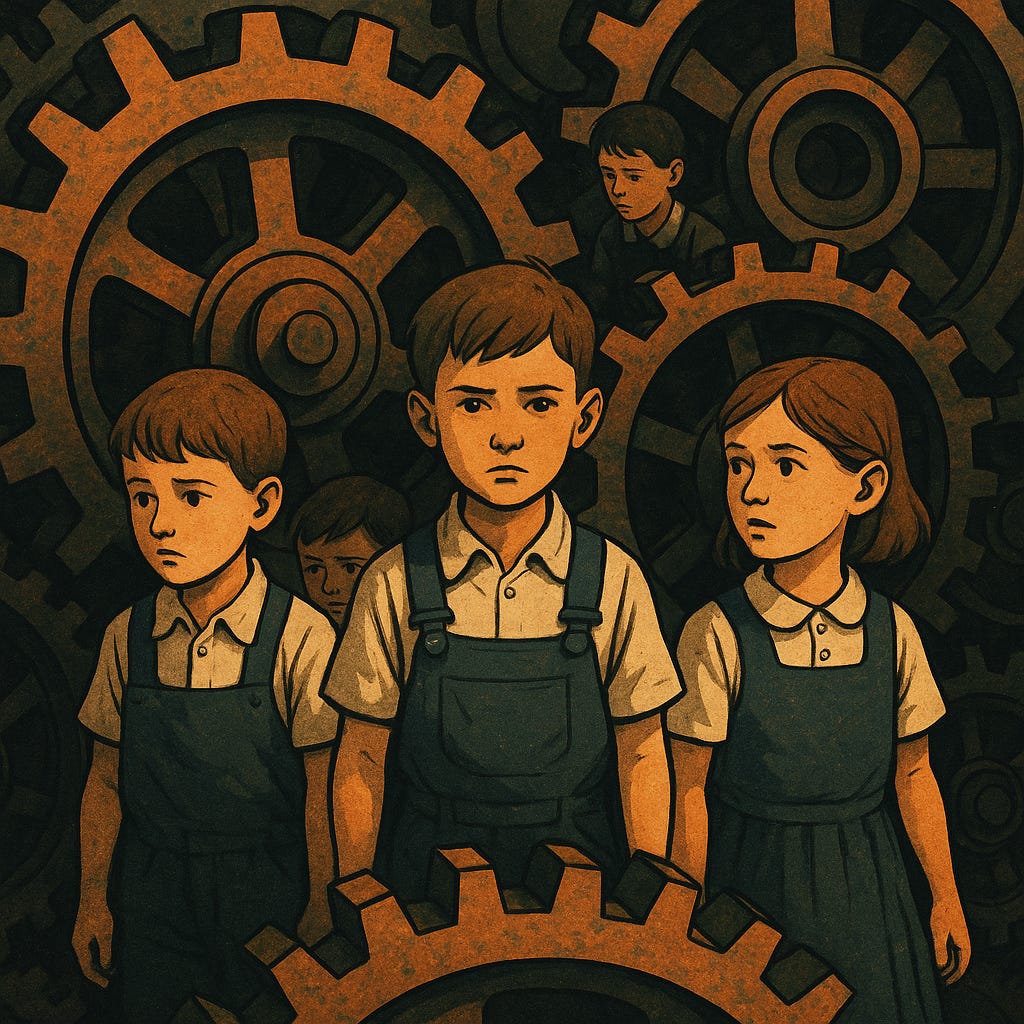
Once, education was seen as a foundation for democracy, a place where young people learned not only how to read and calculate, but how to question, collaborate, empathize, and lead. Now, education is increasingly framed as a workforce pipeline. It’s about readiness, efficiency, and utility. It’s about training “job creators” for the elite and “job fillers” for everyone else.
At the center of this reframing is the idea that the Department of Labor, an agency designed to serve market needs, should now have partial authority over what and how children learn. That’s not just mission drift. It’s a paradigm shift, and it’s one that quietly but profoundly narrows the role of schools from places of growth and discovery into pre-employment boot camps.
What is Education For?
Preparing children for their future is important, of course, but it goes beyond purely their employability. The core skills of any job and of life are built on the same principles of public education, notably communication (reading, writing, speaking), critical thinking (questioning, research, information literacy), and problem solving (scientific method, process-thinking, pattern recognition). With these core abilities deeply learned, apprenticeship and further specialized education can create the necessary skills to succeed in an industry. Specialized skills, however, are not a replacement for these essential abilities.
It’s easy to imagine how this plays out. Students are “tracked” early based on aptitude or perceived utility. School funding increasingly ties to workforce alignment, not enrichment, not equity, not exploration. College becomes “elite,” liberal arts “impractical,” and critical thinking “nonessential.” The question shifts from Who do you want to become to What role can you fill?
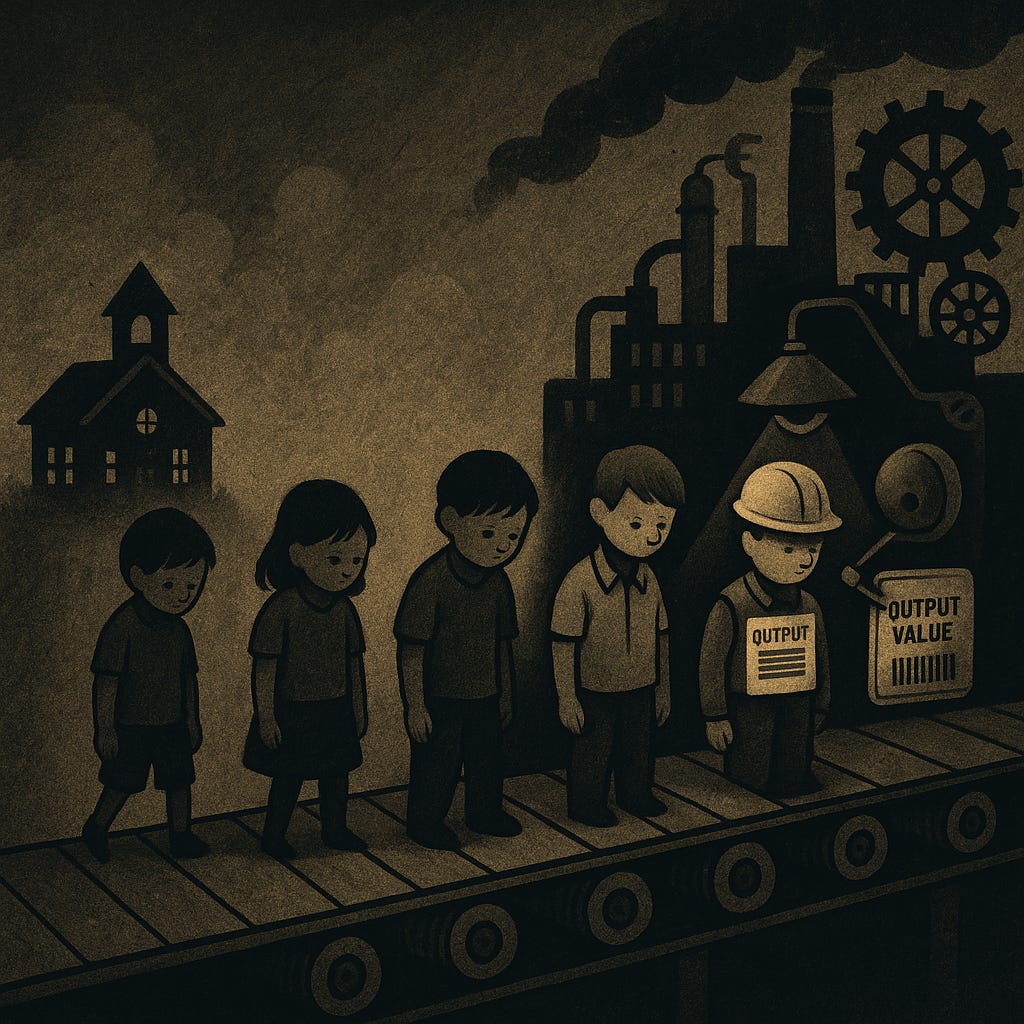
The Cog Model
And here’s the most insidious part: it’s marketed as opportunity. Career pathways, job-readiness programs, and skills-based learning sound empowering. Yet if the only paths you’re offered are tied to today’s market, not your full potential, it’s not education. It’s sorting, and that sorting too often follows the old lines of race, class, and geography.
There’s also a deeper cultural poison at work, the normalization of burnout as virtue. We’re conditioning kids to enter a world where productivity is the highest moral value, where working harder earns you more work rather than better pay, where tools like AI increase the expectations rather than free your time, and where the value of your mind is judged only by your output.
This is where the fantasy of opportunity becomes the reality of exhaustion.
The Hustle Trap
Many of us already know this trap. In our workplaces, the more efficient we become, the more we’re handed. The better we do, the higher the expectations climb with no commensurate increase in recognition, autonomy, or compensation. If you have an off day, the good work you did the week before is forgotten. This is the culture creeping into classrooms, rebranded as “preparation.”
We don’t work this hard just to hand the next generation a more automated, more extractive, more joyless version of the same system. And yet, that’s what the laborification of education offers, a school system whose endgame is not to liberate minds, but to standardize them for deployment.
Future Laborers of America
This isn’t a rejection of labor. It’s a rejection of reducing children to laborers. There’s a profound difference between teaching students how to thrive in the world of work and preparing them to be used by it. Learning to be a citizen and a member of society is not the same as learning to be a cog in the wheel of industry.
Let’s not build an education system that treats children like future employees. Let’s build one that treats them like future leaders, creators, citizens, and fully human beings.
The Technocratic‑Oligarchic‑Authoritarian Nexus
The structural shifts in the ED align with the broader agenda of Project 2025. Each step is outlined clearly in the right‑wing blueprint advocating for the shrinkage of federal oversight, the diminution of civil‑rights enforcement in schools, and the elevation of technocratic governance.
Under this framework, education becomes data, metrics, and machines. When the language of diversity, equity and inclusion is erased, when research is gutted, when oversight is outsourced, the result is a system that values efficiency over justice, compliance over inquiry, and output over imagination.
It reduces the people to their labor, elevates the elite, and further widens the growing wealth gap. In this scenario, the people become the machines that power the elite dynasties, too ill-educated to fight for more. Instead of technology freeing us all to focus more on the qualities that make us uniquely human, it elevates AI and technology to create while we do and the elite profit.
It’s hard not to hear echoes — deeply disturbing ones — in the idea that labor, and only labor, defines a person’s worth. ‘Arbeit macht frei’—‘work will set you free’—was not just a cruel slogan at the gates of Auschwitz. It was a philosophy of erasure. We are not equating this moment with that atrocity, but we are naming the danger of allowing systems to treat humans as instruments of output. History has shown us where that logic can lead.
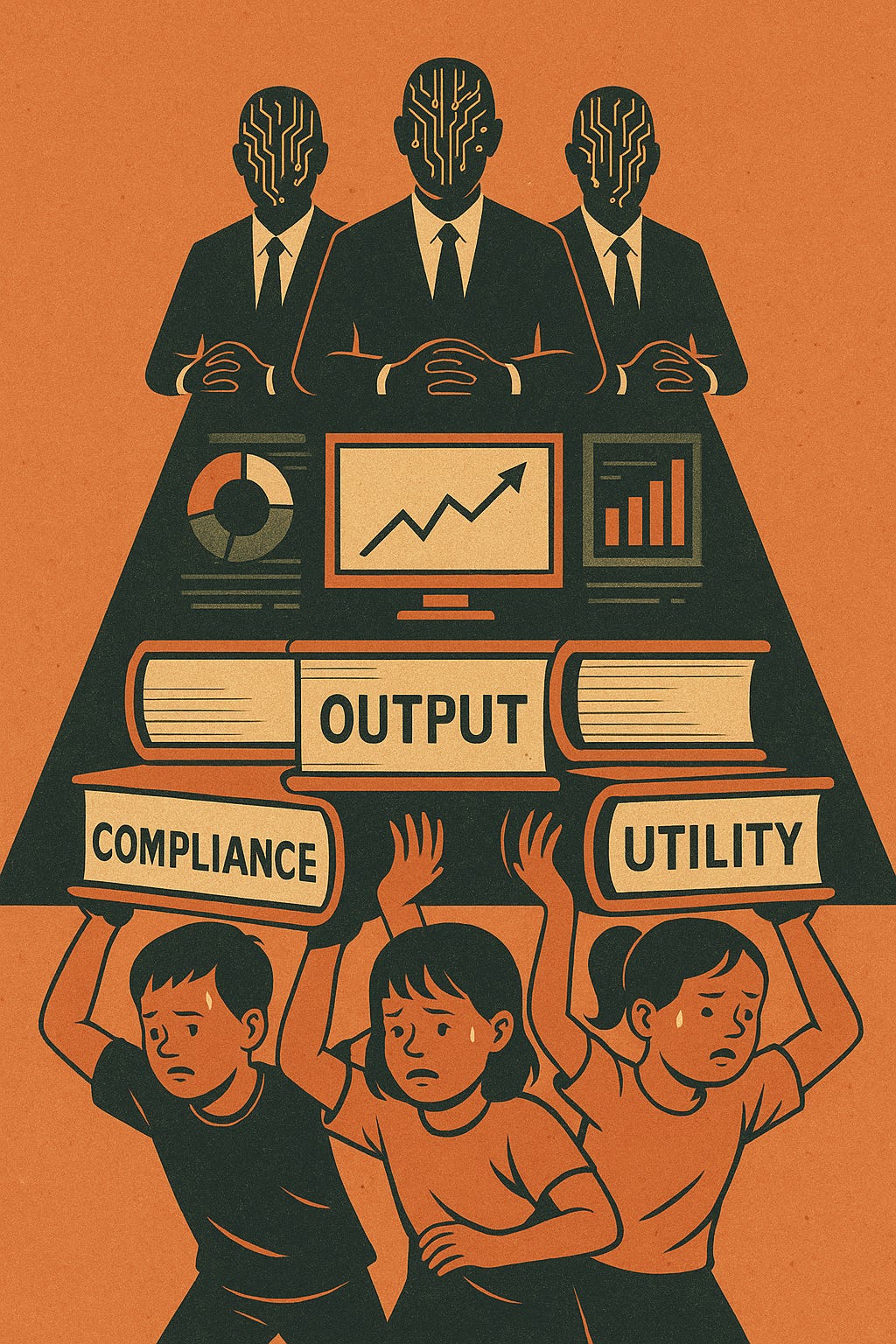
Create vs. Do: The Real Educational Divide
Let’s be blunt. Some schools still prepare children to create, lead, and decide. They are privileged with the skills of question, exploration, and leadership. Others, particularly in underfunded districts, shift toward training children to do. Follow instructions, serve someone else’s agenda, output measurable work. The tools of rote memorization, standardized testing, and efficiency metrics all serve to consolidate one outcome over another. That’s not education. It’s the reproduction of class hierarchy in modern clothes.
Remember the childhood dream of the cartoon The Jetsons? The promise of technology was freedom, not more work. As kids, we dreamed of technology doing our chores so we could play, not taking our play so we could do more chores.
The promise of education shouldn’t be “fit for the economy,” it should be “fit for life.”
We Can Still Choose Something Better
We believe that education is the most radical statement a society can make about its future. It can say: We believe in children. We believe in freedom. We believe in human possibility. Or it can say: We believe in markets. We believe in output. We believe in compliance.
What we’re witnessing now is a shift toward the latter. The Department of Education is not simply being trimmed. It’s being repurposed for a world that says your value begins and ends with your labor.
Is that the world we want for our kids? We don’t work this hard so the next generation inherits a system that asks them to do more, when they should be able to be more.
We must push for a model of schooling that teaches students to think, to question, to create, to change course, to live fully, not merely to serve.
The future isn’t a factory; it’s a field of possibilities, if we fight for it.
Don’t let the bastards sneak anything past you. Subscribe and get your daily dose of rage and receipts delivered fresh, before the spin doctors can scrub it.
Sources:
“Trump administration launches plan to dismantle Education Department” — Politico, Nov 18, 2025
“The Education Department is dismantling. Here’s what that means” — AP News, Nov 18, 2025
“Education Department makes major step toward dismantling with update on future of federal agencies” — People.com, Nov 18, 2025
“Trump makes another big move to shut down the Department of Education” — Business Insider, Nov 18, 2025
“U.S. Department of Education Announces Six New Agency Partnerships to Break Up Federal Bureaucracy” — U.S. Department of Education, Nov 18, 2025
“US Departments of Labor, Education announce new elementary, secondary, and postsecondary education partnerships” — U.S. Department of Labor, Nov 18, 2025
“Education Department off‑loading several key programs to other federal agencies” — Deseret News, Nov 18, 2025
“Many of US education agency’s powers reassigned to other federal departments” — The Guardian, Nov 18, 2025
Wow, when education is subordinated to a very specific goal, it's very dangerous. And it will greatly change education as we know it. Critical thinking and comprehensive knowledge will no longer be needed, as you already said. Poor America. This reminds me of slavery, when people were taught only enough to understand and obey orders.
"Efficiency"
A man wants to lose 20 pounds. He goes to his doctor who recommends a more healthy diet and increased exercise. She tells him over 6 months he should lose 20 pounds.
He then asks a venture capitalist who tells him that he knows a much more efficient way for the man to lose 20 pounds which would save him 6 months.
The man chooses the venture capitalist - who cuts off his leg.
Then he bills him twice the cost of a doctor's visit.