


Stay Informed. Stay Loud.
Subscribe to The Coffman Chronicle for no-BS political analysis, action guides, and daily truth bombs you won’t get from corporate media.
What Just Happened
On September 17, the Department of Education announced a new initiative called the America 250 Civics Education Coalition. On the surface, it appears to be a feel-good project: a nationwide effort to promote “patriotic civics” education as the United States approaches its 250th anniversary.
But look closer. This isn’t a neutral program run by teachers or historians. It’s a coalition built from more than 40 explicitly conservative organizations, including Turning Point USA, PragerU, the America First Policy Institute, and Hillsdale College. These aren’t just education groups. They are ideological engines, each with a long record of pushing partisan content into classrooms.
The DOE’s press release promises student competitions, speaker tours, teacher summits, and college campus events designed to promote “founding principles” and “civic unity.” The Education Department also states that it will prioritize “patriotic civics” in competitive grants, meaning federal dollars will be allocated to schools and programs that adopt this narrative.
That’s not just an educational choice. It’s a political one.
Why This Is Not Normal
The Department of Education typically does not act in this manner. Traditionally, its role is to fund programs, enforce civil rights law, and set broad standards for states. Civics education has always been part of that mission, but handled through grants and partnerships with schools, universities, and nonpartisan organizations, not coalitions dominated by one side of the political spectrum.
Consider the contrast:
Reagan’s “A Nation at Risk” (1983): A landmark report focused on declining test scores and academic standards. It was controversial, but not an overtly partisan rewriting of history.
Obama’s “Educating for American Democracy” (2012): A roadmap for civics that included scholars, teachers, and practitioners across the ideological spectrum, emphasizing inquiry over indoctrination.
Trump’s “1776 Commission” (2020): The closest precedent. This commission produced a report promoting a selective, celebratory view of U.S. history. Historians condemned it as inaccurate and ideologically driven, and the initiative was disbanded after the administration changed.
By launching a coalition stacked with ideological groups, the DOE has crossed into new territory. This is not about ensuring students understand how government works. It’s about ensuring they understand it through one carefully chosen lens.
And when a government begins dictating which version of history its citizens are allowed to learn, that’s no longer education. That’s the first step toward authoritarianism.
Propaganda 101: The Authoritarian Playbook
Every authoritarian regime begins with the same insight: if you can control what people learn about their past, you can control what they imagine for their future. History and civics classes stop being about questions and debates. They become about loyalty. The textbooks aren’t windows into the messy, complicated truth. They’re mirrors, reflecting back the state’s preferred image.
The Department of Education’s new “patriotic civics” push may sound tame compared to jackboots and torch parades, but history shows us where this road leads when governments start dictating which version of history gets taught.
Nazi Germany: From Classroom to Reich
When Hitler rose to power, one of his first targets was education. By 1933, Germany had established a “Reich Ministry of Education” that rewrote curricula to glorify the Aryan race and demonize Jews, communists, and democratic institutions.
Civics became obedience training. Students were taught that true citizenship meant loyalty to the Führer. Textbooks scrubbed away the Weimar Republic’s struggles with democracy and replaced them with mythic tales of German destiny. Teachers who resisted were dismissed or worse.
The lesson is that authoritarianism doesn’t begin with stormtroopers. It begins with classrooms teaching children that their government is flawless and that questioning it is tantamount to betrayal.
Mussolini’s Italy: Textbooks of Obedience
In fascist Italy, Benito Mussolini centralized all school curricula under the Ministry of Education by 1929. Every child in Italy studied from the same state-approved textbook: Libro unico di Stato, or the “Single State Textbook.”
The book presented a curated history in which Mussolini was portrayed as a national savior and fascism was depicted as the natural continuation of Italy’s greatness. Civics was reduced to memorizing the duties of a “good fascist citizen” — loyalty, discipline, sacrifice.
Sound familiar? Replace Mussolini’s name with “founding fathers” and swap blackshirts for “patriotic civics,” and you see the same logic: erase dissent, elevate myth, enforce conformity.
The Soviet Union: History as a Weapon
In Stalin’s Soviet Union, history wasn’t just written by the victors. It was rewritten whenever the victors changed. Textbooks erased purged leaders, airbrushing them out of photos and rewriting their roles in the revolution.
Civics was no longer about understanding how a state worked, but about glorifying the Communist Party and condemning capitalist “enemies.” Children learned a simplified narrative where all progress flowed from the party’s wisdom.
The message was clear. History wasn’t a debate. It was a weapon to be wielded against political opponents.
China Today: Patriotic Education at Scale
Fast forward to the present. In China, “patriotic education campaigns” are a central component of the state’s control. From elementary schools to universities, students are taught to revere the Communist Party as the guardian of stability and prosperity.
Textbooks gloss over the Cultural Revolution, Tiananmen Square, or current abuses in Xinjiang. Instead, they highlight China’s economic growth and historical victimization by foreign powers, fueling nationalism and obedience.
What’s striking is how China sells this as unity, not repression. The language is almost identical to what we’re hearing from the U.S. Department of Education today: “patriotism,” “civic harmony,” “shared values.” The strategy is to wrap propaganda in the language of pride.
See some of our previous reporting here:
Note: These articles are over 45 days old and now live in the archive. Please consider becoming a paid subscriber for exclusive perks including full access to our over 1000 articles.


The Common Thread
Different continents. Different decades. Different ideologies. But the method is always the same:
Centralize control of curriculum.
Erase uncomfortable truths.
Elevate myths that serve the ruling party.
Punish or marginalize dissenting voices.
Once the classroom is conquered, democracy doesn’t stand much of a chance.
That’s why the DOE’s new coalition is more than just an educational initiative. It’s an authoritarian playbook being dusted off and Americanized.
What Gets Left Out
Propaganda isn’t just about what’s taught. More importantly, it’s about what gets erased. When the Department of Education says it wants “patriotic civics,” we need to ask: patriotic for whom, and at whose expense?
If history becomes a highlight reel of founding fathers, battlefield triumphs, and constitutional quotes, then what happens to the rest of America’s story?
The Silences in the Room
Slavery and Jim Crow: A “patriotic” version of civics might reduce slavery to a footnote, framed as an unfortunate detour on America’s inevitable march toward freedom. Jim Crow might vanish altogether or be recast as an aberration that has long since been solved. Worse, it may be (and has been) framed as a quaint time when Africans learned “very valuable skills.”
Indigenous Genocide: From the Trail of Tears to broken treaties, the story of Native nations is central to U.S. history. However, patriotic civics tends to swap out dispossession for “westward expansion,” celebrating pioneer grit while ignoring the cost, much less the ongoing trouble.
Labor Struggles: Coal miners in West Virginia, garment workers in New York, and farmworkers in California fought and sometimes died for basic rights. Their battles are the reason weekends, child labor laws, and workplace safety exist. Yet these fights don’t make for tidy patriotic narratives, so they’re often skipped.
Protest Movements: From suffragists chaining themselves to fences, to Vietnam draft resisters, to Black Lives Matter marches — dissent is part of American democracy. However, in an authoritarian civics framework, protest becomes perceived as dangerous rather than patriotic.
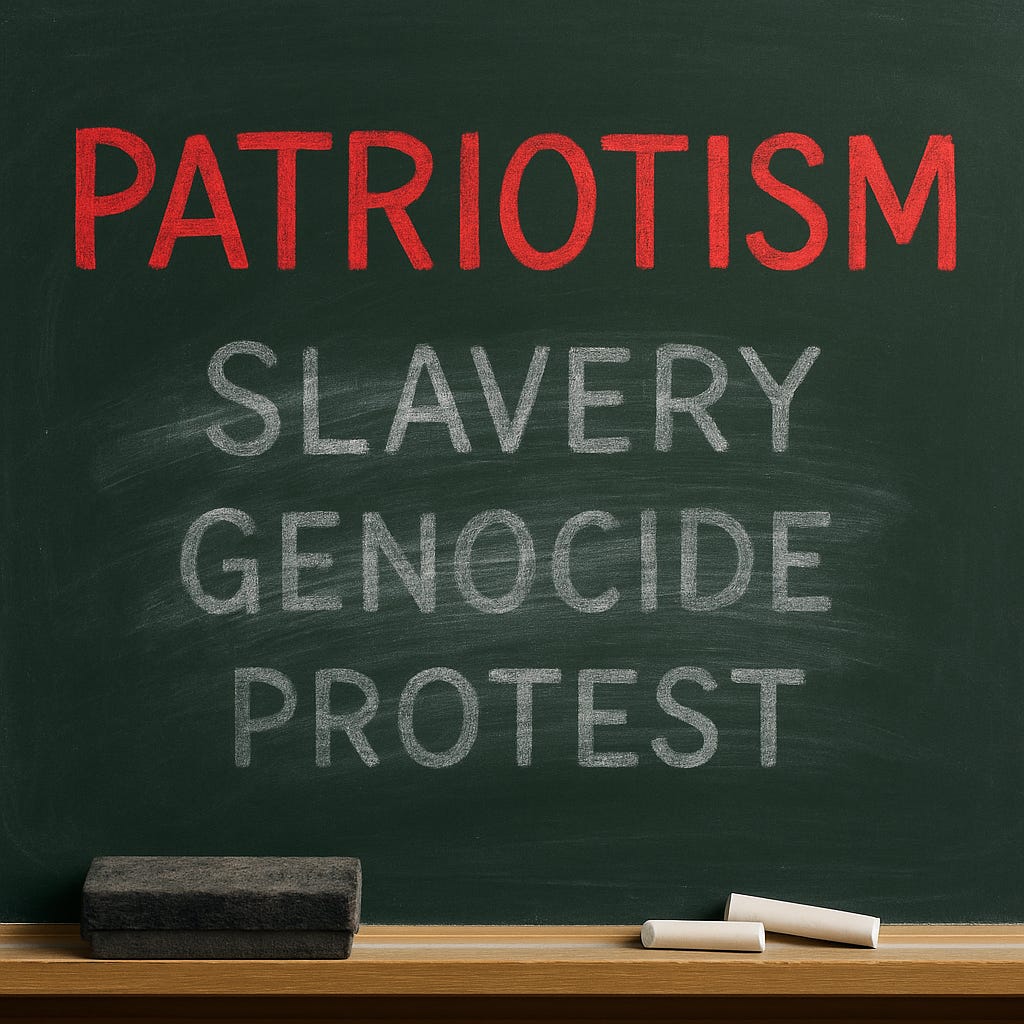
Why Erasure Is Political Violence
Leaving these histories out isn’t just an oversight. It’s a choice that sanitizes America’s past to protect the powerful in the present.
When students don’t learn about systemic racism, it becomes easier for politicians to claim it doesn’t exist.
When labor uprisings are erased, union-busting looks less like oppression and more like “freedom.”
When protest movements are delegitimized, crackdowns on dissent look like “restoring order.”
This is the authoritarian sleight of hand: rewrite history, erase struggle, and suddenly inequality looks natural and resistance looks un-American.
The Slippery Slope
Authoritarianism doesn’t arrive all at once. It’s not a tank in the streets or a dictator at the podium, at least not at first. It creeps in through small shifts that feel harmless, even patriotic. That’s the danger of the Department of Education’s new coalition. What appears to be a civics program is actually the scaffolding for narrative control.
Step One: Follow the Money
When the DOE says it will “prioritize patriotic civics” in grant competitions, that’s code for redirecting federal dollars. Schools already strapped for resources will feel pressure to apply for these funds and to tailor their applications to the ideology embedded within them.
Over time, districts seeking federal support will likely find themselves nudged toward textbooks, speaker programs, and teacher training programs produced by groups like PragerU or Hillsdale. This isn’t a mandate written into law; it’s a market incentive disguised as policy.
Step Two: Pressure the Teachers
Teachers already walk a tightrope when it comes to controversial topics. Add in “patriotic civics” funding, and the rope gets thinner. Will educators risk introducing lessons on systemic racism or protest movements if it might jeopardize their school's grant?
Some won’t. Some will self-censor. That’s how authoritarianism wins, not always by silencing dissent outright, but by making dissent too costly to bother with.
Step Three: Normalize the Myth
Once patriotic civics programming takes root, it becomes the default. Students learn a sanitized version of the story year after year. Parents, who may already be too overworked to track every lesson, see little reason to question it.
The myth becomes the mainstream. And when myths dominate classrooms, they shape voting booths. Children raised on a steady diet of patriotic gloss grow into adults less likely to question power and more likely to accept authoritarian rule as a form of stability.
Step Four: Close the Circle
Finally, the government can point to the civics it paid for as proof of legitimacy. “See?” they’ll say. “This is what our children are learning. This is what America believes.” The narrative is both the product and the justification.
That’s how the slope works. A coalition here, a grant there, and before long, the truth itself has been privatized, subsidized, and sanitized.
Why This Matters for Democracy
At its core, democracy depends on citizens who can think critically, argue honestly, and wrestle with the contradictions of their own country. That’s what civics is supposed to do. It’s not about making kids recite slogans. It’s about giving them the tools to ask hard questions: Who has power? Who doesn’t? Why? And how can we change it?
Authoritarianism, on the other hand, depends on the opposite. It thrives on citizens who salute on command, who repeat what they’re told, who believe the nation has always been perfect and therefore cannot be improved. That’s not civic education. That’s civic obedience.
Inquiry vs. Indoctrination
Inquiry means learning about slavery, Jim Crow, and Indigenous genocide, not because America is irredeemable, but because understanding the hard parts of history makes democracy stronger. Inquiry empowers citizens to identify injustice and demand improvement.
Indoctrination means skipping past the uncomfortable truths to tell a cleaner story. It teaches students that criticism is disloyalty, that protest is chaos, and that inequality is either invisible or inevitable. Indoctrination doesn’t raise citizens. It manufactures subjects.
That’s the fork in the road we’re standing at now.
The Authoritarian Advantage
When history is rewritten to glorify the state, democracy loses its immune system. Lies go unchallenged because the truth is no longer common knowledge. Citizens can’t recognize propaganda when they’ve been raised on it.
Think about what that means:
A citizen who doesn’t know about labor uprisings is more likely to believe unions are corrupt.
A citizen who hasn’t learned about voter suppression is less likely to notice when it’s happening today.
A citizen who has never studied protest movements will be more inclined to view dissenters as enemies of the state rather than guardians of democracy.
That’s not hypothetical. That’s the authoritarian formula in action.
Democracy Is Fragile — and Teachable
The real danger isn’t just that kids will grow up misinformed. It’s that entire generations will be conditioned to accept a thinner, weaker version of democracy, one where questions are unwelcome and obedience is rewarded.
Democracy can only survive if it is taught honestly, warts and all. If we sanitize the past, we sabotage the future.
This is why the Department of Education’s “patriotic civics” push matters. It’s not a curriculum fight in some distant classroom. It’s a battle over the very survival of democratic citizenship.
Call to Action
If history teaches us anything, it’s that authoritarianism doesn’t wait politely for permission. It advances wherever people leave the door cracked open. The Department of Education’s new “patriotic civics” coalition is one of those cracks. And if we don’t act, it will widen until the truth itself is squeezed out.
The Practical Steps
Show up locally. School boards decide which textbooks are adopted and which grants are applied for. Attend meetings. Ask hard questions. Don’t let “patriotic civics” slip in without debate.
Hold your representatives accountable. Call, email, or attend town halls. Demand that federal education funds support inquiry, not indoctrination. Tell them: civic pride comes from honesty, not whitewashing.
Support independent history projects. The 1619 Project, the Zinn Education Project, and countless local initiatives are keeping real history alive. Donate, share, and use their resources.
Defend teachers. When educators come under fire for teaching hard truths, speak up. They are the frontline guardians of democracy.
The Moral Imperative
This fight is bigger than curriculum. It’s about whether we want citizens or subjects. Do we want the next generation to inherit a democracy that encourages dissent, or an obedience culture that rewards silence?
Patriotism is not pretending America has no flaws. Real patriotism is loving this country enough to confront its failures and fight for its improvement. Anything less is propaganda.
The authoritarian playbook is clear: control the story, erase the struggle, normalize obedience. But so is the democratic response: expose the truth, honor the struggle, and insist on freedom.
The classroom may look quiet, but the stakes are loud. Our kids aren’t just learning history. They’re living it. And right now, it’s up to us to decide whether that history bends toward democracy or toward obedience.
Stay Informed. Stay Loud.
Subscribe to The Coffman Chronicle for no-BS political analysis, action guides, and daily truth bombs you won’t get from corporate media.
Bibliography:
U.S. Department of Education. “U.S. Department of Education, AFPI, TPUSA, Hillsdale College, and Over 40 National and State Organizations Launch America 250 Civics Coalition.” September 17, 2025.
“Education Department Unites Conservative Groups to Create Patriotic Civics Content.” Washington Post, September 17, 2025.
“Ed Dept Will Emphasize ‘Patriotic Education’ in Grant Competitions.” Education Week, September 17, 2025.
“U.S. Education Dept Unites Conservative Groups to Create Patriotic Civics Content.” NPR, September 17, 2025.
American Historical Association. “AHA Statement Condemning Report of Advisory 1776 Commission.” January 19, 2021.
“Educating for American Democracy Roadmap.” Educating for American Democracy, 2012.
Time for alternative programs in neighborhoods. Prayer U is a BS vomit factory. Saturday programs teaching original documents and research methods. One voice was all it took when I was a kid. We had a duck & cover exercise in case of an nuclear attack. My dad laughed when I told him. He told me there wouldn't be time, don't do it and why. I repeated it the next day. It worked.
This country has had a love affair with the Nazi party as far back as I can remember. McCarthy brought it front and center during the hearings and blacklisting. Sinclair Lewis and George Orwell warned us.