


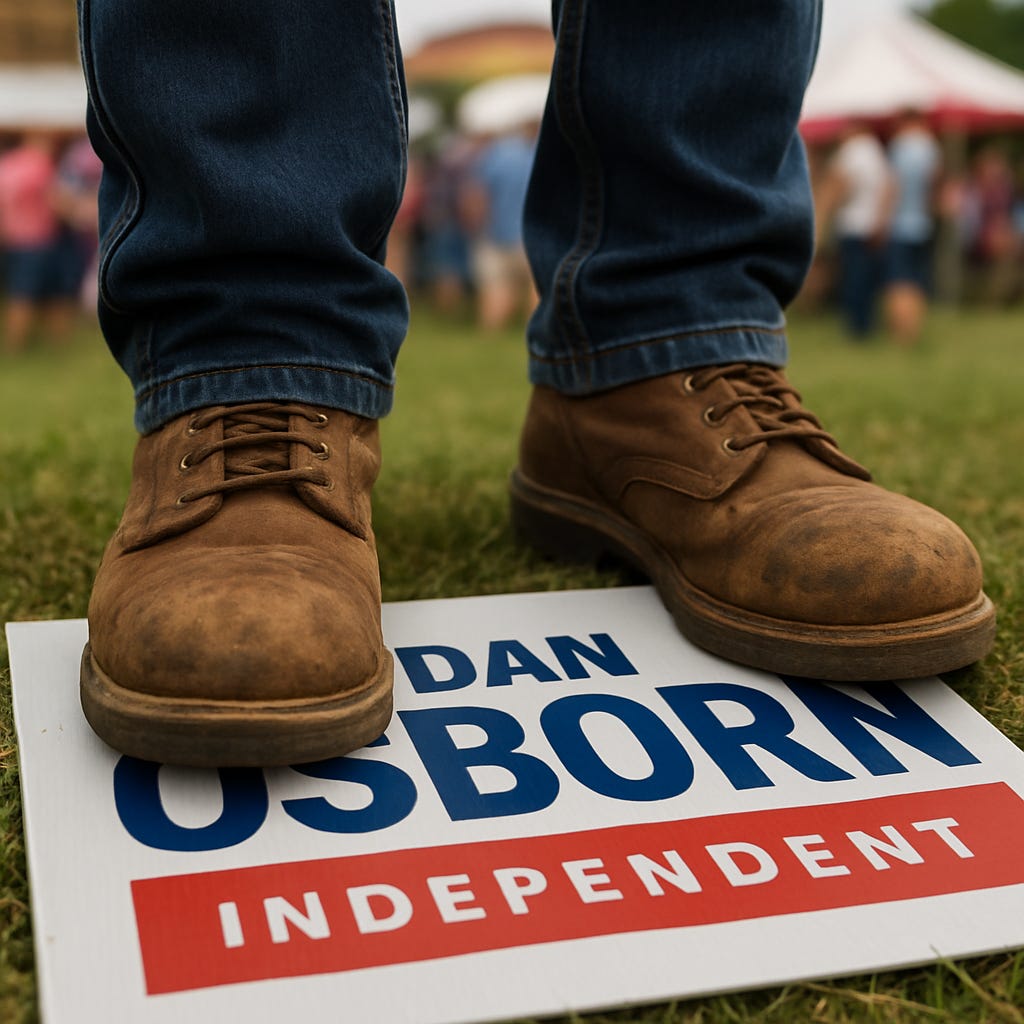
The Unexpected Contender
On a muggy summer evening in Nebraska, the parking lot outside the VFW hall is filled with pickup trucks, beat-up sedans, and a few rust-dusted farm trucks with seed company stickers on the bumpers. Inside, the fluorescent lights hum, the coffee is strong, and the folding chairs creak as neighbors settle in.
There’s no podium, no slick campaign banner hanging behind the speaker. Dan Osborn doesn’t need one. He’s leaning forward at the head of a long plastic table, arms resting on his forearms, listening intently to a man across from him explaining how his property taxes jumped another 14% this year. Osborn nods, asks a follow-up question, and makes a note in a beat-up spiral notebook.
When it’s his turn to talk, there’s no “red versus blue” rhetoric, no mention of party at all. Instead, he starts with the price of milk, then the jump in homeowners’ insurance, then the fact that a new set of tires now costs more than some folks’ monthly rent. The crowd murmurs in agreement.
It’s not the language of a polished politician. It’s the language of someone who’s been on the same shop floor, felt the same budget strain, and stood in the same checkout line as the people in front of him. And that’s exactly why, in 2024, this independent challenger came closer to flipping a U.S. Senate seat in deep-red Nebraska than anyone thought possible.
Stay Informed. Stay Loud.
Subscribe to The Coffman Chronicle for no-BS political analysis, action guides, and daily truth bombs you won’t get from corporate media.
Who Dan Osborn Is & Why He Resonates
Dan Osborn’s story doesn’t start in a think tank or a governor’s mansion. It starts in working-class Omaha. Born in 1975, he graduated from Roncalli Catholic High School and enlisted in the U.S. Navy, serving aboard the USS Constellation. After active duty, he joined the Nebraska Army National Guard, then settled into a career as an industrial mechanic at Kellogg’s cereal plant in Omaha.
For decades, Osborn worked rotating shifts, the kind that start before dawn or stretch past midnight, keeping the plant’s machinery running. His defining moment came in 2021, when Kellogg’s workers across the country walked off the job in a high-profile strike. As president of BCTGM Local 50G, Osborn became the face and voice of the Omaha strike line, standing in the cold with his members and facing down a corporate giant until they secured a better deal.
That fight gave him a kind of credibility few candidates can buy. In 2024, when he ran as an independent for U.S. Senate against Republican incumbent Deb Fischer, many voters already knew him, not as “a politician,” but as the guy who had gone to bat for workers in their own community. He didn’t have a party machine behind him, but he did have a network of union members, neighbors, and ordinary citizens willing to knock on doors and hand out flyers.
The result: Osborn pulled 46.5% of the vote, the best showing for an independent Senate candidate in Nebraska history. He carried Douglas and Lancaster counties and overperformed in rural areas where Democrats usually struggle. In a state with an ironclad Republican reputation, that was more than an upset scare. It was a political earthquake.
Ask his supporters why they backed him, and they’ll tell you it’s simple: “He’s one of us.” His Navy service, union leadership, and refusal to play the partisan game make him an uncommon political figure in an era of endless party-line warfare. He talks about bills, wages, and health insurance — the things that land on kitchen tables every month — and skips the culture-war scripts.
In 2026, he’s taking that same playbook into a new fight against Senator Pete Ricketts, a billionaire former governor with deep ties to the Republican establishment. It’s a David-and-Goliath matchup, but if 2024 proved anything, it’s that Osborn’s kind of grassroots populism can move votes in places conventional wisdom has already written off.
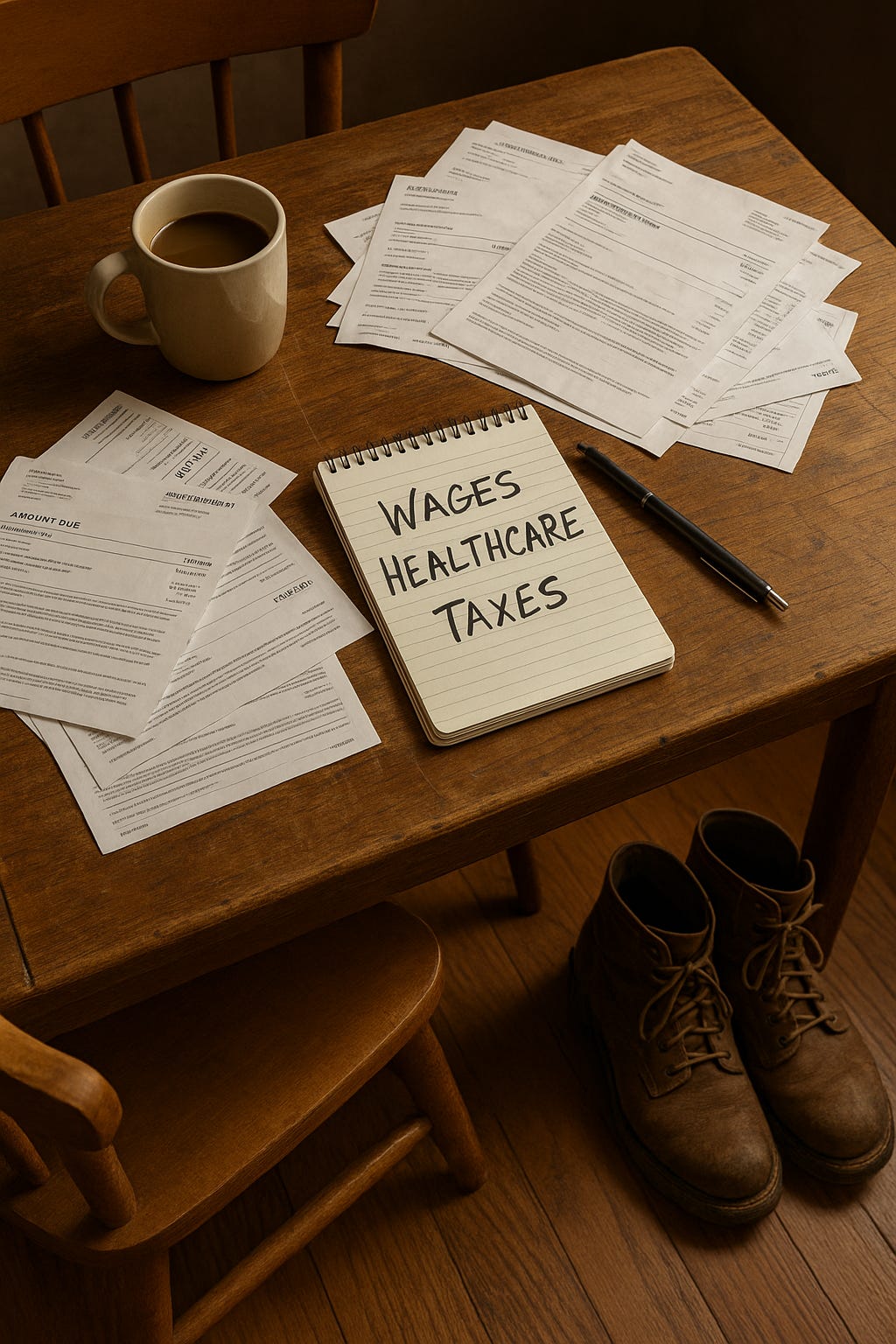
Kitchen-Table Politics in Action
When Dan Osborn talks about “kitchen table issues,” he doesn’t mean it as a vague campaign slogan. He means the literal stack of bills sitting on a Formica countertop, the mortgage or rent, the insurance premium notice, the grocery receipt that’s somehow longer and more expensive than it was a year ago.
In Nebraska, those bills come with their own local spin. Farmers and ranchers talk about the rising costs of seed, fertilizer, and feed. Retirees grumble about property taxes climbing faster than their Social Security checks. Parents weigh whether they can afford extracurriculars for their kids after paying the latest bump in health insurance. These are the topics Osborn brings to every meeting, whether he’s in a small-town café or a union hall in Omaha.
“I don’t want to hear about some national party’s talking points,” says Linda, a retired public school teacher from Hastings who backed Osborn in 2024. “I want to hear about how I’m going to afford my prescriptions next month. He talks about that, so I listen.”
Rather than chasing headline-grabbing culture war battles, Osborn zeroes in on the basics:
Wages and job security — pushing for fair pay and policies that protect workers from sudden layoffs.
Healthcare affordability — openly criticizing both parties for failing to rein in costs.
Tax fairness — aiming to ease the property tax burden without gutting schools and local services.
Rural economic health — from grain prices to broadband access, framing rural issues as part of the same struggle urban Nebraskans face.
The result is a message that doesn’t just land with Democrats or independents; it reaches Republicans who feel national politics ignores their economic reality. “I’m a Republican,” says Don, a small business owner in Kearney. “But when he talks about the cost of doing business or keeping my employees, it’s like he’s speaking my language. That matters more than the letter after his name.”
In a political climate where party labels often dictate votes, Osborn’s kitchen-table emphasis works like a universal translator. The things people talk about at home — over coffee, over dinner, over the monthly budget spreadsheet — don’t come with a party logo. And that’s where his grassroots campaign finds its power.
The Grassroots Model
Dan Osborn’s campaign doesn’t run on million-dollar ad buys or a war chest from Washington. In 2024, his total fundraising came in under $1.5 million, a fraction of what incumbent Deb Fischer spent. Yet he still captured 46.5% of the vote statewide, proving that in Nebraska, personal contact can be more powerful than glossy mailers.
Instead of spending on national consultants, Osborn invested in the oldest and cheapest political tool there is: showing up. His calendar read like a county fair circuit:
Union picnics in Omaha and Lincoln.
Farmers’ markets in Holdrege, Hastings, and North Platte.
Pancake breakfasts at rural volunteer fire halls.
High school football games, where he shook hands until halftime.
He didn’t just appear for a photo-op and leave. Volunteers say he often stayed until the chairs were stacked and the coffee pot was drained.
“I’ve never seen a Senate candidate hang around this long after an event,” says Maria, a volunteer from Columbus. “People remember that. They tell their neighbors. That’s how we picked up votes in places you wouldn’t expect.”
Numbers back it up: In 2024, Osborn outperformed Joe Biden’s 2020 vote share in 88 of Nebraska’s 93 counties, often by double digits in rural precincts. In Garden County, a GOP stronghold where Donald Trump pulled over 85% in 2020, Osborn still managed 31%, far higher than typical Democratic candidates.
This approach taps into a long-standing Nebraska tradition. The state’s unicameral legislature is officially nonpartisan, a legacy of legendary senator George Norris, who ran as an independent in the 1930s. Norris believed politics should be rooted in local accountability, not national party machinery, and Osborn’s campaign channels that same ethic.
Nebraska voters, even in deep-red districts, often value candidates who show independence from party bosses. Osborn’s refusal to run under a party banner is more than branding. It’s a practical way to avoid being boxed in by national talking points.
In a state where politics is often treated like a spectator sport — red team versus blue team — Osborn is reminding voters that they’re not just fans in the stands; they’re players in the game, and the score is measured in grocery bills, wages, and whether the lights stay on at the local hospital.
Why It’s Working in Deep-Red Nebraska
Nebraska has voted Republican in every presidential election since 1968. In 2020, Donald Trump won the state by more than 19 points. On paper, a statewide independent candidate should have no path to even a close race. Yet in 2024, Dan Osborn came within 6 points of unseating an entrenched GOP senator.
The numbers tell the story:
Osborn carried Douglas County (Omaha) and Lancaster County (Lincoln).
He outperformed the 2020 Democratic presidential vote share in 88 of 93 counties.
In rural counties like Custer, Dawson, and Platte, Osborn routinely landed in the high 20s to low 30s.
Statewide, he drew roughly one-third of self-identified Republican voters, according to local exit polling.
Why? Many Nebraskans prize independence from Washington’s partisan noise, and Osborn gives them a place to land without feeling they’ve switched sides.
John, a lifelong Republican from Sidney, put it plainly:
“I’m not switching parties. But when the guy running actually talks about my crop prices, my taxes, and my hospital closing, I’ll listen. Ricketts has money, Osborn has time for you — I’ll take the time.”
That crossover appeal, rooted in economic populism and avoidance of cultural flashpoints, is the linchpin of his strategy. It’s why rural conservatives who won’t back a Democrat will still take a yard sign for an independent.
The 2026 Test Against Pete Ricketts
If 2024 was an underdog fight, 2026 is shaping up as a political clash between Nebraska’s working-class insurgent and one of the wealthiest men in Congress.
Pete Ricketts, the appointed U.S. Senator and former governor, isn’t just a Republican fixture. He’s a billionaire heir to the TD Ameritrade fortune, with nearly limitless personal funds and a national donor network. In 2024, Ricketts spent over $3 million of his own money just to secure the seat midterm.
The contrast is stark:
Ricketts: National party insider, deep pockets, high-dollar TV blitzes.
Osborn: No-party outsider, small-dollar donors, shoe-leather outreach.
The stakes go beyond Nebraska. A win or even another close call would show that an independent can compete in a deep-red state without a major-party label. For Democrats, it’s proof that backing the right independent can deliver seats otherwise unwinnable. For Republicans, it’s a warning: ignore economic populism at your peril.
Politics Around the Table
In the end, Osborn’s campaign is built where politics has always been most real: around kitchen tables, across café counters, in union break rooms, and on the sidelines of Friday night football. It’s built in the quiet moments after a town hall, when the crowd thins and someone finally leans in to say, “Here’s what’s really going on in my life.”
Those moments don’t go viral. They don’t fit in a 30-second ad. But they’re where the trust is built, trust that can’t be bought, only earned, one conversation at a time.
That’s why you can drive across Nebraska and see his yard signs standing in front of farmhouses and city duplexes alike. It’s why you can walk into a café in Kearney or a grocery store in Omaha and find someone who says, “I don’t care about party — I care that he listens.”
Whether Osborn wins or loses in 2026, he’s proving something bigger: in a political era dominated by billionaires and national party machines, the most disruptive thing you can do is sit down, pour the coffee, and listen. The kitchen table might be small, but in Nebraska, one independent candidate is showing it can be the launch pad to shake the walls of the U.S. Senate.
Stay Informed. Stay Loud.
Subscribe to The Coffman Chronicle for no-BS political analysis, action guides, and daily truth bombs you won’t get from corporate media.
Bibliography:
“Dan Osborn.” Wikipedia.
“2024 United States Senate election in Nebraska.” Wikipedia.
“Dan Osborn launches independent Senate bid against Ricketts in Nebraska.” The Hill, July 8, 2025.
AP News. Independent Dan Osborn launches new U.S. Senate bid to challenge Nebraska Republican Pete Ricketts, July 8, 2025.
The Guardian. “There’s an appetite for this brand of politics”: the independent politician making a bid for US Senate, August 4, 2025.
Nebraska Examiner. “Nebraska’s Dan Osborn picks a race, launches Senate bid against U.S. Sen. Pete Ricketts,” July 8, 2025.
Nebraska Examiner. “Nebraska Dems chair ‘supporting’ Dan Osborn vs. U.S. Sen. Pete Ricketts,” July 31, 2025.
New York Magazine Intelligencer. Ross Barkan. “The Democratic Revival Starts With a Non-Democrat,” July 14, 2025.
My main reason for writing this article is to show Democrat and Independent candidates that running on kitchen table issues will,win them the nomination 😉..
Sometimes I think that having party affiliations and making that the brand is doing more harm than good. We are people of America who believe pretty much the same way. OF course, there are those who would rather not. I believe we as a people outnumber those who would rather not. What's so important right now is to continue the function of our democratic republic. Unless someone wants to live under authoritarianism, tyranny, Neoliberalism, etc.; our goal has to be restoring those freedoms that are slowly being eroded by Project 2025, Christian Nationalism, and an erratic man at the helm. I've been both a Republican and a Democrat over 6 decades. It's all about the soul of our Nation, what it was, and what it still can be if we fight for it.