


If you listen to the loudest voices in politics or cable news, you’d think America is being torn apart by a culture war: rural conservatives clinging to tradition, urban liberals pushing social change. It’s red hats versus rainbow flags. Guns versus drag queens. School boards versus woke mobs.
But what if that’s the wrong fight?
Step back, and a different pattern emerges, one hidden beneath the headlines. In both forgotten factory towns and inner-city blocks, millions of Americans are living parallel lives under different labels. They're scraping by in underfunded schools, struggling with addiction, watching jobs disappear, and getting punished by systems that were supposed to protect them. One group might be called “white working class.” The other, “urban poor.” But they’re fighting the same battle, and losing for the same reason.
In one rural Kentucky county, the poverty rate tops 25%. In parts of Cleveland, it’s nearly the same. Neither gets the help they need, but both get blamed.
This isn’t a culture war. It’s a class war.
And it’s being waged by those in power against those they’d rather keep divided. Because when the poor are busy blaming each other, the rich don’t have to answer to anyone.
Coffman Chronicles
We just hit 13,000 subscribers—thank you! To celebrate, we’re offering full access to The Coffman Chronicle at 50% off.
Get exclusive analysis and fearless reporting you won’t find in corporate media.
Support truth. Stay informed.
Economic Reality Check: Different ZIP Codes, Same Struggle
Strip away the geography, and the numbers tell a unified story. Whether in a rural Appalachian hollow or a Black neighborhood on the South Side of Chicago, the economic reality is grim and strikingly similar.
In rural America, over 12.7% of white residents live below the poverty line, with entire counties lacking stable employment or access to child care. In Jackson, Kentucky, the last local factory shut down years ago. Now, many families rely on seasonal labor or gig work—low pay, no benefits, and no path forward.
Meanwhile, in urban America, poverty rates among Black and Hispanic populations are even higher—19.5% and 17% respectively. In Chicago’s Englewood neighborhood, over a third of residents live in poverty, and the nearest full-service grocery store closed in 2022.
Despite different skylines, the view from the ground is the same:
Underfunded schools
Disappearing manufacturing and union jobs
No upward mobility
A political class more interested in photo ops than solutions
The myth says rural Americans are poor because of “bad decisions,” and urban Americans are poor because of “bad culture.” But the truth is simpler and more damning: both were systematically abandoned.
See our recent deep dive into the situation in rural communities here:

Crime, Drugs, and the Punishment Economy
When opportunity vanishes, despair doesn’t just simmer; it explodes. In both rural and urban poor communities, that explosion has taken the shape of addiction, violence, and mass incarceration. And instead of offering help, the system doubled down with punishment.
In urban areas, the crime rate grabs headlines: in 2021, cities reported 24.5 violent crimes per 1,000 people, nearly double the rural rate. But that stat doesn’t tell the whole story. It doesn’t explain why communities are under-policed for protection but over-policed for arrests. Or why entire generations of Black men were swept into prison under drug laws harsher than anything applied in white communities.
Meanwhile, rural America—once considered immune to “urban problems"—now faces its own crisis. Meth and fentanyl have ravaged small towns. In Kentucky, West Virginia, and Missouri, rural jails have seen inmate populations rise by over 50% since 2000, often due to drug-related arrests.
The substances may differ—crack in the '80s, meth in the 2000s, fentanyl today—but the response stays the same: criminalization instead of care.
Schools, Healthcare, and Systemic Neglect
Education
In rural America, many schools are falling apart—literally. Some still rely on coal stoves for heat, or rotate teachers due to staffing shortages. In low-income rural districts, only 44% of students enroll in college, the lowest rate in the country.
Urban schools don’t fare better. In predominantly Black and Latino neighborhoods, buildings often lack functioning AC, textbooks are outdated, and security officers outnumber guidance counselors.
Healthcare
Rural hospitals are closing at a record pace; over 130 have shut down since 2010. Mental health services are almost nonexistent.
Healthcare might be closer in cities, but it’s not always accessible. Black and Hispanic Americans are more likely to be uninsured, and high-need neighborhoods often have the fewest providers.
The Result
Whether it’s a shuttered ER in a Kentucky town or a moldy school in the Bronx, the message is the same: You don’t matter. Not enough to fix. Not enough to fund. Not enough to save.
Divide and Conquer: The Role of Media and Politicians
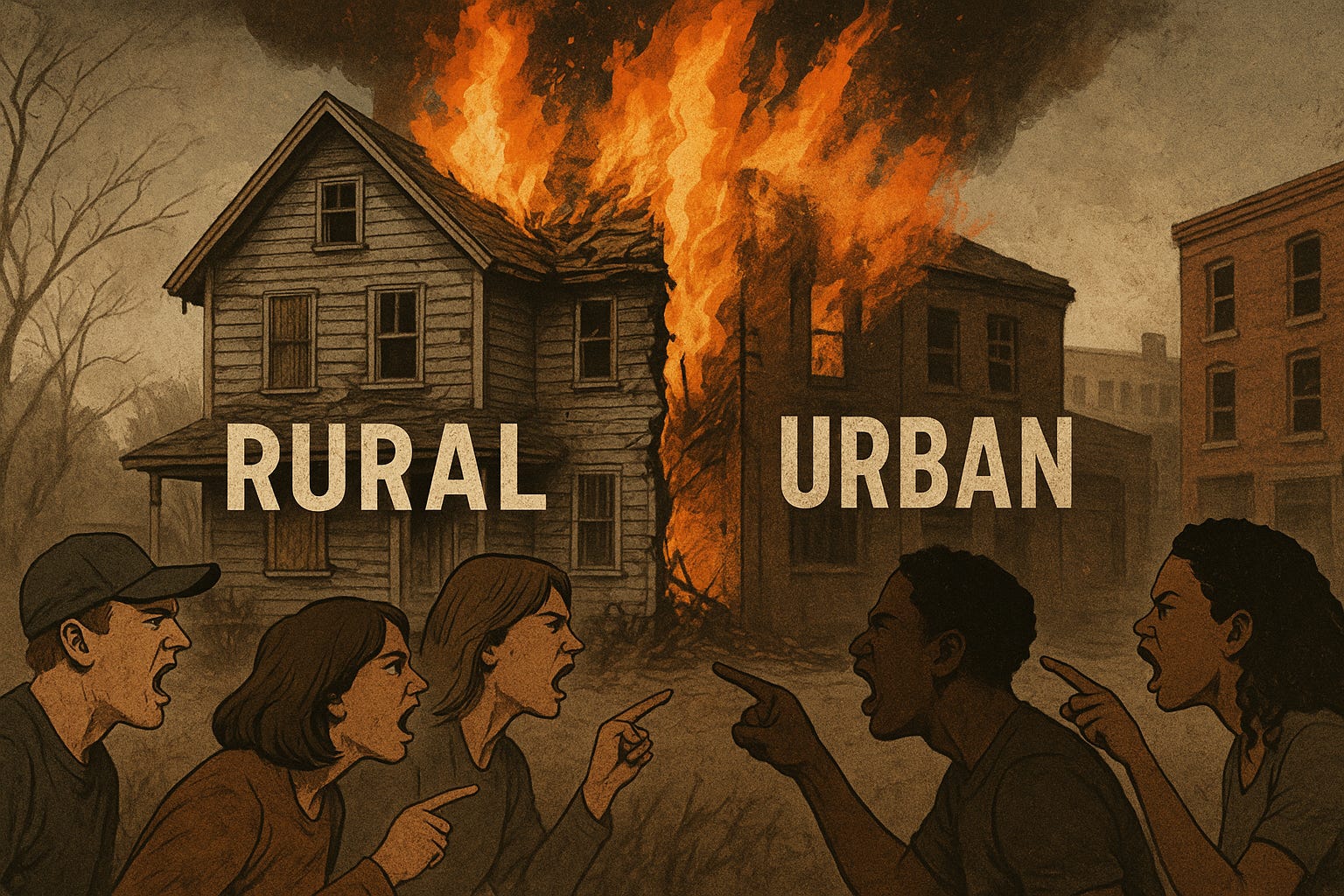
If rural whites and urban minorities are living parallel lives of poverty, pain, and neglect, why don’t they see each other as allies?
Because they were never meant to.
For decades, media and political elites have worked overtime to frame their suffering as a culture clash instead of a class crisis. Both sides are caricatured. Both are lied to. And while poor Americans fight in comment sections, the real winners quietly make off with the money and the power.
Shared Humanity, Shared Interests
Strip away the ZIP code. Strip away the race. Strip away the party affiliation. What’s left?
Mothers working two jobs
Fathers burying children lost to fentanyl
Grandparents raising grandkids
Young people wondering if it will ever get better
They’ve both been robbed.
Robbed by corporations that outsource jobs and raise prices.
Robbed by politicians who cut benefits while giving tax breaks to billionaires.
Robbed by a system that punishes poverty and rewards exploitation.
Fight the Right War
The people hurting most in this country have been handed two choices: fight each other, or stay quiet.
But there’s a third option, and it’s the one the system fears most: Stand together.
This was never a culture war; that’s just the smokescreen. The real war has always been a class war.
We just hit 13,000 subscribers—thank you! To celebrate, we’re offering full access to The Coffman Chronicle at 50% off.
Get exclusive analysis and fearless reporting you won’t find in corporate media.
Bibliography
U.S. Census Bureau. Income and Poverty in the United States: 2020. September 2021.
Centers for Disease Control and Prevention. Drug Overdose Death Rates. February 2023.
Pew Research Center. Demographic and Economic Trends in Urban, Suburban and Rural Communities. May 22, 2018.
U.S. Bureau of Labor Statistics. Labor Force Characteristics by Race and Ethnicity, 2020. August 2021.
U.S. Government Accountability Office. Rural Hospital Closures: Affects Access to Care and Emergency Services. December 2020.
USAFacts. “Where Are Crime Victimization Rates Higher: Urban or Rural Areas?” March 2023.
The Institute for College Access & Success (TICAS). Rural Students and College Completion: A National Primer. December 2023.
National Equity Atlas. “Neighborhood Poverty.” 2022.
Prison Policy Initiative. Mass Incarceration: The Whole Pie 2023. March 2023.
The rural-urban divide goes deep. I grew up on a farm in western Nebraska and I live in Kentucky now, not that far from Jackson. I was taught that farm boys in Nebraska are reliable, hard workers and people in the cities were just lazy. I know how untrue that is now, but that myth still lives in rural areas of the country.
Wow. It‘s so true !!