


On March 19, the Senate Homeland Security and Governmental Affairs Committee voted 8–7 to advance the nomination of Senator Markwayne Mullin to lead the Department of Homeland Security. The vote now sends his nomination to the full Senate, where a final confirmation battle is expected in the coming days.
On paper, it was a routine step in the confirmation process. In practice, it was anything but.
It would be easy to frame the hearing around its most visible moments: a heated exchange between colleagues, a surprise crossover vote, a narrowly divided committee. However, focusing too closely on those elements risks missing what actually made this hearing significant.
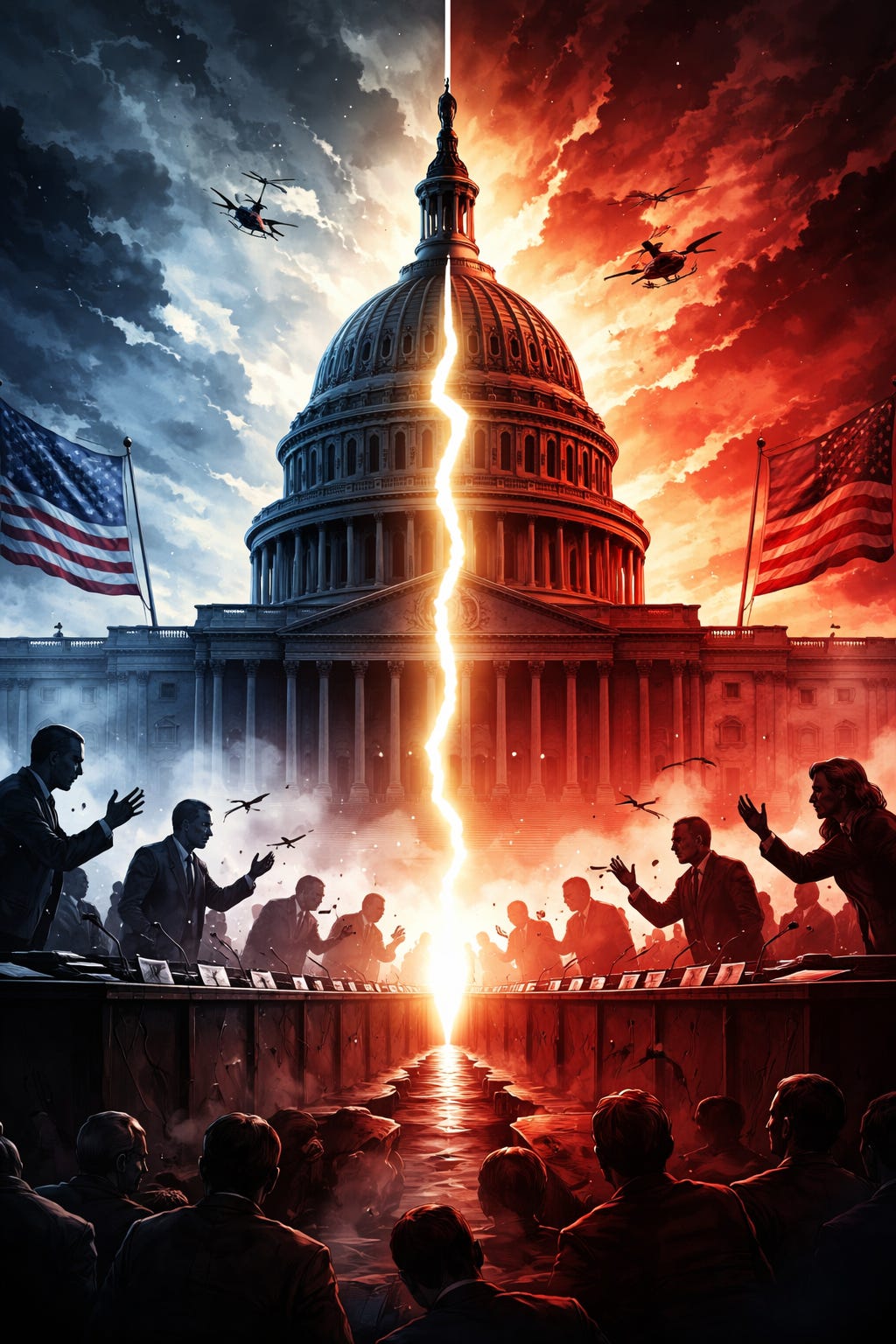
This was not just a test of one nominee. It was a convergence point, a moment where several long-running tensions in American governance surfaced at once, through the lens of a single agency and a single decision.
This Community Is Powered by You
What started as a small circle has grown into something much bigger, and it’s all because of readers like you.
Every time you forward this email, post it on socials, or bring someone new into the fold, you’re helping build one of the most passionate, independent political communities out there.
Want to keep the momentum going?
Share this newsletter with someone who should be part of this conversation.
Thank you for being here. It means everything.
An Agency Built for Crisis, Now Governing in One
The Department of Homeland Security has always occupied an uneasy space in the federal government. Created in the aftermath of 9/11, it was designed for speed, coordination, and threat response. Over time, both parties expanded its authority, particularly in immigration enforcement and domestic security, often in response to immediate pressures rather than long-term design.
Those decisions were rarely revisited with the same urgency that produced them. Guardrails lagged behind capability, and oversight struggled to keep pace with expansion.
Now DHS is operating in a very different political environment, one defined less by unity in crisis and more by polarization, distrust, and heightened scrutiny of state power. Recent controversies surrounding enforcement practices and use of force have only intensified that pressure, contributing to an ongoing funding standoff in Congress as Democrats push for greater accountability measures.
See our recent reporting on the funding standoff here:

All of that context was present in the room, even when it went unspoken.
A Hearing Shaped by Personality and Proximity
Mullin’s nomination came together quickly following the removal and reassignment of former DHS leadership, leaving relatively little time for distance or reset. Unlike many nominees, he was not an outsider stepping into the Senate for the first time. He was already a sitting member, with active relationships and conflicts among those questioning him.
That proximity mattered.
The most visible example was his clash with Senator Rand Paul, the committee’s Republican chairman, whose opposition stemmed in part from longstanding personal and political tensions. Paul has also consistently taken a more libertarian view of federal power, particularly regarding surveillance and enforcement authority, positions that place him at odds with the expansive scope of DHS in its current form.
See our recent short on the exchange here:

While the exchange itself drew attention, it was less an isolated moment than a reflection of deeper fault lines: temperament, yes, but also competing views about how much power the federal government should wield in the name of security.
The Fetterman Factor
If Paul’s opposition represented an internal Republican fracture, Senator John Fetterman’s vote to advance Mullin introduced a different kind of disruption.
Fetterman has been an increasingly unpredictable figure since arriving in the Senate, at times breaking from progressive expectations on issues of national security and immigration. His support for Mullin appears to align with a broader emphasis on border enforcement and institutional stability, even as it sits in tension with both his earlier political identity and his family’s personal immigration story, which has been publicly discussed in recent weeks.
That tension has not been fully resolved and may not be, but in this case, it was decisive.
The result was a rare alignment, one Republican voting no, one Democrat voting yes, and a nomination that advanced not through party unity, but through offsetting defections.
From Governance to Performance
The tone of the hearing also reflected a broader shift in how politics is conducted.
Confirmation hearings once aimed, at least in theory, to evaluate qualifications, judgment, and the limits of authority. Those elements were present here, but they competed with something else, a political environment increasingly shaped by visibility, virality, and audience.
Mullin is a product of that environment. His public persona—combative, direct, often confrontational—is not incidental to his candidacy; it is part of it. When that style intersects with an agency as politically charged as DHS, the line between governance and performance becomes harder to maintain.
See our recent reporting on Mullin here:

What unfolded was not simply deliberation. It was also signaling.
Executive Power, Deferred Accountability
Beneath the surface, the hearing raised a more fundamental question about power itself.
For decades, Congress has delegated significant authority to the executive branch in areas tied to security and immigration. DHS is one of the clearest expressions of that trend. The department’s reach is not accidental, but rather the cumulative result of legislative choices made under pressure, often with bipartisan support.
Those choices carried political advantages. They allowed for decisive action without requiring constant legislative ownership, but they also created a system in which the scope of executive power expanded faster than the mechanisms designed to constrain it.
Now, as the consequences of that imbalance become more visible, lawmakers are attempting to reassert oversight while still operating within the framework they helped construct.
The tension remains unresolved, and it has shaped the hearing in both explicit and implicit ways.
A System Under Stress
What made this moment feel different was not any single vote or exchange. It was the accumulation of pressures: a quickly elevated nominee with a high-profile political style, an agency under scrutiny and caught in a funding dispute, lawmakers navigating both genuine institutional concerns and the demands of a performative political environment, and a broader system adjusting to decades of expanding executive authority.
Individually, none of these elements is new. Together, they create a more revealing picture of the world in which we now live.
What Comes Next
Mullin’s nomination now moves to the full Senate, where the dynamics will shift again. The committee vote suggests that while the path to confirmation is viable, it is not entirely predictable.
However, the larger significance of this moment does not depend on the outcome. This hearing was not just about whether one nominee is qualified to lead DHS. It was about how decisions are being made in a system under strain, how power is exercised, how it is challenged, and how often those challenges come too late.
The question it leaves behind is not limited to this nomination. That question is whether the structures meant to constrain power are still functioning as intended, or whether they are being reshaped—incrementally and often quietly—by the pressures of the present.
That is a question that will outlast any single vote.
We don’t just cover what happened. We dig into why it matters and what it reveals about the system we’re living in.
If you’re looking for analysis that goes beyond the headlines and resists the pull of reaction-driven politics, subscribe and join us.
Sources:
Nomination of the Honorable Markwayne Mullin to be Secretary, U.S. Department of Homeland Security, U.S. Senate Homeland Security and Governmental Affairs Committee, March 18, 2026.
WATCH: Sen. Markwayne Mullin testifies in confirmation hearing for DHS secretary, PBS NewsHour, March 18, 2026.
Trump Homeland nominee Markwayne Mullin advances to vote before full Senate, Reuters, March 19, 2026.
Mullin’s DHS nomination advances to full Senate despite opposition from Republican Rand Paul, Associated Press, March 19, 2026.
U.S. Sen. John Fetterman says he will not vote to shut down government over ICE funding, WHYY, January 27, 2026.
Shutdown looms as ICE shootings spawn partisan fight over DHS funding in U.S. Congress, Reuters, January 26, 2026.
White House officials and senators meet on DHS shutdown, a small sign of progress, Associated Press, March 19, 2026.
Kick Fetterman out of the Democratic caucus, he appears by his votes to be more maga than anything.
Mullin has am deep adherences to White Christian Nationalists group called 'CityElders , in Tulsa, Oklahoma .
https://baptistnews.com/article/markwayne-mullin-has-ties-to-oklahoma-theistic-group/