


In late January 2026, the United States Congress found itself hurtling toward yet another government funding crisis, this time centered not on arcane spending targets, but on the broader question of who the federal government funds and who it protects. With the existing funding deadline set for January 30–31, the Senate is preparing to consider a large, six‑bill appropriations package that includes funding for the Department of Homeland Security (DHS), even as Senate Democrats vow to oppose that portion of the bill, raising the real possibility of a partial government shutdown.
The political standoff reflects not merely a budgetary dispute but a structural governance dilemma in which long‑standing public demands for accountability have repeatedly been ignored, only to come to a head at a moment of tragedy and political risk.
This Community Is Powered by You
What started as a small circle has grown into something much bigger, and it’s all because of readers like you.
Every time you forward this email, post it on socials, or bring someone new into the fold, you’re helping build one of the most passionate, independent political communities out there.
Want to keep the momentum going?
Share this newsletter with someone who should be part of this conversation.
Thank you for being here. It means everything.
A Government on the Line
By January 15, 2026, Congress had passed six of the twelve annual appropriations bills needed to fund the federal government through the fiscal year. The remaining six — covering everything from defense to education and, crucially, DHS — were bundled together and sent from the House to the Senate on January 22nd as a single legislative package expected to be approved by late January.
The Senate faces a hard deadline. They must pass these bills by January 30 or risk a partial shutdown that will affect a range of federal programs. However, this was no ordinary appropriations package. Buried within it was H.R. 7147, the Department of Homeland Security Appropriations Act of 2026, which allocated roughly $64.4 billion to DHS, including about $10 billion for Immigration and Customs Enforcement (ICE).
For many Democrats — already bristling at a federal immigration enforcement surge — this was a breaking point.
Why This Package Is a Trap
At first glance, the crisis looks like a typical shutdown fight. The lawmakers in one chamber pass a spending bill, the other resists, and negotiations begin. However, the structure of this minibus makes it uniquely toxic.
All six appropriations bills are bundled together into a single package, forcing lawmakers to vote yes or no on a wide array of funding areas at once.
Among them are essential services, including education programs, housing aid, disaster response, and military pay, that voters care about deeply.
Tying this to DHS funding means that rejecting the package to protest ICE funding could result in a shutdown of widely supported programs, even though DHS and its enforcement components would largely continue operating anyway as “essential” functions under government shutdown rules.
In other words, the political logic of a shutdown fight has been warped. The Senate Democrats must choose between protecting the programs the public relies on every day and protesting the part of the bill they most oppose, even though the agency they oppose would continue functioning regardless. This creates a political drag race in which good policy intentions collide with avoidable political damage.
Unsurprisingly, the agencies at risk are the same that have been frequent targets of the Trump administration. Further, they are the ones that most impact ordinary citizens and are at the greatest risk.
It is a classic Catch-22. Defend the funding for programs voters need, even if that means funding more atrocities, or risk losing those fundamental programs by taking a belated moral stand on the backs of the most vulnerable constituents.
The Trigger: Minneapolis and the Minnesota Backdrop
This debate did not emerge in a vacuum. A dramatic and controversial event in Minneapolis, Minnesota, sharply changed the political landscape in late January.
In early 2026, the Trump administration deployed thousands of immigration enforcement personnel to the city as part of “Operation Metro Surge,” one of the largest federal immigration enforcement operations ever, aimed at apprehending alleged gang members, criminals, and unauthorized migrants.
That operation was already stirring controversy, which had become explosive due to the death of Renee Good earlier in the month. Then, on January 24, 2026, 37‑year‑old intensive care nurse Alex Pretti was fatally shot by federal agents during a confrontation related to the enforcement surge. Both deaths were widely disseminated in multiple videos that fueled national outrage.
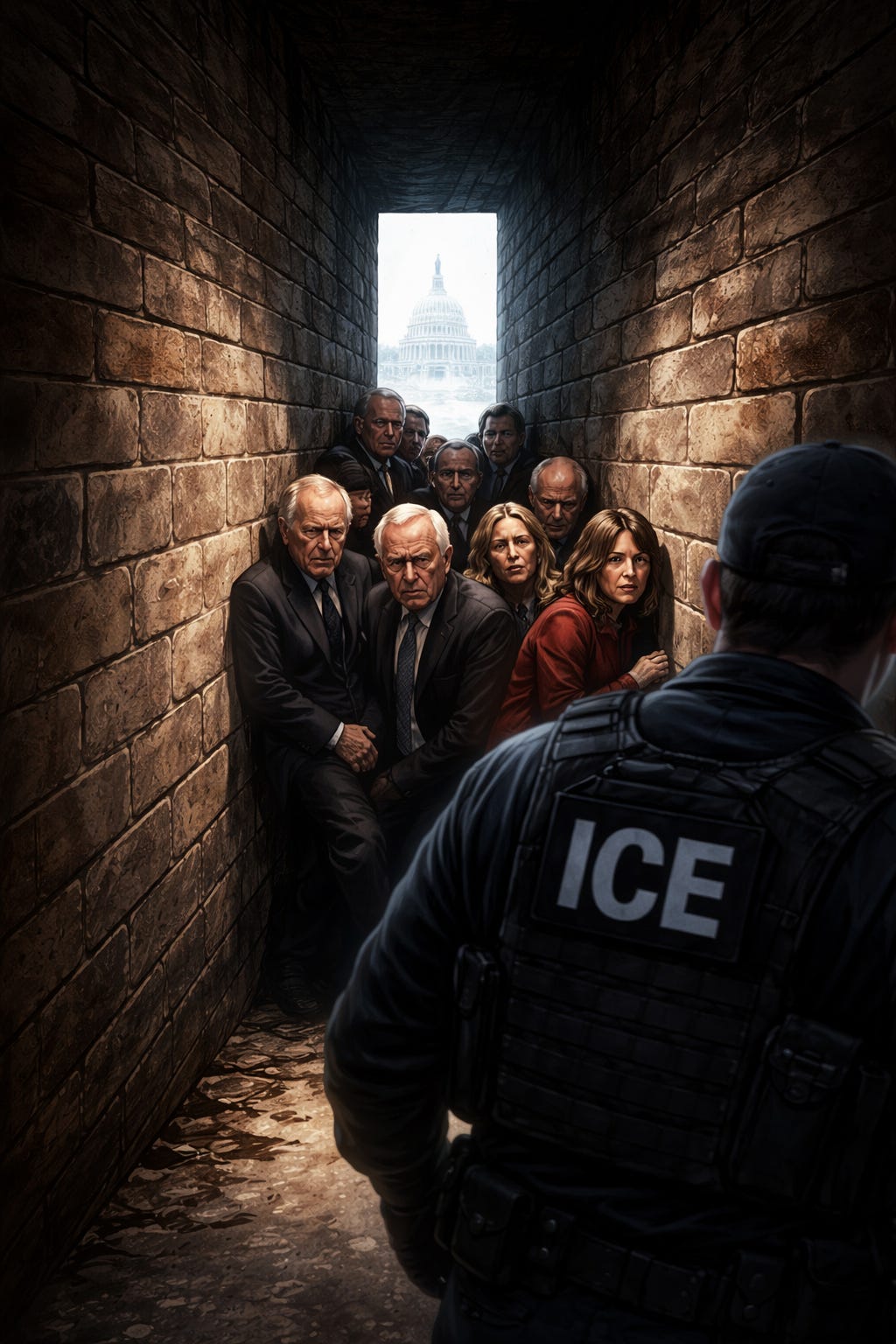
The reaction in Congress was swift. Senate Democratic Leader Chuck Schumer publicly declared that Democrats would not provide the votes to advance any spending package that included DHS funding as currently written, calling federal tactics “appalling” and demanding accountability and reform before further appropriations.
What had been a technical budget fight suddenly became a declaration of principle against ICE enforcement as currently practiced.
The House Vote That Made It Worse
Adding fuel to the fire was the fact that the House of Representatives had already approved the DHS funding measure, and some House Democrats played a decisive role in that outcome.
On January 22, 2026— two days before Preti’s death and weeks after Good’s— the House passed the DHS funding bill as part of a larger package, with a 220‑207 vote. While most Republicans supported the measure, seven Democrats joined them, providing the margin of victory.
Those seven were:
Marie Gluesenkamp Perez of Washington
Laura Gillen of New York
Don Davis of North Carolina
Jared Golden of Maine
Henry Cuellar of Texas
Tom Suozzi of New York
Vicente Gonzalez of Texas
In the days since, at least one — Rep. Tom Suozzi — has publicly expressed regret, saying he “failed” to recognize the broader implications of that vote in light of recent federal actions in Minneapolis.
From the standpoint of the broader Democratic electorate, this wasn’t just a procedural vote. It cemented a funding timeline that made it harder for the Senate to strip out DHS funding or attach serious oversight. It tied the party’s own legislative record directly to the agency under fire.
The Stakes in the Senate
Because the Senate operates under the filibuster, advancing any spending bill requires support from at least 60 senators. With Republicans holding a narrow majority and needing Democratic defectors to clear that threshold, conservatives and moderates alike have become pivotal.
After the Minneapolis shooting, a number of Senate Democrats, including Catherine Cortez Masto, Jacky Rosen, Mark Warner, and Patty Murray, signaled they would oppose the DHS funding portion absent significant reforms. Some who backed avoiding the previous shutdown last year under similar internal pressure have now shifted to opposition, citing the urgency of holding ICE and DHS accountable for their enforcement practices.
Every day that passes without a clear path forward increases the likelihood that the funding deadline will arrive with no agreement. While many federal operations will continue because federal law classifies them as “essential”, other programs beloved by voters, including education funding, housing assistance, and even some environmental operations, would be slowed or interrupted in a partial shutdown. Meanwhile, DHS enforcement functions would persist virtually unabated as essential, and with a prior sizable slush fund, further distorting the political narrative.
A Structural Accountability Problem, Not a Momentary Crisis
If this show of political tension seems disproportionate to what should be a routine appropriations vote, that’s because it is.
For nearly a decade, activists, local officials, and many constituents have raised alarms about immigration enforcement practices, from due process concerns and detention conditions to aggressive interior raids and deaths during enforcement operations. Many of those concerns trace back to well before the 2025 Minneapolis operation or the 2026 shootings. They have been part of the public discourse for years, across multiple administrations and budget cycles.
Yet, despite repeated protests, reporting, and legislative proposals for oversight, meaningful reform has consistently failed to materialize. In the absence of accountability mechanisms, enforcement agencies have continued to operate with broad authority and significant funding, often escalating rather than de-escalating conflicts in local communities.
The January 2026 showdown didn’t create these problems. It exposed the fault lines and made the consequences unavoidable in a moment when Congress was otherwise trying to “get its work done” before a deadline.
What This Means for Democracy
At heart, this moment underscores a fundamental tension in American governance.
A representative democracy relies on elected officials listening and responding to the defined will of the people. Yet when repeated public outcry does not translate into structural change, and when the routine mechanics of budgeting neutralize moral pressure, the system begins to look unresponsive, even unrepresentative.
A funding fight that should have been debated over a decade ago with true reform instead became a litmus test of whether elected leaders are willing to place accountability and human dignity above procedural convenience.
Whether the Senate ultimately passes the DHS‑inclusive minibus, blocks it and triggers a partial shutdown, or negotiates amendments that still fail to satisfy reform demands, the political consequences will be lasting. The optics of this clash — rooted in years of ignored warnings and accelerated by highly visible tragedy — will shape how voters see both the priorities and the responsiveness of their government.
In the end, this is not just a fiscal deadline. It is a referendum on whether a system built to protect powerful enforcement agencies can be reoriented toward the safety and rights of everyday citizens who have been demanding change for far too long.
Stay Informed. Stay Loud.
Subscribe to get sharp, unfiltered political analysis that cuts through the noise and holds power to account. We track the votes, the spin, and the stakes so you don’t have to.
Subscribe now, because silence isn’t an option.
Sources:
“Shutdown looms as ICE shootings spawn partisan fight over DHS funding in US Congress” — Reuters, January 26, 2026
“House passes DHS funding bill despite Democratic opposition over ICE” — The Washington Post, January 22, 2026
“‘Enough Is Enough’: Democrats Threaten Shutdown Over ICE Funding” — Time, January 25, 2026
“Senate seeks escape from Homeland Security standoff” — Roll Call, January 26, 2026
“Democrats vow to oppose homeland security funds after Minnesota shooting as shutdown risk grows” — Associated Press, January 25, 2026
“Senate Dems revolt against DHS funding bill amid Minneapolis chaos, hiking government shutdown risk” — AOL / syndicated, January 24, 2026
“Minneapolis shooting prompts bipartisan blowback” — The Washington Post, January 26, 2026
“Federal Health Workers Warn DHS Is Driving a ‘Growing Public Health Crisis’ After Alex Pretti Shooting” — Time, January 26, 2026
Never Again Action (Wikipedia)
Women Disobey (Wikipedia)
The Republicans hid the DHS part so they didn't look bad. I say vote no and start the fight. Killing US citizens and calling them terrorists means DHS is out of control and need no additional funds to kill more citizens.
I am so tired of the same old same old from both the house and senate.They promise change and nothing really changes.With every year that passes we citizens always get the short end of the stick.I say clean the whole damn house of all of them.