


In May 2025, the United States Postal Service named David P. Steiner as its next Postmaster General. Most Americans are unfamiliar with him. Fewer still questioned what it means when someone with no experience delivering mail and a long history serving corporate logistics giants is handed the keys to one of the country’s oldest public institutions.
Steiner is not a postal veteran. He is not a civil servant. He is not a product of the U.S. Postal Service. He’s a boardroom executive best known as the former CEO of Waste Management and, until this spring, the lead independent director of FedEx.
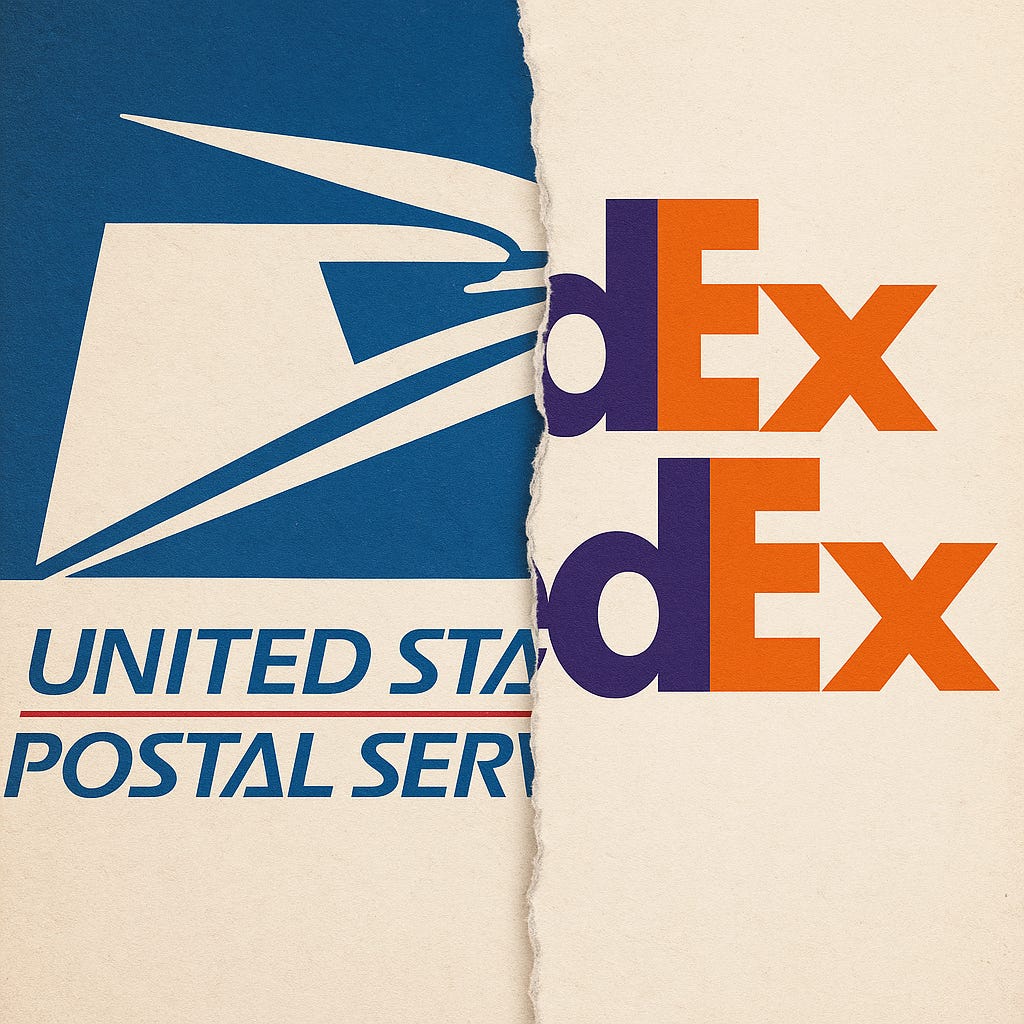
That final role should bring the conversation to a halt. FedEx is not just a logistics company; it is a direct competitor to the USPS, one that has long pushed for policy changes favoring outsourcing, subcontracting, and market-rate delivery models. In short, everything the Postal Service is not supposed to be.
Steiner says he will step down from the FedEx board before assuming his new post. On paper, that ends the formal conflict. But stepping away from a board seat doesn’t erase years of decision-making or the worldview it reflects. He may be leaving FedEx, but he is not leaving behind the logic of FedEx.
He’s not here to preserve the Postal Service. He’s here to remake it in the image of the boardrooms he came from.
We just hit 14,000 subscribers—thank you!
Get exclusive access for just $1/week or $52 a year.
Get exclusive analysis and fearless reporting you won’t find in corporate media.
The Broken Selection Process
If it seems strange that the head of the United States Postal Service is a former FedEx executive, it’s because it is. But what’s stranger still is that Steiner didn’t need Senate confirmation to get the job. No hearings. No public vetting. No opportunity for lawmakers or the public to question his priorities.
That’s because the Postmaster General is chosen not by elected officials, but by the USPS Board of Governors, a group of political appointees who themselves are nominated by the president and confirmed by the Senate. Once seated, the Board can select the Postmaster General entirely on its own authority.
No oversight. No floor debate. No questions like:
“Do you believe the Postal Service should be privatized?”
“Will you continue slowing rural mail delivery?”
“Do you hold stock in companies that compete with USPS?”
The answer to all of those questions might be “yes”, but we’ll never know, because the person now in charge of a 650,000-person workforce and the daily movement of 421 million mailpieces didn’t have to answer for any of it.
This isn't a bug in the system. It's the system. A public service, led by a corporate strategist, was approved behind closed doors by a board of insiders.
The person running your mail never had to deliver a letter or explain to a senator why he deserves the job.
It is no secret that we love the USPS. See our previous article here:
Note: This article is more than 45 days old and now lives in our archive. Consider becoming a paid subscriber for the full 600+ article archive, exclusive content, and occasional early access.

What He Inherits
David Steiner is stepping into a Postal Service already reshaped by years of slow-burning austerity. His predecessor, Louis DeJoy, spent his tenure implementing the “Delivering for America” plan, a 10-year blueprint for cost-cutting, route consolidation, and service delays dressed up as reform.
On paper, the plan promised to modernize USPS and save $36 billion. In practice, it has done something else: slowed mail delivery, shuttered rural branches, and rerouted first-class mail through centralized hubs that often delay, rather than streamline, service.
The changes are already in effect. In early 2025, the USPS began rolling out revised delivery standards, which include longer transit times for many rural ZIP codes. Internal memos reveal a clear pattern: dense urban areas receive faster sorting and shipment, while remote routes are deliberately deprioritized to “optimize transport efficiency.”
What that means in real life:
A ballot that used to take two days now takes five.
A prescription shipped on Monday arrives after the weekend.
A pension check misses its regular delivery window—again.
This isn’t just about delays. It’s about a philosophy shift. The Postal Service was founded on the principle that every address in America matters, regardless of its distance, remoteness, or cost to reach. That principle—equal service for all—is what has always set the USPS apart from FedEx, UPS, or Amazon. But under the new model, service is no longer measured by reach or reliability. It’s measured by volume, and if your community doesn’t have enough of it, your mail waits.
What Steiner inherits isn’t just a mail system under strain. It’s a public service already mid-pivot, moving away from equity and toward efficiency for efficiency’s sake.
The Real Conflict of Interest
Steiner’s defenders will point out that he resigned from the FedEx board before accepting his new role, technically ending any formal conflict of interest. However, that’s the narrowest possible definition of the word conflict.
Steiner isn’t just someone who happened to sit on FedEx’s board. He spent years helping guide one of USPS’s biggest competitors, shaping policies, steering strategy, and advancing a business model built on subcontracting, automation, and profitability.
Those instincts don’t vanish just because a resignation letter has been filed. They’re baked in.
He may no longer hold a formal title at FedEx, but he arrives at the Postal Service carrying the logic of FedEx: reduce labor, centralize control, outsource what you can, and treat delivery as a business equation, not a public obligation.
This is the deeper conflict, the one that doesn’t show up on a disclosure form. Not financial, but philosophical. Not illegal, but corrosive.
Resigning from the board doesn’t mean he stopped working for their benefit. It just means he’s doing it from a different seat.
The Sad Politics of a Public Service
The United States Postal Service was never intended to be a political entity. It was never supposed to turn a profit, either. Its mission was simple, yet radical in its simplicity: deliver mail to every address, six days a week, at the same price, regardless of where you live or who you are.
However, over the past two decades, this mission has been steadily undermined by Congress, corporate interests, and appointees who view public service as a problem to be “solved” through private-sector logic.
Today, the USPS is governed by a politically appointed Board of Governors, staffed by figures aligned with ideological goals rather than postal experience. From that board comes leadership like David Steiner, executives with résumés full of balance sheets, not mail routes.
At the same time, internal talent such as postal workers, regional managers, and plant supervisors is often overlooked for top leadership roles. Their crime? They understand what the USPS is actually for. They understand that service comes before efficiency, and that universal delivery isn't a luxury—it’s the point.
There are more than 650,000 people who keep the Postal Service moving, many of whom have spent decades learning its systems, routes, and rhythms. However, when the time comes to lead, they’re often ignored in favor of individuals whose only qualification is that they once optimized truck routes for shareholder returns.
We don’t ask the Army to be profitable. We don’t ask the fire department to deliver dividends. However, the Postal Service, one of the few institutions still binding the country together, is being run like it’s just another logistics startup, and that is a national shame.
The Stakes: Rural Communities, Democracy, and Public Trust
What’s happening at the Postal Service isn’t a policy tweak; it’s an institutional shift. And, like every shift in public power, the consequences fall hardest on those with the least leverage.
In rural communities, delays aren’t theoretical. They’re daily life. When a mail truck is rerouted through a central hub hundreds of miles away, it means prescriptions arrive late. Social Security checks miss their windows. Ballots don’t get counted. These are not efficiencies. They’re erasures.
This isn’t an accident; it’s a feature of the system as it undergoes reshaping. Strip the institution of its public-service mission. Push out the civil servants who understand it. Install loyalists and profit-minded managers who don’t ask why—just how fast, how cheap, how far they can cut.
That’s the quiet part of “drain the swamp”: it was never about rooting out corruption. It was about replacing institutional memory with ideological loyalty. Replace veterans of public service with corporate operatives and political allies, and suddenly the mission doesn’t matter, only obedience does.
And the cost? It’s trust. Trust that your mail will arrive on time. Trust that your vote will count. Trust that the federal government sees your life and your address as worth serving.
The mail still arrives for now. But with every delayed route, every shuttered post office, and every executive who views the USPS as a business problem rather than a public promise, we edge closer to losing something foundational. Not just a service, but a symbol of what it means to live in a country that doesn’t forget its people, no matter how far, how rural, or how unprofitable they might be.
What You Can Do
Call your elected officials today
Ask them to oppose further USPS privatization, demand oversight of rural delivery slowdowns, and ensure that leadership at the Postal Service reflects public—not corporate—interests.
Call the Capitol Switchboard: (202) 224-3121
You’ll be connected to your representative or senator’s office.Sample script:
“Hi, my name is [Your Name], and I’m a constituent in [Your City/State]. I’m calling to ask [Senator/Representative] to demand public oversight of the USPS. I’m deeply concerned about the slowdown in rural mail service and the appointment of a former FedEx executive to lead the Postal Service. We need leadership that prioritizes public service over private profits. Please do everything you can to preserve USPS as a universal, reliable, and accountable institution.”
Support grassroots organizers & watchdogs.
American Postal Workers Union (APWU) – apwu.org
Save the Post Office – savethepostoffice.com
Center for Public Integrity – publicintegrity.org
Common Cause – commoncause.org
These groups are doing the work, fighting to protect democracy, labor, and access to essential services. Follow them, donate if you can, and help spread their research.
We just hit 14,000 subscribers—thank you!
Get exclusive access for just $1/week or $52 a year.
Get exclusive analysis and fearless reporting you won’t find in corporate media.
Bibliography:
“FedEx Board Member David Steiner Selected as Next USPS Postmaster General.” CBS News, May 2025.
Cowboy State Daily. “Postal Regulatory Commission Says Rural Populations Will Suffer Under ‘Delivering For America’ Plan.” February 10, 2025.
United States Postal Service. Service Standard Changes – Fact Sheet. April 2025.
United States Postal Service, Board of Governors. “Postal Service Board of Governors Appoints David Steiner to Be 76th Postmaster General and CEO of the United States Postal Service.” May 9, 2025.
Planetizen. “Delivering for America Plan Will Downgrade Mail Service in at Least 49.5 Percent of Zip Codes.” February 12, 2025. https://www.planetizen.com/news/2025/02/134282-delivering-america-plan-will-downgrade-mail-service-least-495-percent-zip-codes washingtonpost.com+7planetizen.com+7cowboystatedaily.com+7.
National Association of Letter Carriers (NALC). “NALC Statement on the Reported Selection of David P. Steiner to Lead USPS.” May 6, 2025.
DC Velocity. Ben Ames. “USPS Governors Name David Steiner as Next Postmaster General.” May 9, 2025.
AP News. “FedEx Board Member Steiner Is Picked to Be Next USPS Postmaster General amid Talk of Privatization.” May 9, 2025.

As a former FedEx management employee who couldn't take anymore of that company's corruption, here are some facts to know:
1. In 2008, FedEx SmartPost lost the Apple contract because of unbelievable employee theft that one hub manager didn't care about. One employee bragged that he had all five colors. If a box of almost any merchandise broke open, the hub manager told employees to dump it in the trash because the customer would simply reorder the materials.
2. When you see a FedEx truck and a driver in a uniform, you are not seeing a FedEx employee in a FedEx owned vehicle. From the beginning of its existence, FedEx made those drivers independent contractors who have to obtain their own trucks and maintain them.Its a great business model because as independent contractors FedEx doesn't need to pay taxes or social security or health insurance for them. The IRS has tried for many decades to correct this charade but FedEx is too big and powerful. UPS has to compete being a union shop. UPS has a stellar record regarding theft of packages. They actually award $5,000 for reporting a theft incident. Given a choice of shippers, I always choose UPS. Any price differential doesn't matter to me.
This is sad - but not surprising. We are witnessing the consolidation of power by the oligarchy.