


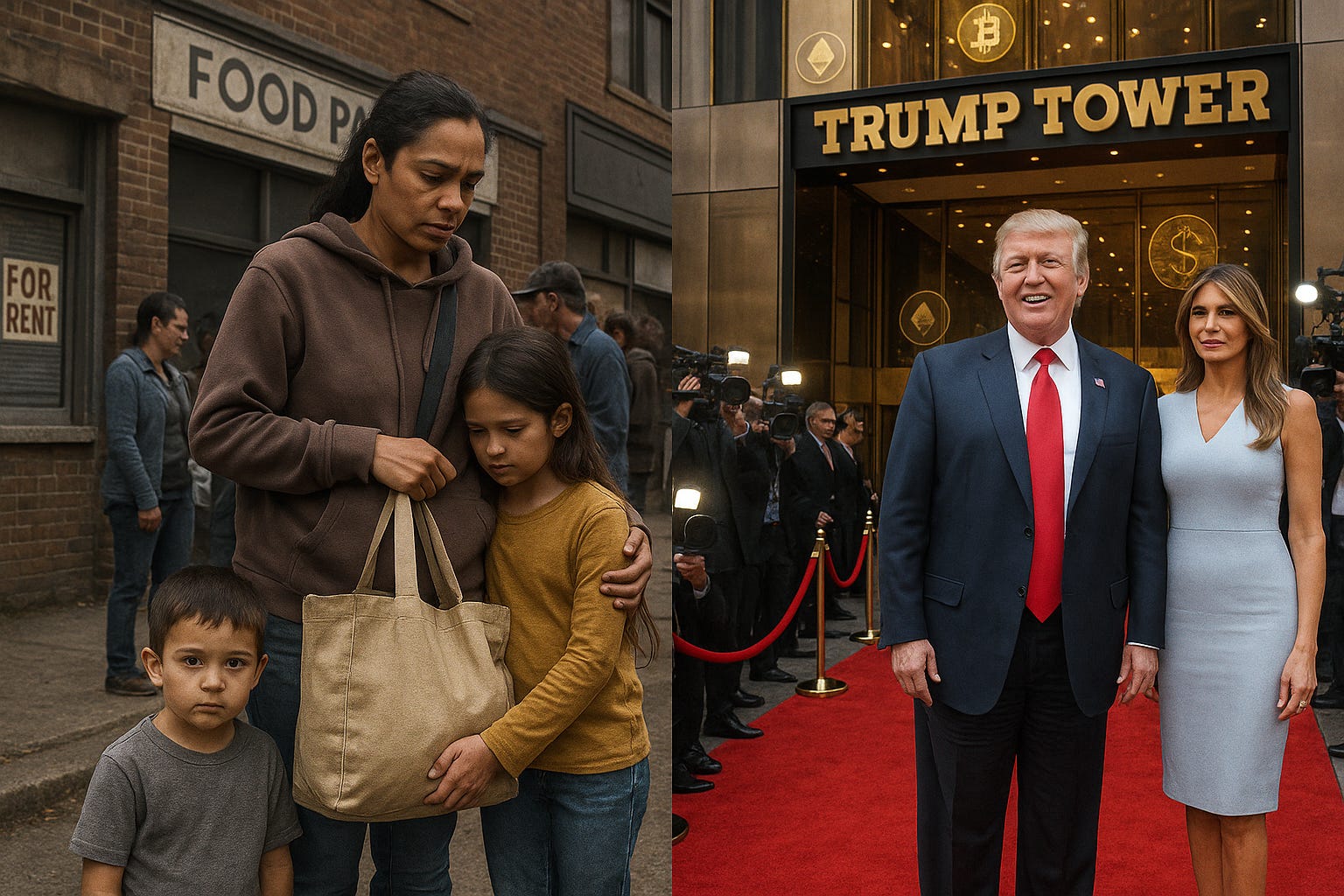
It is spring, 2026. In Houston’s Fifth Ward, Janice, a 42-year-old single mother of two, waits in line at a food pantry she’s never needed before. Her SNAP benefits were slashed last month under Trump’s new budget. Her federal contractor job cut her wages by 40%. Her daycare subsidy evaporated in a wave of “efficiency reforms.” She now works two jobs, neither of which provides health insurance.
Janice isn’t an outlier. She’s a warning.
Her story mirrors what will happen to millions of working Americans across the country, squeezed not by misfortune, but by design, if the budget bill passes the Senate and is signed as it currently exists.
Across the country, families struggling to make ends meet on hourly wages are watching the ground beneath them give way. Food assistance slashed, health care gutted, and rent rising while wages stagnate. What once passed for a fraying safety net is now being cut loose entirely.
This isn’t mismanagement. It’s targeted abandonment.
This article traces the fallout from Trump’s second term—not in press releases, but in kitchens, clinics, and courtrooms. We’ll show who’s hurting, who’s profiting—and why the working class was always the intended sacrifice.
We just hit 14,000 subscribers—thank you!
Get exclusive access for just $1/week or $52 a year.
Get exclusive analysis and fearless reporting you won’t find in corporate media.
Wages Down, Costs Up: The Wage Rollback Agenda
While Trump’s billionaire allies mint meme coins and media deals, the workers who clean federal buildings and deliver government mail have seen their paychecks slashed by up to 60%. One of the administration’s first executive actions rescinded Obama-era minimum wage protections for federal contractors. Nearly 400,000 workers, many of them women and people of color, now earn less doing the same jobs.
And it doesn’t stop there.
Despite soaring prices on rent, groceries, and gas, the federal minimum wage remains stuck at $7.25, unchanged since 2009. The administration has flatly opposed any increase, claiming it would “hurt business.” For workers living paycheck to paycheck, it’s not a policy stance; it’s a sentence.
Meanwhile, the Trump-aligned Department of Labor is targeting worker classification laws, pushing changes that would allow companies to define workers as “independent contractors” more easily. On paper, that sounds like flexibility. In practice, it means no health insurance, no overtime, no unemployment insurance, and no right to unionize.
For millions of gig workers—rideshare drivers, delivery app couriers, freelance content creators—this means longer hours and unpredictable income with no safety net. A recent Human Rights Watch report warned of a growing “gig trap,” where workers are at the mercy of algorithmic pay cuts and app suspensions with no legal recourse.
This isn’t innovation. It’s exploitation repackaged as entrepreneurship. The Trump administration’s deregulation spree is creating a two-tier workforce: protected jobs for the well-connected, and app-driven precarity for everyone else.
And while wages fall and job security erodes, the support systems that once helped families bridge hard times are being systematically dismantled.
See our reporting on the OBBB here:


The War on Public Services
The American safety net was never luxurious, but for decades, it was the difference between struggle and catastrophe for millions. That fragile lifeline is now being cut with surgical precision.
In just three months, the Trump administration has gutted the foundational programs that working families rely on to survive. Over $300 billion in SNAP cuts could leave hundreds of thousands without food support. In North Texas, food banks are seeing record demand.
Housing is no safer. A proposed $32.9 billion cut to HUD would gut Section 8, leaving vulnerable families defenseless in a tightening rental market. In Dallas, eviction filings have surged, with a 21% serial filing rate, landlords repeatedly using the courts to terrorize tenants into leaving. For many, one missed paycheck means the street.
In rural America, Medicaid cuts topping $700 billion are putting hospitals on life support. Seventy-eight rural Texas hospitals face closure. Without them, workers have nowhere to go for emergencies, prenatal care, or even insulin.
Public transportation, a daily necessity for millions without cars, is buckling. Bus and rail systems are preparing to reduce service by up to 25%. If the bus doesn’t run, how do you keep your job?
Community anchors are disappearing too. Over 32,000 AmeriCorps roles—encompassing services such as food delivery, mental health outreach, and after-school care—have been eliminated. These aren’t bureaucrats. These are neighbors holding communities together.
Meanwhile, a $750 million slash to Head Start threatens to lock 80,000 kids out of early education. In Texas alone, 95,000 children are on waitlists for subsidized daycare. And with Pell Grant cuts looming, low-income college students may have to choose between tuition and survival.
These aren’t fiscal adjustments. They are deliberate severances of the American promise. Public support is being withdrawn like a utility, available only to those who can afford it.
This isn’t austerity. It’s abandonment. A government once expected to soften life’s blows is now delivering them. And for the working poor, the message couldn’t be clearer: if you can’t buy security, you don’t deserve any.
Who Wins? Follow the Money Up
While Janice waits in line at a food pantry and Marisol drives twelve-hour days just to break even, the Trump family is having the most lucrative hundred days of their public life.
Donald Trump’s second term hasn’t been a return to governance. It’s been a business expansion. Backed by a web of cryptocurrency ventures, media contracts, and foreign capital, the Trump empire has seen its value balloon. A new decentralized finance company, World Liberty Financial, reportedly secured $2 billion from an Abu Dhabi sovereign wealth fund, helping to launch meme coins like $TRUMP and $MELANIA into right-wing investor frenzies.
While working families lose Medicaid, Melania signed a $40 million Amazon deal. While food aid is gutted, Trump’s real estate portfolio expands in Asia and the Gulf. The conflict of interest isn’t subtle; it’s a business model.
And then there’s the “One Big Beautiful Bill,” passed by the House with pageantry and promises. Touted as relief for the working class, the bill scraps federal taxes on tips and expanded child tax credits, then quietly slashes the programs those same workers rely on to survive. Households earning over $200,000 gain $13,200. Those earning under $10,000? They lose up to $2,700, primarily through cuts to Medicaid and SNAP.
This is class warfare in a tailored suit.
The Trump administration isn’t just failing the working poor. It’s robbing them in broad daylight. The presidency is once again being used as a launchpad for private enrichment, while the government that once provided a hand up now offers a boot down.
But the consequences aren’t just economic. They strike at the foundations of American law.
These aren’t just ethical failures. They may be constitutional violations. The Foreign Emoluments Clause of the U.S. Constitution bars presidents from accepting money or gifts from foreign states without congressional approval. Yet Trump’s family businesses appear to be thriving on foreign-backed crypto investments and international real estate deals, many with opaque financial trails. This isn’t a technicality. It’s a warning sign of a collapsing boundary between state power and personal profit.
“America First” was the slogan, but billionaires, lobbyists, and oil-rich Gulf states are the only ones cashing in. And the working poor? They’ve been told to tighten their belts and thank the president for a tax-free tip.
Everyday Life in the Fallout Zone
In policy memos and press conferences, the Trump administration talks about “efficiency,” “liberty,” and “free enterprise.” But on the ground, in places like rural Missouri, South Dallas, or West Virginia coal towns, the rhetoric crumbles fast.
For millions of working-class Americans, the first 100 days haven’t been a political chapter. They’ve been a crisis.
In North Texas, families are lining up hours early outside food pantries, not because they’re unemployed, but because their wages can’t keep up. Bryan Downer, president and CEO of the Community Enrichment Center in North Richland Hills, noted, "We’re probably seeing about 10% brand-new people every day right now." He continues: “If three years ago, if we saw 80 people in a day, that was an extremely busy day for us. Now, we’re close to 200 people a day.”
In Dallas, eviction courts are backed up for weeks. Serial filings against tenants, predominantly Black and Latino families, are on the rise. With Section 8 gutted, many are living day to day, knowing that one missed paycheck could mean homelessness.
In rural towns, hospital closures are no longer a hypothetical. Clinics that once provided care to entire counties are shuttering because Medicaid reimbursements have dried up. For people working two jobs without insurance, an injury now means debt or death.
Childcare costs have exploded, with over 95,000 Texas kids on daycare assistance waitlists. That leaves parents making impossible choices: leave their children unattended, quit their job, or go into debt. And if they somehow make it through the week, college is slipping further out of reach. Pell Grant cuts mean students have to work longer hours or drop out altogether.
The Fallout by the Numbers:
– North Texas food pantries report a 30% increase in demand since February.
– Dallas eviction filings increased by 8%, with 21% being repeat filings.
– 78 rural hospitals in Texas are at risk of closure due to proposed Medicaid cuts.
– Nearly 80,000 Head Start seats could disappear under federal budget proposals.
– Low-income students face a $1,500 Pell Grant cut, threatening college access nationwide if the budget is passed.
This is what “freedom” looks like under Trump’s second term: the freedom to starve, to sleep in your car, to bury loved ones because you couldn’t afford a doctor. This is not a shared sacrifice. It’s strategic abandonment.
And it’s happening in every ZIP code where political speeches never go.
This Is Policy by Design, Not Accident
There’s a tendency in American politics to excuse cruelty as incompetence, to frame policy disasters as the result of poor planning or partisan gridlock. But what we’re witnessing in Trump’s second term is not a fluke. It’s not dysfunction. It’s design.
The systematic unraveling of public services, from housing aid to health care, from wage protections to Pell Grants, isn’t happening behind closed doors. It’s happening in press conferences, in budgets, in executive orders. It’s laid out in black and white. And it’s all being justified with the same tired lines: “cut waste,” “restore freedom,” “shrink government.”
But the government isn’t shrinking for everyone.
It’s only shrinking where the working class used to find relief. It’s shrinking in poor neighborhoods, in rural counties, in child care centers, emergency rooms, and food banks. Meanwhile, government power is expanding wherever wealth accumulates: in tax loopholes, deregulated financial platforms, and private influence over public policy.
We’ve seen this pattern before. Reagan promised to get government “off our backs” while gutting social programs and unleashing corporate monopolies. George W. Bush pushed massive tax cuts for the rich while wages stagnated and inequality soared. Trump isn’t breaking from that tradition; he’s accelerating it, using populist branding to sell policies that protect the powerful and punish the poor.
And he’s not hiding it. “I’m not going to subsidize failure anymore,” Trump said in March, defending cuts to Medicaid and housing. But what he calls “failure” is often a single mother’s second job, a child’s pre-K classroom, or a rural hospital’s last gasp of funding.
This is a deliberate redistribution, not of wealth, but of risk. Under this administration, the risks of illness, eviction, debt, and instability are being offloaded entirely onto the shoulders of the working class.
These policies aren’t just failures of compassion. They are the product of an ideology that views poverty not as a problem to be solved, but as a condition to be exploited.
Call to Action: This Is Our Fight Too
This is not just a policy crisis. It’s a moral one. And it won’t be fixed by waiting for someone else to act.
Here’s what you can do right now, because silence is complicity, and inaction is surrender.
The working poor didn’t create this broken system, but they’ve been forced to carry its weight. The good news? They’re not alone. Millions of Americans are waking up to the fact that this isn’t sustainable and it’s not inevitable.
The first step is clarity. The next is pressure.
Call your representatives. Demand oversight, hearings, and immediate resistance to these cuts. Demand restoration of SNAP, Medicaid, housing aid, child care funding, and wage protections. Don’t let them call this "freedom" when it's really abandonment.
Call the U.S. Capitol Switchboard
Phone: (202) 224-3121
Sample Script:
“Hello, I’m calling to demand that my representative oppose the Trump administration’s attacks on working families. Cuts to Medicaid, housing, food aid, and wages are hurting real people in my district. We need urgent action to stop these policies and reinvest in the people who make this country work. Say no the OBBB.”
Speak out. Share the stories in this piece. Support local organizations that are feeding families, fighting evictions, and keeping clinics open. Volunteer. Organize. Vote.
The war on the working class won’t end with a speech or a headline. But it can end with us.
Because if we don’t fight for the people being left behind, no one else will.
We just hit 14,000 subscribers—thank you!
Get exclusive access for just $1/week or $52 a year.
Get exclusive analysis and fearless reporting you won’t find in corporate media.
Bibliography:
Economic Times. “Thousands Could Lose SNAP Benefits Under Big Beautiful Bill.” May 2025.
Houston Chronicle. “Fifth Ward may be the hardest-hit neighborhood in all of Texas by SNAP cuts.” May 2025.
Human Rights Watch. “The Gig Trap: Algorithmic Wage and Labor Exploitation in Platform Work.” May 2025.
Investopedia. “Medicaid Cuts Could Lead to Hospital Closures.” May 2025.
Stateline. “Deep cuts to bus and rail services loom across big cities, small towns.” May 2025.
The Guardian. “Trump’s safety research cuts heighten workplace risks, federal workers warn.” May 2025.
Washington Post. “What Trump’s Budget Reveals the Real MAGA Agenda.” May 2025.
KERA News. “Amid federal funding cuts, North Texas food pantries see rising demand — and budget gaps.” April 2025.
Your suggestion to all of us to address this utter catastrophe is for us to call our representatives?! It's an excellent article, General Azmundus, but your suggestions on how We, The People should respond to this are as ineffective as the Democratic party! Holy Shit! Too few are listening on Capital Hill! Not only are they not listening, most of the asswipes in our government are co-conspirators in the robbery. So many of you in the alternative press and in the comments keep saying, "I can't believe the Democratic party isn't fighting this." It's not that fucking hard, people! They're not fighting because they don't want to fight. Some, I'd bet the vast majority, are in tRump's pocket and are directly profiting from Project 2025. They have zero financial (ideological?) incentive to act on behalf of the people who put them in office. This includes all of the Repuglicans, the Supreme Court, our intelligence community, the Pentagon. ... And you want us to write, email, or call them!? ... AND, And, and! I don't see or hear anyone even mentioning the fact that most of the people in Congress are millionaires themselves. This is an important point. They don't give a shit about The People! Why should they? Because it's the ethical and humane thing to do? "It is easier for a camel to go through the eye of a needle than for a rich man to inherit the kingdom of heaven." According to The Apocalypse of Baruch, which graphically wrote about the Romans sacking the temple in Jerusalem in the year 60 CE, the rich Jews betrayed the poor Jews to the Romans. BUT, But, but, the Roman blockade of Jerusalem encircled the rich along with everyone else. The goal was, of course, to kill by starvation and murder any and all rebellion against the empire. To keep from starving and to hide their wealth, the rich Jews literally swallowed their gold and jewels. When the Romans figured out what they were doing, they sliced them open like we would a fish and then threw their bodies on the mounds with the dead bodies of the poor that they had betrayed.
I would not put it past the current administration to attempt to privatize both air and water. All part of a plan to make the American population too desperate and dependent to fight back.
I agree that we need to keep pressuring our representatives. It’s frustratingly slow but right now it’s the only Peaceful means with which to fight.
And then we have to show up and vote all of the Stepford wives/GOP out where we can. Again, slow and horrible for anyone in the hands of ICE agents or losing Quality of life and/or life-saving services. directly.