


Something extraordinary leaked around December 19th and 20th, 2025. A proposal known as Project Sunrise has begun circulating in diplomatic and investment circles. It is a blueprint to transform the war‑torn Gaza Strip into a futuristic, high‑tech, luxury destination over the course of a decade or more. The roughly 32 pages of slides reportedly envision beachfront resorts, AI‑optimized power grids, luxury hotels, high‑speed rail, and smart city infrastructure across the narrow Mediterranean enclave that has been the pivot point of conflict for centuries. The price tag floated for the first ten years of redevelopment is a staggering $112 billion. The United States would anchor the program with about $60 billion in grants and financial guarantees, and the pitch is being brought to wealthy Gulf states, Egypt, and Turkey as potential investors. Project Sunrise imagines Gaza rising from rubble as a coastal metropolis and “smart city” for global capital. But asking who this future is designed for reveals most of what matters.
What is remarkable about this moment is not that such a plan has been proposed at all. What is remarkable is when it was proposed, by whom, and on what assumptions it rests. Despite a ceasefire in October, the Gaza Strip remains under devastating bombardment. Civilians are killed nightly as Israel prosecutes its war against Hamas. Millions were displaced. Scenes of destruction and suffering fill global news feeds. In that context, an idea that had once been a bizarre rhetorical flourish by a U.S. president quickly became an actual proposal with real diplomats and investors pondering its feasibility.
And the American press? A $112 billion proposal to gentrify Gaza is being floated behind closed doors, and most of the Western media is missing in action, maybe because it’s still unofficial, perhaps because it’s too absurd, or maybe because it says the quiet part out loud about how capital imagines the future without the people who live there.
The story of Project Sunrise is the story of how war and capital collide in the modern age, how colonial imagination never dies, and how money reshapes ideals when power brokers decide the shape of the world.
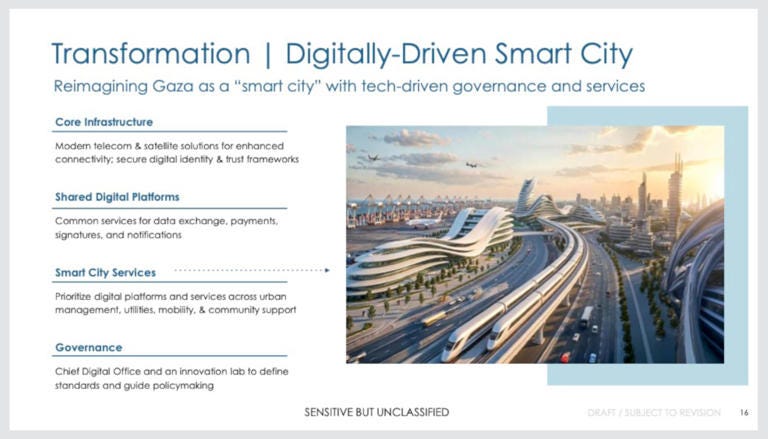
Source: Wall Street Journal
Want to Know Your Rights?
Download a free digital copy of the U.S. Constitution, the same document Trump is trying to bulldoze. Learn exactly what he’s breaking, and how to fight back.
80,000+ strong — and counting.
This holiday, become a paid subscriber for just $1 a week and help us keep the truth alive.
Join The Coffman Chronicle — $1/Week
From Riviera Rhetoric to a Real Plan
The roots of this vision go back to early February 2025. On February 4, 2025, President Donald Trump stood at a joint press conference in the White House alongside Israeli Prime Minister Benjamin Netanyahu. That was just weeks into a temporary ceasefire in the then‑ongoing Gaza war. Trump declared that the United States intended to “take over” and “own” the Gaza Strip. He described a plan to level vast swaths of the territory, clear rubble and unexploded ordnance, and then rebuild it with housing and jobs. In his telling, this was a path to stability and prosperity. However, buried in the language was something far more audacious. Trump suggested that Palestinians might be relocated and that Gaza could become something he later called the “Riviera of the Middle East.” His words reverberated across diplomatic capitals. Arab states rejected the idea outright. Palestinian leaders called it an affront to sovereignty and identity. International commentators decried it as unethical. At the time, Trump walked back some of the more extreme elements after backlash, saying he would “recommend” rather than enforce relocation, but the original statement had been made.
Just a few weeks after that press conference, on February 25 and 26, 2025, Trump posted an AI‑generated video on social media showing a vision of Gaza transformed into a luxurious resort. The clip featured war‑torn landscapes morphing into palm‑lined beaches and gleaming buildings, set to promotional music. In scenes that drew ridicule and outrage, the video included surreal imagery such as a rendered Trump lounging poolside with an AI version of Israel’s prime minister and appearances by figures like Elon Musk. That video was widely shared on Truth Social and other platforms. Its creators later said it was intended as satire, but Trump’s decision to post it without context signaled either a strange embrace of its vision or at least a willingness to let the imagery stand. Palestinians and Arab governments denounced the clip as offensive and tone‑deaf, given the ongoing violence. The video fed perceptions that the president was treating the future of a living, breathing population like a brand opportunity.

Screenshots from the AI video. Source: Newsweek
At the time, critics were baffled. They saw a grotesque mismatch between the rhetoric of luxury resorts and the grim reality on the ground. Few thought it would move beyond satire or absurdity. Few believed it would affect real policy. And yet, here we are, months later, with a Project Sunrise pitch being circulated by U.S. government officials, led by individuals closely tied to the president, complete with investor outreach and developer language.
Jared Kushner and the Business of War
At the center of this shift from fanciful rhetoric to a concrete proposal is Jared Kushner. Kushner, former senior advisor to Donald Trump in the first administration and his son‑in‑law, has occupied a unique role in U.S. foreign policy and finance over the better part of the last decade. After Trump’s first term, Kushner founded the investment firm Affinity Partners. The firm received a $2 billion investment from the Saudi Arabian sovereign wealth fund, known as the Public Investment Fund (PIF), shortly after Kushner left the White House. That deal raised ethical questions and concerns about conflict of interest, because Kushner had been a key diplomatic figure with extensive interactions with Gulf leaders. The Saudi investment became the backbone of his firm’s capital and helped elevate his profile in international finance.
Affinity Partners’ focus has been on large technology and cross‑regional infrastructure investments, with strong ties to Gulf capital. Part of Kushner’s pitch with Affinity has been to build an “investment corridor” between Saudi interests and other markets, including Israel’s burgeoning tech sector. Through these years, Kushner’s business and political roles often overlapped, drawing scrutiny from ethics experts, lawmakers, and international observers.
This background matters because abstract international organizations are not floating Project Sunrise. It is being crafted by Kushner, a private investor with deep connections to Gulf capital, and Steve Witkoff, a U.S. special envoy and longtime developer. The pitch deck reportedly being shown to potential donor countries is full of the language of investment and return, of asset optimization and tourist revenues. There is talk of monetizing up to 70 percent of Gaza’s coastline, of turning the economy into something attractive to global capital. What is notably absent from many of these slides is a clear accounting of the nearly 2 million displaced Palestinians, where they fit into this vision, and how their lived experience is supposed to intersect with a glittering future built on their shattered homeland.
The Irony of Investor Outreach
There is a cold irony in the fact that some of the same governments and investors who rejected Trump’s early rhetoric are now being courted as partners in the redevelopment vision. In early 2025, Saudi Arabia and other Arab states publicly rejected Trump’s comments about Gaza being “better than Monaco” or a U.S.‑owned asset. Riyadh’s foreign ministry stated its rejection of any attempt to displace Palestinians from their land. Regional powers regarded the rhetoric as destabilizing and contrary to the principle of Palestinian self‑determination. Yet Project Sunrise proponents are now presenting this lavish vision to those very governments as an investment opportunity.
This evolution from outrage to investor pitch illustrates a fundamental feature of how political and economic elites operate. Money has a way of reshaping conflict narratives. Where once ideals about statehood, rights, and sovereignty dominated diplomatic discourse, the possibility of financing “economic growth” provides an opening for even skeptical actors to keep one foot in the room. Accepting an invitation to view a PowerPoint deck on luxury development is not the same as endorsing it, but the very act of presenting the vision to sovereign wealth funds and finance ministers suggests that commercial potential has entered the conversation about the future of Gaza before the violence has even ended.
What This Says About Power and Imagination
The tragedy is not only that such a plan could be conceived while the Gaza Strip is still reeling from war. The tragedy is that the plan frames Gaza not as the homeland of a people, but as a projectable urban canvas for profit and branding. Gaza’s residents are rarely centered in these discussions beyond the vague notion that economic “opportunity” will somehow arise from their displacement. The project’s very language — smart city, luxury destination, tech metropolis — reflects a worldview that sees land and infrastructure first through the lens of market logic.
This is not reconstruction in the traditional sense. Reconstruction implies rebuilding what was, restoring what was lost, and returning agency to the people affected by catastrophe. What is being pitched under Project Sunrise is a transformation that presupposes a political and social reset. It presupposes the displacement or marginalization of the existing population in favor of capital inflows and global mobility. Further, it ignores that the bombs and bullets have not gone quiet.
Seeing Gaza discussed this way reveals how colonialism did not end in the twentieth century. It evolved. It now hides behind the language of “smart cities” and “economic transformation” rather than explicit imperialism. What was once a state conquest often wore military uniforms. Now it wears suits and slideshows.
The Price of “Better Than Monaco”
The arc from Trump’s Riviera rhetoric in February 2025 to Project Sunrise in December 2025 exposes how easily fantasy can become policy when powerful backers and entrenched capital interests are involved. An AI video that once seemed like absurd satire became in less than a year a template for policy pitches. Saudi investment that once bought access for Kushner’s firm now underpins discussions about who might bankroll Gaza’s future. Hard ideals about sovereignty, rights, and justice are being shadowed by investment calculus.
It is worth asking not only what will be built in Gaza, but for whom it will be built. Whose voices are being heard in these rooms? Whose futures are being shaped by these slides? And who gets to say yes or no?
In the end, Project Sunrise reveals something deeply uncomfortable about how international power operates. Dreams of prosperity can mask plans for dispossession. Visions of innovation can overwrite histories of violence. And the markets that fund these visions can become arbiters of political reality. Gaza may someday rise again, but whether that rise is for Gazans themselves or for global capital remains an open question.
Don’t let the bastards sneak anything past you. Subscribe and get your daily dose of rage and receipts delivered fresh, before the spin doctors can scrub it.
Sources:
U.S. Said to Pitch Project Sunrise — $112B Plan to Rebuild Gaza as Luxury Destination The Times of Israel (Dec. 20, 2025)
Exclusive | U.S. Pitches ‘Project Sunrise’ Plan to Turn Gaza Into High‑Tech Metropolis Wall Street Journal (Dec. 19, 2025)
Project Sunrise: $112 Billion Plan to Rebuild Gaza With Rafah, Luxury Resorts, and Smart City Ambitions. NewsX (Dec. 21, 2025)
‘This is Fake News’: Trump admin rejects reports claiming US will pay $60 billion for Gaza reconstruction. mint (Dec. 21, 2025)
US pitches ‘Project Sunrise’ to rebuild Gaza as high‑tech, luxury coastal hub News of Bahrain (Dec. 20, 2025)
Trump’s Son‑in‑Law Pitches $112B Tech Utopia on Gaza Rubble. The Daily Beast (Dec. 20, 2025)
US pitches Plan to Rebuild Gaza as High‑Tech Metropolis. thecradle.co (Dec. 20, 2025)
Understanding ‘Project Sunrise’ as Donald Trump Pitches Again to Turn Gaza into a Luxury Destination. The Week (Dec. 20, 2025)
Trump’s Gaza ‘Riviera’ Echoes Kushner Waterfront Property Dreams Reuters (Feb. 5, 2025)
2025 Donald Trump Gaza Strip Takeover Proposal Wikipedia
Affinity Partners Wikipedia
Trump Shares AI‑Generated Video of Gaza Vision YouTube
Donald Trump Shares AI Gaza Video Depicting Hotel Built on Strip Newsweek via MSN
Seems the genocide continues to benefit the opulence of the rich and powerful. Disgustingly cold and criminal.
They already stated their intent. To give current residents an one way ticket to somewhere else. They are treating Gaza like an urban renewal project in the USA. Step 1. Relocate current residents what ever it takes to make it happen. We have already seen how slum lords operate in this situation. Step 2. Take over the real estate to do whatver. Step 3. Make it Techo Bros and Oil Sheik Fiefdom and dream big. If this a genocide then it has been done numerous times in the USA already without all the bombs and guns. For Israel, one less neighbor who is a security threat since Hamas isn't going away. This is what you get when peace isn't an option and nobody who has any agency cares-- you get ugly, awful and perverse.