


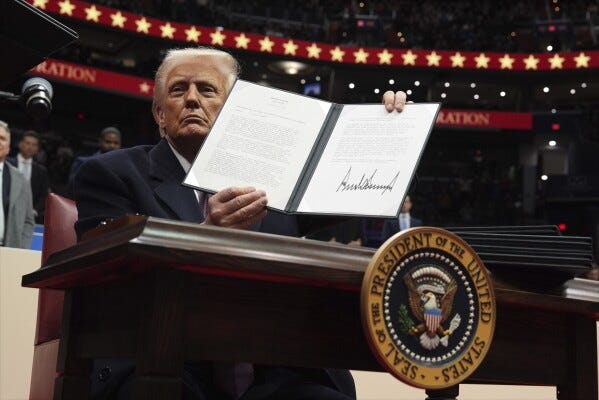
President Donald Trump kicked off his second term with a slew of executive orders, unveiling an ambitious agenda targeting immigration, energy, social policies, and federal governance. While these actions are framed as fulfilling campaign promises, they raise questions about who benefits most: everyday Americans or powerful corporations and donors. Although the full text of these orders is slowly being made public, early reports offer insight into their intent, scope, and the divisions they are already sparking. Below is a snapshot of what some key orders do, who benefits, and what challenges these orders face. Stay tuned to the Coffman Chronicles for more analysis as the details are released.
Signed Executive Orders: Helping Americans or Corporations?
"Initial Rescissions of Harmful Executive Orders and Actions"
This order revokes several policies from the Biden administration, including rules for artificial intelligence oversight and expanded abortion protections. Trump argues these were overregulations that stifled progress.Impact: For most people, these changes may go unnoticed. Critics say deregulating AI could hurt long-term safety, and reversing abortion protections could restrict access to healthcare for women.
Beneficiaries: Looser regulations primarily benefit corporations, such as Trump’s tech company cronies, rather than individual Americans.
"Restoring Freedom of Speech and Ending Federal Censorship"
Prohibits federal agencies from promoting or engaging in censorship, particularly on social media.Impact: Regular people may see little direct change since private platforms control content moderation and are not bound by this order. The vague language could create conflicts over what constitutes censorship.
Beneficiaries: Some media and tech companies may benefit, but the order’s ambiguity suggests it serves more as a political gesture than a tangible aid to citizens.
"Ending the Weaponization of the Federal Government"
Directs government agencies to remain neutral and avoid targeting individuals or groups based on politics.Impact: Enforcing neutrality could stall legitimate investigations into wrongdoing, raising questions about who this really protects.
Beneficiaries: This may be more symbolic, appealing to donors or groups worried about government overreach, with little direct benefit to most Americans.
"Putting America First in International Environmental Agreements"
Withdraws the U.S. from the Paris Climate Agreement, halting international climate contributions.Impact: Supporters see this as saving taxpayer money, but critics warn it slows the growth of renewable energy jobs and harms global climate efforts.
Beneficiaries: Fossil fuel corporations stand to gain significantly, while the long-term effects on the environment and job creation may harm regular people.
"Declaring a National Emergency at the Southern Border"
Establishes a national emergency to address illegal immigration, deploys troops to the border, and expedites border wall construction. It also attempts to end birthright citizenship for children of unauthorized immigrants.Impact: Border communities may face disruption, while immigrant families risk increased hardships. Ending birthright citizenship directly challenges the 14th Amendment, setting the stage for costly legal battles.
Beneficiaries: Construction and defense contractors gain from wall-related contracts, while regular Americans are unlikely to see a boost to safety or wages.
"Designation of Criminal Cartels as Terrorist Organizations"
Official title: Designating Cartels And Other Organizations As Foreign Terrorist Organizations And Specially Designated Global Terrorists
Labels certain drug cartels as terrorist groups, expanding the government’s ability to fight them.Impact: Supporters argue this strengthens national security, but critics warn it could escalate cartel violence or strain diplomatic relations with Mexico.
Beneficiaries: Increased funding for defense industries and law enforcement agencies could benefit everyday people, but the impact on safety is uncertain.
"Rescission of Transgender Protections"
Official title: Defending Women From Gender Ideology Extremism And Restoring Biological Truth To The Federal Government
Changes federal policies to recognize only male and female genders, impacting healthcare, workplace protections, and educational rights for transgender individuals.Impact: Transgender people who already face reduced access to services and protections will see increased threats and a lack of legal alternatives. For others, the order offers no material benefit.
Beneficiaries: This move appears to target cultural and political allies more than corporations or the general public.
"Termination of Diversity, Equity, and Inclusion (DEI) Programs"
Official title: Ending Radical And Wasteful Government DEI Programs And Preferencing
Ends DEI programs in federal hiring and training, favoring merit-based systems.Impact: Critics argue this reduces opportunities for marginalized groups, reinforcing systemic inequalities.
Beneficiaries: Corporations may indirectly benefit if anti-DEI sentiment spreads to the private sector, but everyday workers see no clear advantage.
"Declaration of National Energy Emergency"
Declares an energy emergency to boost fossil fuel production and lower energy prices by expediting drilling permits and cutting restrictions. Related orders deal directly with drilling in Alaska and other environmental energy issues.Impact: Consumers may see slight savings on energy costs, but environmental degradation could lead to long-term costs, particularly for low-income communities near industrial sites.
Beneficiaries: Fossil fuel companies reap the most significant benefits, while savings for regular people are likely minimal.
Changes to Federal Hiring & Employment
Official title: Reforming The Federal Hiring Process And Restoring Merit To Government Service
This and related orders freeze most federal hiring (except for key roles like military), mandate the return of federal workers to full-time office work, and add new accountability for policy influencing.Impact: Job seekers lose opportunities in federal employment, and employees face higher commuting costs, disrupted work-life balance, and potential backlash for appearing “disloyal.”
Beneficiaries: This does not benefit corporations but appeals to voters who support smaller government.
"Pardoning of January 6 Capitol Attack Defendants"
Official title: Granting Pardons And Commutation Of Sentences For Certain Offenses Relating To The Events At Or Near The United States Capitol On January 6, 2021
Grants pardons to about 1,500 people convicted for crimes related to the January 6 Capitol attack.Impact: Critics argue this undermines justice and accountability, while supporters say it corrects unfair treatment.
Beneficiaries: This serves more as a political gesture for Trump’s base than a move to help the public.
The Coffman Chronicle is powered by YOU—no billionaires, no corporate overlords. Help us keep exposing the BS, delivering sharp insights, and keeping you informed.
For just $8 a month or $80 a year, you can fuel the fight and be part of the movement .
Not ready to subscribe? No worries, chaos loves company, and you're always welcome. But if you’re fired up to keep us loud, proud, and unfiltered, smash that subscribe button now!
Public Response
The public reaction to these executive orders is sharply divided. Supporters praise Trump for delivering on promises, especially in immigration and energy. However, critics argue that many orders prioritize corporations and political allies over everyday Americans. Policies like rolling back DEI initiatives and transgender protections are seen as catering to cultural battles rather than addressing issues like wages, safety, or living conditions. Meanwhile, fossil fuel companies and defense contractors stand to gain the most from deregulation and border enforcement measures.
Sidenote
In addition to the executive orders reviewed above, Trump also released "Ensuring Flags Fly at Full-Staff on Inauguration Day”, “Restoring Names That Honor American Greatness” to potentially rename the Gulf of Mexico (because, apparently, his administration can rename an international waterway) and revert Mt. Denali to Mt. McKinley, and, of course, he officially formed D.O.G.E. This suggests that the optics of being inaugurated under the half-staff memorial flag honoring former President Jimmy Carter and giving his biggest donor a government job bore equal weight to the new administration as border safety and energy prices. Do with that as you will.
Conclusion
President Trump’s executive orders clearly focus on energizing his base, with actions targeting immigration control, traditional social policies, and energy independence. These dramatic moves are part of the showman’s play to his crowd, but the actual legality and impacts are less ideal. Many of these measures appear to prioritize the interests of powerful corporations, donors, and political allies over the needs of ordinary Americans. While some actions, like the energy emergency, might offer modest short-term benefits, others, such as ending birthright citizenship and rolling back protections, raise concerns about who is truly being served. One thing is clear: these executive orders and those proposed, including tariffs on our closest neighbors, will do little to pad your wallet or drop the price of groceries. There is an executive order aimed at economic relief, which will be addressed in a future editorial.