


There are more Americans paid to deny you healthcare than to give it to you.
Let that sink in.
More people are employed to second-guess your pain, stall your medication, and reject your surgery than to actually treat your illness. The largest employment sector in the country isn't teaching, or nursing, or construction. It's insurance.
And somehow, in a system this upside down, we’re supposed to believe we can’t stop it?
Is a general strike, a mass refusal to work across industries, just too radical, too unrealistic, too French?
Please.
General strikes are not foreign. They’re not fantasy. They’re not some wild dream from history books or protest chants. They are happening right now across the world—in France, in India, in the UK, in Canada—and they are working. They have blocked laws, brought governments to their knees, and protected millions of people from policies designed to crush them.
And here’s a gut check: Even Ukraine, a country literally under siege by Russia, just pushed back against its own government and won. When anti-corruption reforms were quietly gutted, Ukrainians protested even while air raid sirens wailed. The pressure worked. The law was reversed.
If people can stand up for justice while bombs fall, we have no excuse.
The only reason we think it can’t happen here is because we’ve been told not to believe it, told that Americans are too lazy, too selfish, too scared, and too “divided.”
But what if that’s all propaganda? What if we’re not apathetic—we’re just exhausted, isolated, and lied to?
Because the truth is, we’re angry. We’re hurting. We’re ready. What we’re not is organized—yet.
This article isn’t about theory. It’s about proof, proof that general strikes work, that democratic countries use them often, and that if we recognize our own pressure points—our nurses, our teachers, our drivers, our warehouse workers—we can make this country listen.
We’ve been told to sit down and take it. It’s time to stand up and shut it down.
Want to Know Your Rights?
Download a free digital copy of the U.S. Constitution—the same document Trump is trying to bulldoze. Learn exactly what he's breaking… and how to fight back.
📬 Stay Informed. Stay Loud.
Subscribe to The Coffman Chronicle for no-BS political analysis, action guides, and weekly truth bombs you won’t get from corporate media.
What Is a General Strike & What Makes It Work?
A general strike isn’t just a big walkout. It’s a strategic refusal, a mass decision across industries to stop working, stop producing, and stop pretending things are okay.
It’s not about one union or one employer. It’s about all of us stepping back from the system that exploits us and saying: “You can’t run this country without us.”
And the thing is… they can’t.
So what makes a general strike different from a regular strike?
Scale: Instead of one workplace or one industry, it spreads—teachers, truckers, nurses, janitors, fast food workers, warehouse crews, delivery drivers—all refusing together.
Purpose: It’s not just about wages or hours. It’s about stopping systemic violence—poverty, racism, police brutality, eviction, climate destruction, and union-busting.
Visibility: It forces the public to pay attention because it shuts down the very things society runs on: care, transport, food, movement, safety, and communication.
And it works because capital and power are fragile. They depend on your participation. Without your labor, your cooperation, your silence, the machine stalls.
General strikes don’t just make noise; they make governments back down.
It happened in:
France, when workers forced a rollback of pension cuts.
India, when farmers and laborers repealed billion-dollar corporate land grabs.
Canada, when a province tried to outlaw a strike and got publicly humiliated into reversing it.
Greece, when a decade of strikes stopped waves of austerity.
And Ukraine—at war—when citizens still managed to organize and win anti-corruption reforms.
Strikes work because they instill fear in the system, not through violence, but through silence and the grinding of productivity to a halt. From nurses not checking in, trucks not moving, classes not starting, and profits not flowing.
It’s not chaos. It’s order demanded from the bottom up.
And it’s how people, everywhere, have fought back when nothing else worked.
Strikes That Shook the World
If you want to see what power looks like, don’t look to Wall Street. Look to the moments when everything stopped.
Across the globe, general strikes have frozen cities, broken laws, reversed policies, and toppled prime ministers. They weren’t polite. They weren’t quiet. They didn’t wait for permission.
They said: “This stops now.” And they made it real.
France: Disruption Gets Results
1995: 3 weeks of strikes shut down Paris and killed a pension-slashing plan.
2006: Students and unions united to block a youth “hire-and-fire” law.
2023: Mass strikes over retirement age increases crippled Macron politically.
In France, when the state tries to steal from the people, the people make sure the country stops working.
India: The Largest Strike in Human History
2020–2021: Over 250 million workers and farmers walked out to stop corporate land grabs.
Highways, ports, and public transport shut down.
After a year of resistance, Modi repealed the farm laws.
These weren’t elites. These were the working poor. And they won.
Greece: Striking Against Austerity
2010–2015: Over 30 national strikes defied IMF and EU-imposed cuts.
Air traffic stopped. Schools closed. Even the Acropolis shut down.
Strikes delayed and softened the worst austerity measures and fueled new political power.
United Kingdom: The New Winter of Discontent
2022–2023: Nurses, teachers, rail workers, and civil servants struck during a cost-of-living crisis.
Despite harsh anti-union laws, they forced wage negotiations and won partial raises.
Public support stayed with the workers, even when services paused.
Canada: Striking Through Illegality and Winning
1983: “Operation Solidarity” threatened a general strike, stopping key austerity bills.
2022: Ontario’s education workers struck despite a law banning it.
The public backed them. The government reversed the law in days.
Ukraine: Even in War, They Protested and Won
2025: Ukrainians protested the gutting of anti-corruption oversight during a war.
Protests and public pressure forced parliament to restore the law.
Bottom Line: They didn’t beg. They didn’t wait for permission. They withdrew consent, and they won.
Why the U.S. Lags Behind
So, if general strikes work around the world, why hasn’t the U.S. had one in modern memory?
It’s not because American workers are weak. It’s because the system here was designed to make striking feel impossible.
Taft-Hartley Act (1947) crippled solidarity by banning secondary strikes and giving presidents the power to break them.
Right-to-work laws starve unions of resources.
Fragmented labor means no national coordination, as seen in countries like France or South Africa.
Corporate media frames strikers as selfish, while billionaires breaking the economy are “innovators.”
Psychological warfare tells workers: “It’s hopeless. You’ll just get fired.”
Racial division has been weaponized for centuries to block solidarity.
We haven’t failed because we’re weak. We’ve been disarmed by design.
But the cracks are showing.
Our Pressure Points Are Just as Powerful
We have every pressure point that wins strikes abroad:
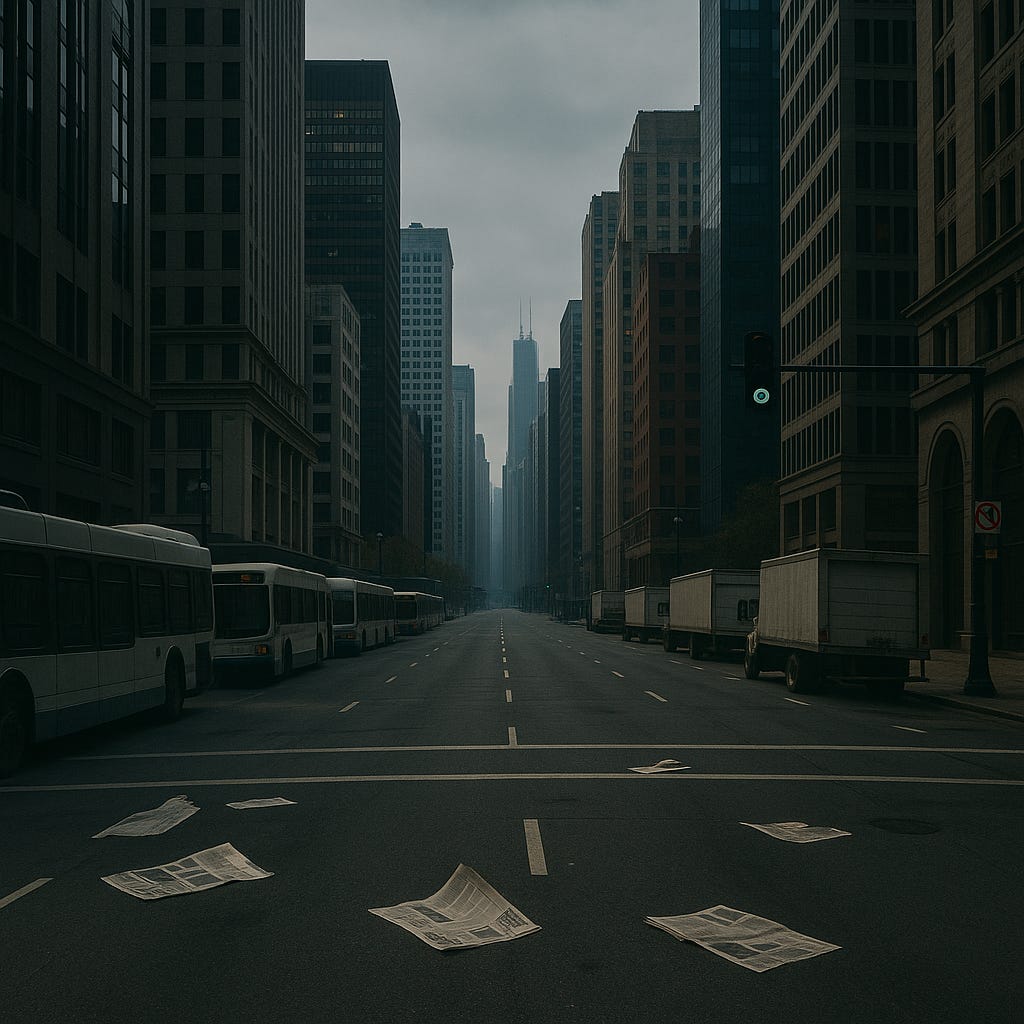
Construction: If they walk, cities stall.
Transportation: If they walk, goods stop moving.
Hospitals: If they walk, the country panics.
And here’s the kicker: More Americans work in insurance than in hospitals.
More people are paid to deny and delay care than to give it. That’s not efficiency. That’s institutional cruelty, and a machine that won’t stop unless we pull the plug together.
We don’t need 100% participation. We just need enough people in the right places.
What It Would Take to Get There
A general strike must be built, step by step:
Normalize the idea. Talk about it everywhere.
Create on-ramps. Sick-outs, walkouts, digital pickets, “Don’t Buy, Don’t Work” days.
Build local coalitions. Mutual aid groups, tenants, students, nurses—connect the dots.
Pick strategic flashpoints. May Day, Black Friday, July 4, or the next injustice that lights a spark.
Push big labor. Demand unions coordinate instead of isolate.
Expect retaliation. Document it. Go public. Fear backfires in the light.
Remember: You don’t need everyone, just enough in the right industries.
The machine is fragile. All it takes is the courage to pull the first pin.
Call to Action: Believe Bigger, Fight Harder
We’ve been told to settle, to be grateful for scraps, to endure.
But endurance is not freedom.
If France can strike for pensions, if India can strike for land, if Canada can strike illegally and win, if Ukraine can protest and win during a war, then we can damn well refuse to suffer in silence while billionaires choke the life out of this country.
You are someone.
Talk about the general strike.
Join or support local strikes.
Organize your workplace.
Push your union leaders.
Build local networks and be ready.
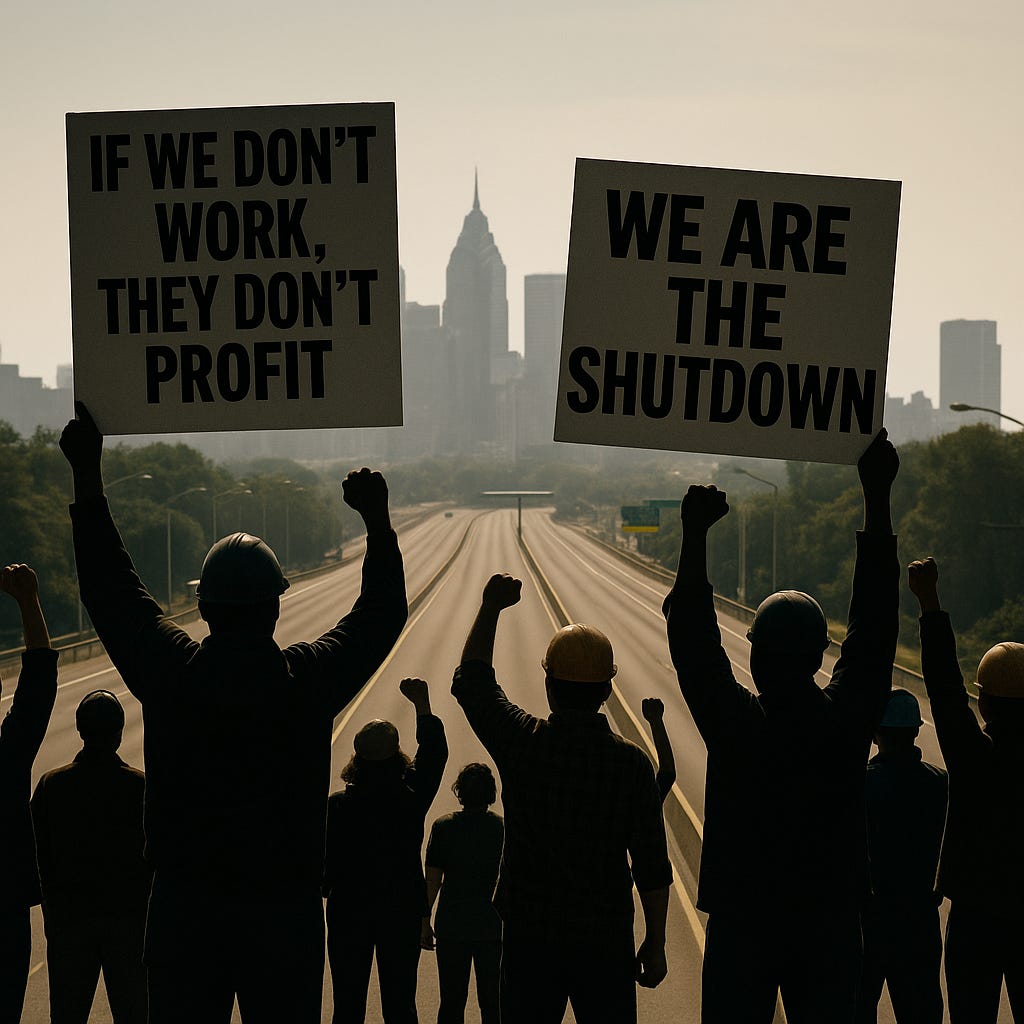
Because if we don’t work, they don’t profit. If we don’t move, nothing moves.
And if we stand up together—teachers, drivers, nurses, cashiers, students, janitors, coders, tenants, baristas, farmers— we become the shutdown.
And from that shutdown, we build something better.
Stay Informed. Stay Loud.
Subscribe to The Coffman Chronicle for no-BS political analysis, action guides, and weekly truth bombs you won’t get from corporate media.
Bibliography:
“1995 Strikes in France.” Wikipedia.
Lowry, Sam. “The French Pension Strikes, 1995.” Libcom.org, April 12, 2007.
“Strikes in France: Is It a Tactic That Actually Works to Change the Government’s Mind?” Euronews, July 3, 2023.
“2020–2021 Indian Farmers’ Protest.” Wikipedia.
“2020 Indian General Strike.” Wikipedia.
“Zelenskiy, moving to defuse crisis, restores power of anti‑graft agencies.” Reuters, July 31, 2025.
“Ukraine parliament votes to restore anti‑corruption agencies after protests.” Al Jazeera, July 31, 2025.
“Ukraine adopts new anti‑corruption law as protests force Zelensky to retreat.” Washington Post, July 31, 2025.
“Ukraine’s Parliament approves law restoring independence of anti‑graft watchdogs following backlash.” PBS, July 31, 2025.
“Bill restores independence of anti‑graft bodies.” DW, July 31, 2025.
I’m going to strike. I will protest and I will call representatives and senators.
I am retired, but want to support ageneral strike in Washington state. Which union is pro general strike? I need phone numbers!!!