


On the first day of the federal government shutdown, a bright red banner appeared at the top of WhiteHouse.gov: “Democrats Have Shut Down the Government.” Beneath it, a live countdown clock.
This wasn’t a campaign ad. It wasn’t a meme. It was an official government message, published on a taxpayer-funded platform.
And it wasn’t alone.
Across multiple federal agencies — from the Department of Justice to the Treasury and HUD — shutdown messaging blamed Democrats by name. This marked a stunning break with tradition: not just a change in tone, but a collapse of the neutral language that once defined how the U.S. government speaks to the public.
This shift matters. Not just because it’s unprofessional or petty, but because it signals a broader transformation in American governance: The voice of government is no longer the voice of the institution. It’s the voice of the campaign.
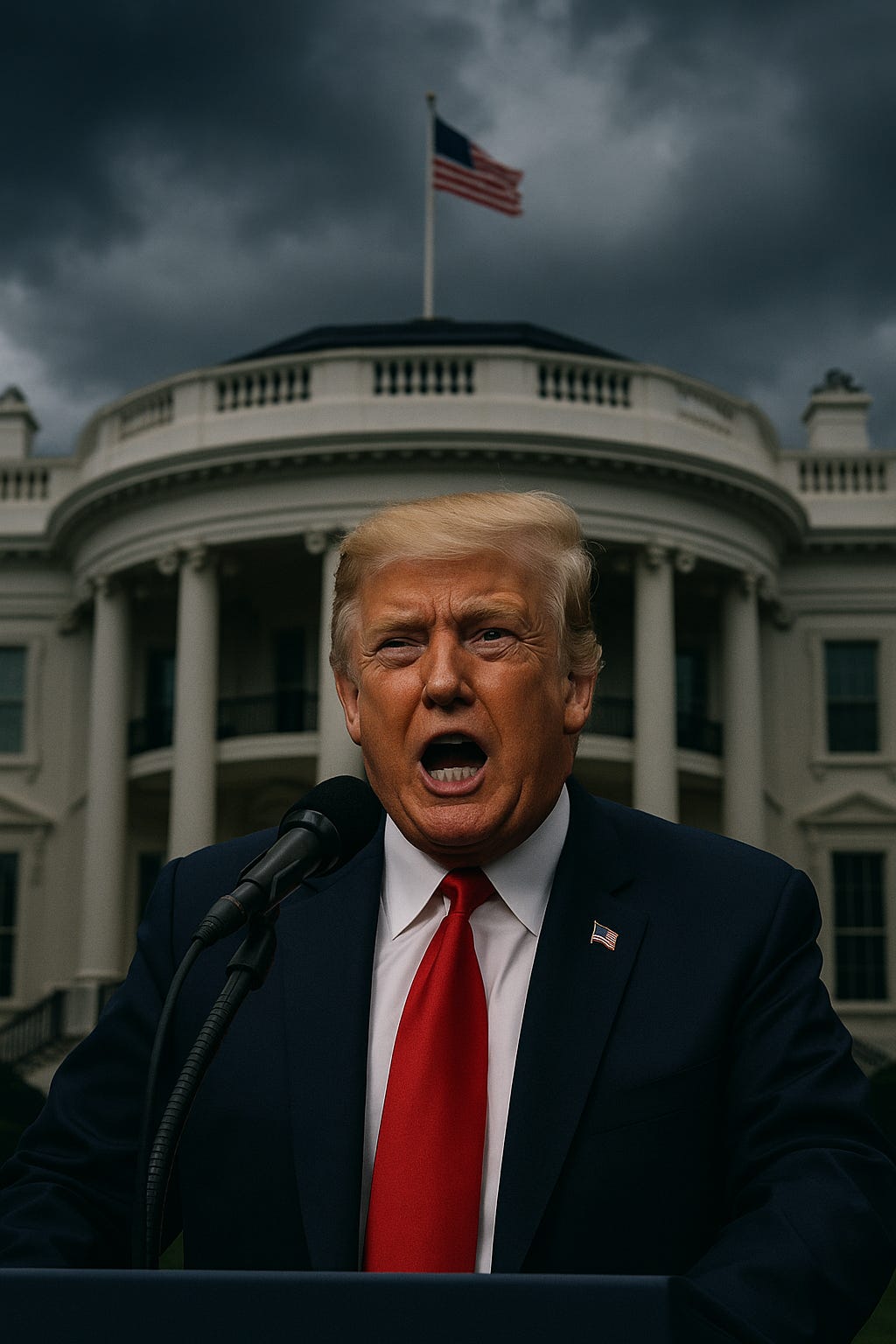
AI-generated image: United States of Donald
Stay Informed. Stay Loud.
Subscribe to The Coffman Chronicle for no-BS political analysis, action guides, and daily truth bombs you won’t get from corporate media.
The Shutdown’s Two Voices
The current government shutdown has split the federal government into two rhetorical factions.
Some agencies have held the line, delivering standard, apolitical service notices.
Others have veered hard into campaign territory, all within the same administration.
Neutral Messaging: Business as Unusual
Departments like Defense, Labor, Homeland Security, and the National Park Service kept their messages short, dry, and functional:
“Due to a lapse in appropriations, this website will not be updated.”
“Agency operations are limited during the federal government shutdown.”
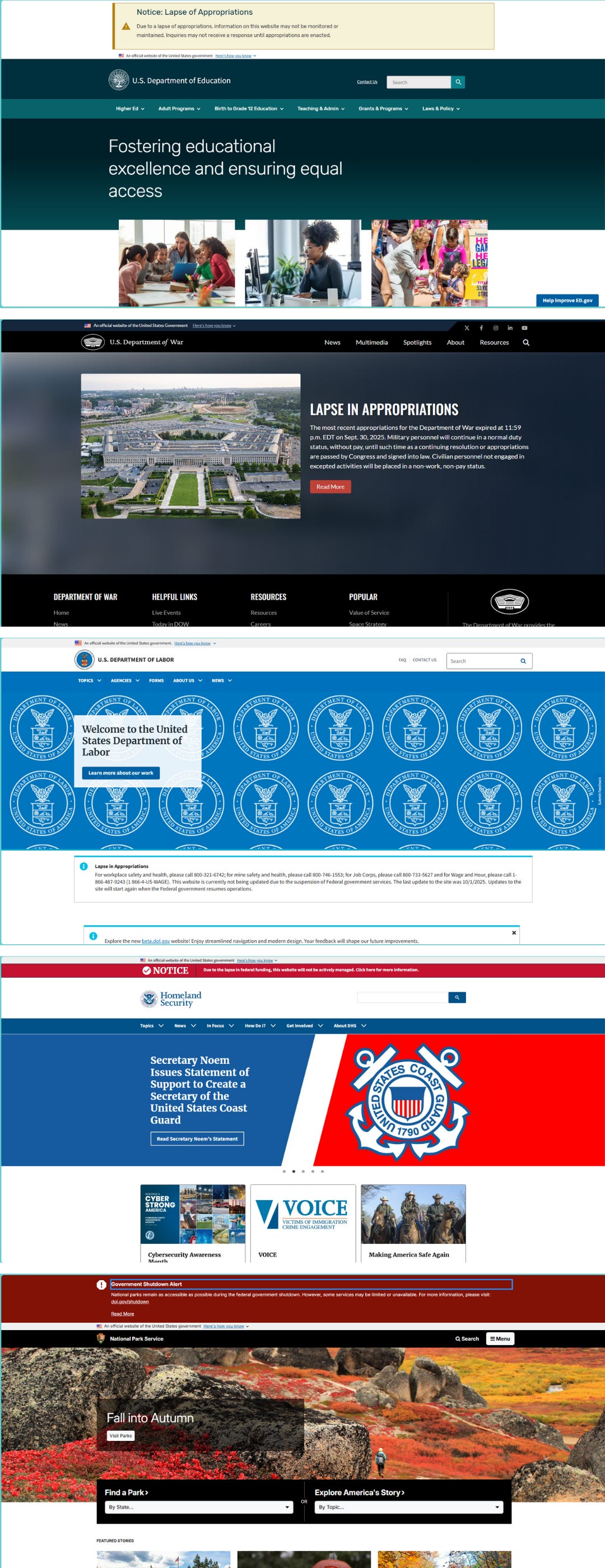
Screenshots were taken around 10:00 p.m. EST on October 5, 2025.
This kind of language has been the norm in previous shutdowns — deliberately sterile to avoid assigning blame or fueling controversy. These agencies still treat the shutdown as a nonpartisan failure of governance.
But not everyone followed that script.
Partisan Messaging: From Blame to Full-On Campaigning
At the other end of the spectrum, several agencies used their official platforms to point fingers, and in some cases, to campaign.
WhiteHouse.gov: A prominent banner reading: “Democrats Have Shut Down the Government”
with a countdown clockDepartment of Justice (DOJ): Mirrors the White House banner verbatim, with no clock
Department of the Treasury: Goes further, adding ideological framing: “The radical left has chosen to shut down the United States government in the name of reckless spending and obstructionism.”
Department of Housing and Urban Development (HUD): Adopts a more overtly political tone, declaring not just blame, but advocacy in a bold, centered section reading “The Radical Left in Congress shut down the government. HUD will use all available resources to help Americans in need.” (Note the religious reference in the image below immediately following the declaration)
Department of Agriculture (USDA): Goes all in with an equally bold, centered section that assigns blame and includes this nugget, “Due to the Radical Left Democrat shutdown, the government website will not be updated during the funding lapse. President Trump has made it clear he wants to keep the government open and support those who feed, fuel, and clothe the American people.”
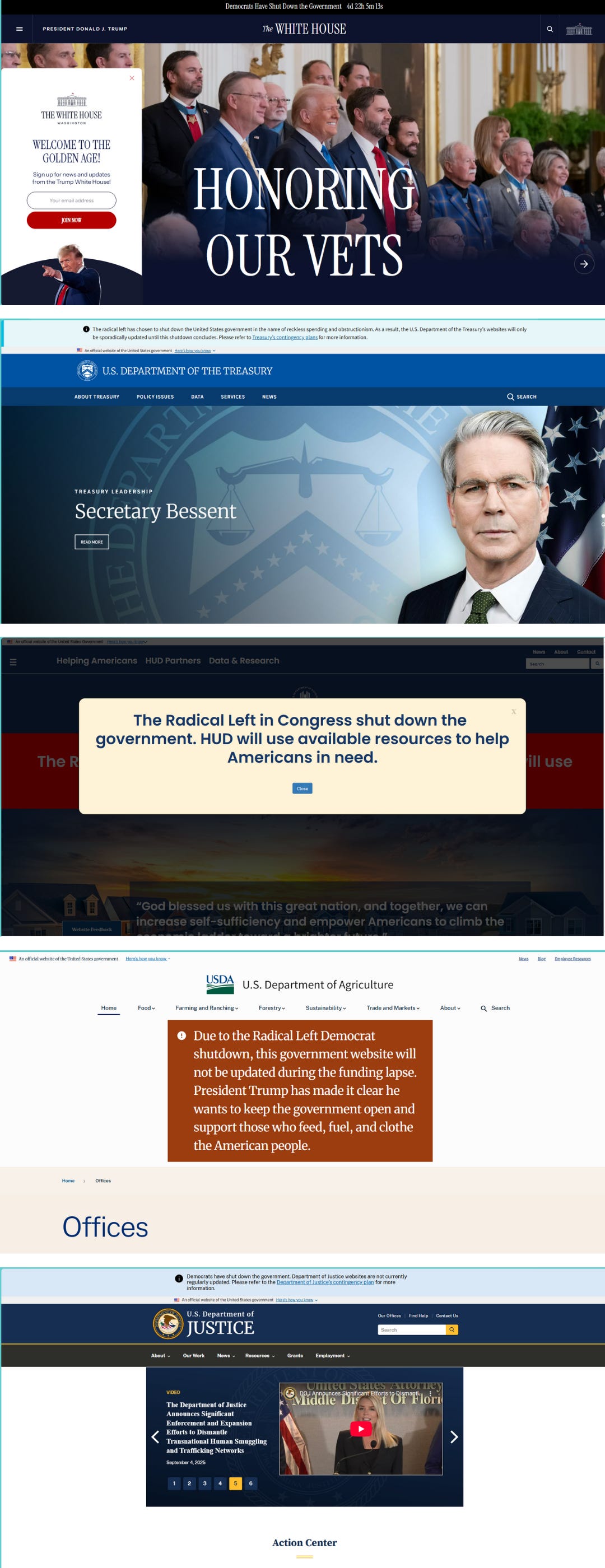
Screenshots taken around 10 pm EST on October 5, 2025.
At that point, the message is no longer about operations or updates. It’s a campaign endorsement, stamped with the legitimacy of federal agency branding. As a reminder, this is just a sampling of agency messages.
Why These Differences Matter
When the Department of Agriculture echoes a president’s campaign line, and the DOJ issues statements that read like political ads, we are no longer dealing with public information. We are talking about propaganda embedded into the architecture of governance.
Out-of-Office Emails and Internal Messaging: Bureaucracy with a Blame Agenda
It isn’t just agency websites that have carried the administration’s talking points during the shutdown. The same partisan messaging began appearing in automated out-of-office replies, the kind sent when government employees are furloughed and unable to respond to emails.
This is where the situation turns from unusual to unsettling.
In several cases, career civil servants reported that their email templates were altered without their consent, with the language changed to include blame for the shutdown attributed to Senate Democrats. These weren’t rogue staffers improvising. These were centralized messaging directives, pushed from above.
One auto-reply read:
“I am currently out of the office because Senate Democrats voted to block a clean federal spending bill to fund the government. Every day that Senate Democrats continue to oppose bipartisan efforts, critical services remain unavailable.”
This wasn’t just a message. It was a message with a target.
It used official infrastructure — government servers, employee emails, agency letterhead — to assign political blame. And in doing so, it co-opted public servants into spreading partisan narratives, even as they were prevented from performing their actual duties.
This is not just ethically questionable; it raises potential legal concerns.
The Hatch Act, which prohibits federal employees from engaging in political activity on government time or resources, may have been skirted or violated here. However, enforcement is complicated: watchdog agencies like the Office of Special Counsel were themselves shut down during the shutdown, and the staffers who alerted the press to these altered messages claim they did not make the changes, and that their own attempts to revert to a neutral message were again manipulated.
Weaponizing Bureaucracy
Out-of-office messages are one of the most mundane functions in government. Their job is to inform, not persuade. But in this administration’s hands, even a passive autoresponder became an opportunity for partisan theater.
This wasn’t universal. Some agencies used neutral auto-replies, adhering to standard language about funding lapses and temporary unavailability.
However, the fact that some employees were ordered to send politicized messages or had their generic messages changed reveals the extent to which the messaging strategy is ingrained. It’s not just public-facing websites or presidential speeches. It’s embedded in the internal machinery of government communication.
It’s propaganda by passive aggression. And it tells us something chilling: Even the smallest, quietest parts of the government are now expected to speak in the voice of the campaign.
The Devil Is In The Details
Yet here’s what’s most revealing: the Department of Education’s website — the agency’s most public-facing platform — displays a neutral, standard message about the shutdown. It is a simple notice about the lapse in appropriations, with no finger-pointing or ideological language, as seen in the screenshot above.
But behind the scenes, internal messaging told a different story.
According to multiple reports and firsthand accounts, many of the altered out-of-office replies originated from within the Department of Education. Employees claim they were provided with template language that blamed Senate Democrats for the shutdown, and in some cases, when they attempted to remove or neutralize the language, it was reinstated by IT or management.
This contrast — between a neutral face to the public and a partisan voice in private communication — reveals something even more troubling: The administration understands the boundary between professionalism and propaganda and is willing to cross it when it thinks the public isn’t looking.
It’s strategic, not accidental.
The messaging isn’t consistent, but it is coordinated, tailored by channel. In public, some departments play it safe. Internally, the gloves come off.
And if staff are being used as involuntary messengers of blame, it represents a profound abuse of bureaucratic trust. These are career professionals, not political operatives, being conscripted into the rhetorical machinery of an administration that increasingly views every government function as an opportunity to campaign.
When the Law Starts Speaking Like a Campaign Ad
The shift in government language hasn’t been limited to websites or email replies. It’s now fully embedded in formal legal instruments, particularly executive orders and Department of Justice guidance documents.
This is the most dangerous transformation yet, because it doesn’t just politicize communication. It politicizes the law itself.
Executive Orders as Ideological Messaging
Traditionally, executive orders have been written in neutral, legalistic language, meant to direct federal agencies, not rally political supporters. However, over the last nine months, that norm has eroded fast.
Recent executive orders are now peppered with:
Explicit partisan framing
Culture war rhetoric
References to ideological enemies
One striking example is Executive Order 14224, designating English as the official language of the federal government. On its face, the policy is presented as an administrative streamlining measure. The supporting documents and follow-up guidance, however, reveal a very different tone.
The DOJ’s official implementation memo refers to the order as eliminating “wasteful virtue-signaling policies” and supporting “assimilation over division.” These are not neutral terms. They’re the language of political talk shows, not federal rulemaking.
And crucially, the memo doesn’t just define the law — it defines the enemy.
It casts previous language access policies, like President Clinton’s 2000 Executive Order on meaningful access for people with limited English proficiency, as divisive, ideologically driven, and counter to American values.
This is policy, not as governance, but as narrative warfare.
Why This Is A Double-Edged Sword
Legal language sets precedent. What appears in an executive order today can be used in court tomorrow, not just as policy, but as evidence of intent.
When that language is loaded with ideology and directed blame, it invites challenges on constitutional grounds:
Equal protection violations if a policy appears to target specific groups.
First Amendment concerns if it suppresses expression or viewpoint.
Procedural bias if it appears to retaliate against political opponents.
And it weakens the administration’s legal standing before it even reaches a courtroom. Judges and justices — even conservative ones — may be forced to consider whether an order was written in good faith or for political spectacle.
The louder the rhetoric, the shakier the legal ground.
Case in point: Abrego Garcia. After successfully suing the Trump administration over his wrongful removal to El Salvador, Abrego was later indicted by the DOJ on human smuggling charges. However, in a recent decision, a federal judge held that there was “some evidence that the prosecution … may be vindictive,” citing public statements by DOJ officials that linked the criminal charges to his civil suit. The court has ordered discovery and an evidentiary hearing into prosecutorial motive, effectively using the government’s own words to question whether this prosecution is law or retribution.
The DOJ’s Shift: From Prosecutor to Pundit
The Department of Justice, once revered for its restraint, is now issuing press releases that mirror the tone of campaign ads — praising the president, invoking ideological slogans, and blaming political opponents for national crises.
This has real consequences:
It raises due process concerns in criminal cases.
It undermines public trust in prosecutorial impartiality.
And it pressures the judiciary, forcing courts to decide not just the law, but the administration’s credibility.
In a functioning democracy, the law speaks with clarity and neutrality. In this moment, however, it speaks with a sneer, and it speaks in slogans.
The Collapse of Legitimacy In the Courts, Abroad, and Across History
The erosion of neutral language in federal government communication is more than unprofessional. It is destabilizing.
It destabilizes the courts, where legal arguments must be assessed on facts, not political messaging. It destabilizes international perceptions, where U.S. credibility has long depended on diplomatic clarity and institutional restraint. And it destabilizes the historical record, where government documents once told the story of the nation, not the agenda of its ruling party.
In the Courts: Language as Liability
When the DOJ publishes statements that blame “radical Democrats,” or when executive orders target ideological opponents, they create legal vulnerabilities that any good defense attorney will exploit.
They can argue that a prosecution is politically motivated, undermining the government’s case.
They can challenge executive orders on the basis of improper intent, citing the administration’s own words as evidence.
They can push for dismissals, venue changes, or constitutional claims, not because the facts are weak, but because the language is biased.
Neutral language is not a nicety. It’s a legal shield. Without it, the government’s actions become suspect by design.
On the World Stage: The Loss of Professional Voice
Foreign governments are watching and taking note.
It is damaging enough when the President rants like he is on the campaign trail. However, when American agencies speak in culture war slogans, the U.S. no longer sounds like a serious actor. It sounds like a divided, unstable state performing its own dysfunction for the world.
Diplomatic language is supposed to be precise, careful, and credible. It’s the currency of treaties, alliances, and soft power. But when DOJ memos sound like Twitter threads, and executive orders sound like talk radio, the United States loses its voice as a global leader, not because it’s silent, but because it is at best incoherent, and at worst, brash and petty.
What’s lost isn’t just decorum. It’s trust.
In the Archives: Propaganda as Permanent Record
Perhaps most disturbing of all is that the language being used today will live forever.
Executive orders, DOJ memos, agency guidance documents, and government websites are not ephemeral. They are the official, archived voice of the U.S. government. And right now, that voice is shrill, accusatory, and ideologically driven.
One hundred years from now, a historian may read a government document blaming “radical Democrats” for a shutdown and, unless context survives, may accept it as fact.
The architecture of memory is being rewritten in real time. This isn’t just messaging. It’s historical manipulation in the voice of the state.
When the government no longer sounds like a government, it no longer functions like one. It campaigns. It accuses. It performs. But it does not govern.
And what it leaves behind will not be a record of public service, but of power, weaponized through words.
When the Government Stops Sounding Like Itself
What’s happening isn’t just messaging or political theater. It’s a transformation of the American government’s voice, and with it, its legitimacy.
Across websites, auto-replies, executive orders, and DOJ guidance, the line between administration and campaign has collapsed. Neutral language, once a cornerstone of democratic governance, is being replaced by rhetoric lifted straight from the rally stage.
This isn’t incidental. It’s strategic. Most importantly, it’s dangerous.
Language is not just how a government explains itself. It’s how it establishes authority, defines legality, and records history. And when that language becomes partisan, the state stops speaking to all of us and begins speaking for only some of us.
We see the consequences already: Courts questioning prosecutorial motives based on public statements. International actors watching U.S. credibility wither under the weight of its own propaganda. Agencies that once delivered services now delivering slogans.
And long after this administration ends, its words will remain — in archives, in court records, in the institutional memory of a country that was told, day after day, that Democrats were to blame, that wokeness was the enemy, that this group is less than, that law and order meant loyalty, not justice.
Language doesn’t just describe power. It creates it. It doesn’t just reflect reality. It shapes it.
In law, in religion, in culture, the word precedes the thing. “In the beginning was the Word…” — and from there, the world is spoken into being.
In governance, too, language is creation. A law doesn’t exist until it is written. A policy has no power until it is declared. A state does not act until it speaks.
So when the language of the state changes — when it becomes partisan, petty, vengeful — the state itself is remade in that image.
When a government chooses words that divide, distort, and deceive, it is not just changing its message. It is rewriting its nature.
This is not just a communications crisis. It is a crisis of becoming. The question isn’t just what the government is saying. The question is: What kind of government is it becoming by saying it?
Stay Informed. Stay Loud.
Subscribe to The Coffman Chronicle for no-BS political analysis, action guides, and daily truth bombs you won’t get from corporate media.
Sources:
“Trump admin adds banner attacking ‘Radical Left Democrats’ to government websites” The Verge
“First Thing: Federal agencies blaming Democrats for shutdown in possible breach of law” The Guardian
“Judge Says DOJ May Be Vindictively Punishing Abrego Garcia for Challenging Removal to El Salvador” Democracy Docket
“Government Workers Say Their Out-of-Office Replies Were Forcibly Changed to Blame Democrats for Shutdown” WIRED
“Ed. Dept. Out-of-Office Emails Changed to Blame Democrats for Shutdown, Staff Say” Education Week
“Education Department altered employees’ emails to blame shutdown on Democrats, lawsuit says” Reuters
“Language Access and Civil Rights: Analyzing the Impact of the Executive Order Claiming to Make English the Official National Language” NILC

Another lawsuit coming at MAGA!