


Two landscapes, one message
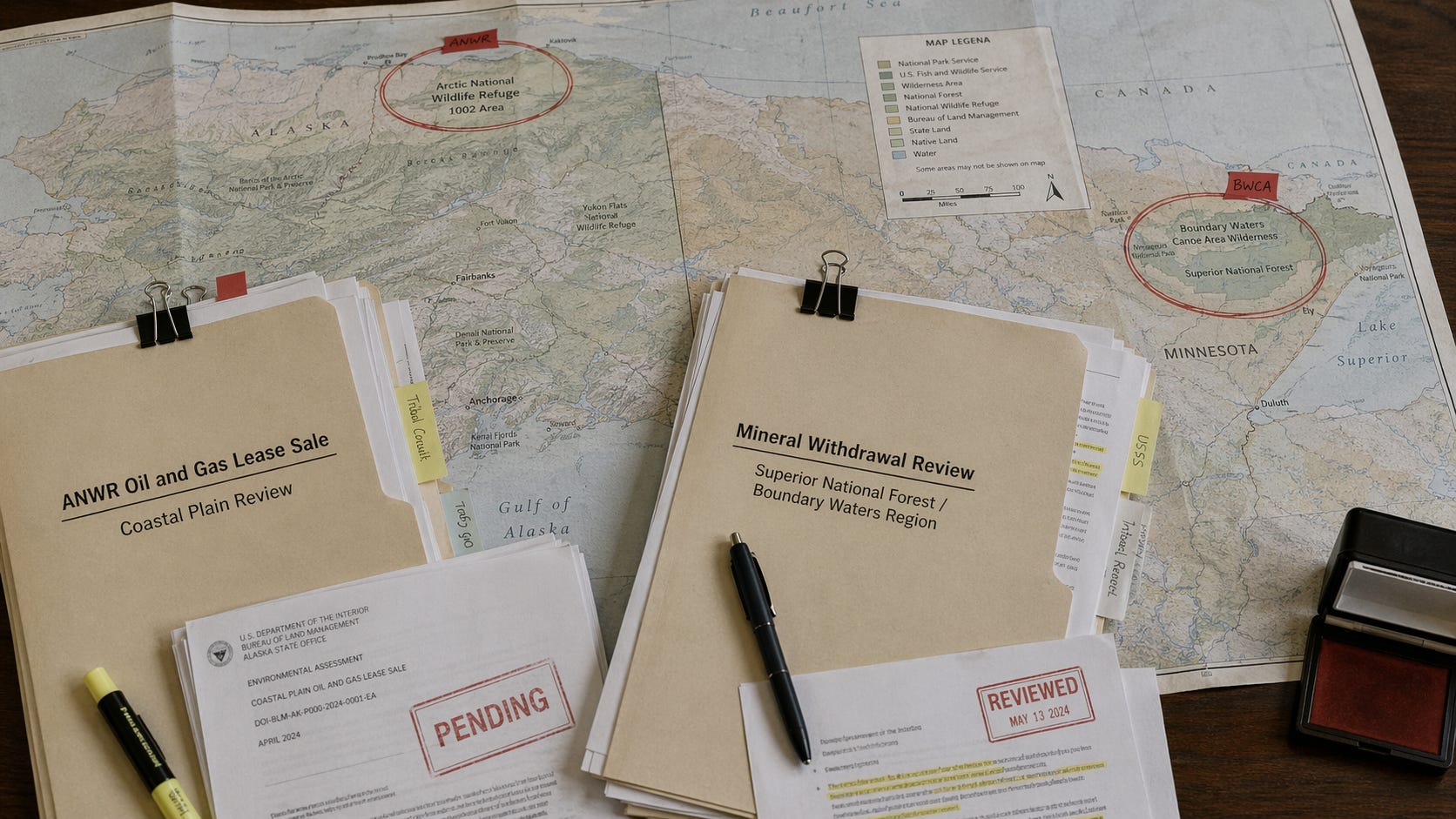
Within days, Washington moved two of America’s most sensitive landscapes closer to industrial extraction. In Alaska, the Bureau of Land Management scheduled a June 5 oil-and-gas lease sale in the Arctic National Wildlife Refuge’s Coastal Plain. In Minnesota, the Senate voted 50–49 to overturn the 20-year mineral withdrawal covering 225,504 acres in the Superior National Forest near the Boundary Waters, reopening the path for a long-contested mining project.
These are different places, different resources, and different legal fights. Together, though, they say the same thing: in today’s Washington, land is protected only until the politics change.
That is the real story. Not just one lease sale. Not just one rollback. It is the steady narrowing of what protection means in practice. Land set aside because it is fragile, irreplaceable, or too important to gamble with is being treated less like a public trust than a temporary obstacle. The safeguards are no longer durable. They are conditional.
From ANWR to the Boundary Waters, the terrain is different. The governing philosophy is not. Protections can be lifted, withdrawals can be undone, and landscapes once described as worth preserving can be pushed back toward drilling and mining with the stroke of a pen or the margin of a vote.
This Community Is Powered by You
What started as a small circle has grown into something much bigger, and it’s all because of readers like you.
Every time you forward this email, post it on socials, or bring someone new into the fold, you’re helping build one of the most passionate, independent political communities out there.
Want to keep the momentum going?
Share this newsletter with someone who should be part of this conversation.
Thank you for being here. It means everything.
ANWR goes back on the auction block
The Alaska side of this story is straightforward on paper and enormous in consequence. The Bureau of Land Management has formally scheduled a new oil-and-gas lease sale for the Arctic National Wildlife Refuge’s Coastal Plain on June 5, with sealed bids due by June 3. The sale notice says the offering will cover tracts in the refuge’s Coastal Plain and make available no less than 400,000 acres.
That does not mean drilling begins on June 5. It means the federal government is once again putting one of the most contested landscapes in the country up for lease.
That distinction matters, but only up to a point. A lease sale is still a policy choice. It is the moment when the government stops treating a place primarily as something to protect and starts treating it as something to offer. In ANWR, that shift carries unusual weight because the Coastal Plain has long stood as one of the clearest tests of whether some landscapes are too ecologically sensitive, too symbolically important, or too politically contested to open at all.
The recent history matters too. This would be the third lease-sale effort at the refuge and the first under a new law requiring four sales over a ten-year period. Earlier efforts did not prove that industry demand was overwhelming. One sale held near the end of Trump’s first term drew limited participation. Another in early 2025 drew no bids at all. That record undercuts the idea that ANWR is being reopened in response to irresistible market pressure. This is politics insisting that the refuge remain available for extraction whether the market is eager or not.
The Boundary Waters shield gets knocked down
Minnesota’s side of the story moves through a different mechanism, but the result is similar. In 2023, the federal government withdrew roughly 225,504 acres in the Superior National Forest from mineral and geothermal leasing for twenty years. The order was explicit about why. It said the withdrawal was meant to protect the Rainy River watershed, the Boundary Waters Canoe Area Wilderness, related wilderness values, and the 1854 Ceded Territory from the adverse effects of exploration and development.
In other words, the government had already decided that this landscape was important enough and vulnerable enough to keep new leasing off the table.
Now that shield is being removed. The Senate voted 50–49 to overturn the withdrawal, sending the measure to Trump after the House had already approved it. The vote gives a major lift to the long-contested Twin Metals project, backed by Antofagasta, a Chile-focused mining company that has spent years trying to develop a copper, nickel, and cobalt mine in the region. Supporters frame the move as a win for domestic mineral production and supply-chain security. Opponents see something simpler and more dangerous: another decision to treat protected public land as negotiable when industry and political power align.
It is important to be precise about what this does and does not do. It does not mean a mine opens tomorrow. Federal officials would still need to reissue leases, and the project would still need environmental review and permits before mining could begin. But removing the withdrawal is still a major policy shift because it strips away one of the clearest federal barriers standing in the project’s path. Once that protection is gone, the debate changes. The question is no longer whether this area should remain off-limits. The question becomes how quickly the machinery of extraction can resume.
The Boundary Waters fight has never been just a technical dispute over permits. It is a dispute over whether a water-rich, interconnected wilderness should be exposed to the risks associated with sulfide-ore mining in its watershed. Opponents warn pollution could move through that watershed, harming fish, wildlife, plants, and tribal wild-rice areas. Supporters answer with promises of jobs, critical minerals, and modern mining methods. But the federal government’s own 2023 withdrawal already reflected a judgment that this place carried environmental and cultural stakes too high to dismiss. The Senate vote does not erase that judgment. It overrides it.
Why these two fights belong together
At first glance, ANWR and the Boundary Waters can look like separate disputes unfolding at the same time. One is an Arctic oil-and-gas lease sale. The other is a Midwest mining fight centered on copper, nickel, and cobalt. One moves through a federal lease auction. The other moves through Congress and the Congressional Review Act.
The deeper logic is the same.
In both cases, the federal government is taking land that had been treated as deserving special restraint and moving it back toward extraction. That is what makes this more than a two-item roundup. The common thread is not just drilling here and mining there. It treats environmental protection as provisional.
In Alaska, the administration is advancing a lease sale in the refuge’s Coastal Plain as part of a multi-sale program set by law. In Minnesota, Congress is not merely debating one project on its merits. It uses a rollback mechanism that makes the underlying protection harder to restore once it is gone.
Put plainly, both moves tell the same story about how power now treats protected land. A safeguard is no longer a settled decision about stewardship. It is a delay. A withdrawal is no longer a durable boundary. It is a hurdle waiting for the right majority to remove it.
That is why these stories belong together. They show two versions of the same federal impulse: auction the refuge, lift the withdrawal, keep the map open. The details differ. The message does not. Places once set aside because they were judged too fragile, too valuable, or too consequential to gamble with are being pulled back into the development pipeline, not because the environmental case collapsed, but because the political balance changed.
The environmental stakes are the point
The danger in stories like this is that the legal mechanics can start to overshadow the landscapes themselves.
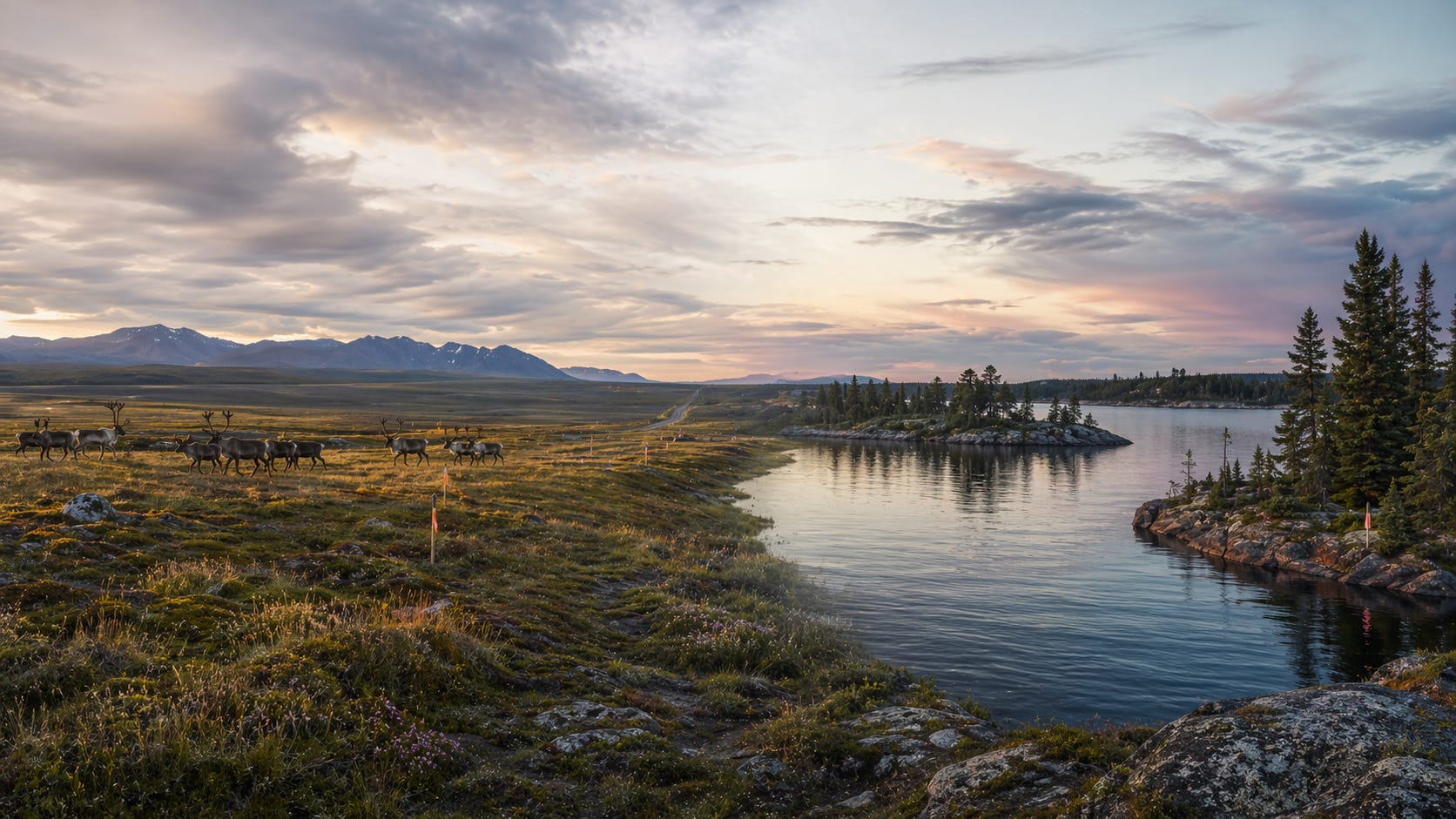
ANWR is not just a line item in an energy plan. The Arctic Refuge is home to all three North American bear species, both the Porcupine and Central Arctic caribou herds, muskox, Dall sheep, wolves, wolverines, and more than 200 bird species. The Coastal Plain now being put up for lease is not incidental terrain inside that refuge. It is one of the most ecologically consequential spaces in the Arctic Refuge. Caribou use the area during calving season. Migratory birds use it during the brief Arctic summer. Opening that ground to industrial leasing is not the same as access to an empty expanse. It is access to a biologically critical landscape.
The Boundary Waters fight turns on a different kind of vulnerability. This is a water-rich wilderness where contamination does not stay neatly confined to a single pit or parcel. The 2023 withdrawal order said the land was being protected to preserve fragile social and natural resources, ecological integrity, wilderness values, and the Rainy River watershed from the adverse effects of mineral development. That language matters because it reflects an official judgment that this is the wrong place to take even a calculated risk.
And in mining country, that risk is not abstract. Sulfide-bearing minerals exposed by mining can react with air and water, forming sulfuric acid and dissolving heavy metals into groundwater or surface water. That does not prove every mine will fail in the same way. It does explain why people fight so hard over where mining should be allowed in the first place. Once water is contaminated, the politics that authorized the risk are usually long gone. The cleanup is not.
That is the environmental truth beneath both fights. Oil infrastructure and sulfide-ore mining do not threaten these landscapes in identical ways, but they operate on the same brutal timeline: the decision to open a place can be made in a season, while the ecological consequences can last far longer than the administration, Congress, or industry campaign that pushed it through. The land does not recover during election time. Water does not care who held the gavel when the vote was taken.
The extraction case, and what it leaves out
Supporters of both moves have their arguments ready. In Alaska, the lease sale is being sold as part of “unleashing Alaska’s vast energy potential.” In Minnesota, backers of the Twin Metals project say copper, nickel, and cobalt are important to domestic industry, supply chains, and national security.
On paper, that case sounds straightforward. America needs energy. America needs minerals. Public land should help deliver both.
What that argument leaves out is how often the politics of extraction outrun the economics.
The ANWR push is being presented as a milestone, but recent leasing history has hardly shown unstoppable market demand. An earlier sale in early 2025 drew no bids. This new June 5 sale would be the third ANWR lease sale overall. That suggests Washington is not responding to overwhelming commercial pressure. It is keeping the refuge open, whether industry enthusiasm is there or not.
The same gap appears in Minnesota. The Senate vote gives Twin Metals a major political win, but the project still needs leases reissued, along with environmental reviews and permits, before any mining can begin. In other words, the rhetoric moves as if the land is already producing strategic minerals, while the real-world project remains tied up in years of unresolved legal and regulatory conflict. Even the supply-chain case comes with a complication: the minerals would likely be processed overseas. That does not erase the critical-minerals argument, but it does make the sales pitch less clean-cut than the slogan suggests.
The political system moves quickly to reopen land, celebrate development, and frame resistance as obstruction. The harder questions are pushed aside. How strong is the actual market? How durable are the promised benefits? Who carries the risk if the economics disappoint or the environmental damage outlasts the boom?
Extraction politics is very good at accelerating the opening move. It is much less honest about the long tail that follows.
Protected until power changes
This is the deeper pattern running through both fights. Not just drilling in Alaska or mining in Minnesota, but the steady conversion of protection into something temporary.
A refuge is supposed to be more than acreage waiting for a different administration. A withdrawal is supposed to mark a boundary, not merely delay the next push. But when safeguards can be reversed this easily, conservation starts to look less like a durable public commitment and more like a temporary condition of whoever happens to control Washington at the moment.
The Minnesota case sharpens that point. Once a rule is overturned under the Congressional Review Act, future presidents are constrained from restoring similar protections through the same kind of action. That means this is not only a rollback in the present tense. It is an attempt to narrow the government’s future ability to put the shield back up. Paired with ANWR’s legally mandated multi-sale structure, the message is hard to miss. Extraction is being written into policy as the default. Protection is being treated as the exception that must constantly defend itself.
That changes what the word protected really means. If a refuge can be reopened despite weak market demand, and if a watershed shield can be stripped away despite an earlier federal finding that the place was too sensitive to lease, then conservation is no longer operating as a settled national choice. It is operating as a holding pattern.
If everything is back on the table, nothing is really protected
That is where these two fights finally meet.
The Arctic Refuge and the Boundary Waters are very different places, but both are now being asked to absorb the same lesson: in modern American politics, protection lasts only as long as extraction lacks the power to challenge it. The language used to justify these openings will vary. It will be energy security in one case, mineral strategy in another, jobs in one place, development in the next. The message to the land is the same.
No designation is truly settled. No safeguard is beyond revision. No promise of stewardship is safe from the next political turn.
That should trouble anyone who thinks public land is supposed to mean something more than temporary restraint. A refuge should not function like inventory waiting for the right administration. A watershed shield should not be treated as a bureaucratic inconvenience to be brushed aside when industry regains leverage. If places as ecologically significant and symbolically important as ANWR’s Coastal Plain and the Boundary Waters can be pushed back toward drilling and mining this easily, then the issue is bigger than either fight on its own.
It is whether the country still believes some landscapes are worth protecting in a durable way, or whether every map is now provisional.
Because if every protection can be reopened, repealed, or auctioned when power changes hands, then protected land stops being a commitment and starts becoming a pause.
Support Independent Media: The Coffman Chronicle
The Coffman Chronicle exists to follow power, expose the pattern, and tell the truth about who pays when protections are stripped away and public goods are put back on the auction block. If that kind of independent journalism matters to you, and you can afford to support it, please consider becoming a paid subscriber.
Sources
“New Oil and Gas Lease Sale Set for Alaska’s Arctic National Wildlife Refuge, amid Litigation.” Associated Press, April 17, 2026.
“Senate Republicans Send Trump Resolution to Lift Mining Ban near Boundary Waters Canoe Area.” Associated Press, April 16, 2026.
“BLM Announces 2026 Oil and Gas Lease Sale in Alaska’s Coastal Plain.” Bureau of Land Management, April 17, 2026.
“Notice of 2026 Coastal Plain Oil and Gas Lease Sale.” Federal Register, April 20, 2026.
“Public Land Order No. 7917 for Withdrawal of Federal Lands; Cook, Lake, and Saint Louis Counties, MN.” Federal Register, January 31, 2023.
“US Senate Narrowly Overturns Minnesota Mining Ban, Sending Bill to Trump.” Reuters, April 16, 2026.
“Arctic National Wildlife Refuge | Species.” U.S. Fish and Wildlife Service. Accessed April 20, 2026.
“How Does Mine Drainage Occur?” U.S. Geological Survey. Accessed April 20, 2026.
The dictator wannabe and his pathetic minions have no right to sell and destroy our precious protected natural resources. Hands off, opportunistic criminal legislators and cronies!!
It is unacceptable that many of our nation's precious lands that were supposed to be preserved and protected into the future for all Americans are instead being opened, and protections weakened to serve no purpose other than politics and exploitation by a greedy, rapacious few.