

Imagine waking up to the sound of your front door being battered down. Armed SWAT officers storm in, shattering windows, detonating flashbangs, and aiming guns at you and your family. Minutes later, they realize—oops—they hit the wrong house.
But instead of accountability, those officers walk away without a scratch on their records, protected by a legal shield called qualified immunity.
This isn’t some dystopian fiction; it’s real life. It happened in Jimerson v. Lewis, where a SWAT team terrorized an innocent family during a botched raid. When the victims tried to sue, their case was dismissed. The Supreme Court refused to hear the appeal, allowing the officers to walk free under the legal fiction of qualified immunity—a doctrine that time and time again has let police evade justice for their abuses.
This judicial loophole has given cops a blank check to violate constitutional rights, commit wrongful killings, and brutalize civilians without consequence.
So how did we get here? And why does the Supreme Court—our supposed safeguard of justice—keep protecting the wrong side?
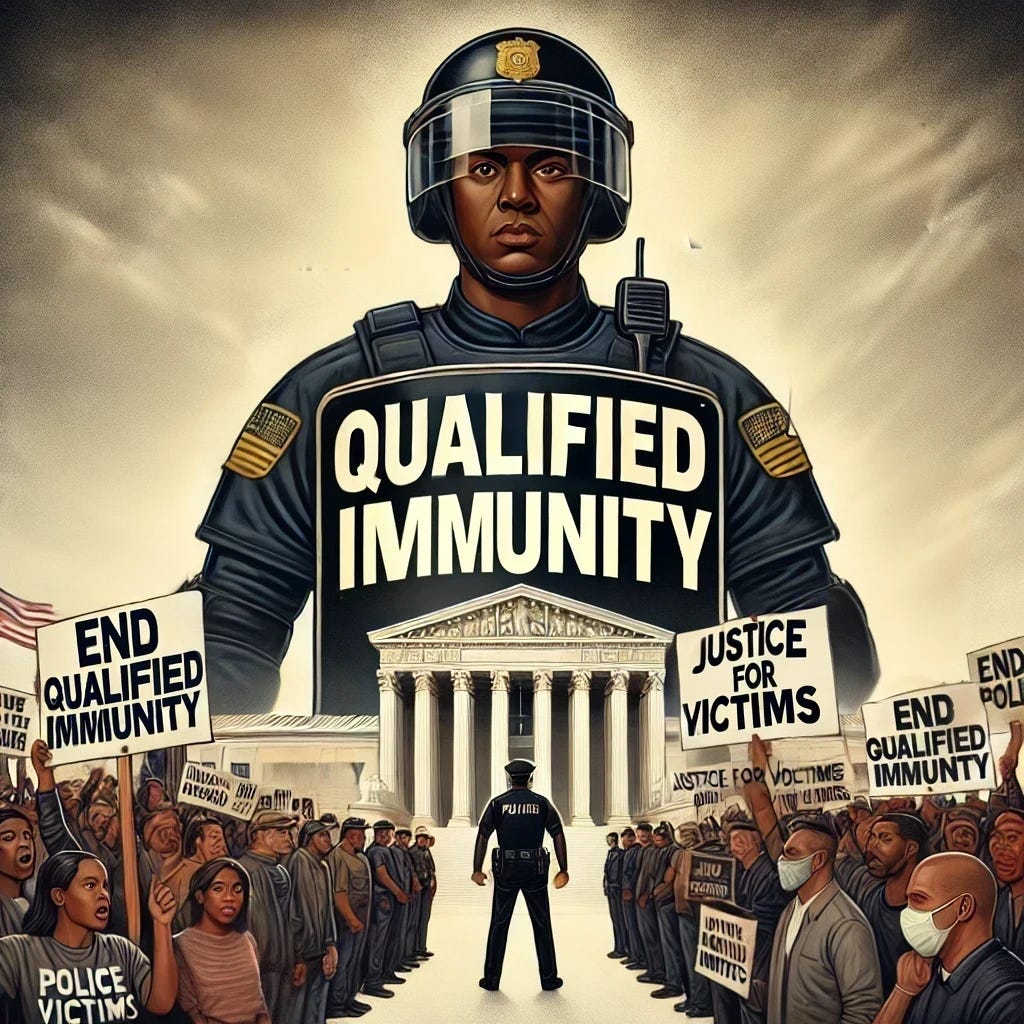
What Is Qualified Immunity? A Free Pass for Police Brutality
Qualified immunity is a get-out-of-jail-free card for police. It shields officers from lawsuits unless a victim can point to an identical past case where the courts ruled against similar misconduct.
Translation? If cops violate your rights in a way that hasn’t already been ruled illegal, they can get away with it, even if it’s blatantly unconstitutional.
The Supreme Court invented this doctrine in Harlow v. Fitzgerald (1982), claiming it would protect public officials from “frivolous lawsuits.” Instead, it’s morphed into a near-impenetrable legal shield for police brutality.
What This Looks Like in Action:
If officers wrongfully kill someone, but there’s no past ruling on that exact method of killing, they can be immune from lawsuits.
If police invade your home without a warrant, but the exact circumstances don’t match a prior case, they skate free.
If cops beat a protester unconscious, but the courts haven’t ruled on that precise method of assault, there is no justice.
This is not justice. It’s a rigged system.
The Supreme Court’s Long History of Siding with Police Over the People
The Supreme Court has had plenty of chances to dismantle qualified immunity. Instead, it has doubled down on protecting police.
One of the most well-known cases?
🔴 Tennessee v. Garner (1985) – The Case That Should Have Changed Everything
A Memphis police officer shot and killed 15-year-old Edward Garner as he fled a suspected burglary. Garner was unarmed, posed no immediate threat, and was running away, yet the officer still used deadly force.
The Supreme Court ruled that police cannot shoot fleeing suspects unless they pose an immediate danger, setting an important precedent on the use of force.
But here’s the problem:
Even though this case established that Garner’s killing was unconstitutional, it did nothing to eliminate qualified immunity. Officers in future cases continued to escape accountability for shooting unarmed civilians, claiming that no prior case had ruled on their exact set of circumstances.
Since then, the Supreme Court has repeatedly refused to close this loophole. Instead of ensuring accountability, the Court doubled down on shielding police:
Mendez v. County of Los Angeles (2017): Cops raided a home without a warrant, shot an innocent couple, and got away with it.
Pearson v. Callahan (2009): Officers violated the Fourth Amendment by entering a home without a warrant. Instead of accountability, the Court expanded qualified immunity.
Messerschmidt v. Millender (2012): Police raided the wrong home based on a faulty warrant. The Court sided with the officers, reinforcing their immunity.
Jimerson v. Lewis (2025): A SWAT team terrorized an innocent family during a botched raid, and the Supreme Court refused to hear the case, letting the officers walk free.
Even in cases where the Supreme Court acknowledges a constitutional violation, they consistently stop short of removing the legal shield that protects police from lawsuits.
And the result? Officers know that even if they break the law, the courts have their backs.
The Consequences: How Qualified Immunity Harms the Public
Police Officers Operate Without Consequences
Cops know that no matter what they do—whether it’s using excessive force, invading homes, or even killing civilians—they’ll likely walk away scot-free. This emboldens bad cops and corrupt departments.
Victims Are Denied Justice
Families who lose loved ones to police violence rarely get their day in court.
The System Becomes a Police Protection Racket
Police unions, prosecutors, and courts collaborate to shield law enforcement, turning qualified immunity into a weapon against accountability.
What Needs to Change? A Progressive Roadmap for Reform
End Qualified Immunity—NOW
Create a National Police Misconduct Database
Right now, officers fired for misconduct can quickly jump to another department without scrutiny. A federal misconduct database tracking disciplinary records, use of force complaints, and terminations would prevent bad cops from escaping accountability.Independent Oversight with Real Power
Departments cannot be trusted to police themselves. Civilian oversight boards with disciplinary authority are essential.Make Cops Personally Liable
If officers knew they could be sued personally, reckless policing would stop overnight.Reform the Supreme Court
SCOTUS has proven it won’t fix this. Expanding the Court or setting term limits would stop it from being a rubber stamp for police impunity.
Conclusion: Enough Is Enough
Let’s be clear: Qualified immunity is not about protecting good cops but about ensuring bad cops never face consequences.
Until we abolish this corrupt legal shield, police will continue to kill, brutalize, and violate rights with impunity.
This fight isn’t just about court rulings. It’s about justice. It’s about accountability. And it’s about stopping the next innocent person from becoming another statistic.
It’s time to demand change.
You power the Coffman Chronicle—no billionaires, no corporate overlords. Help us expose the BS, deliver sharp insights, and keep you informed.
You can fuel the fight and join the movement for just $8 a month or $80 a year.
Not ready to subscribe? No worries, chaos loves company, and you're always welcome.
Bibliography:
Eurasia Review. (2025, March 7). Can Police Raid the Wrong Home with No Consequences? SCOTUS Says Maybe [Op-Ed]. Eurasia Review. Retrieved from https://www.eurasiareview.com/07032025-can-police-raid-the-wrong-home-with-no-consequences-scotus-says-maybe-oped/
Human Rights Watch. (1998, June). Shielded from justice: Police brutality and accountability in the United States. Human Rights Watch. https://www.hrw.org/legacy/reports98/police/uspo02.htm
Oyez. (n.d.). Harlow v. Fitzgerald (1982). Oyez Supreme Court Archive. https://www.oyez.org/cases/1981/79-1738
Oyez. (n.d.). Tennessee v. Garner (1985). Oyez Supreme Court Archive. https://www.oyez.org/cases/1984/83-1035
Oyez. (n.d.). Pearson v. Callahan (2009). Oyez Supreme Court Archive. https://www.oyez.org/cases/2008/07-751
Oyez. (n.d.). Messerschmidt v. Millender (2012). Oyez Supreme Court Archive. https://www.oyez.org/cases/2011/10-704
Oyez. (n.d.). Mendez v. County of Los Angeles (2017). Oyez Supreme Court Archive. https://www.oyez.org/cases/2016/16-369
Reason Magazine. (2025, February 25). A SWAT Team Raided This Innocent Family’s Home. The Supreme Court Won’t Hear Their Case. Reason. Retrieved from https://reason.com/2025/02/25/a-swat-team-raided-this-innocent-familys-home-the-supreme-court-wont-hear-their-case/
Police State... sounds like Putin's Russia 🇷🇺
This is why we live in constant fear.