


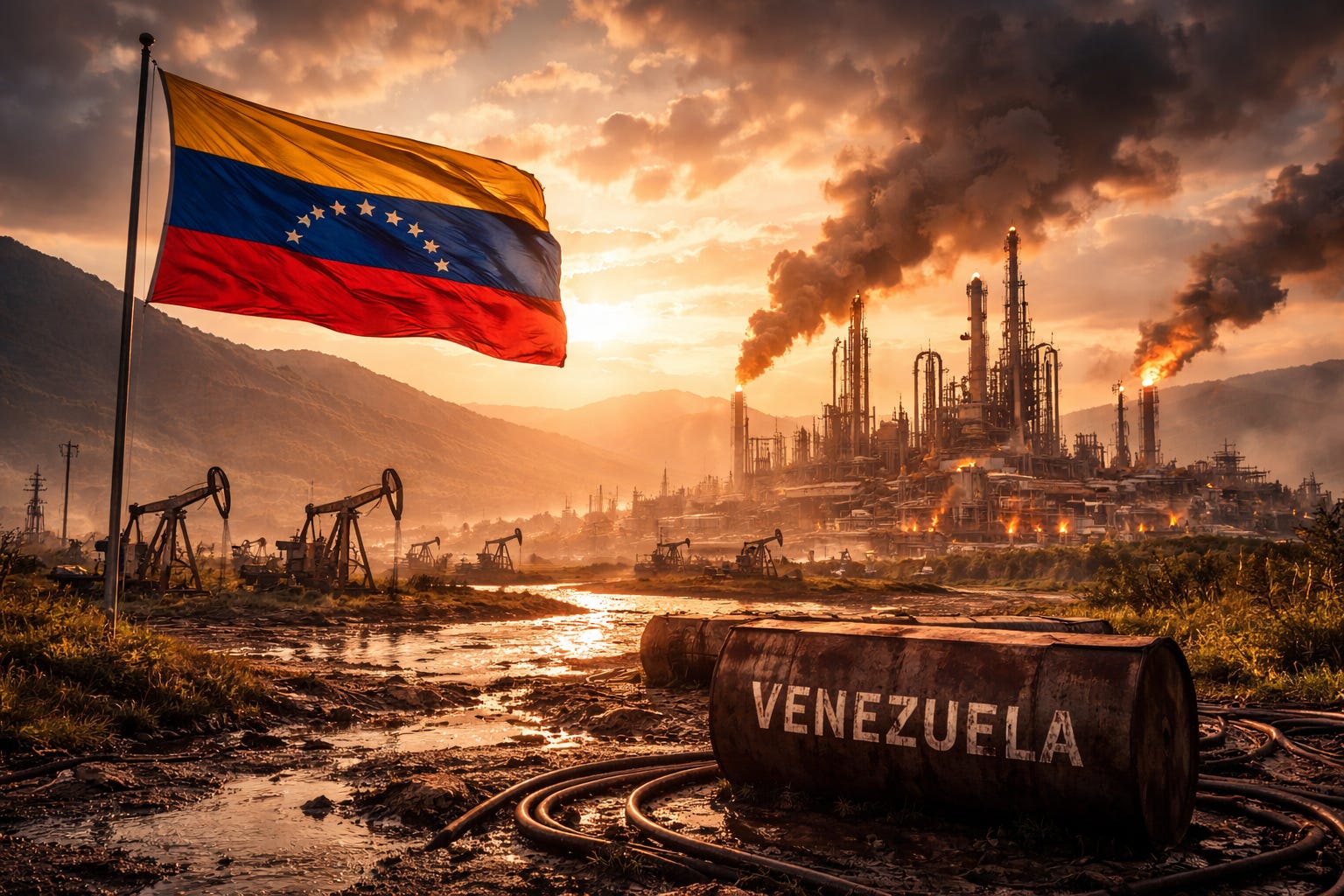
On December 16, 2025, Donald Trump posted on Truth Social that the United States intends to “reclaim the oil” Venezuela supposedly “took from us.” There was no mention of humanitarian concerns, no appeals to democracy, or even to national security. There wasn’t even any narrative scaffolding—just oil and vengeance.
There are no noble justifications, no pretense of peacekeeping. The empire is no longer hiding its motives behind platitudes. This isn’t a return to form. It’s a reveal.
Want to Know Your Rights?
Download a free digital copy of the U.S. Constitution, the same document Trump is trying to bulldoze. Learn exactly what he’s breaking, and how to fight back.
80,000+ strong — and counting.
This holiday, become a paid subscriber for just $1 a week and help us keep the truth alive.
Join The Coffman Chronicle — $1/Week
How We Got Here: Venezuela’s Nationalization, 1976
To understand the brazenness of Trump’s claim, we have to return nearly five decades, to January 1, 1976. On that day, Venezuela nationalized its oil industry, bringing all operations under the control of a newly created state-owned company: Petróleos de Venezuela, S.A. (PDVSA). This was not a coup nor a seizure at gunpoint. It was the passage of national legislation by a sovereign nation, carried out within the bounds of international law.
Until that point, Venezuela’s oil reserves — the largest proven in the world — had been controlled by a handful of multinational corporations, including U.S.-based firms like Exxon, Mobil, and Gulf Oil. These companies had operated for decades in the country, extracting massive wealth under contracts that were, in many cases, deeply favorable to corporate interests and deeply exploitative toward the Venezuelan people.
The nationalization law offered companies compensation for expropriated assets. Some, including ExxonMobil, rejected the settlement terms and pursued legal action through international arbitration. ExxonMobil eventually received a partial payout, though far less than it had initially demanded. Under international law, Venezuela had met its obligations. Sovereign nations have the right to nationalize their own natural resources, provided fair compensation is offered.
There was no ruling, then or now, that Venezuela stole anything from the United States. At most, American oil companies lost long-term business deals and profits, not national assets. Business, by its nature, is rife with risks and rewards. This was a civil legal dispute between corporations and a sovereign government. Most notably, it was resolved.
The Case That Was Closed Until the Military Showed Up
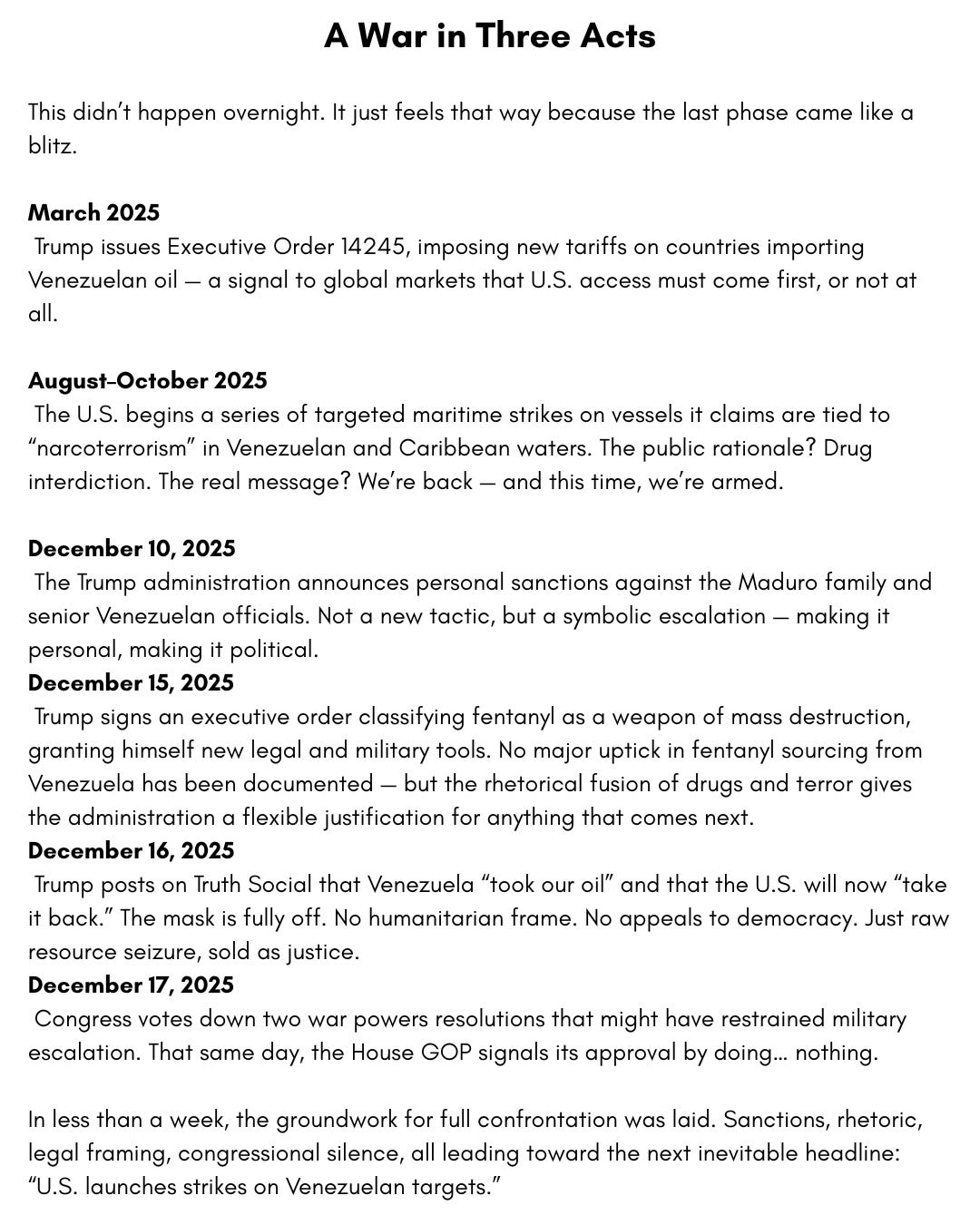
Trump’s language reframes that settled dispute as theft, and his administration’s military posture makes clear that the U.S. now intends to enforce that framing with the full weight of its naval and economic power. Over the past several weeks, the Trump administration has ordered strikes on Venezuelan boats it alleges were tied to drug trafficking operations, seized oil tankers, and instituted a sweeping blockade targeting Venezuela’s oil exports. This move, many international legal scholars have noted, may constitute an act of war.
The justification now given is that Venezuela took something that belonged to us.
However, the United States never had a legal or sovereign claim on Venezuela’s oil. It was never American territory. There were no treaties guaranteeing access to oil. No promises of permanent foreign control were issued. What Trump calls “ours” was, at most, private commercial interest held by corporations, not the U.S. government.
Those corporations had — and used — legal channels. They sued. They were compensated. They moved on.
So why hasn’t the United States?
The Power Behind the Flag
The answers are as simple and damning as you think.
First, Stephen Miller, the White House whisperer who uses legal loopholes like a jump rope, said plainly what this was about when he retweeted Trump’s post.
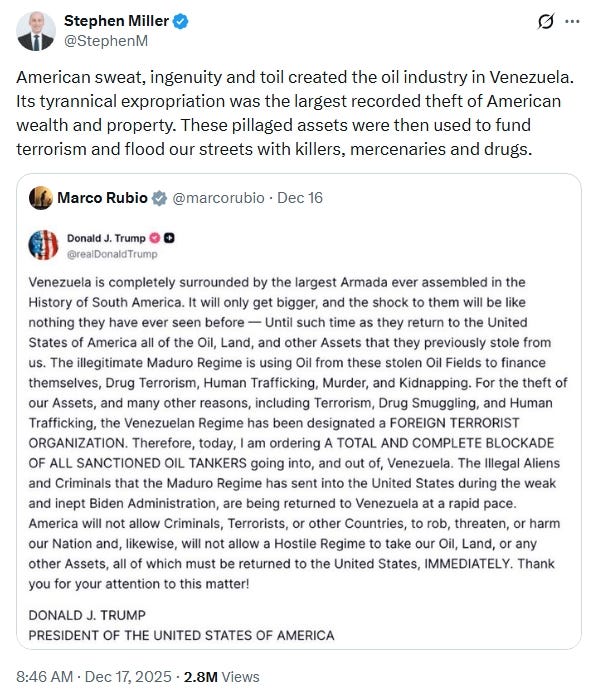
X.com
Then there are the oil companies and corporate interests that share their priorities, who have never stopped exerting pressure on American foreign policy.
ExxonMobil, Chevron, and other major fossil fuel interests spend tens of millions each year on lobbying. Their influence shapes energy, foreign, and military policy. The military-industrial complex — itself a dense web of contractors, donors, and consultants — has no financial interest in diplomacy when confrontation is more lucrative.
That has always been the answer. The military is being deployed to relitigate a corporate loss from the 1970s because the corporations never stopped demanding repayment. And the political class has never stopped delivering for their masters.
This isn’t about justice or security. It’s about softening the ground for re-entry — for future contracts, future drilling, and future profit. And if it takes a blockade, a bombing, or a coup to make that possible, so be it.
The Fentanyl Red Herring
On December 15, 2025, President Trump signed an executive order classifying fentanyl and its precursors as a “weapon of mass destruction.” The move, announced with characteristic bluster, was framed as a national security escalation in response to the domestic opioid crisis. The administration vowed to treat fentanyl the way it might treat a biological or chemical weapon, unlocking sweeping legal and military authorities for use against “foreign networks.”
That framing was already being used to justify military operations off Venezuela’s coast, including the blockade and targeted strikes on boats allegedly linked to drug trafficking. It is, we’re told, part of a broader “counter-narcotics” effort to protect American lives.
There’s just one problem. Venezuela is not a meaningful source of fentanyl entering the United States.
The vast majority of fentanyl and its chemical ingredients come through Mexico, with precursor compounds often shipped from China. This has been stated repeatedly by federal law enforcement and international analysts. Even members of Trump’s own administration — including Secretary of State Marco Rubio, in a congressional hearing — have acknowledged that Venezuela is not a significant part of the fentanyl supply chain.
Unsurprisingly, the facts don’t appear to matter. The drug war narrative is simply more useful than the truth. It adds moral urgency to a resource war. It stirs public anger. It allows the administration to invoke terrorism-adjacent rhetoric to justify military actions that would otherwise face legal and diplomatic scrutiny.
Fentanyl is real. The crisis is real. However, in this case, the fentanyl framing is a sleight of hand, a convenient justification, not a genuine cause. And like the WMD claims in Iraq, it may prove just as effective in launching an unnecessary war.
The difference? Bush never admitted it was really about oil. Trump did.
What We Could Have Done Instead
There was another way. Venezuela, under Maduro, had signaled a limited openness to diplomatic engagement in recent months. There were talks, envoys, and even the outline of a framework for cooperation.
The United States could have used its corporate power to offer infrastructure investment in exchange for oil access, not as a bribe, but as a partnership. This could have focused on rebuilding power grids, hospitals, and roads, creating jobs, stabilizing the economy, and easing the suffering that has driven millions of Venezuelans northward in search of safety and food.
Such a policy would address America’s so-called immigration “problem” far more effectively than militarizing the border. It would reduce the influence of China and Russia by offering an alternative rooted in shared prosperity. It would increase American energy access without firing a shot. If fentanyl were really the root cause, such cooperation and investment would address that as well.
But that model requires a willingness to share profits, a foreign policy that values stability over dominance, and a view of Venezuela as a partner, not a vassal. Notably, it also removes the political power of fear of immigration.
As a result, it was never on the table.
What We’re Risking
Instead, we are on the edge of another regime-change campaign with all the predictable consequences.
If this turns into war, it will not be short. It will not be clean. It will destabilize a region already stretched thin by poverty, migration, and climate pressure. It will drive more people to our borders, not fewer. It will push Venezuela — and its oil reserves — closer to China and other global powers eager to offer an alternative to U.S. bullying.
If you wanted to alienate a hemisphere, enrich defense contractors, create another forever war, and deepen domestic chaos, you couldn’t design a better plan.
This Is What Empire Does
This is not new. For generations, the United States has used its military, intelligence agencies, and financial power to control the internal politics of other nations, especially in Latin America. From Guatemala to Chile to Honduras to Panama, the U.S. has backed coups, funded rebels, armed death squads, and installed dictators, all to protect commercial interests and geopolitical dominance. The entire global south has been our playground for extractive political theatre.
We’ve reported previously on the history of U.S. action in Latin America. See that here:
Note: Articles roll into the archive over time. Please consider becoming a paid subscriber for exclusive perks including occasional early access, special content, and access to our full extensive article archive.

The only real difference now is tone. The excuses are thinner, the language more blatant. There are no covert operations or secret cables. There are tweets, Truth Social posts, and press conferences where the president talks openly about annexing Panama or threatening Venezuela if it elects the wrong leader.
The empire no longer hides what it is. It doesn’t have to.
Where Is Congress?
Congress, under the Constitution, is tasked with declaring war and funding military operations. It has the power to stop this. It didn’t.
Yes, the National Defense Authorization Act includes symbolic language sunsetting older Authorizations for the Use of Military Force. However, the 2001 AUMF — the one Trump is using to justify strikes in the Caribbean — remains untouched. The Senate just passed the NDAA with that language intact. The House passed it before them.
See our previour reporting here:

On December 17, the House voted on two Democrat-led war powers resolutions that would have required explicit congressional approval for any further military action against Venezuela. One aimed to block unauthorized escalation. The other attempted to prevent ground deployment. Both failed.
The votes came just one day after Trump designated Venezuela’s government as a “foreign terrorist organization” and ordered a “total and complete blockade” of oil imports and exports. The timing made the meaning clear. The House won’t stop him, not when it counts.
Democrats gestured at oversight. Republicans closed ranks. And the war powers — once again — were ceded by vote, not stolen by force.
Congress isn’t powerless. It’s just complicit. Its members take money from the same fossil fuel and defense interests that drive this policy. They issue letters. They post statements. Occasionally, they float a resolution. They do not stop the machine.
We’ve reported extensively on the ceding of Congressional power. See some here:
Note: Articles roll into the archive over time. Please consider becoming a paid subscriber for exclusive perks including occasional early access, special content, and full access to our full article archive.

Even those who once built reputations as anti-interventionists, like Tulsi Gabbard, now serving as Director of National Intelligence, have remained silent. Power has a way of muting principles.
Beacon or Burnout
We call ourselves the light on the hill, the guardian of democracy, the standard bearer for the rule of law.
Yet when we send warships to enforce a corporate grudge, when we blockade a nation to reopen access for oil executives, when we militarize poverty and turn suffering into leverage, what we are is not democratic. What we are is imperial.
This is not about keeping Americans safe. This is about keeping the donors happy, keeping the corporations fed, and keeping the machine running, even if it runs on lies and blood.
And who pays? We pay do, in tax dollars, in credibility, and in lives. While we ration insulin, close schools, and criminalize desperation, our leaders play empire with what’s left of the treasury.
And the worst part? They’re not even pretending anymore.
Don’t let the bastards sneak anything past you. Subscribe and get your daily dose of rage and receipts delivered fresh, before the spin doctors can scrub it.
Sources:
Trump orders blockade of sanctioned oil tankers entering and leaving Venezuela — The Guardian (Dec. 16, 2025)
Oil rises as Trump’s Venezuela blockade takes edge off global crude surplus concerns — Reuters (Dec. 17, 2025)
Trump aide Stephen Miller suggests Venezuelan oil belongs to US — Al Jazeera (Dec. 17, 2025)
US slaps sanctions on Maduro family, Venezuelan tankers: What we know — Al Jazeera (Dec. 12, 2025)
Venezuela Accuses Trump Administration of ‘Piracy’ After Oil Tanker Seizure — Time (Dec. 10, 2025)
US strike on alleged drug boat in Pacific kills four, as Trump accuses Venezuela of taking ‘our oil’ — The Guardian (Dec. 17, 2025)
Mexican president calls on UN to avoid bloodshed in Venezuela — Reuters (Dec. 17, 2025)
House crushes Dems’ attempt to rein in Trump’s military campaign against Venezuela — New York Post (Dec. 17, 2025)
Trump brands fentanyl a ‘weapon of mass destruction’ in drug war escalation — Reuters (Dec. 15, 2025)
Fact Sheet: President Donald J. Trump Designates Fentanyl as a Weapon of Mass Destruction — The White House (Dec. 15, 2025)
Experts assess Trump’s declaration of fentanyl as weapon of mass destruction — STAT News (Dec. 15, 2025)
2025 United States military strikes on alleged drug traffickers — Wikipedia
2025 United States naval deployment in the Caribbean — Wikipedia
Executive Order 14245: Imposing Tariffs on Countries Importing Venezuelan Oil — Wikipedia
I agree Maduro is essentially a despot and is creating more harm than good for the people of Venezuela, but this act and the mindset of Trump puts him in the same category of Madura as being a dictator and a thug. Big oil in this country should focus on the developing alternative fuels including fusion !! We should not be war mongering like Putin !
History has set a presidence for taking lands, breaking treatise especially in non white nations