


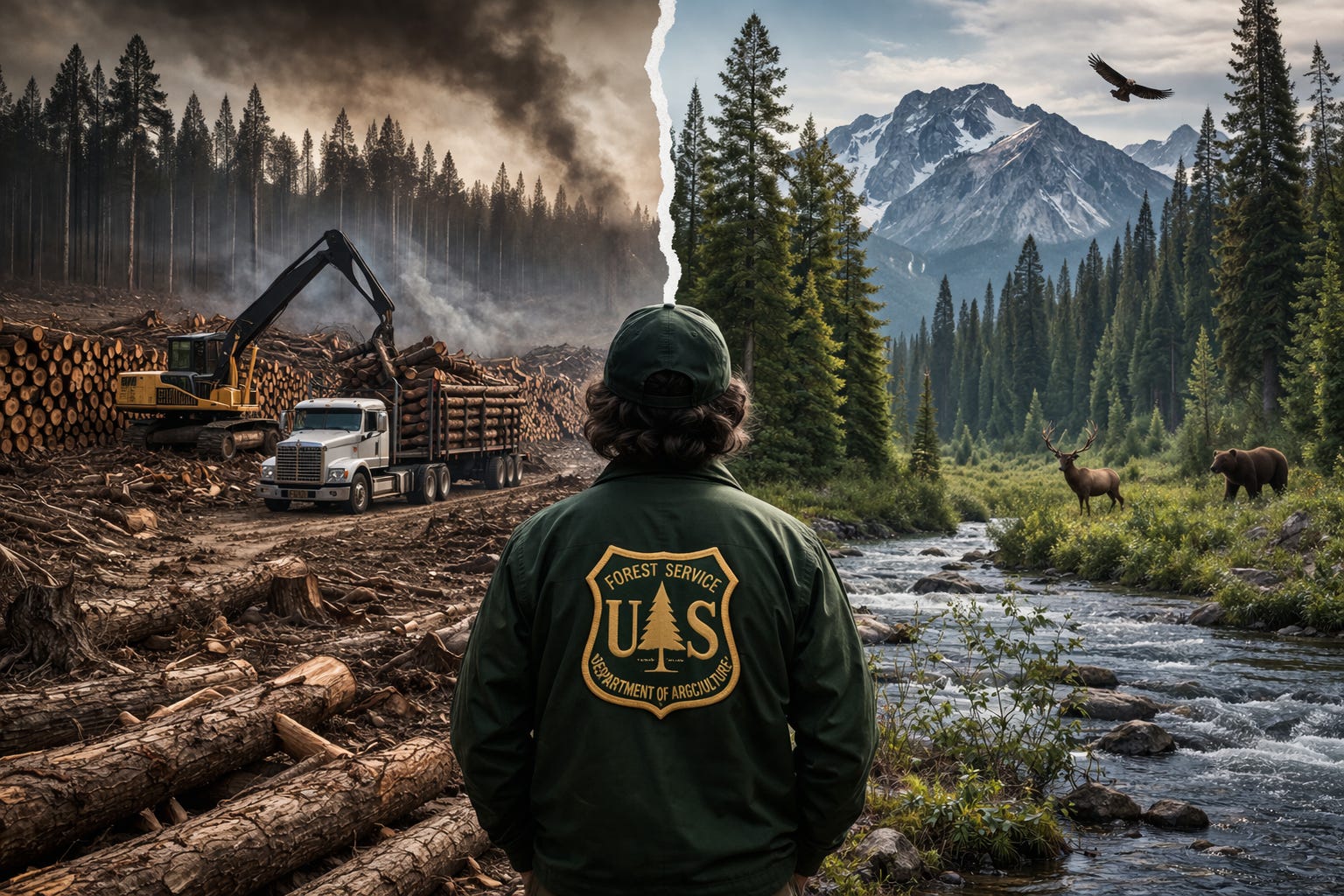
On March 31, 2026, the U.S. Department of Agriculture announced a sweeping restructuring of the U.S. Forest Service. The plan moves the agency’s headquarters from Washington, D.C., to Salt Lake City, eliminates all regional offices, and consolidates research leadership in Fort Collins, Colorado. It is framed as a modernization effort designed to bring leadership closer to western forests, streamline decision-making, and improve efficiency. The announcement also makes clear that the changes will unfold in phases over the coming year, with more detailed guidance to follow.
On its face, that may sound like a familiar Washington story about bureaucratic reshuffling. However, the context matters. This restructuring arrives after a formal public comment period that closed on September 30, 2025, during which USDA says it received 46,845 emails. In its own analysis of the non-form comments, the department reports that 82% expressed negative sentiment. The themes were not obscure. Commenters repeatedly raised concerns about the loss of local expertise, the weakening of research capacity, risks to the agency’s mission, and the lack of transparency around how such a large transition would be carried out. Notably, many of those comments came from within the field.
The final announcement does not read like a response to those concerns. It reads like a decision to proceed anyway.
This Community Is Powered by You
What started as a small circle has grown into something much bigger, and it’s all because of readers like you.
Every time you forward this email, post it on socials, or bring someone new into the fold, you’re helping build one of the most passionate, independent political communities out there.
Want to keep the momentum going?
Share this newsletter with someone who should be part of this conversation.
Thank you for being here. It means everything.
What the Forest Service Actually Does
To understand why this matters, it helps to step back from the announcement and consider the institution being reshaped.
The U.S. Forest Service was established in 1905 under President Theodore Roosevelt. Today, it manages roughly 193 million acres of public land across 154 national forests and 20 national grasslands. That is an area larger than the state of Texas. It is also one of the primary agencies responsible for wildfire response, outdoor recreation access, watershed protection, and forest science in the United States.
The agency’s mission is not singular. Under the Multiple-Use Sustained-Yield Act of 1960, the Forest Service is required to balance timber production, recreation, conservation, water protection, and scientific research. The idea is not to maximize any one of those priorities. It is to manage them together over time so that forests remain healthy, productive, and accessible to the public.
That balancing act is difficult even under stable conditions. It becomes more complicated when the agency's structure itself is changing.
The Forest Service does not operate in isolation. Its lands often surround and connect to those managed by the National Park Service, which is tasked with preservation rather than multiple use. In practice, national forests frequently serve as buffers for national parks, absorbing recreational use, supporting shared ecosystems, and helping to manage wildfire and watershed risk. Those systems do not stop at administrative boundaries. If the Forest Service weakens its regional capacity, scientific infrastructure, or stewardship balance, the effects are not confined to forest land. They ripple outward into the parks and landscapes that depend on those same systems.
See our previous reporting regarding the National Park Service and Forest Service here:
Note: Articles roll in the archive over time. Become a paid subscriber for full access to our extensive catalog.


The Missing Link Between Comments and Policy
The restructuring is being carried out under Forest Service Chief Tom Schultz, who was appointed on February 27, 2025. His selection was notable. The agency has said he is the first chief not to come from within the Forest Service, and his background includes both public land management in Idaho and a senior role at Idaho Forest Group, a timber company. That does not, on its own, determine the merits of this restructuring. Yet it does place a significant institutional overhaul—announced just over a year into his tenure—within a leadership context that appears more comfortable foregrounding production than clearly explaining how science, conservation, and regional expertise will be protected.
The USDA’s own comment analysis provides a clear picture of what stakeholders were worried about before this announcement was finalized. Employees, retirees, researchers, tribal representatives, and other partners emphasized the importance of regional expertise, long-term scientific capacity, and institutional continuity. These were not abstract objections. They were grounded in how the Forest Service actually functions.
The March 31 announcement, however, does not directly address those concerns. It emphasizes efficiency, proximity to western lands, and the benefits of “active management.” It also explicitly states that the restructuring will support timber growers and increase timber production. There is far less detail about how the changes will preserve the scientific and regional infrastructure that underpins the agency’s broader mission.
That gap is not just rhetorical. It shapes how the plan is understood, and comes after a year of administration policy focus on extraction over conservation.
See our previous reporting here:
Notes: Articles roll in our archive over time. Become a paid subscriber for full access to our extensive catalog.

Why Regional Structure Is Not Just Bureaucracy
One of the most consistent concerns raised during the comment period was the potential loss of regional expertise. At first glance, regional offices can sound like administrative overhead. In practice, they are part of how the Forest Service manages vastly different ecosystems across the country.
Forests in the Pacific Northwest, the Rocky Mountains, and the Southeast do not behave the same way. They face different fire regimes, pests, water systems, and climate pressures. Regional offices and distributed facilities exist in part to reflect that reality. They connect local staff, state partners, and federal leadership in ways that allow decisions to be informed by place-based knowledge.
Eliminating that structure does not eliminate the differences between those landscapes. It changes how the agency navigates them.
This is also where relationships matter. Wildfire response, for example, depends on coordination with state agencies, local fire districts, and tribal governments. Those relationships are built over time and often maintained through regional networks. A more centralized structure may streamline authority on paper, yet it risks weakening the connective tissue that makes coordination work in practice.
The Quiet Role of Science, Universities, and the Talent Pipeline
The research question is just as important but easier to overlook.
The Forest Service operates a distributed research system that includes multiple research stations, laboratories, and long-term field sites across the country. These are often located near universities, creating partnerships that support graduate training, shared data, and region-specific expertise. A lab in the Northeast may focus on hardwood forests and invasive species common to that region, while a lab in the West may specialize in wildfire behavior and drought conditions.
Those university connections are not incidental. They are part of how the agency sustains its scientific capacity and its workforce. Students work alongside Forest Service scientists, build expertise in forest ecology, fire science, watershed management, and invasive species, and often move into federal or state roles. When a regional lab disappears, that pipeline does not simply relocate. It can weaken or break.
Reporting on the restructuring suggests that this consolidation could affect research facilities in 31 states, not just a handful of offices. That scale means the disruption is not localized. It reaches across a national network of labs, field sites, and university-linked research communities.
Centralizing research leadership in Fort Collins may simplify administration. It does not make ecosystems less local, nor does it replace the value of scientists embedded in the regions they study.
Timing, Transparency, and Fire Season
The timing of the announcement adds another layer of concern.
The restructuring was announced on March 31, just four weeks before wildfire activity begins to ramp up across much of the West. The press release states that changes will occur in phases over the coming year and that detailed transition guidance will be provided as milestones approach. It also assures the public that there will be no interruption to fire operations.
Those assurances may ultimately prove accurate, yet the lack of a detailed public timeline makes it difficult to evaluate how continuity will be maintained during the transition. Moving staff, closing offices, and reorganizing chains of command are complex processes even under ideal conditions. Doing so on the cusp of fire season raises obvious operational questions.
This is where the earlier comment record becomes relevant again. Stakeholders did not only raise abstract concerns about structure. They also asked for clearer implementation plans and more transparency about how the transition would work. The announcement signals that more details are coming, but does not yet provide them.
Production Depends on Stewardship
One of the clearest problems with the USDA announcement is not simply what it says. It is what it assumes.
The press release speaks in confident terms about streamlining management and boosting timber production, as though production were the obvious measure of success. Yet the Forest Service was not built to function as a timber-maximizing agency. It was built to balance timber, recreation, watershed protection, ecosystem health, and scientific research over time. That balance is the mission.
The production side of that equation does not stand on its own. Timber output depends on healthy forests, usable watersheds, effective fire management, and the science required to understand pests, drought, and long-term ecological change. When those systems are weakened, production may still rise for a while. Yet the conditions that make future production possible can quietly deteriorate underneath it.
The issue is not whether timber matters. It does. The issue is whether the administration is treating the scientific and conservation side of the Forest Service’s mandate as the foundation of production, or as an obstacle to it. The March 31 announcement speaks directly about increasing timber production. It does not, however, offer the same level of clarity about how this restructuring strengthens research, conservation, or long-term stewardship.
What Comes Next
The Forest Service is not a marginal agency. It manages nearly 200 million acres of public land and plays a central role in wildfire response, ecosystem management, and outdoor recreation. Changes to its structure carry real consequences for how those responsibilities are carried out.
The administration has made its decision to move forward with a major reorganization despite widespread concerns from the field. The public has seen the broad outline of that plan, along with assurances that operations will continue uninterrupted. What remains less clear is how the agency will preserve the local expertise, scientific capacity, and institutional continuity that underpin its mission.
That uncertainty is not an argument against change in itself. Rather, it is an argument for clarity. When an agency of this scale and significance is reshaped, especially on the eve of another wildfire season, the details matter as much as the direction.
Public lands, public policy, and the decisions shaping them deserve more than surface-level coverage. Subscribe for clear, grounded analysis that follows the details where they lead.
Sources:
USDA Prioritizing Common Sense Forest Management, Moves Forest Service Headquarters to Salt Lake City, USDA, March 31, 2026.
USDA Reorganization: Summary and Analysis of Feedback, USDA, December 8, 2025.
USDA Reorganization, USDA
Meet the Forest Service, U.S. Forest Service
About the Agency, U.S. Forest Service.
A Citizens’ Guide to National Forest Planning, U.S. Forest Service
Trump plans to move Forest Service headquarters to Utah and shutter research sites, Associated Press, March 31, 2026.
NPS Organic Act of 1916, National Park Service, January 27, 2021
The Lyin' King and Muskrat want to sell off ALL public land to oligarchs for the creation of 'freedom cities' where they will be free to do whatever they desire with the occupants. The first step is to destroy the organization that manages these lands. Welcome to modern feudalism.
These destroyers seek to use the demise of the natural environment as a reason to leave earth for Mars and beyond. I am enlightened by actions of much of the rest of the peoples of the earth to protect the natural world though not enough. But the US / Native Lands are among the most beautiful on earth, it will be an unforgivable sin to destroy them by selling to capitalist exploiters. It will rank as the most rank political actions ever made qualifying them all for expulsion from earth.