


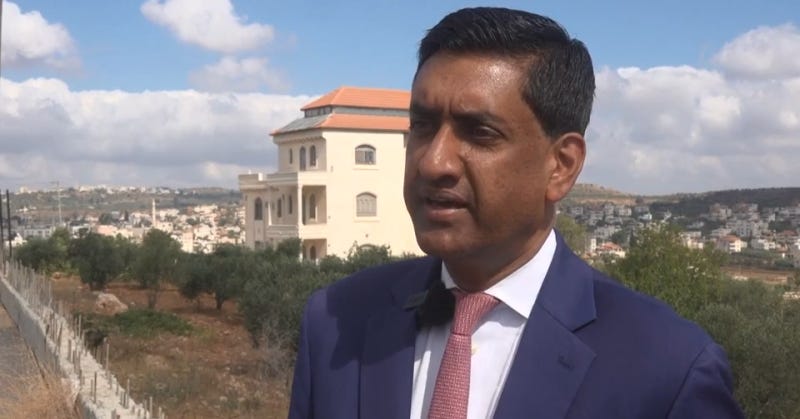
Rep. Ro Khanna said armed Israeli settlers detained him and other Americans during a visit to the occupied West Bank, creating a new flashpoint in the widening U.S. political fight over Israel, settlement violence and American military aid.
Reuters reported that Khanna said settlers carrying U.S.-made M4 rifles blocked his group’s van during a tour near Khirbet Zanuta, a Palestinian hamlet in the southern West Bank. An aide who was with Khanna said the group was held for more than an hour and appealed to the U.S. Embassy in Jerusalem before police intervened.
The Israeli military gave a different account. The IDF said troops and police responded after receiving a report of Israeli citizens blocking foreign nationals and media, then dispersed the civilians and reopened the road. AP reported that the IDF denied its soldiers took part in blocking Khanna’s group.
Khanna escalated the dispute Sunday, saying the IDF was lying about the incident. He said settlers threatened and mocked his group before soldiers arrived and further blocked them in. He called for investigations into both the settlers and soldiers involved.
Subscribe free for daily political analysis they won’t broadcast. Join 110K+ readers →
Israeli officials pushed back. The Guardian reported that Israel’s ambassador to the U.S., Michael Leiter, accused Khanna of staging a political trip and rejecting Israeli efforts to shape the visit. Khanna responded that he had met Israeli hostages and condemned the Oct. 7 attacks, but said that did not excuse the detention of American citizens.
The broader consequence is political. Reuters noted that Israel receives about $3.8 billion per year in U.S. military aid, while AP reported that 58 percent of Democrats in a recent AP-NORC survey said the U.S. is too supportive of Israel.
That makes the Khanna incident more than a travel confrontation. It gives Democrats a concrete, high-profile case to cite as they debate settlement policy, U.S. weapons support and whether American aid should carry stronger human-rights conditions.
Subscribe free for daily political analysis they won’t broadcast. Join 110K+ readers →