


The night sky has never been more active. Rockets launch weekly, streaking across the atmosphere, and constellations of Starlink satellites orbit above us like glowing pearls. To many, it's the golden age of space exploration. But to those watching more closely, it's something darker: the quiet dismantling of environmental safeguards in the name of profit, enabled by the Trump administration and exploited by Elon Musk.
"It's not just the sky we're losing. It's the climate, the silence, the science."
— Environmental scientist, anonymous source near Boca Chica
What we're witnessing isn't just the privatization of space. It's the pollution of it, and the deregulation of the agencies that could stop it. The consequences won't stay up there. They will come down to Earth in the form of climate disruption, ozone depletion, and silenced science.
We just hit 13,000 subscribers—thank you! We’re offering full access to The Coffman Chronicle at 50% off to celebrate.
Get exclusive analysis and fearless reporting you won’t find in corporate media.
Trump Cleared the Launchpad
In a sweeping series of executive actions, the Trump administration rolled back decades of environmental policy. One of the most consequential changes was gutting the National Environmental Policy Act (NEPA), a bedrock law that required environmental review of major federal projects, including space launches.
By rescinding Executive Order 11991, Trump effectively declawed the EPA’s oversight of new launch sites. The FAA, with its dual mission of promoting and regulating aerospace, became the only gatekeeper. That cleared the way for SpaceX to dramatically expand its operations at Starbase, Texas, without complete environmental assessments.
At the same time, the administration ended funding for research into rocket and satellite pollution, cutting off the very data needed to hold companies accountable. This void in oversight created ideal conditions for Elon Musk to ramp up launch activity without concern for long-term environmental impacts, making it harder for scientists to measure the damage being done.
Billionaire in the Blast Zone
No one has taken more advantage of this regulatory vacuum than Elon Musk. As SpaceX launches hundreds of Starlink satellites per year and tests massive rockets like Starship, environmental oversight has been minimal.
Musk, who played a key role in launching Trump’s post-reelection Department of Government Efficiency (DOGE), has long pushed for deregulation. His companies benefit enormously from fast-tracked approvals, tax breaks, and public contracts, but are rarely held accountable for environmental costs.
When asked about critics, Musk has often responded with deflection or disdain. Meanwhile, his satellites burn up on re-entry, releasing harmful aluminum oxides into the upper atmosphere.
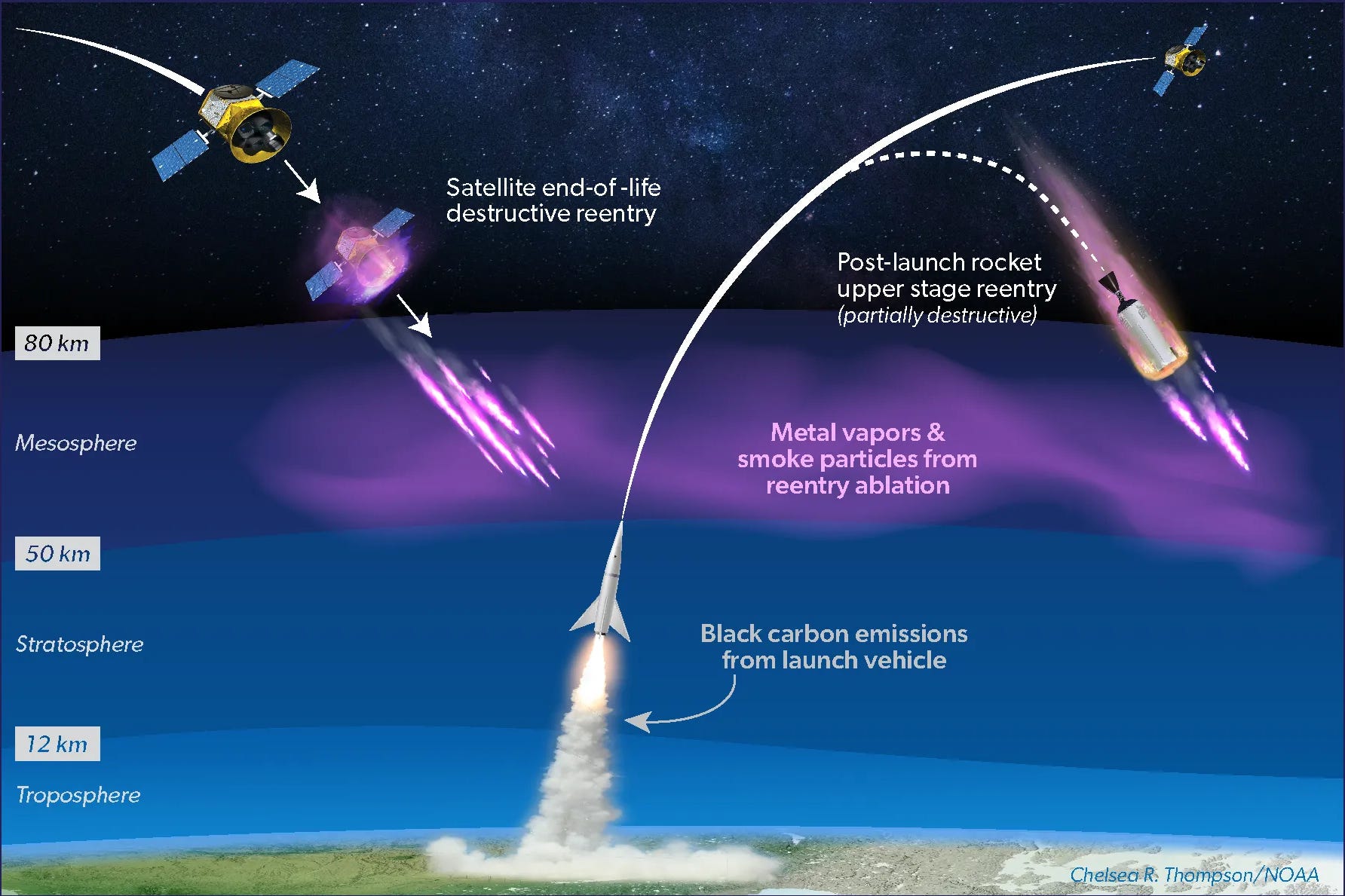
The various layers of Earth's atmosphere and how satellites vaporize as they hit the mesophere at the end of their lifetimes. This process seeds the middle and upper atmosphere with metal vapors, aerosols, and smoke particles. The mesosphere is also where naturally occurring meteors vaporize. The ozone layer lies within the stratosphere. Graphic: Chelsea Thompson, NOAA
We’ve covered DOGE, Musk, and the deregulation efforts of the administration extensively. We have a full series on deregulation in our archive. This article may be of interest for further context:
Note: Articles over 45 days old move into the archive. Consider becoming a paid subscriber to enjoy all 500+ articles, exclusive content, and occasional early access.

The Pollutants We Don’t See
Rockets don’t just punch holes in the sky. They inject it with black carbon, nitrogen oxides, water vapor, and alumina at altitudes where these particles can linger for years.
A 2022 study published in Nature Communications found that soot from frequent launches could lead to localized warming over the poles. The aluminum oxides from both launches and re-entering satellites threaten to thin the ozone layer, which protects life on Earth from harmful UV radiation.
Satellite re-entry—once a rare event—is now constant. This growing frequency is a direct result of policy failures that abandoned the need for oversight, allowing companies like SpaceX to saturate the skies without environmental checks. With thousands of Starlink satellites planned, the upper atmosphere could soon be saturated with combustion byproducts that no one is regulating.
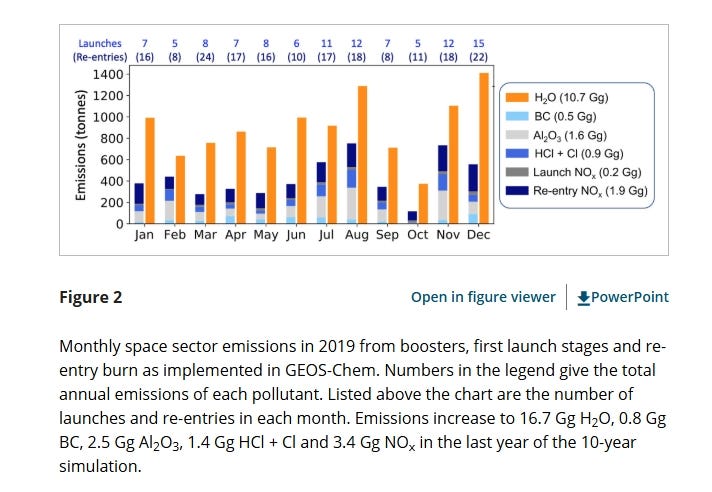
The chart below the impact in 2019.
Boca Chica Burns
On the ground, the consequences are already visible. In Boca Chica, Texas, SpaceX’s Starbase launch facility has scorched protected land, scattered debris across sensitive ecosystems, and driven local residents from their homes. Environmental groups have filed lawsuits alleging that the FAA failed to conduct a proper review of Starship launches.
"We used to hear birds. Now we hear sonic booms,"
— Maria T., Boca Chica resident
What used to be a wildlife haven is now a testing zone for interplanetary ambition. This transformation was made possible by weakened oversight and deregulation that prioritized corporate speed over community safety. Thanks to policy changes made under Trump, it remains largely shielded from scrutiny.
Who Benefits, Who Pays
Winners:
Elon Musk and SpaceX
Aerospace investors and contractors
Trump-aligned deregulators
Losers:
Our climate and ozone layer
Local communities and ecosystems
Scientists whose research was defunded or silenced
Future generations who will inherit the cost
Opposition Rises
Not everyone in Washington is on board. Rep. Zoe Lofgren (D-CA) criticized the Trump administration for "handing billionaires blank checks while muzzling scientists." Sens. Jeff Merkley (D-OR) and Lisa Murkowski (R-AK) opposed the halting of EPA climate funding, which included pollution tracking.
The Congressional Environmental Justice Caucuses issued joint statements condemning the NEPA rollback, warning that low-income and Indigenous communities bear the brunt of this deregulated chaos.
Some international partners, like the European Space Agency (ESA), are already exploring stricter environmental standards for launches and satellite decommissioning. In contrast, the U.S. has rolled back many of its oversight mechanisms, creating a regulatory gap that not only harms the atmosphere but also undermines global leadership on sustainable space policy. This divergence is putting the U.S. on the defensive diplomatically and environmentally.
What Happens If We Do Nothing
By 2030, some experts estimate thousands of satellites will burn up annually in Earth’s atmosphere. Without strict environmental review and international agreements, we may face:
Accelerated ozone depletion
Warming in sensitive polar regions
Air pollution near launch and reentry corridors
A breakdown in global cooperation on space governance
This is the cost of doing nothing: a climate altered not just by coal or oil but also by aluminum and soot falling from orbit.
Call to Action
If you believe the sky should not be for sale, that we deserve clean air, climate science, and accountability, then act now.
Call the U.S. Capitol Switchboard at (202) 224–3121.
Tell your representative:
Restore NEPA protections for all launch sites.
Fully fund the EPA, NOAA, and NASA’s climate science divisions.
Support legislation to regulate space-based pollution.
Have you seen a Starlink streak? That glow is more than light. It’s power burning unchecked. Share this story before the sky burns too bright to ignore.
We just hit 13,000 subscribers—thank you! We’re offering full access to The Coffman Chronicle at 50% off to celebrate.
Get exclusive analysis and fearless reporting you won’t find in corporate media.
Bibliography
The Guardian. “Rocket launches and satellite returns creating dangerous pollution, scientists warn.”
The Guardian. “Dying satellites can drive climate change and ozone depletion, study finds.”
Business Insider. “Elon Musk's Starlink satellites could help deplete the ozone layer, study warns.”
Bloomberg. “Thousands of Falling Satellites Put the Atmosphere at Risk.”
The Verge. “Elon Musk and Trump's Project 2025: Inside the push to dismantle environmental enforcement.”
AguPub. “Impact of Rocket Launch and Space Debris Air Pollutant Emissions on Stratospheric Ozone and Global Climate.”
NOAA Chemical Sciences Lab. “Within 15 years, plummeting satellites could release enough aluminum to alter winds, temps in the stratosphere.”
Scientific American. “Global 3D rocket launch and re-entry air pollutant and CO2 emissions at the onset of the megaconstellation era.”
MySanAntonio. “FAA clears SpaceX for full Starbase launch operations.”
House Committee on Science, Space, and Technology. https://democrats-science.house.gov
Public Employees for Environmental Responsibility (PEER). https://www.peer.org
It‘s unbelievable. But I admit, until now, I hadn't thought that far. 🫢
With all of Musks money he could fix the world's problems and find an environmental solution for his tech. He would leave a legacy of hope. Instead he is destroying the world. I don't think my grandchildren will have a livable world. All so a greedy racist can amass more money.