


At a scholarship event honoring one of the most recognizable names in American broadcast journalism, an 18-year-old student journalist sparked a national conversation about language, media, and the increasingly unstable meaning of the word “news.”
Santiago Campos, a student journalist and recipient of the Mike Wallace Memorial Scholarship, drew widespread attention after criticizing CBS News during his acceptance speech. Reactions to his remarks quickly divided along familiar political and ideological lines. However, the intensity of the response revealed something larger than disagreement over one student’s comments or one network’s editorial choices.
The controversy surrounding Campos’s remarks raises a deeper question. Do Americans still share a common understanding of what journalism is supposed to be?
This Community Is Powered by You
What started as a small circle has grown into something much bigger, and it’s all because of readers like you.
Every time you forward this email, post it on socials, or bring someone new into the fold, you’re helping build one of the most passionate, independent political communities out there.
Want to keep the momentum going?
Share this newsletter with someone who should be part of this conversation.
Thank you for being here. It means everything.
The Speech That Sparked a Debate
Campos, a senior at the District of Columbia International School, received the Mike Wallace Memorial Scholarship during the News & Documentary Emmy Awards in New York City. The scholarship, named for legendary CBS journalist Mike Wallace, honors promising young journalists entering the profession.
During his acceptance speech, Campos praised journalism while also criticizing what he described as the current direction of major media institutions, including CBS. Among the remarks that generated the strongest reactions were comments criticizing the network’s handling of politically sensitive reporting and its reluctance to use certain language in coverage of international events.
One line in particular circulated widely online after Campos referenced the network’s hesitation to use the word “genocide” in certain contexts. Supporters described the remarks as courageous and overdue criticism of institutional caution. Critics viewed them as inappropriate political activism delivered during an event intended to celebrate journalism rather than challenge it.
The speech quickly spread across social media, news commentary programs, and political discussion forums. Much of the resulting debate focused on Campos himself, his politics, or the substance of his criticism. However, the reaction to the speech may ultimately prove more revealing than the speech itself.
Campos did not merely criticize a network. He touched a fault line in American public life regarding how people understand journalism, media language, and the perceived role of the press.
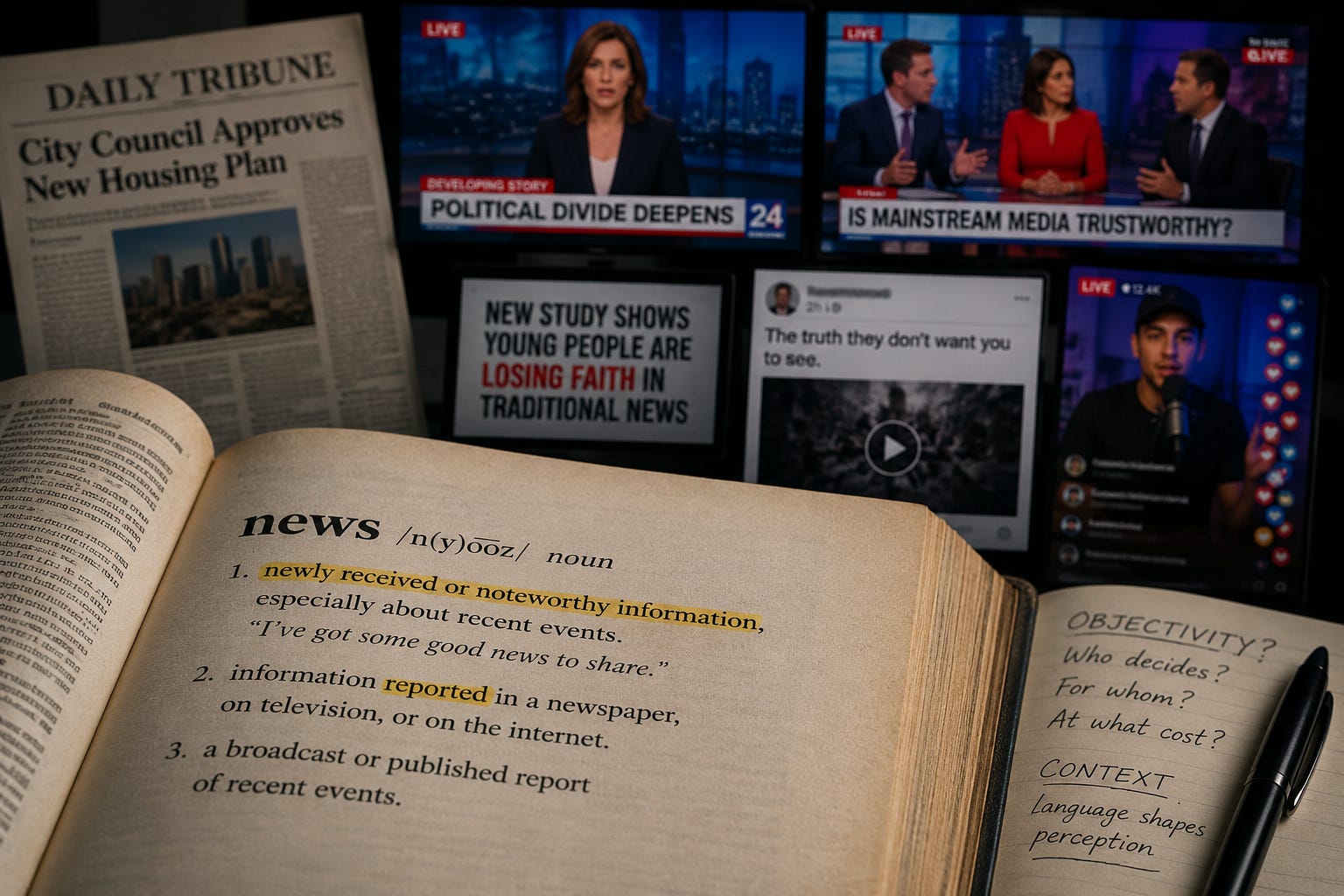
What Do Americans Mean by “News”?
One reason the controversy resonated so strongly is that Americans increasingly use the same media vocabulary while meaning very different things by it.
Terms such as “news,” “journalism,” “bias,” “objectivity,” and even legally defined words like “genocide” now carry sharply different meanings depending on the audience hearing them. In many cases, the disagreement begins before any factual argument occurs.
One listener may hear the word “genocide” as a specific legal or descriptive term. Another may hear it as a partisan political statement. The network or person using it may also influence this perception. One viewer may understand journalism as restrained, fact-based reporting. Another may see journalism as a moral obligation to challenge power openly and directly.
Those are not merely disagreements about politics. They are disagreements about definitions and expectations.
The public response to Campos’s remarks clearly illustrated this divide. Some audiences interpreted his criticism of CBS as evidence that journalism has become too cautious and corporatized. Others viewed the same comments as proof that younger journalists increasingly approach reporting through an activist framework.
The deeper issue is not whether Campos was right or wrong. It is not necessarily even whether corporate or mass media has become too cautious. The deeper issue is that Americans no longer appear to share a stable understanding of what journalism is supposed to do in the first place.
The Older Understanding of Journalism
American journalism has never been perfectly objective, nor has it ever been free of sensationalism, bias, or institutional blind spots. The era of yellow journalism in the late nineteenth century remains a well-known example of how media organizations have historically shaped public opinion through emotionally charged reporting and aggressive editorial framing.
However, for much of the 20th century, particularly during the dominance of major network television news, there was a more widely shared public understanding of what straight reporting was attempting to be. Whether you watched the evening news on CBS, ABC, or NBC, the core news story you received was nearly identical.
News reporting traditionally emphasized attribution, verification, chronology, and restraint. Reporters were trained to answer basic questions clearly and efficiently. Who said it? What happened? When and where did it occur? What information has been independently confirmed?
The language itself often reflected that restraint.
A traditional news report might state that a public figure “said,” “announced,” or “stated” something during a speech or interview. Modern media language increasingly favors emotionally loaded verbs such as “blasted,” “slammed,” or “destroyed,” terms that quietly shape audience interpretation before readers have evaluated the underlying facts for themselves.
The distinction may seem subtle, yet in practice, it changes how information is experienced.
Traditional reporting also acknowledged uncertainty more openly than modern audiences sometimes remember. Journalists frequently used phrases such as “according to preliminary reports,” “officials said,” or “it is not yet clear.” Those formulations were not necessarily evasions. They reflected an understanding that information evolves and that early reporting is often incomplete.
That older framework did not eliminate bias or disagreement. It did, however, establish a more commonly understood professional model for what news reporting was attempting to accomplish.
The Fragmentation of Media Culture
That shared understanding did not disappear overnight.
The repeal of the Fairness Doctrine and the rise of cable television transformed news from a scheduled daily product into a continuous 24-hour cycle competing for attention. Commentary and personality-driven programming became increasingly profitable. Emotional engagement proved more commercially successful than restrained reporting.
The internet accelerated those changes dramatically.
Social media platforms, livestreams, podcasts, independent newsletters, influencer commentary, and algorithmically curated feeds reshaped how Americans consume information. Reporting, analysis, entertainment, activism, satire, propaganda, and speculation increasingly appear side by side within the same digital spaces.
Most of it is labeled simply as “news.”
At the same time, political rhetoric surrounding the media intensified. Public figures across the political spectrum increasingly framed unfavorable coverage not merely as flawed or incomplete reporting, but as evidence of corruption, conspiracy, or ideological warfare.
The result is a fragmented media environment in which audiences often approach information through fundamentally different assumptions about what journalism is supposed to be.
For some Americans, journalism is expected to remain restrained, fact-driven, and linguistically cautious. For others, journalism is expected to confront injustice or ideology directly and reject what they see as false neutrality or bias.
Neither side is necessarily operating in bad faith. However, they often use the same words to describe very different professional expectations.
The Problem of Shared Meaning
The debate surrounding Campos’s speech illustrates a broader problem facing American public discourse.
A society can survive disagreement. Democracies are built around disagreement. However, meaningful disagreement becomes increasingly difficult when people no longer share common definitions of the terms under debate.
The issue extends far beyond journalism.
Words such as “censorship,” “propaganda,” “fascism,” “socialism,” “bias,” and “free speech” now carry layers of political and emotional meaning that frequently overwhelm their descriptive function. Conversations often become reactive rather than responsive. Audiences hear a term, associate it with a political tribe or moral accusation, and respond emotionally before clarifying how the speaker intended the word to be understood.
That dynamic contributes to a growing sense that Americans are talking past one another rather than with one another.
The Campos controversy provides a useful example. The strongest reactions to his remarks were often less about the factual details of what he said and more about what audiences believed certain words symbolized politically.
The reaction itself became the story.
Media Literacy as Civic Literacy
This is where media literacy enters the conversation.
In recent years, several countries, including Finland, have expanded media literacy education in schools, teaching students how to evaluate sources, recognize misinformation, understand context, and examine how information systems operate.
Media literacy, at its best, is not ideological training. It does not require audiences to trust specific institutions blindly or adopt predetermined political conclusions.
Instead, it teaches method. Who produced this information? What evidence supports it? What incentives shape its presentation? Is this reporting, analysis, commentary, entertainment, or advocacy? What language choices are shaping audience interpretation?
Those questions are essential because modern audiences increasingly consume fundamentally different forms of media under the same broad label of “news.”
A cable panel debate, a reported newspaper investigation, a political livestream, a satirical TikTok video, and a partisan Substack essay may all appear in the same social media feed despite serving entirely different standards and purposes.
Without some shared understanding of those distinctions, public trust becomes difficult to sustain. Since we do not have a rating system for “news” as we do for movies and games, there is nothing but consumer attention and knowledge to inform whether what is present is commentary, news, satire, or propaganda. Let us be clear here. Propaganda is not inherently good or bad. By definition, it is about the intent to persuade, often through the intentional exclusion or framing of specific information to elicit a particular response or understanding.
Rather than asking the state to determine truth, some scholars have proposed disclosure-based frameworks, such as the Awareness Doctrine, that help audiences understand when information is being shaped, targeted, or manipulated. The goal is not censorship, but awareness.
Beyond Campos
The controversy surrounding Santiago Campos will eventually fade, replaced by the next media flashpoint, viral speech, or cultural argument. However, the questions exposed by the reaction to his remarks are unlikely to disappear.
Americans remain deeply divided over politics, institutions, and the role of journalism itself. Beneath those divisions lies an even more fundamental challenge. Increasingly, the public no longer shares stable assumptions about the meaning of the language used in those debates.
That fragmentation makes communication harder and democratic discourse more fragile.
A society does not need universal agreement in order to function. It does, however, require enough shared understanding for disagreement itself to remain possible.
The reaction to Campos’s speech suggests that common ground may be eroding not only at the level of politics but at the level of definition itself.
News moves quickly. Understanding takes longer.
Subscribe for thoughtful commentary exploring the ideas, systems, and cultural shifts shaping the stories dominating the national conversation.
Sources:
“National Press Club awards Santiago Campos with the 2026 Wes Vernon Broadcast Scholarship,” Journalism Institute, May 13, 2026.
“Student Scholarship Recipient Slams Bari Weiss-Era CBS at News Emmys: ‘Stains Mike Wallace’s Legacy’,” TheWrap, May 27, 2026.
“CBS Scholarship Winner Tears Into Network in Blistering Acceptance Speech,” The Daily Beast, May 28, 2026.
“Student Journalist Awarded by CBS Condemns Network’s Shift Right at News Emmys,” Truthout, May 28, 2026.
“Winner of CBS-Funded Scholarship Blasts Network In Acceptance Speech,” Mediaite, May 28, 2026.
“Finland’s Preschool Classrooms Lead the Fight Against Fake News,” AP News, January 5, 2026.
“Digital Literacy: Can the Republic ‘Survive an Algorithm’?” AP News, March 20, 2023.
“Fairness Doctrine,” Ronald Reagan Presidential Library & Museum, updated August 21, 2025.
“The Awareness Doctrine,” Harvard Law Review, May 6, 2022.
“Media Literacy Defined,” National Association for Media Literacy Education, n.d.
“Media and Information Literacy,” UNESCO, February 5, 2024.
“Social Media and News Fact Sheet,” Pew Research Center, September 25, 2025.
“How Americans’ Trust in Information From News Organizations and Social Media Sites Has Changed Over Time,” Pew Research Center, October 29, 2025.
Trumplicans like news that is an echo chamber for Trump’s lies. It gives them a sense of validation for believing strange things like Trump is doing a fantastic job on the economy. The rest of us just like updated truthful news.
Made me think of that saying about placing the emphasis on the right syllable! Simple changes make a difference.