


On January 1, 2026, Tennessee became the first state in the United States to implement a public registry specifically for repeat domestic violence offenders. Known as Savanna’s Law, the new statute directs the Tennessee Bureau of Investigation to maintain a searchable online database of individuals convicted of more than one domestic violence offense after that date, complete with names, birth dates, conviction locations, and photographs. The registry is tiered so that an offender’s name may remain on the list for years, depending on the number of convictions recorded under the law. A $150 fee accompanies registration, with $100 earmarked for family violence prevention and intervention services.
The law was passed unanimously by the Tennessee General Assembly in the spring of 2025 and signed by Governor Bill Lee, honoring the memory of Robertson County Sheriff’s Deputy Savanna Puckett, who was 22 when she was shot and killed by her ex‑boyfriend in January 2022. Her killer, James Jackson Conn, had a documented history of prior domestic violence and stalking that was not easily accessible at the time Puckett met him, inspiring advocates, including her mother, to believe that a registry might have saved her life. Savanna’s Law is rooted in a tragic belief that better information might avert future deaths.
Tennessee’s registry is a legislative first. However, for all its national notoriety, it remains a limited tool in a much larger struggle, one that hinges not just on tracking past offenders but on preventing abuse and supporting those who live with it every day.
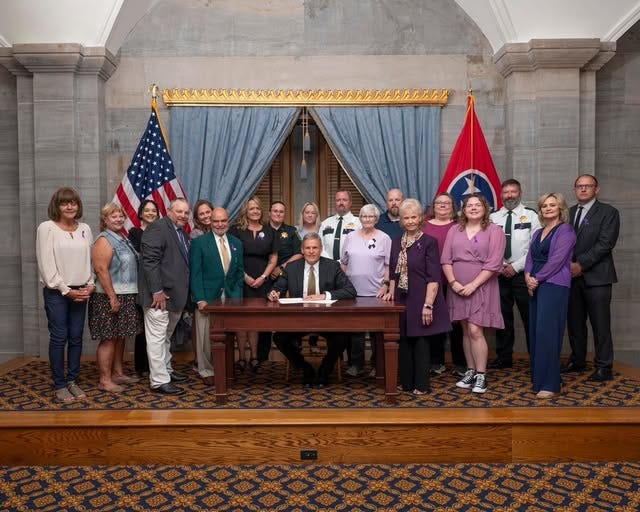
Tennessee Governor Lee signs Savanna’s Law
Want to Know Your Rights?
Download a free digital copy of the U.S. Constitution, the same document Trump is trying to bulldoze. Learn exactly what he’s breaking, and how to fight back.
100,000+ strong — and counting.
This holiday, become a paid subscriber for just $1 a week and help us keep the truth alive.
Join The Coffman Chronicle — $1/Week
What Savanna’s Law Does & Does Not Do
Savanna’s Law creates a registry intended to function somewhat like existing sex offender lists by giving the public access to information about repeat domestic violence convictions. Individuals convicted of a qualifying offense after January 1, 2026, must be registered following a second conviction, and court clerks must provide the Tennessee Bureau of Investigation with qualifying convictions within 60 days. Those entered may remain listed for 5 to 20 years, depending on the number of prior convictions.
In theory, this tool could help survivors or even third parties identify a pattern of violent behavior that was previously buried in disparate court records. Its supporters argue that it might allow people to make more informed decisions about relationships or employment and could assist background checks in contexts where private sales, such as gun transactions, currently evade formal scrutiny.
What the law does not do, however, is prevent abuse before it happens. It does not apply retroactively to convictions prior to 2026, meaning many offenders with long histories will never appear on the list unless they are convicted again. It does not guarantee that a potential partner checks the registry before dating. It does not ensure that victims will be believed, protected, or supported in the most dangerous moments of their lives. Even the funding attached to the registry, while well‑intentioned, is symbolically modest. A $150 fee for each registered offender yields only a small per‑case infusion for services that are chronically underfunded and unevenly distributed, especially in rural areas where shelters and housing resources are scarce or nonexistent.
In cases of criminal domestic violence, courts can order restitution that compensates victims for tangible losses, such as medical bills or lost wages. However, such restitution must often be requested, documented, and ordered on a case-by-case basis, and frequently fails to address long‑term harm. A small registry fee is no substitute for comprehensive support systems.
Savanna’s Law in the Context of Similar Legislation
Savanna’s Law joins a pattern of post‑tragedy legislation that has emerged in recent years. At the federal level, bills like the Laken Riley Act and the Kayla Hamilton Act were named after victims of murder by immigrants, and each aims to tighten specific elements of prosecution, placement, or immigration treatment in the wake of those tragedies. Although framed as meaningful reforms, critics argue that these laws tend to respond to individual cases rather than address the deeper patterns that make such tragedies possible.
See our previous reporting here:

In each instance, lawmakers have rallied around the story of a life cut short. However, naming a law after a victim does not by itself address the underlying dynamics of violence or the systemic gaps that allowed the abuse to occur or continue. Savanna’s Law is often held up alongside federal acts like Riley and Hamilton as evidence of progress. Yet, all fall short of confronting the web of social, economic, and cultural factors that shape the prevalence and lethality of violence.
Domestic Violence: A Widespread and Underreported Reality
To understand the limitations of any registry, it helps to grasp the scope of the issue it attempts to address. Domestic violence is not rare. It does not affect only a narrow demographic. According to CDC data, roughly 41% of women and 26% of men in the U.S. have experienced sexual violence, physical violence, or stalking by an intimate partner in their lifetime. These surveys capture a broad range of abusive behaviors, many of which go unreported to law enforcement and never enter the criminal justice system.
Most victims do not report abuse, and even when they do, the path to conviction is fraught with barriers. Abuse often begins early in life, with a significant portion of female and male victims experiencing their first victimization before age 25, and many before adulthood. Physical violence, sexual violence, psychological aggression, and stalking are all part of the lived experience for millions of Americans. While lifetime prevalence varies across demographic groups, the patterns cut across gender, sexuality, and relationship type. Domestic violence is not limited to heterosexual couples, nor is it solely male‑perpetrated and female‑experienced. In fact, studies suggest that intimate partner violence may be equal or even higher in LGBTQIA+ populations. All forms of intimate partner violence share an underlying logic of power and control, whether expressed through physical harm, emotional manipulation, forced isolation, or coercion.
Reported injury rates, psychological impacts, and related harms paint a picture of violence that can leave long‑term scars. Many survivors report fear for their safety, mental health consequences, lost income, and the need for legal or housing services, needs that extend far beyond what a registry alone can address.
Most alarmingly, U.S. government data show that about 34% of female murder victims were killed by an intimate partner. Advocates point out that the most dangerous time for a victim is when they attempt to leave, with a direct correlation between restraining orders, filing reports, arrests, and trying to remove themselves from the home, resulting in lethal or near-lethal violence.
Where Real Solutions Might Begin
The limitations of Savanna’s Law are not reasons to reject every effort, but they should make clear that symbolic progress cannot replace structural support. If the goal is to reduce domestic violence — not just to name it — then strategies must extend far beyond registries.
Survivors need a continuum of support that begins before a first conviction, continues through moments of crisis, and sustains them long afterward. Fully funded, accessible resources for victims in every community are essential, including safe housing, child‑friendly shelters, comprehensive legal representation, transportation assistance, and mental health care. A justice system that listens to victims without penalizing them for reporting abuse or for circumstances beyond their control, such as a lack of economic resources, is equally important.
Equitable judicial outcomes should combine accountability with rehabilitation where appropriate. Mandated therapy for abusers, anger management programs, and emotional intelligence education embedded in sentencing could help shift patterns of violence, just as early and ongoing relationship education for young people can build emotional literacy before violence ever begins.
Finally, societal change remains the largest, most intractable challenge. Domestic violence is shaped by cultural norms, economic systems, and deeply embedded patterns of behavior that cannot be legislated away. A registry may help illuminate repeat offenders, but it does nothing to dismantle the cultural forces that normalize control, silence victims, or minimize harm.
Symbolism Isn’t Enough
Savanna’s Law is, in many ways, a meaningful first step. It reflects a growing awareness that domestic violence is a serious public safety issue and that survivors deserve tools and information to protect themselves. Tennessee’s move to create the first domestic violence offender registry in the nation acknowledges the urgency of the problem.
Yet the gap between symbolic gestures and systemic change remains vast. A public list of repeat offenders, funded by modest fees and applied only to future convictions, is not on its own an answer to the epidemic of intimate partner violence that affects millions. It does not reach survivors in crisis, does not address underreporting, and does not confront the economic, psychological, and cultural realities that keep many victims trapped.
Yet if we settle for a list of names as proof of progress — if we point to a registry and say “problem solved” — we risk fooling ourselves into thinking that visibility is the same as safety. A list of people to avoid is not the same as addressing the cultural and societal roots of intimate partner violence. It does not create new outcomes. It merely catalogs the aftermath.
Savanna’s Law matters, but if it stands alone, it will be remembered less as a solution and more as a reminder of how easily we mistake action for impact.
If you or someone you know is experiencing domestic violence, help is available. You are not alone.
Immediate Assistance
National Domestic Violence Hotline thehotline.org
📞 1-800-799-SAFE (7233)
Text “START” to 88788
Available 24/7. Free, confidential, and available in 200+ languages. Live chat is also offered.Love Is Respect (For Teens & Young Adults) loveisrespect.org
📞 1-866-331-9474
Text “LOVEIS” to 22522StrongHearts Native Helpline (For Indigenous Peoples) strongheartshelpline.org
📞 1-844-762-8483RAINN (Rape, Abuse & Incest National Network) rainn.org
📞 1-800-656-HOPE (4673)
Legal, Shelter, and Support Services
Women’s Law womenslaw.org
Legal information and support tailored to domestic violence survivors in every state.Safe Horizon safehorizon.org
New York–based, but offers guidance and helpful advocacy nationwide.National Network to End Domestic Violence (NNEDV) nnedv.org
Resources for survivors and service providers, including housing and digital safety tools.DomesticShelters.org domesticshelters.org
Find nearby shelters and services by ZIP code.
If you made it this far, thank you!
For more reporting on state and national legislation, policy analysis, and the latest in domestic politics, consider becoming a paid subscriber.
You, never corporate interests, fuel our work.
Sources:
US’s first registry of domestic abusers takes effect in Tennessee — (The Guardian), January 2, 2026.
Tennessee’s domestic violence registry goes into effect today, first in the nation —(WZTV), January 1, 2026.
About Intimate Partner Violence — (CDC), May 16, 2024.
National Domestic Violence Hotline Statistics — The Hotline
Gender-based Domestic Violence Information — Interact
Reports and Publications | National Intimate Partner and Sexual Violence Survey — (CDC)
Domestic violence in the United States (Wikipedia summary) — Wikipedia
Intimate Partner Violence Surveillance: Uniform Definitions — CDC
For now, providing information and post-trauma support are the only tools we have.
Societal change is a wish, not an action.