


In early August 2025, two stories broke within the same week that, when taken together, illuminate a much larger pattern.
On August 5, leading climate scientists issued a coordinated public rebuttal to a Department of Energy report that sought to cast doubt on the scientific consensus surrounding climate change. Just days later, on August 9, a coalition of health professionals released a formal demand calling for the removal of Robert F. Kennedy Jr. from his role in the Department of Health and Human Services, citing his promotion of medical disinformation and hostility toward evidence-based public health.
Taken separately, they read like isolated bureaucratic clashes. But together, they mark a turning point in a growing resistance, a swelling pushback from within the scientific and medical communities against a federal administration increasingly defined by ideological interference, political censorship, and the systemic dismantling of American science.
These two flashpoints—the climate scientists' public defiance and the professional outcry against RFK Jr.—aren’t isolated acts of protest. They’re part of a broader pattern of resistance emerging across the American scientific landscape. Over the past seven months, researchers, lab directors, public health officials, and federal scientists have raised alarms about escalating attacks on scientific institutions, such as funding cuts, immigration crackdowns, data erasure, and the replacement of peer-reviewed research with politically manufactured narratives. What began as targeted administrative changes has evolved into something more profound: a campaign to reshape public understanding of reality itself.
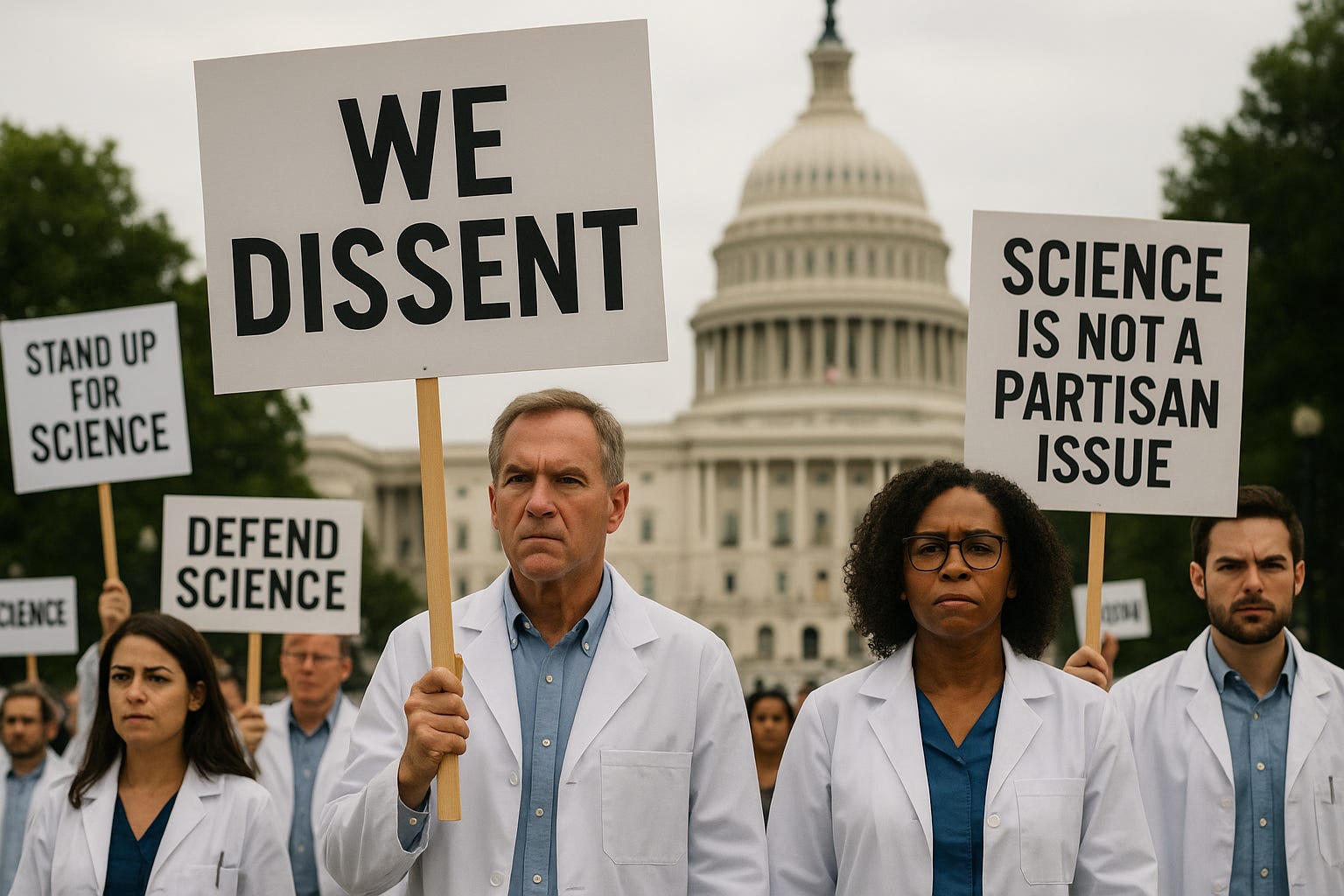
Image is AI-generated.
Stay Informed. Stay Loud.
Subscribe to The Coffman Chronicle for no-BS political analysis, action guides, and daily truth bombs you won’t get from corporate media.
Scientists Under Siege: The Personal Costs of Political Power
The assault on science isn’t abstract. It’s personal. It looks like a researcher detained at the airport for attending his brother’s wedding, and a Harvard scientist jailed over a customs form. It is a generation of emerging scientists quietly packing their bags, not for a conference, but for good.
These stories may not dominate headlines, but they define the lived reality of American researchers under an administration that treats scientific inquiry as a threat. Each case offers a window into how political repression is reshaping not only what science gets done, but who is even allowed to do it.
A Scientist, a Vaccine, and a Windowless Detention Room
On July 21, 2025, Tae Heung “Will” Kim returned to the U.S. after attending his brother’s wedding in South Korea. Kim, a permanent U.S. resident who has lived in the country since the age of five, is a doctoral researcher at Texas A&M working on a promising Lyme disease vaccine, a breakthrough project with the potential to protect thousands. However, instead of returning to his lab, he was detained by Customs and Border Protection at San Francisco International Airport.
Kim was held in a windowless detention room for more than a week without access to a lawyer or proper medical care. Officials cited a sealed 2011 misdemeanor—a minor marijuana possession charge—as grounds for holding him, despite his legal residency and spotless record since. A CBP supervisor reportedly told his attorney that Kim "has no constitutional rights."
This is what it now means to be a scientist working on behalf of public health in America.
A Harvard Researcher, a Box of Embryos, and a Jail Cell in Louisiana
The same month, Dr. Kseniia Petrova, a Russian-born biomedical researcher at Harvard Medical School, was detained at Logan Airport upon returning from a research trip to France. She’d brought with her legal samples of frog embryos needed for ongoing cancer and aging studies. It was a routine handoff between labs that was improperly declared.
That technicality cost her 68 days of detention in an ICE facility in Louisiana.
Despite her standing as a senior researcher at one of the nation’s top institutions, she was cut off from her lab, denied access to counsel for weeks, and threatened with criminal prosecution. A bureaucratic error turned into a national spectacle and a chilling reminder that even elite scientists are not immune when research and nationalism collide.
The Quiet Exodus: America’s Scientific Brain Drain
While the public watches headline fights over budgets and appointees, something quieter and more permanent is happening beneath the surface. Scientists are leaving, not just for fellowships or sabbaticals, but for good.
A March 2025 Nature poll found that three in four U.S. scientists are seriously considering leaving the country due to political hostility, grant instability, and threats to scientific integrity. For many, that consideration has already become reality.
“I wanted to make my home here,” said Danielle Beckman, a neuroscientist who left the U.S. for Germany after struggling to maintain NIH support for her work on COVID and Alzheimer’s. “I feel like my research matters—but the U.S. government doesn’t think our research is important anymore.”
Others are being driven out by administrative whiplash, including NOAA labs closed with 30 days’ notice, NSF grants pulled mid-cycle, and student visas delayed or denied altogether. Dr. Anastasia Khvorova, an RNA researcher at UMass Chan Medical, described the environment simply: “Basic research and innovation are being stifled.”
Even governors are sounding the alarm. Massachusetts Governor Maura Healey warned that the Trump administration is not just cutting science funding; it’s "giving away our intellectual assets."
This isn’t just a loss of individual opportunity. It’s a national weakening, a slow hollowing of the very system that once made the U.S. a global scientific leader.
See our recent reporting on the brain drain epidemic here:

Erasing the Evidence
The war on science isn’t only being fought in laboratories and courtrooms. It’s being waged in code and on servers, in the metadata of government websites and the footnotes of policy documents. In 2025 alone, thousands of pages of publicly funded research and datasets have been altered, suppressed, or quietly deleted from federal websites.
Disappearing Data, Disappearing Truth
Starting in early 2025, entire sections of the CDC, EPA, and NOAA websites—once home to climate data, pollution metrics, vaccine efficacy studies, and health equity statistics—began to vanish or redirect. Environmental justice reports that had taken years to compile were scrubbed from the EPA’s digital archive. Interactive public health dashboards suddenly featured blank maps or outdated figures.
In some cases, datasets weren’t just removed but rewritten. Internal whistleblowers reported being ordered to “revise for consistency” with administration messaging. Keywords like “climate change,” “racial disparity,” and “gender identity” were flagged as “politically sensitive” and quietly extracted from health assessments and grant abstracts.
“This is what a war on knowledge looks like,” wrote one scientist in a Washington Post op-ed, after her entire NIH-funded study on environmental racism was removed from the agency’s public portal.
We reported on this digital purge previously. See some of that reporting here:
Note: This article is more than 45 days old and now lives in our archive. Consider becoming a paid subscriber for exclusive perks including complete access to our nearly 900 articles.

Science Replaced with Scripted Narrative
At the policy level, a new form of erasure is taking hold—not by deletion, but by fabrication. Recent federal reports, including the DOE’s climate assessment and the MAHA public health framework, have been roundly criticized for relying on misleading citations, non-peer-reviewed sources, and even fabricated data to justify deregulation and anti-vaccine policies.
The climate report, released August 5, suggested that global warming “remains under debate” and cited industry-funded white papers rather than consensus climate models. The MAHA document, published July 27, justified curtailing pandemic preparedness programs based on claims debunked by every major scientific institution.
“We’re watching a parallel reality being constructed in real time,” said one former EPA analyst, “and the scariest part is that it’s dressed in the language of science.”
See our reporting on those incidents here:
Note: This article is more than 45 days old and now lives in our archive. Consider becoming a paid subscriber for exclusive perks including full access to all 900 of our articles.


Defunding the Future
If erasure is one weapon in the administration’s war on science, economic starvation is another. The defunding of American research is doing more than slashing budgets. It’s dismantling the infrastructure of discovery, innovation, and public protection.
Grants Cut, Labs Closed, Projects Abandoned
In 2025, the administration has overseen unprecedented cuts to federal research agencies:
The NIH has lost over $3 billion in funding, resulting in the cancellation of more than 3,500 research grants.
The NSF budget was cut by 22%, halting scores of early-career scientist programs and climate-related studies.
BARDA, once the nation's frontline for pandemic response, has seen its funding gutted, especially for mRNA-based vaccine research.
“My experience has been like navigating a battlefield,” said Dr. Natoshia Cunningham, a grantee who saw her long-running mental health study defunded mid-cycle.
At UMass Chan Medical School, Dr. Anastasia Khvorova’s lab had to let staff go and cancel graduate admissions after core funding was revoked. At Texas Biomed, CEO Dr. Larry Schlesinger warned bluntly that these cuts “will result in lost lives and diminish U.S. leadership in biomedical innovation.”
The Political Logic of Suppression
These cuts aren’t random. They’re ideological. Projects tied to climate change, vaccine development, reproductive health, racial equity, and gender identity have been disproportionately targeted. Entire fields of study are being abandoned, not because they failed, but because their findings challenge the administration’s worldview.
“We’re not just losing grants—we’re losing the ability to ask questions,” said one NSF researcher, whose study on climate-linked migration was shelved before it began.
What’s being defunded isn’t just data. It’s the very idea that public policy should be grounded in evidence.
Replacing Reality with Manufactured Science
Defunding and data erasure are blunt-force tactics. However, the Trump administration has also embraced a more insidious strategy: manufacturing science-like narratives that appear rigorous but are crafted to justify preexisting political agendas. These pseudo-scientific documents do more than distract from evidence. They actively displace it.
Invented Consensus, Strategic Confusion
The Department of Energy’s climate report, released on August 5, is a case study in this technique. Rather than referencing the Intergovernmental Panel on Climate Change or U.S. government climate models, the report draws heavily from fossil fuel–funded think tanks and misinterpreted data points. It concludes with no basis in peer-reviewed literature that “warming trends remain inconclusive.”
The MAHA public health framework, issued on July 27, goes further. It fabricates claims about vaccine injury rates, mental health impacts from COVID-era lockdowns, and the supposed superiority of “natural immunity.” It cites withdrawn papers and non-existent studies. In hearings, agency officials have refused to name the researchers behind its claims.
“This is not science—it’s stagecraft,” said Dr. Peter Hotez, calling the documents “an exercise in disinformation.”
mRNA Research Cut in the Name of ‘Safety’
Perhaps the most dangerous example of manufactured science came with the August 5 announcement that the administration would suspend nearly $500 million in mRNA vaccine research. Justified as a precaution against “known risks,” the move ignores decades of safety data and ongoing work to improve the platform for cancer, HIV, and flu prevention.
“While mRNA vaccines are not the only type we need… we definitely should not be turning our back on them,” said Professor Adam Finn, a pediatric vaccine expert.
Dr. Katalin Karikó, co-developer of the technology, called the move “a national betrayal.”
And yet, that’s precisely what’s happening. The administration is treating rare adverse outcomes—well within expected vaccine safety margins—as justification to kill the entire field.
The Seat Belt Fallacy
It’s the public health equivalent of banning seat belts because they occasionally cause bruising. Yes, rare injuries and even deaths have occurred from seat belts. However, no serious policymaker proposes we drive without them. We improved them and accepted them as life-saving. mRNA technology is in that same early phase: proven, promising, and still evolving. Yet instead of investing in safety, we’re pulling the plug.
What’s being promoted in place of real science is a curated illusion, one that looks credible enough to fool the headlines, but hollow enough to collapse under scrutiny.
This Is What Resistance Looks Like
For every dataset deleted, grant defunded, or research silenced, there has been an answer—a refusal. Scientists and institutions across the country are not just enduring this assault on evidence; they are confronting it, organizing against it, and in some cases, putting their careers on the line to speak out.
What was once a whisper has become a roar.
The SOS Letter: A Warning from the Nation’s Top Scientists
In March 2025, nearly 2,000 members of the National Academies of Sciences, Engineering, and Medicine signed an open letter to the American public. It was titled, simply, “SOS.”
“We see real danger in this moment… the nation’s scientific enterprise is being decimated,” the letter read.
The signatories, many of them the country’s most respected experts, called out political interference, censorship, and a climate of fear overtaking federal agencies. They warned that continued suppression of evidence-based policy would not only weaken the U.S. domestically but also surrender its global scientific leadership.
NASA Speaks: The Artemis Letter
In April 2025, a group of NASA scientists, engineers, and Artemis mission personnel released what became known as the Artemis Letter. Their concern: that the moon mission was being rerouted away from its scientific objectives and toward politically motivated, commercially beneficial contracts.
“We are compelled to speak up when our leadership prioritizes political momentum over human safety, scientific advancement, and efficient use of public resources,” they wrote.
For an agency known for discipline and internal unity, this was a clear warning: the scientific mission of space exploration was being hijacked by profit motives and political calculation.
NASA’s Voyager Declaration: “We Dissent”
On July 21, 2025, nearly 300 current and former NASA employees, including astronauts, engineers, mission directors, and science officers, signed what came to be known as the Voyager Declaration. It was a formal protest against abrupt budget cuts, the dismantling of NASA’s internal safety authority, and what they called “the politicization of space.”
The declaration focused especially on the weakening of NASA’s Technical Authority, a crucial oversight body established after the Columbia disaster to ensure mission safety and data integrity.
“We dissent,” the letter begins, echoing language typically reserved for Supreme Court opinions. “This is not a matter of partisan preference—it is a matter of professional ethics and scientific responsibility.”
Signatories described being sidelined from mission planning, pressured to alter language in scientific documents, and cut off from collaboration with international partners. It marked one of the most sweeping acts of professional resistance in the agency’s history.
Coming just months after the Artemis Letter, the Voyager Declaration made one thing clear: the resistance isn’t just growing. It’s naming names, setting terms, and putting dissent in writing.
View our reporting here:

NIH Researchers Push Back: The Bethesda Declaration
In June 2025, nearly 300 researchers at the National Institutes of Health signed a quiet but consequential internal statement: the Bethesda Declaration. It marked a rare breach in protocol by career scientists who typically avoid public political action. Their protest targeted the escalating internal censorship at NIH, including directives to avoid terms like “gender identity,” “health equity,” and “climate-sensitive diseases” in grant language and internal communications.
“Our silence does not serve the public,” one signatory said anonymously. “The truth doesn’t need protection—but the people who speak it sometimes do.”
It was a subtle rebellion, but one that signaled just how deeply political pressure had reached into the heart of federally funded science.
Marching in Lab Coats: Stand Up for Science
And then came the streets.
In March and April 2025, thousands of scientists, doctors, and educators took to the streets in Washington, Boston, Seattle, San Diego, and beyond. The Stand Up for Science rallies were organized not by politicians, but by lab technicians, postdocs, and university instructors. Protesters carried signs that read:
“Defend Research, Defend Reality”
“Science Is Not a Partisan Issue”
“Facts > Fear”
They weren’t demanding funding. They were demanding truth.
This is what resistance looks like: not a single act of defiance, but a pattern, a movement, and a refusal to let the truth be exiled without a fight.
What We Still Stand to Lose & What We Can Still Defend
The erosion of science in America isn’t theoretical. It’s already happening in detentions, in data deletions, in shuttered labs and lost careers. However, as this resistance shows, it’s not too late.
The researchers fighting back, including the scientists in protest marches, the engineers signing open letters, the doctors demanding accountability, aren’t just protecting their work. They’re protecting us. When science is silenced, it’s not just the researchers who suffer. It’s the communities left unprotected, the pandemics unprevented, the environments unmonitored, and the lives lost for lack of data.
We know what happens when we stop listening to science. We’ve lived it.
What remains now is the choice: to allow this dismantling to continue quietly or to name it, resist it, and rebuild what it threatens to destroy.
“Science doesn’t need to be defended. It needs to be practiced—out loud, in public, and without fear.”
— Dr. Mariana Sosa, protester at the Stand Up for Science rally in D.C.
There’s still something left to defend: a public that deserves the truth, a future that requires evidence, and a scientific enterprise that, for all its flaws, is still one of the last remaining tools we have to confront reality and shape it.
Take Action: Science Needs Defenders
This isn’t just a crisis for scientists—it’s a crisis for all of us. And we all have a role to play.
Call Your Representatives
Tell Congress that you support funding for NIH, NSF, BARDA, and science-driven agencies. Ask them to oppose censorship, support oversight, and protect the independence of research institutions. Call for the removal of unqualified, politically-motivated officials who are undermining vetted science and endangering us all.
Congressional Switchboard: 202-224-3121
Support the Watchdogs
Organizations like Protect Our Science, Union of Concerned Scientists, and Science for the People are tracking these developments, filing FOIAs, and defending scientific integrity in the courts and on the streets.
Show Up for Scientists
If there’s a local Stand Up for Science protest, go. If there’s a university teach-in, attend. If a scientist speaks out, amplify them.
Vote with Science in Mind
Elections matter. So do school board meetings, city councils, and state funding bills. Anti-science policy starts small and grows in the dark.
If we want science to survive this moment, we can’t leave the defense to scientists alone. The future is ours if we seize it before it is too late.
Stay Informed. Stay Loud.
Subscribe to The Coffman Chronicle for no-BS political analysis, action guides, and daily truth bombs you won’t get from corporate media.
Bibliography:
“U.S. health agency to wind down mRNA vaccine development”, Reuters, August 6, 2025.
“US orders Vaxart to stop COVID‑19 trial amid mRNA wind down”, Reuters, August 14, 2025.
“RFK Jr. Is Supporting mRNA Research — Just Not for Vaccines”, Wired, August 13, 2025.
“Friday briefing: What will US funding cuts on mRNA vaccines mean for the health of the world?”, The Guardian, August 8, 2025.
“RFK Jr. Is Slashing mRNA Funding as HIV Vaccine Approaches Possible Breakthrough”, Them.us, August 12, 2025.
“RFK Jr. Is Slashing mRNA Funding as HIV Vaccine Approaches Possible Breakthrough”, Express News, August 13, 2025.
“More than 1,900 scientists write letter in ‘SOS’ over Trump’s attacks on science”, The Guardian, March 31, 2025.
“Some 1,900 scientists accuse Trump of ‘wholesale assault’ on science”, The Washington Post, April 3, 2025.
“The NASA Voyager Declaration.” NASA Watch, July 21, 2025.
“Nearly 300 NASA scientists sign 'Voyager Declaration' to protest Trump space science budget cuts.” Space, July 22, 2025.
“CDSE Letter for the House Committee on Science, Space, and Technology’s Space and Aeronautics Subcommittee Hearing entitled ‘Step by Step: The Artemis Program and NASA’s Path to Human Exploration of the Moon, Mars, and Beyond’”. Explore Deep Space, February 26, 2025.
“1900 Leading Scientists Sound Alarm on Trump Administration’s Attacks on Science and Public Health”, Public Citizen / Citizen.org, March 31, 2025.
“Bethesda Declaration: A Call for NIH and HHS Leadership to Deliver on Promises of Academic Freedom and Scientific Excellence.” Stand Up For Science, June 9, 2025.
“Bethesda Declaration,” Wikipedia.
“Stand Up for Science protests 2025.” Wikipedia.
“2025 United States government online resource removals”, Wikipedia.
“Science policy of the second Donald Trump administration”, Wikipedia.
Trump and is allies forget the science. Trump is false.
So we know anything Dear Leader and The Trumpettes do has a singular motive: control for the sake of self-enrichment.
And I include corporations that support Trump and Project 2025 as Trumpettes.
Control of the narrative is shutting public labs and public funded research, development and innovation, which will leave only the private sector to carry out this work, for the lowest cost and highest return.
For labs doing medical research, this means only the most profitable diseases will get the funding - and let's remember, the money is in the treatment, not the cure, so get ready for anything medical to be "at least 10 years away from a cure", in the same way nuclear fusion and free energy has been 20 years away for the past 40 years.
And, of course, AI is starting to pull its weight in the design of new treatments, so who needs a scientist anyway, right? Just program the lab to make the treatment and then test it out in Florida or Brazil, or Africa, where you can get human guinea pigs for pennies (or free).
As to space, forget science!
There are literally trillions of dollars of profit to be mined on the moon and asteroids. Musk's goal is fast turnaround with the ability to put huge amounts of tonnage into orbit cheaply. Anything he does, if you look at it, is about building self-sustaining life 'out there' - building materials and processes using native resources, tunnel boring for fast transport underground in those pesky inhospitable locations, efficient and powerful electric vehicles that can be charged locally, even robotic avatars you can control with an implant in your brain, all connected through a proprietary do-all X app and blanket micro-satellite coverage. Heck, even Starship is designed to use fuel made on-site where methane is abundant.
Musk is about establishing colonies under his terms. You'd need the colonies to get those trillions of dollars of abundand, valuable minerals back to Earth.
Which is where Bezos comes in... He has made it clear his intention is to move manufacturing off-Earth. Refining, processing, manufacturing - and some reusable rockets to bring it down to us here.
Musk goes to the farthest reaches, brings back mined resources to Bezos' orbiting factories, and we get some funky new stuff available on Amazon.
A lot of companies stand to make a shit load of cash for their shareholders and investors, using AI, robots/avatars and off-world resources. Sure, America might need to lead the fight to melt Antarctica and trash the Arctic (annexing Canada and Greenland on the way) to get the tariff-free rare earth minerals that will get us started, but Gilead won't be beholden to anyone else. Control the minerals, control the tech. Control the tech, control market share and dominance.
And, sure, it'll well and truly screw our homeworld, but the billion or so wealthy humans who run the genetic modification labs can afford to ride out the ecological holocaust, as well as any domestic slaves fit enough to survive.
Anyone else who doesn't make it is one less drain on limited resources, right? That's a small price to pay, when there are trillions of dollars in the balance.
In the meantime, make the venture as cost-effective as possible. We've taxed the poor to the limit, the welfare states are being dismantled and, with no cheap healthcare, the unfittest can die. AI can do the math and the science, CRISPr can modify the crops - and the humans who control the crops. The robots can build the machines and the tech (on American soil, of course).
Adam Smith would be as proud of his disciples as Trump is of his. Just so long as they don't try to take too big a cut.
And if you think this is too dystopian for your liking, what makes you think Tango and the Trumpettes aren't playing a long game here...?