


It begins, like so many acts of political violence, with a quiet announcement dressed in bureaucratic language.
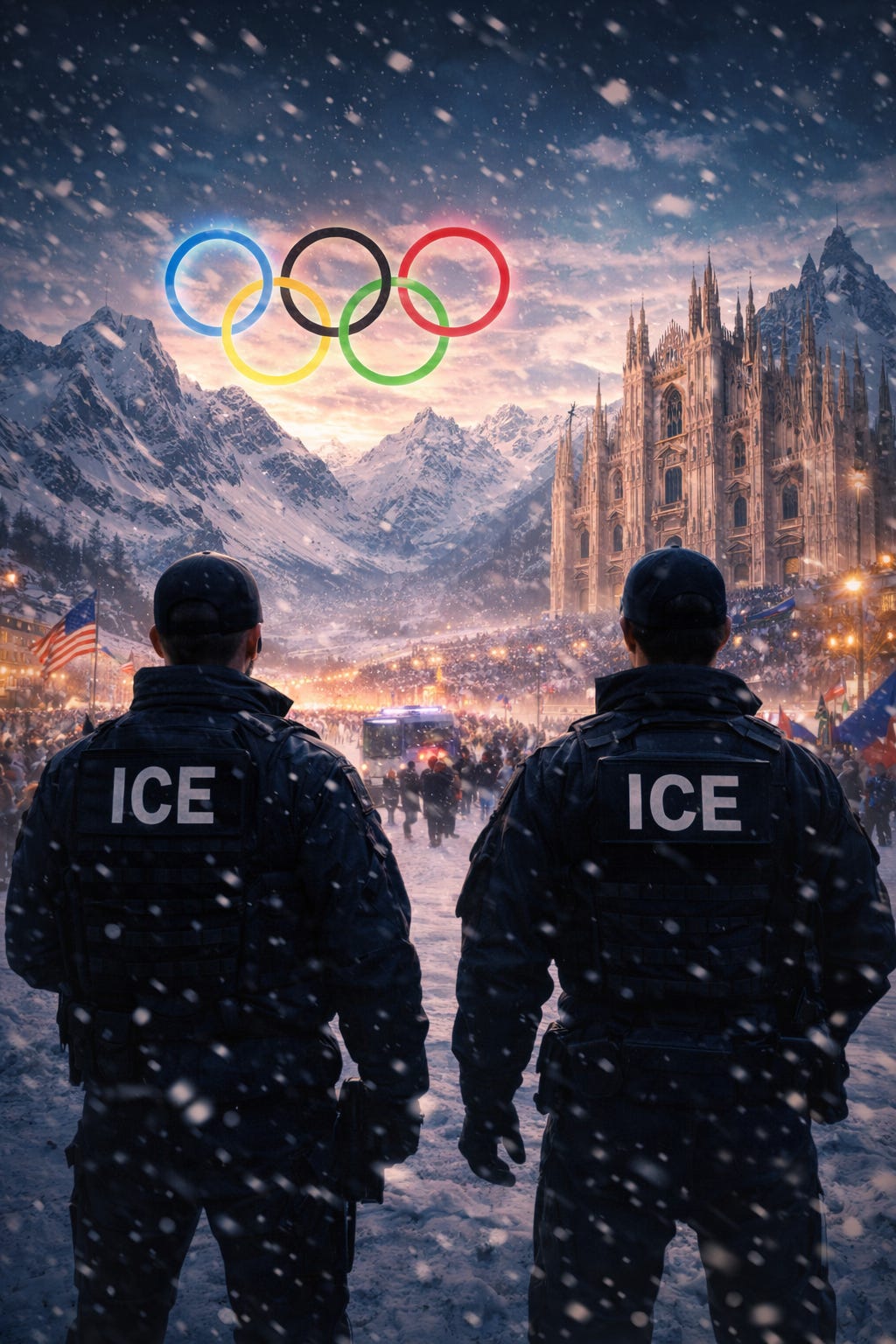
Just days before the 2026 Winter Olympics are set to begin in Milan and Cortina, Italy, the U.S. government confirmed that it will deploy agents from Immigration and Customs Enforcement (ICE) — specifically its Homeland Security Investigations (HSI) division — as part of the security team accompanying the U.S. diplomatic delegation. The agents will not be investigating any specific threat. They won’t be quietly embedded in consular offices, liaising discreetly with Italian police. They will, according to DHS and ICE officials, be “supporting Diplomatic Security Service efforts” to “vet and mitigate risks from transnational criminal organizations.” They will be with the diplomats.
That phrase — “with the diplomats” — is more than a logistical detail. It’s the key that unlocks the entire reality of this deployment. It tells us everything about what this really is, what it isn’t, and why it represents not a protective measure, but a deliberate, aggressive politicization of U.S. presence on the world stage.
This Community Is Powered by You
What started as a small circle has grown into something much bigger, and it’s all because of readers like you.
Every time you forward this email, post it on socials, or bring someone new into the fold, you’re helping build one of the most passionate, independent political communities out there.
Want to keep the momentum going?
Share this newsletter with someone who should be part of this conversation.
Thank you for being here. It means everything.
What the Administration Claims and Why It Doesn’t Hold Up
The official line from DHS is that these agents are being sent to help identify and mitigate threats posed by transnational crime. It sounds reasonable. It even sounds responsible. After all, major international events like the Olympics attract global attention and with it, potential bad actors.
However, this explanation falls apart under even modest scrutiny. Real threat vetting doesn’t happen the week diplomats land on foreign soil. It doesn’t take place with the diplomats, inside Olympic venues. It happens in consulates and embassies, through months, even years, of collaboration, analysis, and information-sharing. The moment Milan and Cortina were named Olympic hosts in 2019, that work would have already begun. In fact, it did. That’s part of what the ICE/HSI attachés already stationed in the U.S. embassy and consulate in Italy are there for.
Had the Biden or Trump administrations truly believed ICE agents were needed to bolster that mission, they would have quietly deployed them long ago. They would have been embedded into the existing intelligence infrastructure, worked behind the scenes, and coordinated with Italian and international law enforcement through formal channels. That’s how it works. That’s how it always works. The U.S. has similar HSI attachés at embassies and consulates worldwide. These aren’t enforcement officers, but investigators.
Instead, the United States waited until the final days before the Games to announce rather than discreetly deploy agents from one of the most politically toxic and internationally criticized law enforcement agencies in its history. Further, they are not being sent to embassies or consulates, but to stand alongside U.S. diplomats, not as intelligence analysts, but as a security presence.
What Diplomatic Security Is and Who’s Supposed to Handle It
To understand why this deployment is so unusual, it helps to know how the U.S. typically protects its diplomats abroad, especially at high-profile international events like the Olympics.
The agency charged with that mission is not ICE or even DHS. It’s the Diplomatic Security Service (DSS), a division of the U.S. Department of State. DSS agents are highly trained federal law enforcement officers who specialize in protecting U.S. diplomats and visiting officials, coordinating with foreign law enforcement agencies, managing security for overseas embassies and consulates, and handling large, complex, international events where American personnel are present.
When the U.S. participates in Olympics or G7 summits, it’s DSS — not ICE, not the FBI, not the military — that takes the lead on protecting diplomats and securing venues alongside host nation authorities.
ICE’s Homeland Security Investigations division, by contrast, has a very different mandate. HSI agents focus on transnational crime, things like drug trafficking, human smuggling, and financial fraud. While HSI maintains attachés at foreign embassies to coordinate on cross-border criminal cases, they are not trained in diplomatic protection and are not part of traditional security details for events like the Olympics. They aren’t enforcement officers. They are investigators.
This deployment, then, represents a major departure from standard protocol. It isn’t just an interagency collaboration. It’s an unprecedented decision to place a domestic immigration enforcement agency into a role normally handled with discretion and expertise by DSS professionals.
And that’s before you even consider the political baggage ICE brings with it.
“With the Diplomats”: A Phrase That Undermines the Entire Justification
The moment ICE’s presence was tied to the U.S. delegation itself, the entire narrative collapsed. These agents are not simply reinforcements for the investigative teams already stationed in Rome or Milan. They are not staying behind the scenes. They are being sent as part of the diplomatic convoy, physically accompanying it, visibly supporting it, publicly symbolizing it.
Investigators don’t accompany diplomats. Intelligence officers don’t travel in formation at international sporting events. You don’t “vet” or “mitigate” transnational threats with agents marching next to ambassadors. That is not what investigative security looks like. That’s what performance looks like. That’s what theater looks like.
That’s what ICE is doing in Milan.
The Host Nation Sees It, and They’re Not Happy
If this were merely a staffing decision, such as a few more investigators behind embassy walls, Italy wouldn’t care. The Italian government, like every Olympic host before it, has already accepted a surge in diplomatic staffing from every participating nation. Embassies are busier. Consulates are swelling. Everyone is preparing. This is normal.
What is not normal is a host nation’s mayor holding a press conference to declare a U.S. federal agency “not welcome.” What is not normal is a city leader referring to a U.S. security presence as a “militia that kills.”
These are not the words of a partner in coordinated threat mitigation. These are the words of a host nation that understands exactly what it’s seeing: not an ally sending support, but a state projecting intimidation.
No other country has done this. As of a week before the Games, no other Olympic participant has publicly announced they are deploying domestic law enforcement agents to accompany their diplomats. Most wouldn’t dream of it, not because they’re soft on crime or inattentive to global threats, but because they know what the Olympics are supposed to be. They know what this would look like.
Optics Matter and This Is a Disaster
ICE is not just another agency. It is one of the most controversial institutions in American government. It is associated globally with racial profiling, family separation, deadly force, and an increasingly lawless and unaccountable regime. Its actions have been condemned by human rights groups, legal scholars, international observers, and foreign governments. It is viewed — rightly — as an instrument of state violence.
To send it abroad, under the guise of diplomacy, is to telegraph that this is not just who America is at home, but who it intends to be everywhere. To send them now, just days after yet another death of a citizen during DHS activities, in year already on track less than a full month in to be the deadliest for those in custody on record, breaking the precedent set by the previous year, is a threat.
Even authoritarian regimes have shown more discipline. Nazi Germany didn’t send its Brownshirts or Gestapo to the Games hosted by other nations in the lead-up to the 1936 Berlin Olympics. When it did host, the regime carefully stage-managed the presence of its domestic security, projecting calm and order to the outside world, even as it brutalized its own people.
More recently, in 2014, Russia hosted the Sochi Winter Olympics under Vladimir Putin. The country was already surveilling and oppressing journalists, dissidents, and LGBTQ+ citizens. Yet in the lead-up, Russia didn’t deploy its FSB or internal military police to the Olympics in other countries, and kept its security presence largely invisible at Sochi itself, understanding the need for a palatable international image.
The United States, now, is breaking even those norms, not just during its own hosting duties in 2028, but at someone else’s Games. Worse, it is doing so loudly.
This administration doesn’t care about the optics. This is more than clumsy. It’s intentional. It’s a warning.
The Road to LA 2028 Starts in Milan
Los Angeles is set to host the Summer Olympics in 2028. It is already a surveillance-heavy city with deep policing infrastructure and ongoing struggles around immigrant rights, housing displacement, and police militarization. Civil rights groups and immigrant advocates are already raising alarms that ICE and DHS could be deeply embedded in those Games, targeting protesters, intimidating communities, and chilling international participation.
The deployment in Milan isn’t just a diplomatic misstep. It’s a trial balloon.
If ICE can be normalized at the 2026 Olympics abroad — publicly visible, politically justified, and unchallenged — then it will be ready for prime time at home in 2028. The message will be clear. Every international event hosted by the United States will now come with federal enforcement presence, armed, unaccountable, and above reproach.
And it won’t stop with the Olympics.
This Isn’t Security. It’s Strategy
There are already trained agencies responsible for this work. There are already established procedures and partnerships among the host country, local law enforcement, DSS, and ICE attachés at Italian embassies and consulates. There is a long tradition of Olympic cooperation, quiet diplomacy, and mutual respect between host nations and visiting powers.
This move breaks all of that.
It replaces professionalism with provocation. It replaces discretion with dominance. It replaces safety with the spectacle of force.
In doing so, it tells us exactly what kind of global actor this administration intends to be, domestically and abroad.
If you found this breakdown useful, consider subscribing. The Coffman Chronicle explores the intersection of U.S. politics, security, and power, focusing on the stories that slip past headlines but shape the future. No outrage bait. No fluff. Just clear-eyed analysis you can use.
Sources:
US sending ICE unit to Winter Olympics for security, prompting concern and confusion in Italy — AP News (Jan. 27, 2026)
US ICE agents going to Winter Olympics sparks anger in Italy — Reuters (Jan. 27, 2026)
Milan mayor calls ICE ‘a militia that kills’ and says agents not welcome — CBS News (Jan. 27, 2026)
ICE agents’ role in Milan‑Cortina Olympics sparks criticism in Italy — Euronews (Jan. 27, 2026)
ICE’s Role in Winter Olympics Security Draws Ire From Italian Leaders — Time (Jan. 27, 2026)
ICE Agents Will Deploy to Winter Olympics to Join U.S. Security Team, but Milan Mayor Says “Militia That Kills” Isn’t Welcome — People.com (Jan. 27, 2026)
ICE agents from US set to help with security at Winter Olympics in Italy — Al Jazeera (Jan. 27, 2026)
Italian officials voice outrage at the presence of U.S. ICE agents at the 2026 Olympics — New Hampshire Public Radio/NPR (Jan. 27, 2026)
This is about showing off the "new" America - the white supremacy/totalitarian version - it is about saying "we are not friendly anymore and we don't like you - any of you." And it is disgusting.
We must encourage Olympic athletes to boycott the Olympics as long as ICE agents will be there. in Italy.