


There is something deeply upside-down about the current DHS funding fight.
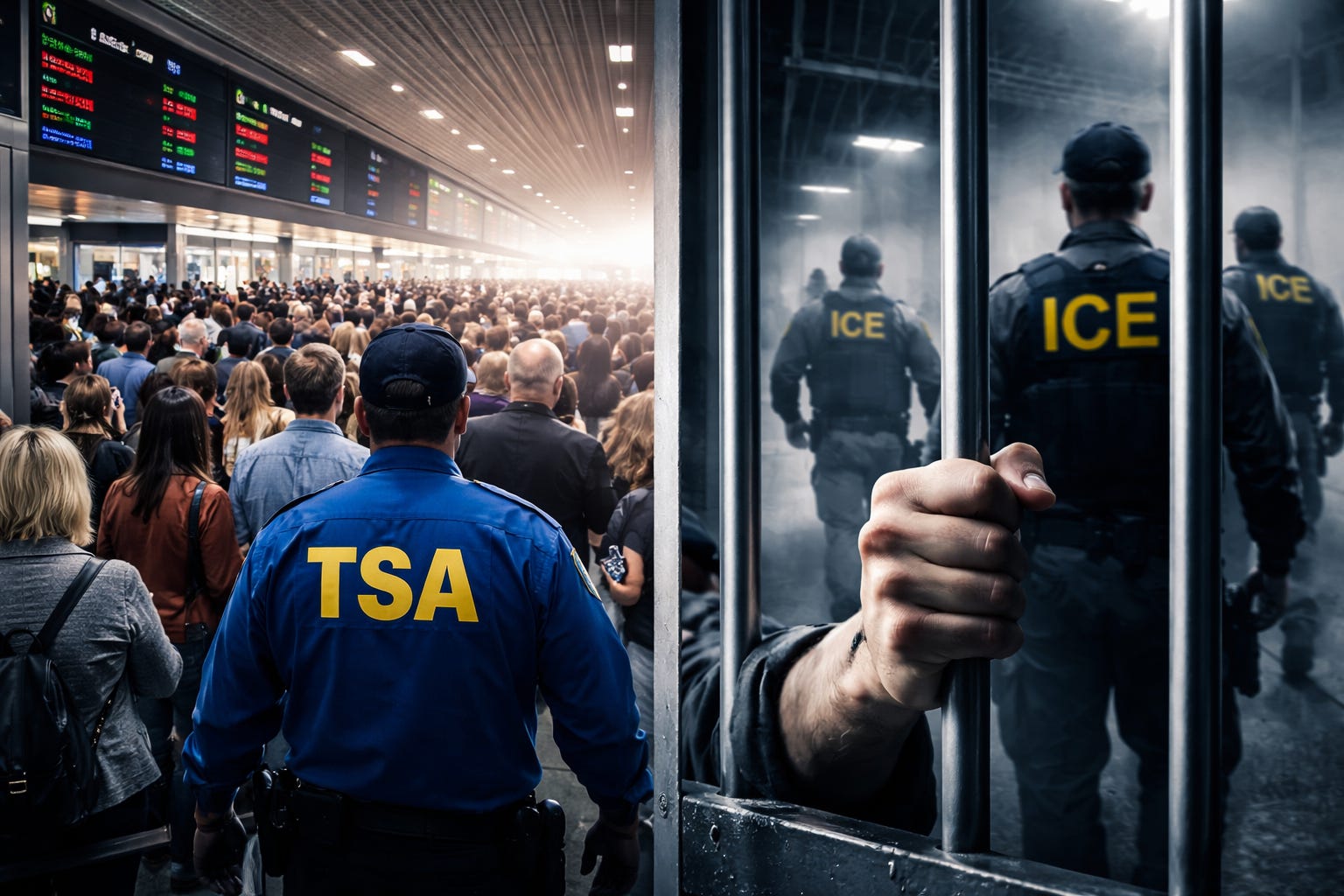
We are in a prolonged shutdown of essential workers. TSA officers, FEMA personnel, Coast Guard members, and cybersecurity staff have all been caught in the blast radius. Airport lines have become unbearable. Workers are going unpaid. Stress has piled up across the department.
Yet the part of DHS that is actually under the most scrutiny for documented, repeated concerns about immigration enforcement and detention has been among the least affected.
That is the first tell. The second is what happened next.
The Senate pushed through a bill to fund most of DHS while leaving out the agencies at the center of the reform fight. The House refused. Then, after airport chaos became impossible to ignore, the administration suddenly found a way to get TSA paid by other means. Yes, only the TSA will be paid.
So let’s say the quiet part plainly: when the political pain became visible enough, they acted, just not in a way that resolved the larger problem, and not in a way that forced a real debate over the conduct and guardrails of ICE and CBP.
That is not what good-faith governance looks like. This is what leverage looks like.
This Community Is Powered by You
What started as a small circle has grown into something much bigger, and it’s all because of readers like you.
Every time you forward this email, post it on socials, or bring someone new into the fold, you’re helping build one of the most passionate, independent political communities out there.
Want to keep the momentum going?
Share this newsletter with someone who should be part of this conversation.
Thank you for being here. It means everything.
What is actually happening
The public version of this fight is that Republicans want to fully fund DHS, Democrats want reforms to immigration enforcement, and the whole thing has turned into a standoff over precedent and legitimacy.
However, that framing leaves out the most important reality.
The agencies at the center of the reform dispute are not the ones taking the brunt of the shutdown pain. The pressure has landed on the rest of DHS instead: TSA workers at airports, Coast Guard families, emergency personnel, cybersecurity staff, and everyone else expected to keep showing up while Washington plays chicken with their paychecks. ICE and Border Patrol have other funding they are drawing on, so their workers remain paid.
See some of our recent reporting here:


Then, once airport lines became a national embarrassment, the White House found a workaround for the TSA. It wasn’t proposed when funding first lapsed. It wasn’t floated in the first weeks of the shutdown. No, instead this idea landed on Friday after a week of viral videos of long wait times and a Congress ready to go on Spring recess.
That selective rescue tells you everything. The administration did not suddenly discover a general principle that essential workers should not be used as bargaining chips. It discovered that angry travelers and airport chaos create bad headlines.
The contradiction at the center of the fight
If you strip away the slogans, the logic of the House position is strange.
We are told that funding most of DHS while withholding or conditioning funding for ICE and CBP is somehow illegitimate, dangerous, or a bad precedent. However, Congress uses targeted funding restrictions, carveouts, and policy riders all the time, especially when conservatives want them for abortion, research, environmental policy, or education fights.
So let’s not pretend this is about whether Congress can single out one part of a larger department. Of course it can. It does it constantly.
The real argument is simpler. House Republicans do not want immigration enforcement debated on its own terms.
Why? Because if you separate out ICE and CBP and ask a very basic question — should armed federal agents be subject to identification requirements, body cameras, use-of-force standards, basic detention safeguards, legal access protections, and humane treatment rules — the answer becomes much harder to dodge.
This is especially true when many of these agencies already claim those guardrails exist.
That is what makes this so maddening. If the standards already exist, why is codifying or enforcing them such a threat? If the agencies are acting lawfully, why is open debate so dangerous? If the reforms are truly unreasonable, why not argue that in daylight instead of hiding behind the suffering of unrelated DHS workers?
This is not anti-enforcement
This is where the conversation always gets warped on purpose.
Demanding guardrails is not the same thing as opposing immigration enforcement. A constitutional democracy can enforce its laws and still require that those enforcing them obey basic standards of accountability and humane treatment.
In fact, that is the minimum.
This matters even more because immigration detention is often discussed as though it were purely about violent criminals. It is not. A large share of those caught up in the system have no criminal record at all. Many are in civil proceedings, not criminal ones. Being in the country without documentation is generally a civil violation, not a criminal conviction. That means the government is exercising extraordinary coercive power over people who have not been tried, convicted, or sentenced in the way most Americans imagine when they hear “detention.”
So ask yourself a simple question. If a state prison had sustained reporting of preventable deaths, dangerous medical neglect, poor hygiene, overcrowding, questionable staff conduct, obstructed legal access, and repeated use-of-force controversies, would anyone accept “just keep everything running as normal” as the answer?
Of course not.
If a local police department had a year of escalating reports about deaths in custody, officer-involved shootings, body-camera problems, failure to identify, and denied transparency, would anyone say that asking for reforms “delegitimizes law enforcement”?
Of course not.
So why is immigration enforcement treated as the exception?
The rule-of-law problem
This is the part that should bother people across the political spectrum.
The public justification for resisting reform is increasingly not that the concerns are fake, but that debating them in this way would set a bad precedent or undermine the agencies' legitimacy. That is revealing.
If the strongest objection is no longer “these reforms are unnecessary,” but rather “we cannot afford to have this debate separated from the larger funding fight,” then the debate is already lost on the merits.
That is where the constitutional issue comes in.
We are not supposed to fund agencies forever on the theory that their mission is important enough to excuse unresolved abuse, secrecy, or rights violations. We are supposed to insist that state power remain accountable precisely where it is most coercive.
That is what constitutional government means— not loyalty to a party, not loyalty to an administration, and not loyalty to an agency’s self-image. Loyalty to the Constitution.
The Constitution is not tested in easy cases. It is tested where fear, anger, urgency, and politics tempt us to look away.
We built this system in panic and then refused to fix it
Part of what makes this moment so dangerous is that none of this appeared out of nowhere.
DHS was born out of the post-9/11 panic, in an era when “security” routinely beat “restraint.” Agencies were built quickly. Powers were expanded. Oversight lagged. As abuses emerged, we too often responded with shrugs, workarounds, or partisan excuses rather than real structural reform.
Now we have an administration intensely focused on detention and deportation, operating machinery that was never built with enough guardrails to begin with.
So yes, we did this to ourselves.
Importantly, the longer the system operates this way, the more the abnormal becomes familiar, and the more the familiar starts to look legitimate.
That is how democracies get into trouble: not usually through one dramatic declaration, but through the steady normalization of practices that would have shocked the public just a few years earlier.
The most honest version of this fight
Here is the cleanest way to describe what is happening.
A Senate majority was willing to fund the rest of DHS and isolate the agencies under reform dispute. The House refused. The shutdown pain fell hardest on workers outside that dispute. Then the administration selectively rescued the most politically inconvenient subgroup, TSA, once airport chaos became impossible to ignore.
Meanwhile, the actual debate over transparency, humane treatment, use of force, legal access, and basic accountability is being stalled in the name of precedent and institutional legitimacy.
That is not a defense of law enforcement. It is a way of avoiding a direct argument over whether these agencies should be required to meet the same basic standards we would demand of any other armed government institution.
They should. If temporarily withholding or conditioning funding is what it takes to force that argument into the open, then so be it.
A government agency does not earn unconditional deference simply by claiming its job is important. It earns public trust by showing it can do that job within lawful, transparent, humane limits.
If it cannot, or will not, then the problem is not the people asking questions. The problem is the agency.
This is not a fight between “security” and “open borders.” That is the cheap version. This is a fight between two ideas of government.
One says that when an agency claims urgency, accountability must wait. The other says that when an agency is using detention, force, secrecy, and removal power, accountability cannot wait.
We know which side the Constitution is on, and we should act like it.
If you believe government power should never outrun the Constitution, subscribe.
We don’t do party loyalty here. We follow the facts, the law, and the consequences — wherever they lead.
Sources:
House Republicans reject DHS funding package earlier passed by Senate — The Guardian, March 27, 2026.
US House passes temporary funding bill to end Homeland Security shutdown — Reuters, March 28, 2026.
Paying Our Great Transportation Security Administration Officers and Employees — The White House, March 27, 2026.
DHS funding freeze now longest partial government shutdown in US history — The Guardian, March 29, 2026.
The Lyin' King has stolen the entire Treasury. He will now just pick and choose who gets paid.
Joe Biden was an embarrassment because he couldn't organize border immigration or evacuate Afghanistan, but Trump has demonstrated enormous dysfunction in everything he has executed.
Executive orders eliminate democracy and planning. The art of the deal is bullshit when dealing in the Middle East. Trump is a bumbling coward and liar as always misrepresenting AMERICA.