


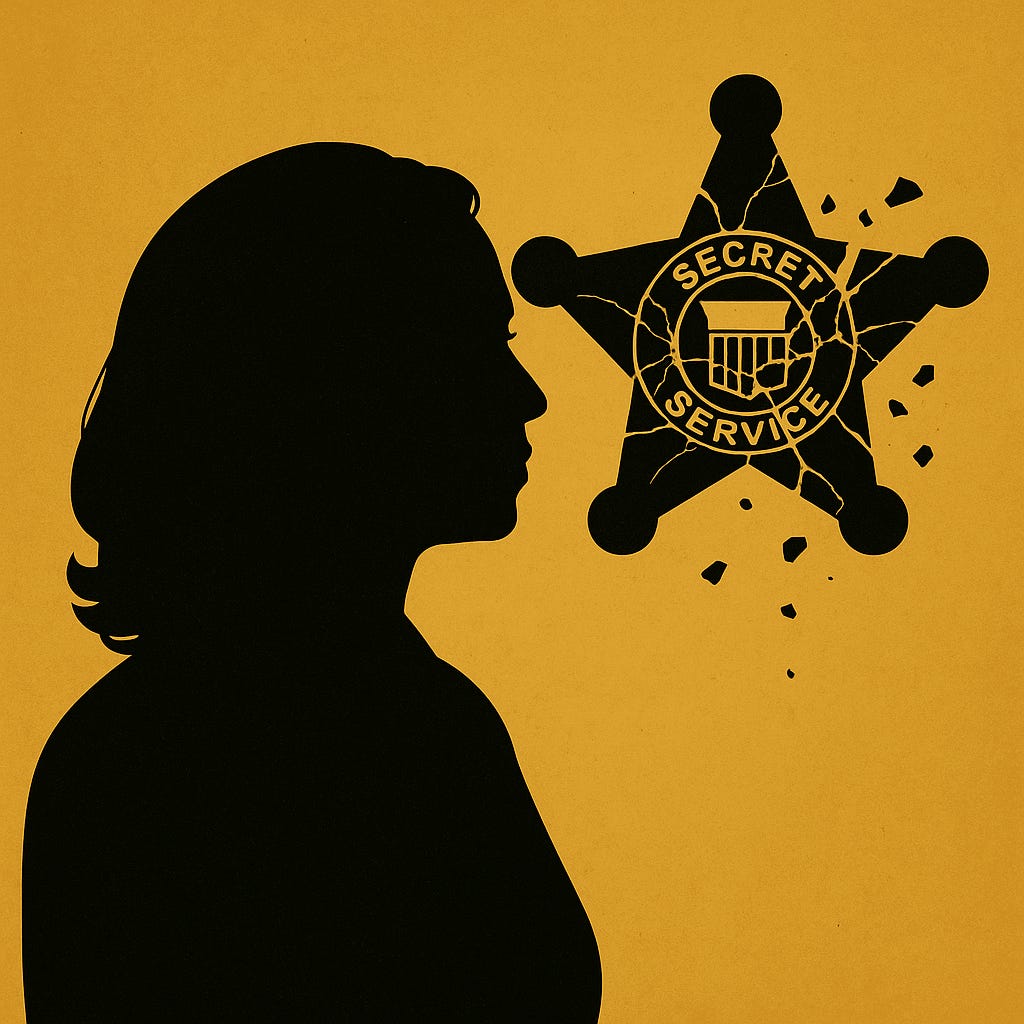
On September 1, 2025, the Secret Service protection detail assigned to former Vice President Kamala Harris was revoked at the direction of President Donald Trump.
No threats were neutralized. No laws had changed. No justification was offered beyond bureaucratic technicalities. What changed was this: Kamala Harris spoke up.
After months of quiet, she stepped back into the national spotlight, not with fanfare, but with purpose. Her new book tour traces her story, her legacy, and her growing concern for the integrity of the 2024 election. She’s speaking about voter suppression, institutional failure, and democratic decay.
And within days, her security was stripped away.
This isn’t just political revenge. It’s strategic intimidation. It’s not meant to punish what she’s done. It’s meant to prevent what she might still do, to silence a voice before it can grow louder, to make an example of someone who dared to re-enter the fight.
And Kamala Harris isn’t the first.
Since returning to power, Trump has systematically revoked the protections of those he perceives as disloyal or dangerous — former military leaders, public health officials, political critics. Each time, the media blinks. The public shrugs. The threshold of outrage moves slightly further down the line.
But Harris is different. She’s not just a former vice president. She is a symbol of resistance, of survival, and of power that was never meant to be allowed.
And that makes her not just a target. It makes her a threat.
This article is about what that threat means, not just to Trump, but to the fragile democracy we’re all still trying to live inside.
Stay Informed. Stay Loud.
Subscribe to The Coffman Chronicle for no-BS political analysis, action guides, and daily truth bombs you won’t get from corporate media.
The Pattern of Revocations: A Test of How Much We’ll Tolerate
Kamala Harris’s revocation didn’t come out of nowhere. It came at the end of a calculated sequence, a quiet campaign of strategic exposure meant to test the public’s threshold for authoritarian behavior.
Before Harris, there was Anthony Fauci, stripped of his security days after Trump’s return to office. Again, there was no formal announcement and no credible reason. Just a political adversary quietly removed from institutional protection.
Then came General Mark Milley, the former Chairman of the Joint Chiefs, and John Bolton, Trump’s own former National Security Advisor, both of whom are now vulnerable despite having faced credible threats from domestic and foreign actors alike.
Then Mike Pompeo and Brian Hook, whose protections had been extended due to ongoing threats from Iran, were abruptly cut off against the advice of intelligence officials and allies.
Hunter and Ashley Biden, private citizens who had no power other than their familial ties to the former president, were also stripped of protection. No one came to their defense.
One by one, Trump tested the water.
What happens if we revoke protection from a scientist?
What happens if we do it to a general?
What if it’s someone in the former president’s family?
Each time, the answer was the same: nothing happened. The press might note it. Civil society might release a statement. But the public? Distracted. Numb. Busy. The outrage faded quickly.
So now, it’s Kamala Harris, a former vice president, a heartbeat from the presidency just nine months ago, the opponent who nearly took him down. Worst of all, she’s a woman who has held her tongue until now.
And with her reemergence, Trump finally took action.
This wasn’t just another name on the list. It was the moment when revocation became a message: If we can take away her protection, we can take it from anyone.
This is how authoritarianism encroaches. Not all at once. Not with tanks or mass arrests. But with small removals of safety, each one a little more extreme, each one a little less shocking.
And every time we accept it, we teach the regime that it can go further.
But unlike the others, Kamala Harris didn’t face this threat alone.
Within days of the revocation, the California Highway Patrol quietly stepped in to provide her with state-level protection while she remains in California. Governor Gavin Newsom hasn’t made a formal statement, but sources confirm his office authorized the move, and several mayors, including Los Angeles’s Karen Bass, voiced support.
It’s a powerful act of defiance: a state protecting one of its own when the federal government has chosen intimidation over duty. And it raises the question: Why did Harris receive this backup, while so many others didn’t?
Because she’s not just a former VP. She’s a symbol. Of resistance. Of power. Of survival.
And that brings us to the deeper fear at play.
Why Now? Why Her?
The revocation of Kamala Harris’s protection didn’t come because she posed a threat in the past. It came because she’s starting to pose one again now.
For most of 2025, Harris remained largely silent. She gave no major interviews, made no speeches, and played no public role in the national Democratic resistance that has been slow to gather steam. But then, at the end of August, something changed.
She launched her national book tour, titled "In the Room". The early reviews describe it as candid, pointed, and deeply concerned with the health of American democracy. In it, Harris outlines her experience in the aftermath of the 2024 election — what she saw, what she warned against, and what institutions ignored. She doesn’t accuse, but she implicates.
And most dangerously for Trump, she speaks clearly, calmly, and with credibility.
The public is paying attention. Crowds are large. Media coverage is growing. Whispers in Washington say her book is reigniting quiet conversations about what actually happened during the 2024 transition of power and how little of it was ever fully investigated.
That’s when the revocation came. not months ago, when her protection technically "expired." Not while she was quiet.
It came after she started talking. It came after she started drawing crowds. It came after she reminded the country who she is and what she still represents.
That timing isn’t bureaucratic. It’s surgical.
Trump’s team, obsessed with loyalty, control, and silencing dissent, saw her return as a potential inflection point. And they moved swiftly to shut it down, not by censoring her, not by arresting her, but by sending a different message: You’re not safe anymore. And no one is coming to protect you.
That’s not just about Harris. That’s about what happens when anyone steps forward to speak inconvenient truths, especially women, especially women of color, especially those with power.
And if Harris backs down? If she cancels events, hires private security, or retreats?
Then Trump gets what he wanted — a chilling effect, not just for her, but for everyone watching.
The Politics of Fear And Who Gets Targeted
Kamala Harris isn’t the only person Trump fears, but she fits a profile that authoritarian regimes and insecure strongmen always seek to dismantle first.
She is a Black woman in a position of power.
And in 2025, that combination is being treated not just as a challenge to authority but as a direct threat to its legitimacy.
Trump’s Pattern of Targeting Black Women in Power
Harris’s revocation comes on the heels of a wave of attacks — rhetorical, institutional, and procedural — against other high-profile Black women:
Lisa Cook, the first Black woman on the Federal Reserve Board, was unceremoniously pushed out this summer. Trump referred to her as a “woke embarrassment” and, in private, used grotesque language to describe her appearance.
Letitia James, New York’s Attorney General, has been smeared repeatedly by Trump since she brought civil fraud charges against him. His language is personal, demeaning, and racialized.
Fani Willis, the Georgia DA prosecuting Trump for election interference, has been doxxed, threatened, and painted as corrupt and “mentally unfit”, all with MAGA surrogates echoing the message.
Judge Tanya Chutkan, who presided over Trump’s federal cases, has endured weeks of online attacks, open threats, and thinly veiled calls to violence, all while doing her job.
Muriel Bowser, DC’s mayor, had her authority over local police stripped during protests under Trump’s new federal oversight plan.
This is not accidental. This is not just racism. This is misogynoir, the specific and strategic targeting of Black women who have climbed the ranks of American power and refused to be silenced.
And now, Kamala Harris joins that list, not just as a victim of political retaliation, but as the clearest example yet of how this regime is choosing who to expose, who to humiliate, and who to isolate.
Why Black Women? Because They Embody the Opposite of Trump’s Power
Trump’s worldview is based on domination, obedience, and spectacle. Black women in power, especially those with legal, institutional, or grassroots legitimacy, undermine that entirely.
They carry:
The moral weight of survival
The intellectual rigor of law and governance
The emotional intelligence of community leadership
The visibility of resistance
They’re not loud to be heard. They’re loud because they must be.
They don’t rise through nepotism, or populism, or wealth. They rise in spite of all the systems stacked against them.
And that kind of power is terrifying to someone like Trump, not because it’s loud, but because it’s legitimate.
Not Spite — Strategy
It’s tempting to dismiss Trump’s actions as erratic, emotional, or driven by personal vendettas. However, that’s a dangerous oversimplification.
This isn’t about petty revenge. It’s about strategic repression, calculated, paced, and designed to escalate just enough to test the system without breaking it too fast.
The Logic of Escalation
Authoritarian regimes rarely flip overnight. They erode slowly, probing the limits of resistance. Trump’s revocations — of security, legitimacy, voice — are not spontaneous. They are:
Intentional escalations
Tests of public reaction
Markers of who’s being watched
And crucially, they’re escalating in complexity.
He didn’t start with Harris. He started with Fauci, with Bolton, with people the public might be too exhausted to defend. When no one pushed back, he moved forward.
The revocation of Kamala Harris’s protection is a step up the authoritarian ladder, not because of who she is alone, but because of what she represents:
A former Vice President
A Black woman who commands credibility and votes
A newly reemerging critic just as Trump’s grip is tightening
She is not being punished. She is being contained.
Repression Without Violence — Yet
Trump doesn’t need to arrest Harris — yet. He doesn’t need to indict her or bar her from TV. All he needs to do is remove the safety net.
Make her vulnerable. Let the threats do the rest.
And if she cancels appearances? If she self-censors? If she fades again?
Mission accomplished.
That’s the genius of authoritarian soft power: it doesn’t need a knock at the door. It just needs you to feel the fear and change your behavior before anyone forces you to.
Silence Isn’t Survival
This tactic sends a message to others too:
Prosecutors
Journalists
Organizers
Voters
"Step out of line, and you’re on your own."
That’s not just chilling. It’s contagious. The more people see even someone like Harris exposed, the less they trust that anyone is safe.
And in that atmosphere, silence doesn’t feel like surrender. It feels like survival until it’s too late.
The Dangerous Precedent And the Choice Ahead
The revocation of Kamala Harris’s protection is not just an isolated act of authoritarian spite. It is a precedent, and like all precedents in autocratic systems, it serves as a test.
If the public accepts this? If the media treats it like old news? If Congress stays quiet?
Then the door opens, not just to more revocations, but to more overt repression. Because every time the line moves without a fight, the next move becomes easier to justify.
From Revocation to Repression
If Trump can strip the safety of a former Vice President without consequence, what’s next?
Federal gag orders against critics?
DOJ investigations into journalists or authors?
Domestic surveillance of political organizers?
Travel bans for political dissidents?
This is how it starts. Not with tanks in the streets but with silence, with submission, and with shrugging.
“She’ll be fine.”
“It’s just Harris.”
“It’s just politics.”
No. It’s not just politics. It’s a trial balloon, and if it doesn’t pop, the next one will rise higher. And we’ve already seen the baby steps into these other escalations.
Democracy Doesn’t Die in a Flash. It Fades
This isn’t about Kamala Harris alone. It’s about whether we still believe that public service deserves public protection, that dissent deserves safety, and that powerful women — especially Black women — deserve the full backing of the institutions they served.
Because if Harris can be stripped down publicly — exposed, isolated, and left to fend for herself — what hope do the rest of us have?
If we allow this moment to pass quietly, we’re not just watching democracy erode. We’re helping normalize it.
And when they come for the next voice, the next critic, the next journalist, the next mayor, there will be no surprise. Only silence.
This is not just a political drama. This is a democratic stress test. And we’re failing it silently.
The revocation of Kamala Harris’s Secret Service protection may seem small, technical, and even forgettable. That’s how it’s meant to feel. Quiet. Bureaucratic. Deniable.
But beneath the surface, it’s a warning shot.
It says: You are not safe if you speak out.
It says: Your protection is political.
It says: Your silence is the price of survival.
And if we let that message stand, we are agreeing to live in a system where fear does the work of force.
Kamala Harris stood at the forefront of government service. She played by the rules. She earned her position. And now, for daring to re-enter the public conversation, she’s being told: You’re on your own.
That cannot be allowed to stand.
We must:
Call it what it is — strategic intimidation.
Demand accountability from our elected officials.
Support journalists, leaders, and citizens who speak the truth, especially those who do so at risk to themselves.
Name the pattern, not just the event.
And most of all, refuse to get comfortable with this creeping normalization.
Because this isn't just about Kamala Harris. It’s about every voice watching this unfold and wondering if they’re next.
Stay Informed. Stay Loud.
Subscribe to The Coffman Chronicle for no-BS political analysis, action guides, and daily truth bombs you won’t get from corporate media.
Sources:
Donald Trump Revokes Kamala Harris' Secret Service Protection Ahead of Her National Book Tour – People
Kamala Harris reportedly getting CHP protection after Trump revokes Secret Service coverage – San Francisco Chronicle
Trump’s push to oust Fed’s Lisa Cook unites anti‑DEI effort, bid to control independent institutions – Associated Press
MSNBC Host Calls Out Trump Targeting 'Only Black Woman' on Fed Board – The Daily Beast“Racist as hell": Trump’s cabinet is almost all white, and he keeps firing Black officials – The Guardian
Trump ends security detail for three of his former officials despite threats from Iran – The Guardian
Trump cuts off security detail for Dr. Anthony Fauci – New York Post
Targeting of political opponents and civil society under the second Trump administration – Wikipedia
Lisa Cook is fighting President Donald Trump’s plan to fire her. What comes next? – PolitiFact
First Black Fed Governor, Lisa Cook, Sues Trump over His … – Democracy Now!

Trump is afraid of women. Especially women of color who won’t kowtow to his fragile ego. Harris is a smart woman who should have been in the race early, instead of Biden, much as I admire his growth over time. Kudos to California for giving her the protection she deserves. I hope other states, especially the blue ones, will too when she does her book tour and when she visits those states. I also hope she runs for a national office again, or be chosen as a cabinet member when the Democrats can come back in power. We need strong women who don’t take bull💩 for an answer. She makes more sense than the president, VP, and the whole cabinet!
The MOST thin skinned bully of all times.