


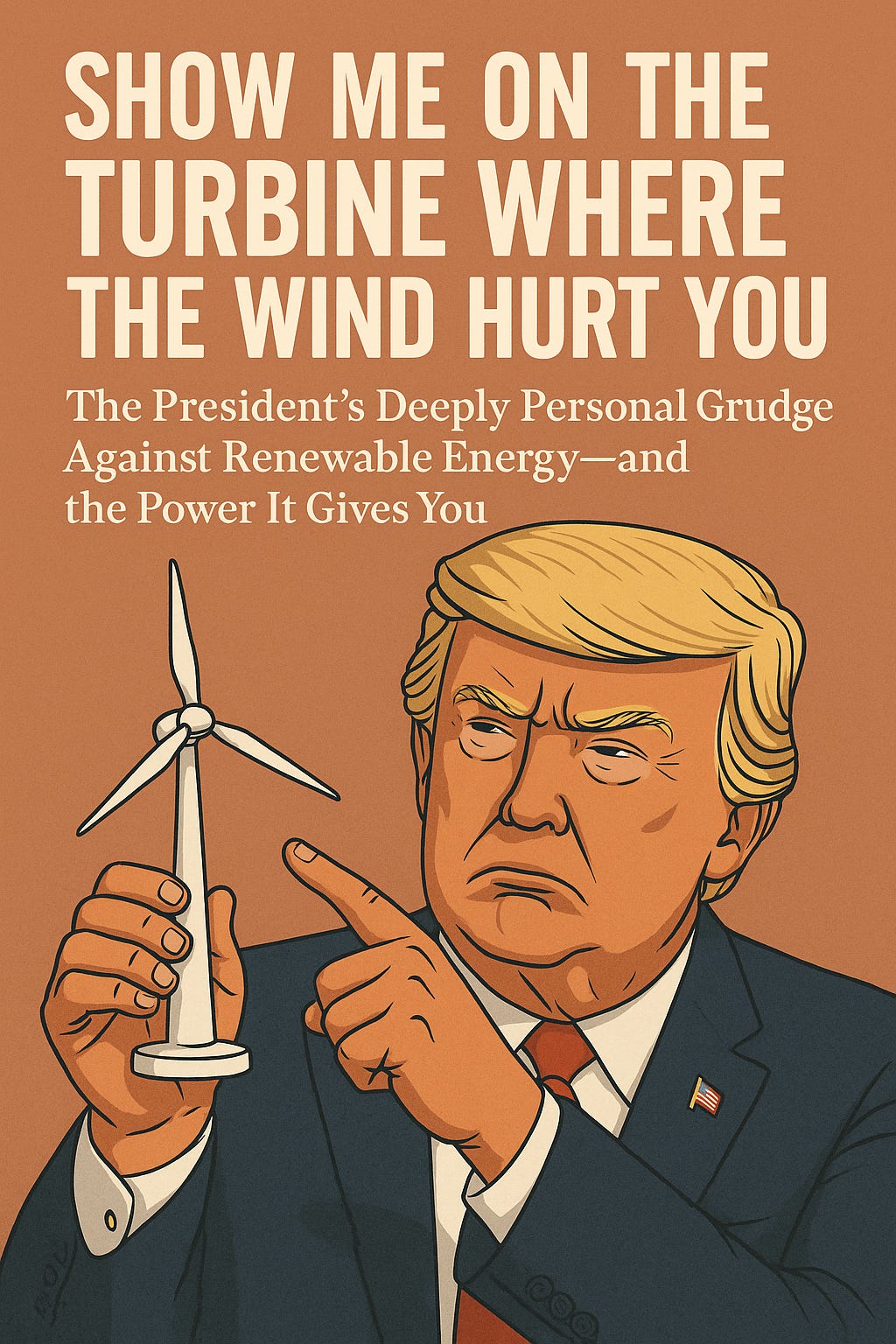
If you listen closely during one of Donald Trump’s windmill rants, you can almost hear a therapist in the background holding up a doll: "Lil' Donnie, can you point to where the wind turbine hurt you?"
The president’s vendetta against wind energy has become so absurd, so personal, and so unhinged that it deserves to be studied, not just mocked. Because behind the cancer claims and bird-apocalypse warnings lies a deeper political truth: Trump’s war on wind isn’t about turbines at all.
It’s about fossil fuel loyalty, personal ego, and a desperate attempt to keep the public dependent on centralized, corporate-controlled energy.
We’ve reached a point where one man’s failed golf course lawsuit, mixed with a pipeline of oil money, is dictating national policy on clean energy. The lies are not just embarrassing. They’re dangerous. When the facts are this clear, and the stakes are this high, misinformation isn’t just noise. It’s sabotage.
Let’s break it down, point by point.
Stay Informed. Stay Loud.
Subscribe to The Coffman Chronicle for no-BS political analysis, action guides, and daily truth bombs you won’t get from corporate media.
The Talking Points: Debunked One by One
President Trump’s anti-wind tirades rest on three main pillars, each one shakier than the last.
“Wind causes cancer.”
This infamous line—“the noise causes cancer, you tell me that one”—was delivered in April 2019 to Republican donors. There is no scientific evidence that wind turbines cause cancer. None. There are no known diseases caused by noise, vibrations, or their proximity to homes.
For the record, wind turbines aren’t even that loud.
At 300 meters away (roughly the length of three football fields), the sound level is about 35–45 decibels, equivalent to a quiet library or a gentle refrigerator hum. Unless you’re hugging the tower, the only thing getting rattled is the fossil fuel lobby.
This wasn’t a misunderstanding of the data. There is no data linking wind turbines to disease. It was pure improvisation, conspiracy theater aimed at sowing distrust in clean energy.
Ironically, the energy sources Trump supports—coal and natural gas—do release cancer-causing pollutants into the air and water. Meanwhile, the wind just blows.
“They kill all the birds.”
Wind turbines do cause some bird deaths. An estimated 140,000 to 500,000 birds per year are killed in the U.S. due to turbines. However, let’s put that in perspective:
Cats: ~2.4 billion bird deaths annually
Windows: ~600 million
Cars: ~200 million
Power lines: ~25 million
Wind turbines account for less than 0.01% of the total. Yet it gets better. A Norwegian study found that painting just one turbine blade black reduced bird strikes by up to 70%. That’s it. Some paint.
There are also exciting innovations that remove the blades altogether, removing the birdstrike risk entirely. These are currently in development and could provide unintrusive, safe alternatives suitable for just about any location.
Meanwhile, fossil fuels continue to devastate bird habitats through mining, pollution, and climate disruption. But sure, blame the wind.
“They don’t work when the wind isn’t blowing.”
This is the laziest argument, and the easiest to refute.
Grids are dynamic. They use wind when it’s available and pivot to other sources when it’s not.
Storage tech is advancing rapidly. In addition to the somewhat problematic lithium-ion model we are familiar with, there are new innovations being made with iron-air, flow batteries, and even molten salt.
Geographic diversity is a thing. When it’s calm in one place, it’s windy somewhere else.
Hybrid systems are effective. Solar + wind + battery = reliable, round-the-clock power.
Claiming that wind isn’t viable because the wind stops is like saying grocery stores don’t work because farms aren’t always harvesting. And by the same token, fossil fuel sources don’t work when no one is feeding the flames.
These talking points aren't just wrong. They’re intentionally misleading. They exist to muddy the waters, confuse voters, and delay progress.
The Real Reasons Behind the Hate
The anti-wind rhetoric is more than bad science. It’s bad faith. Trump’s war on wind has very little to do with turbines and everything to do with ego, politics, and profit.
The Golf Course Grudge
It all started in Scotland.
When Trump built his golf course in Aberdeen, he launched a furious legal battle against an offshore wind farm planned nearby. His argument was that the turbines would ruin the view from his resort. He lost. The turbines went up, and Trump has hated them ever since.
This personal vendetta born of wounded pride and beachfront aesthetics has metastasized into national energy policy. We are literally shaping America's future around one man’s bitterness over a lost court case.
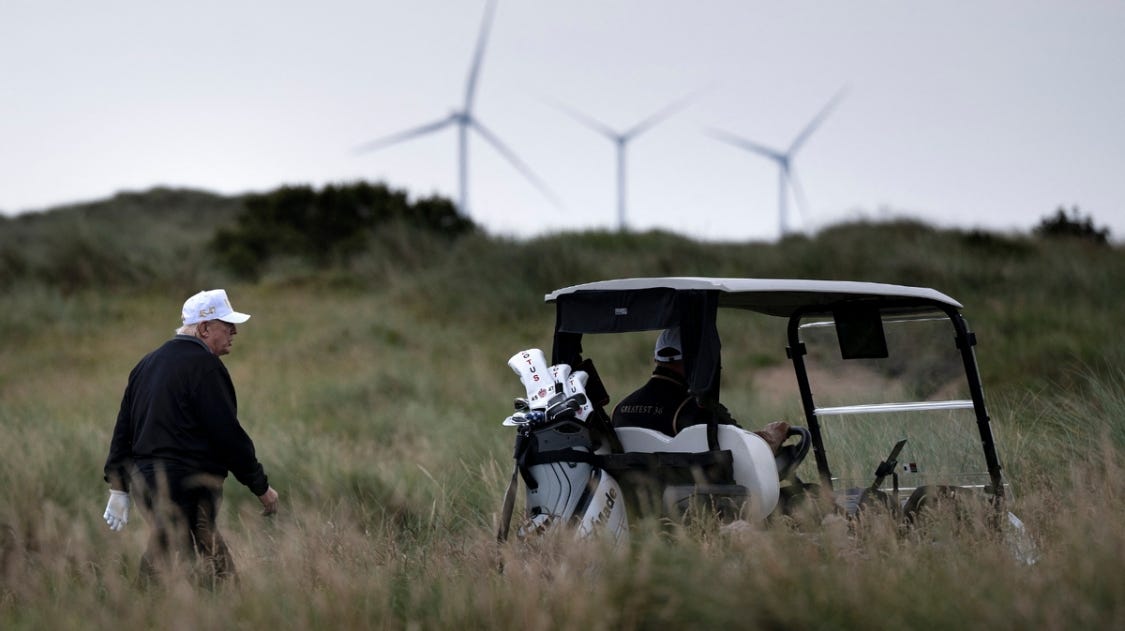
Image courtesy of Getty Images
Loyalty to the Fossil Fuel Machine
Trump’s ties to fossil fuels run deep:
His donors and allies are steeped in oil, coal, and gas money.
His presidency is marked by relentless deregulation of polluters.
His energy “experts” were handpicked from industry insiders, not scientists.
Wind and solar threaten this entire ecosystem, not just economically, but ideologically. The fossil fuel economy relies on centralized infrastructure, monopolized distribution, and constant extraction. Wind and solar don’t need that. They empower individuals. And that’s a threat.
Culture War Theater
Mocking wind energy has become part of the conservative identity toolkit, just like rolling coal, denying climate science, or calling everything they don’t like “woke.”
It’s not about truth. It’s about vibes.
Wind turbines symbolize climate action, liberal policy, and environmental regulation, so the right reflexively opposes them, regardless of the facts.
Wind energy works. It’s growing. It’s cleaner, cheaper, safer. The only way to fight it is with nonsense, nostalgia, and narrative control. Luckily, those are Trump’s favorite strategies.
See our recent reporting on other members of the GOP playing games with alternative energy here:

The Land Tells the Truth
Forget the talking points. Just look around.
Anyone who’s lived near a strip mine, fracking operation, or coal ash dump knows fossil fuel extraction is ugly, invasive, and almost never cleaned up. It leaves behind gouged hills, poisoned water, deforested valleys, and communities shouldering the fallout long after the profits have been banked.
It doesn’t matter if they call it “clean coal” or “safe fracking”, the land remembers.
Wind and Solar Live Differently
By contrast, renewable energy is a guest, not a conqueror:
Wind turbines coexist with farms. Crops grow and cattle graze right beneath them.
Solar panels turn rooftops, parking lots, deserts, and roadside shoulders into power plants.
Agrivoltaics allow us to grow food under solar panels, reducing water loss and boosting yields for certain crops.
Solar farms can even be converted into pollinator habitats or carbon-sequestering grasslands.
Most notably, when a turbine or panel reaches the end of its life, it can be removed. There are no explosions, radiation, or wasteland left behind. Infrastructure is largely surface-level and requires little effort to remediate the location.
This isn’t just about emissions. It’s about how we treat the Earth. Fossil fuels leave scars. Renewables leave options.
When Things Go Wrong
Every energy system has its risks. However, not all risks are equal. Some are manageable; others are catastrophic. And when you look at how different energy sources fail, the contrast couldn’t be clearer.
Fossil fuels and nuclear energy have a long history of disaster. When a coal mine collapses or an ash pond breaches, entire communities are buried, sometimes literally. When a gas pipeline explodes, people die. Methane leaks poison air and water. When a nuclear reactor fails, we don’t just clean up. We evacuate. We cordon off land, sometimes for decades. We draw maps of where people can no longer live. When a dam crumbles, communities are devastated and buried.
These aren’t abstract possibilities. They’ve happened, repeatedly. From the Upper Big Branch mine disaster to Deepwater Horizon to Fukushima, we’ve seen what fossil and nuclear failures look like: environmental devastation, human loss, and multibillion-dollar cleanups that never quite restore what was lost.
Now compare that to wind and solar.
When a wind turbine fails, it may lose a blade or need a gearbox replaced. When a solar panel cracks, it stops working efficiently. That’s it. No explosion. No toxic leak. No mass evacuation. These systems are designed to fail quietly. In the rare cases where they do break, the result is a service interruption and a repair job, not a headline-grabbing disaster. At worst, a turbine may be sheared by a tornado and land on a building or create dangerous flying debris.
This matters. The way an energy source fails is part of its real cost, not just in dollars, but in human and ecological risk. Fossil fuels and nuclear may offer reliability under normal conditions, but when things go wrong, they go really wrong. Wind and solar, meanwhile, just sit there. They wait for the next gust or ray of sun.
The future we build shouldn’t just be clean. It should be safe. Safety means choosing systems that fail with grace, not systems that leave craters.
The Fight for Energy Freedom
This is the part that rarely makes headlines, but sits at the heart of why renewable energy is so disruptive: wind and solar don’t just reduce emissions. They redistribute power in every sense of the word.
If you have access to sun or wind and the capital to invest, you can generate your own electricity. You don’t need a sprawling industrial complex, a refinery, or permission from a utility monopoly. With the right zoning and equipment, a homeowner can install rooftop panels, a farmer can host turbines while still planting crops, and a rural community can form a microgrid that keeps the lights on even when the larger grid falters.
This is something fossil fuels can’t offer. Even if you discovered a natural gas pocket or a coal seam under your land, you couldn’t do anything with it unless you were a corporation with millions of dollars, heavy equipment, and regulatory clearance. Fossil fuels require centralized infrastructure to be useful. You don’t burn coal and power a neighborhood with it. You feed it into an enormous, tightly controlled system. You rely on someone else.
That’s by design. The fossil fuel economy thrives on dependency. It keeps people tied to centralized sources of production and locked into markets they can’t control. It isn’t just about what we burn. It’s about who owns the means of burning it.
Renewables flip that model on its head. They make energy personal. They allow individuals and communities to participate, to opt out, to generate, to store, and to share. They decentralize power, literally and politically.
That’s what scares the fossil fuel industry the most— not the wind or the sun, but the idea that ordinary people could stop needing them.
We’ve reported previously on Trump’s attacks on alternative energy, and attempts to deregulate and hamstring the EPA to please his fossil fuel fetish. See some of those articles here:
Note: These articles are more than 45 days old and now live in the archive. Become a paid subscriber for exclusive perks including full access to all of our 850+ articles.


It Was Never About the Wind
Trump’s windmill crusade might seem absurd on the surface—just another culture war skirmish with a strange personal twist. But once the myths are stripped away, it becomes clear the fight against wind energy isn’t about birds or cancer or whether the breeze happens to be blowing.
It’s about power— who controls it, who profits from it, who’s allowed to generate it, and who’s kept dependent.
Wind energy threatens the very foundation of the fossil fuel economy, not because it’s unreliable or unsafe, but because it offers an alternative that is both accessible and liberating. It allows individuals and communities to break away from systems designed to centralize wealth, control infrastructure, and extract profits at the expense of people and the planet.
That’s what makes it dangerous to those in power.
The right-wing war on renewables is not driven by ignorance. It’s driven by fear. Fear that the public might realize they don’t have to rely on ExxonMobil to keep the lights on. Fear that energy can be clean, distributed, and locally owned. Fear that, once freed from fossil dependence, the political leverage that comes with oil fields and gas pipelines will lose its grip.
Trump’s hatred of wind isn’t just personal. It’s strategic. It feeds into a larger project to discredit the science, obstruct the alternatives, and extend the life of a dying, destructive status quo.
This was never just about wind. It was about control, and the people beginning to take it back.
Deny the Science, Sabotage the Future
You can’t stop a transition by force alone, not when the economics, the technology, and the public are shifting. So instead, those clinging to fossil fuel power have turned to the oldest trick in the authoritarian playbook: erase the evidence.
During Trump’s presidency, climate change pages have vanished from federal websites. Key scientific reports have been buried, rewritten, delayed, or ignored. Terms like “climate change” have been scrubbed from agency language. Entire departments, once tasked with studying environmental threats, have been defunded or redirected to protect industry rather than the planet.
Across Republican-led states and agencies, we’re seeing a renewed push to silence scientists, dismantle environmental regulation, and remove data that might justify moving away from fossil fuels. The goal is chillingly simple: if the public doesn’t see the problem, they won’t demand a solution. If renewables are painted as unreliable, expensive, or dangerous, the only choice left is the one they already control.
This isn’t just political negligence. It’s strategic sabotage. Undermining the science is about suppressing the urgency. Undermining the alternatives is about eliminating the exit. The goal is to manufacture dependence on their fuels, their infrastructure, and their narrative.
But the truth isn’t going away. Neither is the wind.
The Wind Isn’t the Problem. The Power Is
We’ve dismantled the lies, exposed the agenda, and made one thing clear: the war on wind energy has nothing to do with logic or science. It’s about protecting a fossil-fueled status quo built on centralized control, corporate loyalty, and the manufactured illusion of dependence.
This isn’t just Trump’s grudge. It’s a coordinated effort to stall progress by erasing facts, discrediting alternatives, and keeping the public tied to an aging, dangerous energy system. But the truth is still standing on rooftops, in fields, in communities generating their own power every day.
Wind and solar are here. They work. And they belong to all of us.
Take Action
You don’t need a turbine or solar panel on your roof to fight for clean energy. You just need a voice.
Call the U.S. Capitol Switchboard: (202) 224-3121
Ask to speak to your Senators and House Representative.
Sample Script:
“Hi, my name is [Your Name], and I’m a constituent from [Your City, State]. I want my representative to actively support policies that expand wind and solar energy, invest in energy storage, and protect climate science from political interference. We need a clean energy future, and I’m asking you to fight for it.”
Support the Watchdogs and Organizers on the Frontlines:
Energy and Policy Institute – Investigates and exposes fossil fuel misinformation.
350.org – Organizing for global fossil fuel divestment and climate justice.
Sunrise Movement – Youth-led movement for a Green New Deal.
Vote Solar – Advocating for solar access and equity across the U.S.
Climate Nexus – Tracking media narratives and public policy around climate and clean energy.
And if nothing else: Vote. Every. Time.
The fight for clean energy is political, and the people making decisions today will determine what kind of world we leave behind.
Stay Informed. Stay Loud.
Subscribe to The Coffman Chronicle for no-BS political analysis, action guides, and daily truth bombs you won’t get from corporate media.
Bibliography:
U.S. Department of Energy. n.d. “Are Wind Turbine Sounds Noisy or Loud?” WINDExchange.
“How Loud Are Wind Turbines?” Today’s Homeowner, March 25, 2025.
Wind‑Watch (Gülden‑C., C.‑K.). July 2008. “An Examination of
The Health Impact of Wind Turbines: A Review of the Current White,
Grey, and Published Literature.”
“Environmental Impact of Wind Power.” Wikipedia.
“Smøla Wind Farm.” Wikipedia.
“Painting Wind Turbine Blades To Prevent Bird Collisions.” ScienceFriday, May 24, 2024.
“Painting a Single Turbine Blade Saves Birds’ Lives.” The Wildlife Society, August 7, 2023.
“Black Turbine Blades Reduce Bird Collisions.” Vattenfall.com, February 2, 2022.
“UK’s Offshore Windfarms to Be Painted Black to Protect Birds.” The Guardian, February 27, 2025.
“Wind Turbine Syndrome.” Wikipedia.
van Kamp, Irene. 2021. “Health Effects Related to Wind Turbine Sound: An Update.” PMC.
FactCheck.org, “Trump’s Faulty Wind Power Claims,” April 4, 2019.
PolitiFact, “Donald Trump’s ridiculous link between cancer, wind turbines,” April 8, 2019.
Teen Vogue, “President Trump Claimed Wind Turbines Cause Cancer and Attacked Alexandria Ocasio‑Cortez’s Green New Deal,” April 3, 2019.
“Trump International Golf Club Scotland Ltd v The Scottish Ministers,” Wikipedia.
“Trump International Golf Links, Scotland,” Wikipedia.
“European Offshore Wind Deployment Centre,” Wikipedia.
“Balmedie,” Wikipedia.
Helena Horton, “Tilting at windmills? Trump’s claims about turbines fact‑checked,” The Guardian, July 28, 2025.
“Trump’s trip to Scotland as his new golf course opens blurs politics and the family’s business,” AP News, July 26, 2025.
AP News, “Trump caps his Scottish visit by opening a new golf course and promoting his family brand,” July 29, 2025.
NY Post, “Trump tells ‘Pod Force One’ he asked EU to ditch ‘ugly windmills’: ‘Con job’,” July 28, 2025.
“The week the US president's vendetta against renewables went global,” The Guardian, August 1, 2025.
Snopes, “Scotland approved new wind farm after Trump’s visit, but not exactly off the coast from his golf course,” Aug 5, 2025.

The fosel fuel industry attached themselves to Trump because he had a go in with the Scottish government over the off coast windmills at his golf course making him a fervent allie of theirs. Some history just won't go away.
I belong to Climate Now. Trump and cronies are fossil fuel types.