


Editor’s Note: This is the second installment in our Disposable America series (see the first article linked later in this piece), which investigates how federal restructuring and funding decisions are dismantling essential health and social services. In our first piece, we examined the broad reshaping of the Department of Health and Human Services. Now, we turn to one of the most urgent—and invisible—casualties: mental health care.
A Brief History of SAMHSA
The Substance Abuse and Mental Health Services Administration (SAMHSA) was established in 1992 as a standalone agency within the U.S. Department of Health and Human Services (HHS). Its mission was simple yet monumental: to lead public health efforts to advance behavioral health nationwide, especially for those struggling with addiction, mental illness, or trauma.
Over the years, SAMHSA funded treatment centers, state mental health systems, crisis hotlines, tribal programs, and data research initiatives. It became a vital federal partner for local providers, offering grants, guidance, and support. Although it didn’t directly treat patients, it made care possible for millions.
Independent News. Just $1/Week.
We just hit 12,000 subscribers—thank you! To celebrate, we’re offering full access to The Coffman Chronicle for just $1 a week ($52/year).
Get exclusive analysis and fearless reporting you won’t find in corporate media.
Support truth. Stay informed.
What SAMHSA Does (Or Did)
Before this year’s restructuring, SAMHSA coordinated:
Block grants to states for mental health and substance use services
National datasets like the National Survey on Drug Use and Health
Public education campaigns on suicide prevention, addiction, and trauma
Technical assistance to clinics, providers, and first responders
Oversight and funding for the 988 Suicide & Crisis Lifeline
Support for community programs focused on underserved populations
Through these efforts, SAMHSA didn’t just fund programs; it sustained the backbone of the country’s behavioral health ecosystem.
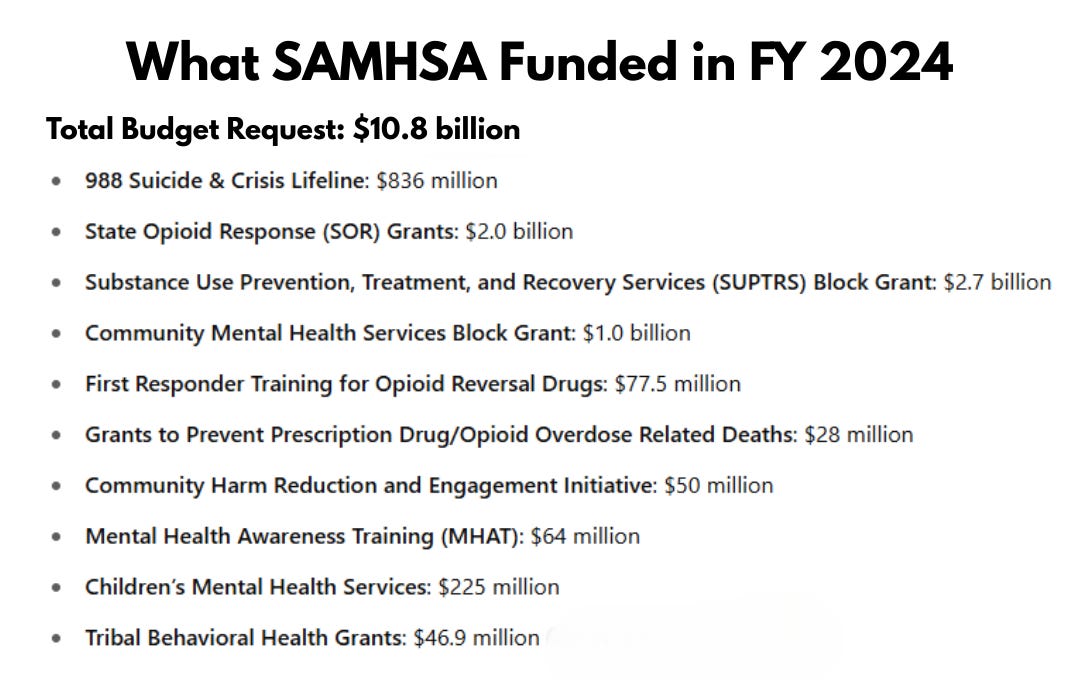
The scope of that support in its final full year is staggering:
What Happened
In March 2025, the Trump administration announced a sweeping reorganization of HHS, consolidating 28 agencies into 15. As part of this overhaul, SAMHSA was dissolved and absorbed into a new entity called the Administration for a Healthy America (AHA)—a restructuring led by the Department of Government Efficiency (DOGE).
The consequences were immediate:
Thousands of staff laid off, including data scientists and grant administrators
The National Survey on Drug Use and Health team disbanded
Behavioral health block grants delayed or canceled
Programs paused, defunded, or quietly shut down
See our previous reporting on cuts to federal health agencies here, including the first in this series:


Among the most devastating losses was SAMHSA’s $56 million Narcan distribution program, which had trained over 66,000 individuals and delivered more than 280,000 life-saving kits in 2024 alone. The decision to cut the program, despite its direct role in a 24% decrease in overdose deaths, was framed as part of a shift toward “community-based solutions.”
But those solutions never came.
“We are currently in a mental health and substance use crisis,” said Dr. Marketa M. Wills, CEO of the American Psychiatric Association. “SAMHSA’s programs have contributed to the advances our nation has made... Its impact across the nation is widespread and crucial.”
What This Means
The immediate consequences of these structural changes are already unfolding across the nation.
Community mental health clinics that relied on federal grants are shutting their doors. Peer support networks are losing funding. Crisis lines are being rerouted or going unanswered. And rural addiction treatment centers—already under-resourced—are being pushed closer to collapse.
In April 2025, the administration rescinded $11.4 billion in behavioral health funding, much of it flowing through SAMHSA to addiction and mental health providers. These pandemic-era grants were lifelines. Their sudden withdrawal forced layoffs, shuttered programs, and terminated care mid-treatment.
“Cutting half or more of SAMHSA staff will undoubtedly hurt Americans, worsen this crisis, and impact millions,” warned Hannah Wesolowski of the National Alliance on Mental Illness. “We urge our nation’s leaders to take every measure within their power to prevent these massive cuts.”
Veterans are also caught in the crossfire. Suicide rates among U.S. veterans remain disturbingly high—6,407 in 2022 alone, or 17.6 per day. While younger and female veterans have seen modest decreases, those improvements are now at risk as the VA shutters inpatient mental health units, cuts research, and braces for an 83,000-person staff reduction.
These cuts come at a time of historic need, when mental health disorders are widespread and services are already strained.
Consider just how many Americans are affected:
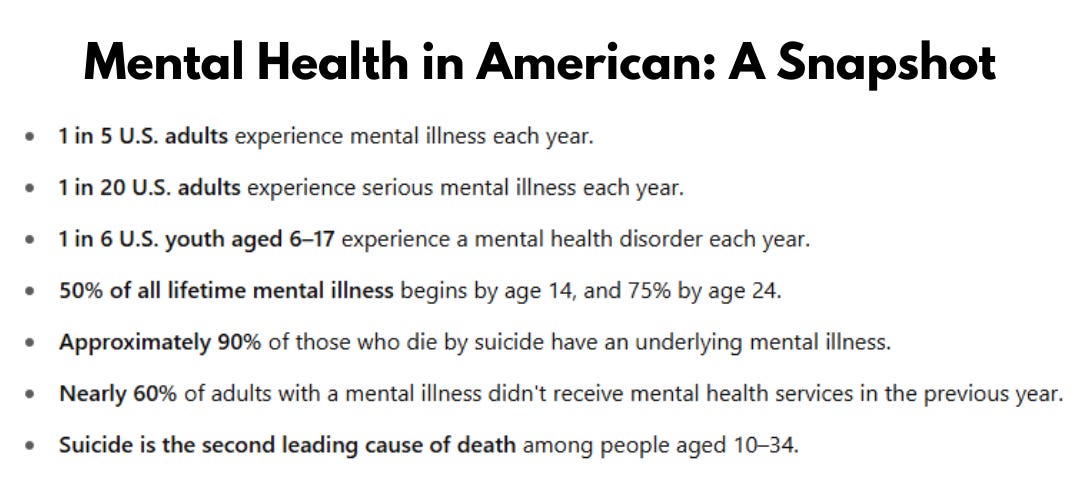
Information from NAMI
Even for those who manage to access care, affordability remains a barrier. Americans pay 2 to 4 times more for medications than citizens in other developed nations, and tariffs on pharmaceutical ingredients have pushed prices even higher. At the same time, insurance coverage remains fragmented and incomplete, leaving many to pay out of pocket for therapy or psychiatric meds.
Undermining the Lifeline
And it’s not just long-term care that’s disappearing. Even our emergency lines are under threat.
In April, a leaked budget proposal revealed plans to eliminate all federal funding for the 988 Lifeline’s specialized LGBTQ+ youth services by October 2025. These services have handled over 1.2 million crisis contacts since their launch and offer culturally competent, trauma-informed care tailored to one of the most vulnerable groups in the nation.
“What they get is somebody who cares... who understands where they’re coming from,” said Hannah Wesolowski of NAMI. “Someone specially trained to address what they are dealing with.”
Meanwhile, broader strains on 988 are emerging nationwide. SAMHSA staffing cuts are affecting the program’s administration, and states like Texas report millions in funding shortfalls, threatening to close local call centers.
When the country’s last-resort lifeline is being quietly dismantled, it’s no longer just a crisis. It’s a declaration.
The Ripple Effect
These cracks in the system don’t stop at the federal level; they ripple outward, straining local providers and leaving entire regions exposed.
State and local agencies depend on federal guidance and funding to sustain behavioral health programs. With SAMHSA gutted and behavioral health grants revoked, downstream providers are collapsing, especially in rural areas, where more than 60% of residents live in mental health provider shortage zones.
Telehealth, once a lifeline during COVID, is now precarious. Funding extensions are short-term. Broadband is inaccessible in many areas. And libraries, which stepped up by installing private telehealth booths, are now under cultural and political assault themselves.
Meanwhile, community-based services—like crisis centers, school counselors, and outreach programs—are stretched thin or being eliminated. The support systems that could have softened the blow are being hollowed out just as they’re needed most.
We recently reported on efforts to legalize alternative therapeautics to treat mental health and addiction. As patients struggle to afford or see success with traditional pharmeseuticals, these show promise, but face tremendous obstacles. See that article here:

The Full Collapse
These cascading failures culminate in a comprehensive breakdown of the mental health support system.
The federal government is withdrawing support by gutting agencies like SAMHSA, ending programs like Narcan distribution, and cutting billions in funding. Science is being undermined, replaced by fringe alternatives. Cultural narratives are shifting, framing mental illness as a moral failure, not a medical condition.
“Millions of Americans who get mental health and substance use services depend on SAMHSA—even if they have never heard the name,” said addiction researcher Dr. Brendan Saloner of Johns Hopkins.
Those who seek help face insurance denials, rising drug prices, and reduced access. Telehealth is unreliable. Community institutions are under siege. There are fewer places to turn, and fewer people left to catch those who fall.
“There’s a reason why we have reduced overdose in this country,” added Dr. Ruth Potee. “It’s because SAMHSA has been doing its job so well. My jaw drops at this news.”
This isn’t a shift in strategy. It’s the erasure of responsibility. Not a redistribution of care, but a declaration that some people-those with trauma, addiction, invisible wounds—are simply not worth saving.
Conclusion: The Quiet Declaration
This isn’t about reform. It’s about abandonment.
Families are drowning. Communities are crumbling. The federal system that once offered support is being dismantled—program by program, person by person.
This is the story of a country that says, in every decision it makes: if you are struggling, if you are broken, if you cannot hold yourself up, you’re on your own.
If You’re Struggling
If you or someone you love is struggling, please know: you are not alone. The systems may be strained, but support still exists, and your life has value.
988 Suicide & Crisis Lifeline – Dial or text 988 anytime, day or night, to connect with trained counselors.
The Trevor Project – Call 1-866-488-7386 or text START to 678-678 for 24/7 crisis support for LGBTQ+ youth.
Veterans Crisis Line – Call 988 and press 1, or text 838255 to connect with VA responders.
National Alliance on Mental Illness (NAMI) – Call 1-800-950-NAMI or text "HELPLINE" to 62640 for peer support and resources.
Stay with us. We see you. We will keep telling these stories.
We just hit 12,000 subscribers—thank you! We’re offering full access to The Coffman Chronicle for just $1 a week ($52/year) to celebrate.
Get exclusive analysis and fearless reporting you won’t find in corporate media.
Bibliography:
Substance Abuse and Mental Health Services Administration (SAMHSA). Fiscal Year 2024 Congressional Justification.
National Alliance on Mental Illness (NAMI). Mental Health by the Numbers. Accessed May 2, 2025.
U.S. Department of Veterans Affairs. 2022 National Veteran Suicide Prevention Annual Report. Office of Mental Health and Suicide Prevention, 2023.
Chatterjee, Rhitu. “The Government Suggests Defunding the 988 Suicide Hotline for LGBTQ+ Youth.” NPR, April 28, 2025.
Newsom, Gavin. “Gavin Newsom Rips Trump, RFK Jr. over Suicide Hotline Cuts.” Politico, April 25, 2025.
The Trevor Project. “Trump Administration Proposes Defunding Suicide Lifeline for LGBTQ+ Youth Beginning October 2025.” The Trevor Project, April 2025.
National Alliance on Mental Illness (NAMI). Transcript: NAMI Virtual Town Hall – What’s Happening with 988? July 17, 2024.
National Alliance on Mental Illness (NAMI). NAMI Releases Issue Brief Exploring Trends in Youth Mental Health State Policy. September 20, 2024.
National Alliance on Mental Illness (NAMI). Federal Priorities 2023–2024. 2023.
U.S. Department of Health and Human Services. SAMHSA Budget. Accessed May 2, 2025.
The entire tRump administration needs to go to prison! Beyond all of this they have taken America from being a world leader in taking EXCELLENT care of those less fortunate and underserved. They have ruined our reputation and we need to take it back!
It is unsavory union between Scrooge and Ayn Rand that produce policies that cost lives. Hey, do everything to give that human zygote rights since it costs you nothing. But, once born then work it, tax it and if doesn't work out jail it.