


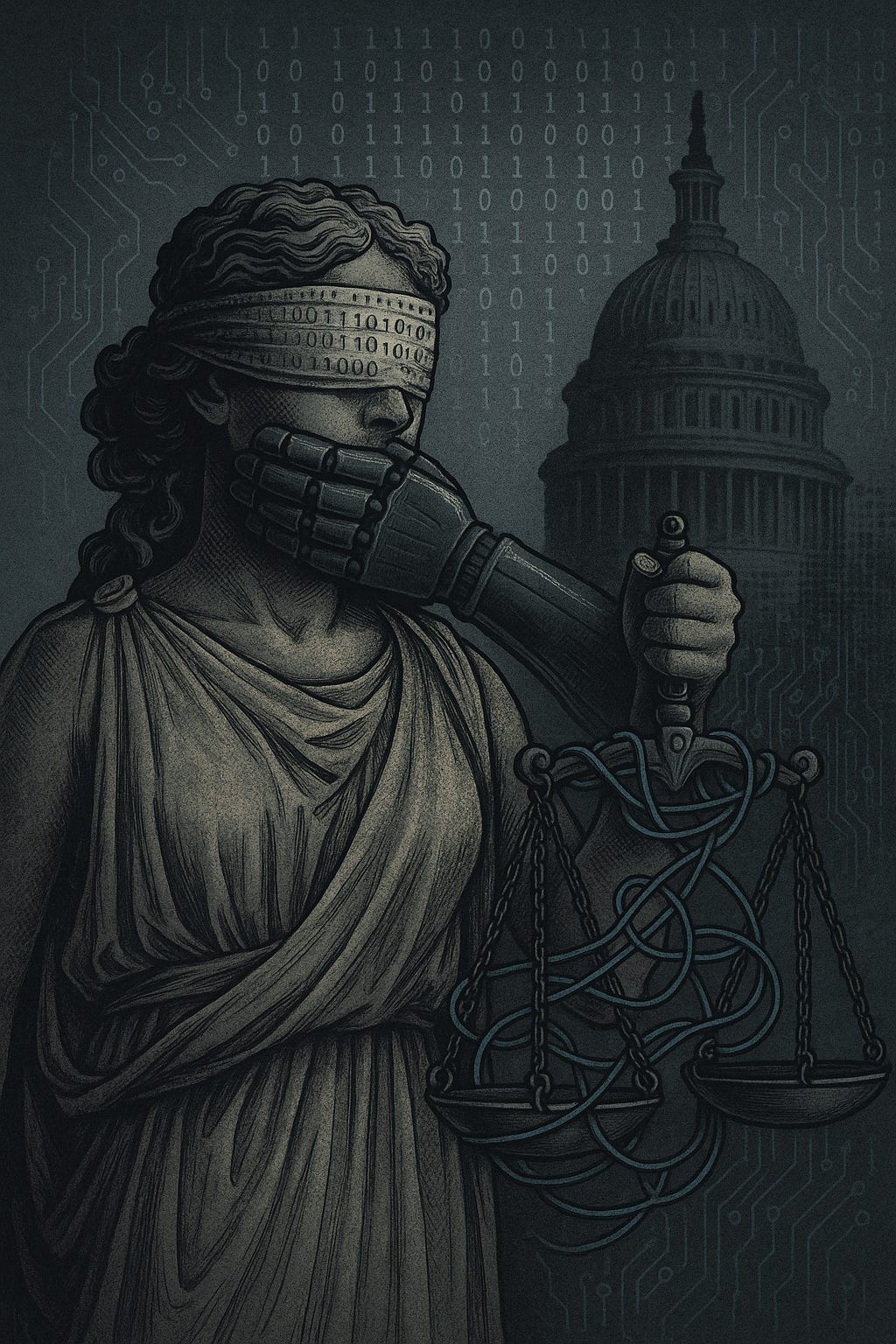
Tucked into a Republican budget bill is a provision that would ban states from passing their own AI regulations for the next ten years. No federal standards are in place, and no protections are guaranteed. This is just a decade-long gag order, locking state governments out of the most critical technological reckoning of our time.
The justification? “We need consistency.”
The reality? This is a power grab designed not to regulate AI, but to remove every possible guardrail so it can grow unchecked, unchallenged, and unaccountable.
We just hit 13,000 subscribers—thank you! We’re offering full access to The Coffman Chronicle at 50% off to celebrate.
Get exclusive analysis and fearless reporting you won’t find in corporate media.
Note: This is just one of the interesting tidbits hidden in the budget reconciliation bill. See our reporting on the larger bill here:

A Decade Too Late & Now a Decade of Silence
For years, Congress has been a punchline in the tech world. It always lags behind innovation and holds hearings long after the damage is done. While Silicon Valley charged ahead, deploying AI in policing, hiring, healthcare, and surveillance, lawmakers nodded, waved, and shrugged. They failed to act when it mattered most.
Now, instead of finally catching up, Congress is doing something far worse: it’s banning everyone else from acting too.
The proposed moratorium would prevent states from passing any laws related to AI systems for a full decade unless those laws are explicitly meant to promote AI adoption. So while the public is grappling with real-world harms like algorithmic bias, deepfake disinformation, and mass surveillance, Congress isn’t offering solutions. It’s offering silence, and it’s demanding that silence from everyone else, too.
This isn’t responsible governance. It’s abdication enforced.
If AI harms are already here, then ten more years without oversight is not a pause. It’s a runway for abuse, for inequality, and for systemic exploitation.
The Excuse? Uniformity. The Reality? Deregulation.
Proponents of the 10-year moratorium on state-level AI regulation argue that a unified federal approach is necessary to prevent a fragmented regulatory environment that could stifle innovation. They claim that a patchwork of state laws would create confusion and hinder the development of AI technologies.
However, this rationale overlooks a critical fact: there is currently no comprehensive federal framework for AI regulation. By preempting state laws without establishing federal standards, the moratorium effectively leaves a regulatory vacuum where AI technologies can operate without oversight.
Moreover, the moratorium would nullify existing state-level protections. States like California and New York have already enacted laws addressing issues such as AI-generated deepfakes and algorithmic bias in hiring practices. By overriding these laws, the federal government would be removing critical safeguards that protect consumers and uphold civil rights.
Critics argue that this move is less about creating uniformity and more about shielding AI companies from accountability. By eliminating state-level regulations, companies could avoid compliance with stricter standards, allowing them to prioritize profits over ethical considerations.
“I strongly oppose any effort to block states from developing and enforcing common-sense regulation; states must be able to protect their residents by responding to emerging and evolving AI technology.”
— Rob Bonta, California Attorney General
In essence, the proposed moratorium appears to be a strategic effort to deregulate the AI industry under the guise of promoting innovation, potentially at the expense of consumer protections and ethical standards.
States as Laboratories Now Being Muzzled
American democracy is built on the idea that states serve as laboratories, where new ideas, policies, and protections can be tested, refined, and scaled to the national level. That’s how we’ve advanced everything from environmental standards to healthcare access to consumer privacy laws. AI regulation should be no different.
In fact, states have already started doing the work.
California passed laws to regulate algorithmic hiring practices and data privacy.
Illinois implemented biometric privacy protections that have become a national model.
New York City enacted rules around AI in employment decisions, demanding transparency and fairness.
Colorado has pursued legislation targeting automated decision-making systems.
These aren’t just laws; they’re democratic experiments, grounded in public concern and driven by real-world impact. And they’re exactly the kinds of efforts a responsible federal government would study, learn from, and expand.
“We’re going to see AI everywhere in the next few years, and bad actors are going to intentionally misuse it to commit crimes and scam people. Our General Assembly has been taking the threat of AI seriously and has passed laws to keep our children safe from AI abuse. The federal government shouldn’t stop states from working to keep people safe.”
— Jeff Jackson, North Carolina Attorney General
Instead, the proposed moratorium would shut it all down. It wouldn’t just freeze future innovation but nullify existing laws protecting millions of people.
This isn’t coordination. It’s a gag order on public problem-solving.
Even Conservative States Smell a Rat
When California and New York oppose a Republican bill, that’s expected. But when Arkansas, Utah, Ohio, and Tennessee start pushing back? That’s a political earthquake.
A bipartisan group of 40 state attorneys general, including many from deep-red states, has opposed the AI moratorium, warning that it would strip states of the power to protect their residents from real and growing harms.
“AI brings real promise, but also real danger, and South Carolina has been doing the hard work to protect our citizens. Now, instead of stepping up with real solutions, Congress wants to tie our hands and push a one-size-fits-all mandate from Washington without a clear direction. That’s not leadership, that’s federal overreach.”
— Alan Wilson, South Carolina Attorney General
Their message is clear: this bill isn't about fostering innovation or creating clarity. It’s about stripping power from the people and consolidating it in Washington, D.C., under the influence of corporate lobbyists.
When Arkansas and California find themselves on the same side of a tech policy debate, you know something is seriously off. When even the conservative states are saying, “Whoa buddy, this is too much,” it’s time to stop pretending this is normal.
The Real Goal: AI Without Guardrails
At the same time Congress is trying to silence the states, the federal government is aggressively rolling out AI across its own institutions. Under the umbrella of the Department of Government Efficiency (DOGE), AI “solutions” are being integrated into agencies to streamline decision-making, reduce costs, and “enhance productivity.”
But here’s the catch: these systems are being deployed without public debate, without meaningful transparency, and now, if the moratorium passes, without the ability for states to step in when things go wrong.
This isn’t a pause for reflection. It’s expansion without accountability.
“This bill does not propose any regulatory scheme to replace or supplement the laws enacted or currently under consideration by the states, leaving Americans entirely unprotected from the potential harms of AI. Moreover, this bill purports to wipe away any state-level frameworks already in place. Imposing a broad moratorium on all state action while Congress fails to act in this area is irresponsible and deprives consumers of reasonable protections.”
— Excerpt from a letter signed by 40 state attorneys general
By stripping states of the power to regulate AI, Congress isn’t just giving private industry a free pass. It’s giving itself one, too. It’s laying the groundwork for a federal bureaucracy that runs on automated decisions, machine-made judgments, and algorithmic governance, all while preventing anyone outside Washington from raising the alarm.
A coalition of 141 organizations, including civil rights groups, labor unions, tech watchdogs, and academic institutions, put it plainly:
“The provision could result in unfettered abuse of AI technologies, undermining critical safeguards such as civil rights protections, protections against fraud, privacy standards, and accountability for harmful AI applications.”
The real goal here isn’t uniformity. It’s the consolidation of power. In this vision, AI becomes a tool not of public service but of top-down control, whether in surveillance, benefits distribution, or even law enforcement.
In a just democracy, AI should serve the people, not replace their voice, strip their rights, or silence their governments, but that’s precisely what this bill is poised to do.
Call to Action: Don’t Let Congress Gag the States. Speak Up Now
If this bill passes, states will be powerless to protect their residents from AI-related abuse, discrimination, and surveillance. We cannot afford to sit this one out.
Call the Congressional Switchboard and ask to be connected to your representative and senators: 202-224-3121
Find your local elected officials and send them a message:
https://www.congress.gov/membersTalking Points to Share When You Call or Write:
Oppose the 10-year moratorium on state AI regulations.
Support state autonomy in protecting civil rights, privacy, and transparency.
Demand a real federal AI framework that sets a minimum standard and allows states to go further.
Do not reward Big Tech lobbying with a regulatory blank check.
Our voices are stronger together. Let Congress know we’re watching and will not remain quiet while they silence democracy.
We just hit 13,000 subscribers—thank you! We’re offering full access to The Coffman Chronicle at 50% off to celebrate.
Get exclusive analysis and fearless reporting you won’t find in corporate media.
Bibliography:
Bonta, Rob. “40 Attorneys General Oppose Federal AI Law That Would Nullify State Protections.” Reuters, May 16, 2025.
Business Insider. “Trump-Backed Bill Could Create 'Unfettered Abuse' of AI, 141 Organizations Warn.” Business Insider, May 14, 2025.
Jackson, Jeff. “Attorney General Jeff Jackson Opposes Move to Prohibit States from Enforcing AI Laws.” North Carolina Department of Justice, May 15, 2025.
The Guardian. “Republican Budget Bill Could Prevent States from Passing AI Laws for 10 Years.” The Guardian, May 14, 2025.
AP News. “Congress May Block States from Regulating AI for 10 Years.” Associated Press, May 14, 2025.
Lawfare Media. “On AI Policy, Congress Shouldn’t Cut States Off at the Knees.” Lawfare, May 17, 2025.
American Progress. “The House Is Close to Passing a Moratorium on State Efforts to Regulate AI.” Center for American Progress, May 16, 2025.
StateScoop. “40 State Attorneys General Reject Federal AI Law That Preempts State Rules.” StateScoop, May 16, 2025.
Brookings Institution. “States Are Legislating AI, But a Federal Moratorium Could Undermine Their Progress.” Brookings, May 15, 2025.
Arxiv. “Regulatory Capture and the Risks of Federal AI Preemption.” arXiv.org, May 10, 2025.
Congress is handing everybody a free pass They are complicit in the trump crimes
Marie, I admire your work. I really do. But every article makes me feel worse. Of course, it's not your fault.
Whenever I think it can't get any worse, I read a new post and realize that it can.
Thank you so much for your work even if I believe the train is already off the track.
Please assure me, there is still hope. I desperately need that.