


When we think of New York City in 2025, we picture a massive metropolis teeming with millions of people, cars, lights, shops, and restaurants. We picture Central Park and the iconic, larger-than-life skyscrapers that make you wonder how people could build buildings so tall and fit so many people in such a small piece of land.
Present-day New York City holds over 8 million residents. However, if we rewind to the 1850s, New York City was considered bursting at the seams with a population of over 500,000. No longer a vast open space of forests and fields, it would become grimy, chaotic, and cramped but pulsing with possibility for the people racing towards the city to grab their piece of the American Dream.
The city’s population, many recent immigrants, crowded into tenements in Lower Manhattan. Streets were rivers flowing with horse-drawn carts, barefoot children, and a rising tide. This city was transformed: canals were filled in, railroads were expanding, and the skyline, though still low, was beginning to bristle with the signs of commerce and ambition we will see 167 years later.
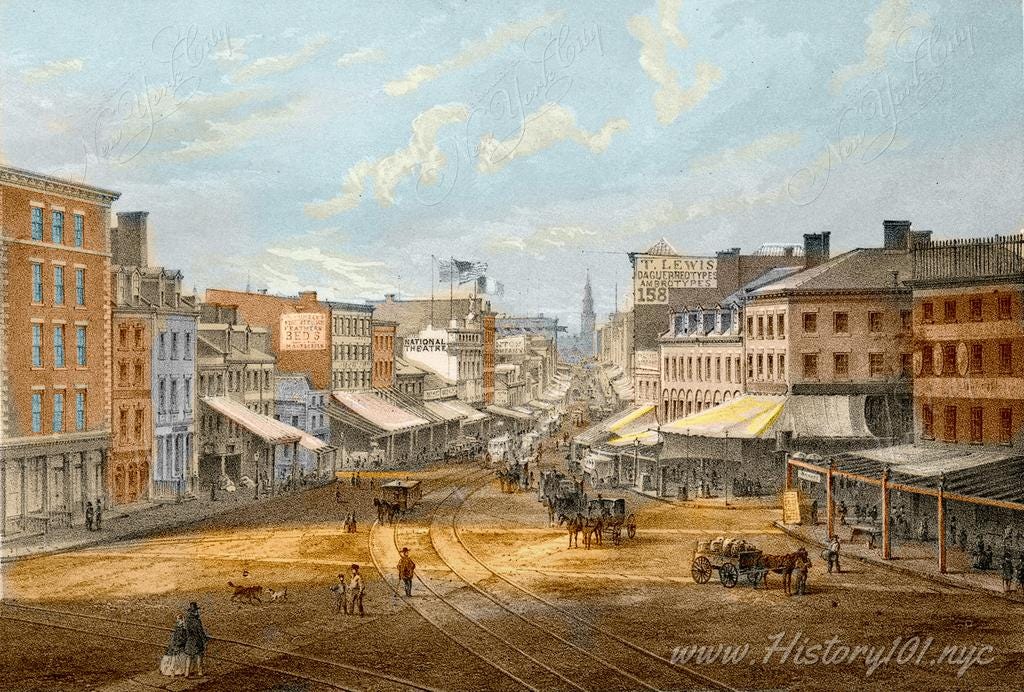
Looking south from Chatham Street: https://www.history101.nyc/looking-south-from-chatham-square-1858
Coffman Chronicles
We just hit 13,000 subscribers—thank you! We’re offering full access to The Coffman Chronicle at 50% off to celebrate.
Get exclusive analysis and fearless reporting you won’t find in corporate media.
Support truth. Stay informed.
But rapid urbanization comes at a cost. Modern sanitation systems had not yet been developed and built by the city, and the cramped and small spaces of the tenement houses gave diseases the perfect conditions to spread rapidly. Water treatment is decades away from being considered a priority, nevertheless. Space in New York City is a commodity, true even in 1858, and because city planners and engineers could not build up past a certain point, the only option was outward. Because clean water was in short supply, children were often given milk to drink as a cleaner alternative.
While milk had its problems with pathogens, in 1850s New York City, it was much safer to drink than water, which led to a skyrocketing demand for milk. With land becoming more scarce and a booming population, dairies began to have difficulties fulfilling orders.
Capitalism At Its Finest
The costs of bringing the product to market increased in the delivery process and in feeding the cows. With the number of fields close to New York City decreasing, the cost of hay and other grains to feed the cows increased.
As we know in capitalism, increased demand coupled with a limited supply and increased production costs meant that the wealthy could pay for farm-fresh milk, leaving the poor with limited options on what they could consume and feed their children.
Another booming industry during this time was alcohol, particularly whiskey. Also deemed a safer alternative to water, this period of American history saw the highest whiskey consumption ever, both in the past and in the present. To meet the demand, New York City was home to many large distillery companies.
The distilleries saw an opportunity to meet the needs of thousands who wanted milk but couldn’t afford the high price or even find a supply. A waste byproduct of whiskey-making is a watery mash of fermented barley and wheat, known in the industry as swill. These companies thought, why don’t we bring cows to the distilleries and feed the cows the swill? It’s still wheat and barely even though it had been soaked in alcohol for months and contained minimal nutritional value. The distilleries started to produce and deliver ‘swill milk.’ Even the poorest city residents could afford it at six cents per quart.
Soon after this business endeavor, while the distillery dairies rolled in huge profits from this new side hustle, child mortality skyrocketed. Thousands of children began to die within months, and 8,000 were dead by the end of the year. No one knew why until Frank Leslie, a reporter and owner of Frank Leslie’s Illustrated Newspaper, broke the story of what we know as the Swill Milk Scandal. The distillery dairies were poisoning much of New York City’s population.
So the question is: Did the distillery owners get away with this? Yes and no. Let’s look at another part of the story, as it is important to be able to answer the question.
Frank Leslie, a Relatively Forgotten Investigative Journalist
Frank Leslie wrote a scathing exposé in his newspaper of what the distilleries were trying to pass off as milk to the residents of New York City.
Leslie would describe in gruesome detail the disgusting living conditions of the cows. Often cramped by the hundreds and thousands into stalls, the cows lived in their manure, covered in fleas and sores, and riddled with viral diseases. The swill had minimal nutritional value, so combined with the cows’ living conditions and poor health, they began to produce milk that had a bluish tint and smelled rotten and rancid. Too weak and sick to stand, milking the cows had to be done by putting them on lifts.
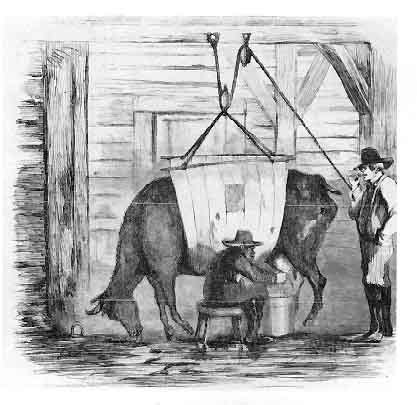
A 19th-century illustration of "swill milk" being produced: a sickly cow being milked while held up by ropes. - Frank Leslie's Illustrated Weekly: https://commons.wikimedia.org/wiki/File:Swillmilk1.jpg
However, as we already know, this did not stop the distilleries from selling it. They added chemicals like formaldehyde to hide the putrid smell and plaster of Paris to make the consistency just right. Reports accused the companies of using eggs that had gone bad, flour, or burnt sugar. They even dared to market the milk as “country milk” or “Orange County” milk.
In the same editorial mentioned earlierl, the New York Times described swill milk as "that bluish, white compound of true milk, pus and dirty water, which, on standing, deposits a yellowish, brown sediment, that is manufactured in the stables attached to large distilleries by running the refuse distillery slops through the udders of dying cows and over the unwashed hands of milkers..." (“How We Poison Our Children,” 1858)
Frank Leslie's exposé caused widespread public outrage, which drew angry mobs to pressure local politicians to punish and regulate the distillery-dairies, which were formally complained of as "swill milk nuisances."
Leslie was so driven to make the public aware of the contents of the swill milk, The New York Times wrote about Leslie’s coverage, stating,
“Unpromisingly matters stood when Frank Leslie found a disgusting dose of milk and pus left at his door as milk, which fairly threw his illustrated newspaper into an emetic convulsion. Bound to know the worst of the horrible story, he analyzed the specimen. Then he dispatched his corps of reporters and artists to the headquarters of the poison … He has reproduced pictures that are true to the life, and so shocking that the very word milk, or the sight of dainties into which it enters as an important component, turns the stomach. The whole town suffers nausea.” (“How We Poison Our Children,” 1858)
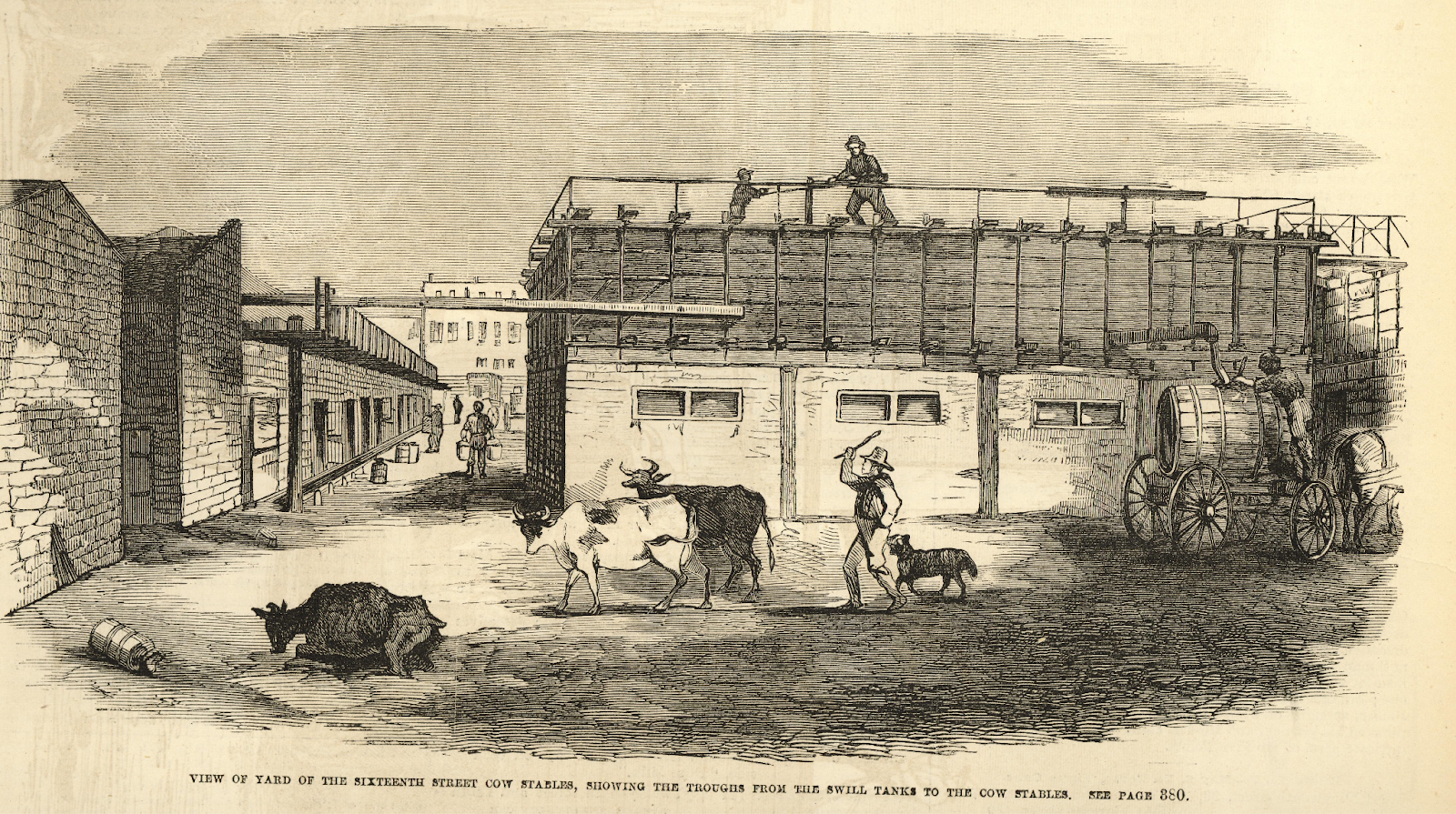
One of Frank Leslie’s damning illustrations, depicting the view of the 16th Street cow stable yard. May 29, 1859.
New York City’s Response
Frank Leslie's Illustrated Newspaper would not let this story be forgotten. The newspaper staked out distillery owner Bradish Johnson's mansion and reported that Tuomey (a local politician) was observed making late-night visits amid the investigation. Politicians with the most power, including Frank Leslie, were bribed to make this story disappear from the headlines.
The Tammany Hall (a political machine that ruled New York City politics from 1787 through the 1960s, most known for its corruption) politician Alderman Michael Tuomey, known as "Butcher Mike," vigorously defended the distillers throughout the scandal. The corruption was so profound that Tuomey oversaw the Board of Health investigation. (Sachsman et al., 2013, p. 132)
Tuomey assumed a central role in the ensuing investigations, shielded the dairies with fellow Aldermen E. Harrison Reed and William Tucker, and turned the hearings into circuses designed to discredit dairy critics and establish health authorities.
The New York City Board of Health exonerated the distillers, but there was massive public outcry, and the public wanted justice. The New York City government was not going to give it to them. They would sweep this under the rug and even allow the distilleries to gaslight the public into thinking the milk was fine and keep drinking it.
So, They Got Away With It
Looking back at an earlier question, did the distilleries get away with it? It appears that the distillery dairies got away with everything. And yes, the owners suffered minimal financial liability and zero criminal consequences. However, they saw implications, and the liquor and dairy industries suffered unintended consequences.
Frank Leslie Wins the Information Battle… Eventually
Leslie pursued the distillery owners so fiercely that Tuomey even launched a disinformation campaign to argue that swill milk was as good or better for children than regular milk. In the end, Reed and Tuomey successfully blocked any serious inquiry into the dairies and stymied calls for reform.
The facts were the facts thought. Eight thousand children were dead, thousands of others were sickened and suffered permanent health problems. This did not sit well with the public or Frank Leslie.
When it looked like the wealthy distillery owners would get away with their crimes, Frank Leslie placed full-page ads in competing newspapers. There, he advertised his swill milk exposé series with dramatic lines such as: “Are you aware what kind of milk you are drinking?” He also published precise maps depicting the street corners where swill milk was sold and produced.
Leslie met setbacks fighting the distillery dairies, but 1862, after years of the local governments doing nothing, the New York State legislature passed laws regulating milk production, health standards, and safety. While there would still be bacterial challenges with milk until refrigerators or railcars were available, only milk from cows that ate regular hay, grass, and grains could be sold as milk in New York.
Do not be mistaken or look at the New York State government as the story's heroes. They only put this into law because of the ever-increasing public pressure and newspaper campaigns of Frank Leslie, and later The New York Times. (Sachsman et al., 2013, 122)
The Unintended Consequences
Thanks to Leslie's reporting, Michael Toumey was forever known as “Swill Milk Toumey.” His political career did not go much further after this, either. Because of this scandal, the dairy industry’s reputation was tarnished, and Toumey worked with a social activist, Robert Milham Hartley, to repair public opinion on drinking milk. However, it would remain tarnished until 1906 when the first major food safety laws were passed nationally.
Hartley and Toumey’s work to repair the dairy industry came at a cost to the liquor industry, as Hartley had been working to mainstream the temperance movement for decades. He is credited with the work before the big push for abolition. He said publicly that milk was less sinful to drink and could help in repentance for the nation’s sins. (DuPois, 2002)
What Can We Learn from the Swill Milk Scandal?
So what’s the point in looking into a scandal from the 19th century? Well, we can learn several things from the Swill Milk Scandal.
Public Pressure Works
Once the public was made aware of what they were consuming, relentless public pressure was part of the success of getting the dairy distilleries and the precursors to our modern food safety laws. People showed up to protest the distilleries and massive corporate corruption that was exerted, covering up the scandal.
Whenever you get discouraged about the modern-day horrors we are witnessing, get mad, and contact your representatives just as relentlessly. We’re in a time where we must non-violently make our voices heard.
Emails are not enough. Go to their offices and show up at townhalls. Make daily calls to their local and federal offices. Elected officials do not make change until there is public backing. They rarely make significant changes that benefit the public good until there is sustained public persistence and insistence. Join activist groups who are working around the clock to do something to resist the Trump administration and protect the public. There is strength in numbers.
The Press Is a Powerful Tool
Frank Leslie’s tireless work is why people knew of the swill milk and probably saved countless lives by exposing it. However, did more than write a story. He painted horrific pictures of what these distilleries were doing to raise the public outcry. His crusade has been limited in the short term, but Leslie is credited and criticized for stigmatizing the dairy industry for decades after. So much so that the dairy industry had to hire someone to repair the severely damaged reputation of consuming milk products. It also should not be glossed over how difficult it was at the time to get a state legislature to pass legislation that went against the large industries of the time.
It is no wonder Trump is going after the press and doing what he needs to discredit and dismantle news outlets and organizations. This is why freedom of the press is included explicitly in the First Amendment. Freedom of the press is the most critical part of a liberal (small liberal) democracy. Without the ability to speak truth to power, power will always claim victory.
Food Safety In 2025
In April this year, the U.S. Food and Drug Administration suspended its Milk Proficiency Testing Program, citing workforce reductions and federal budget constraints (Reuters, April 2025). This program didn’t test milk directly, but it did something just as crucial: it ensured that the laboratories performing milk safety tests nationwide were doing so accurately and consistently.
Approximately 170 laboratories relied on this federal program to evaluate their ability to detect pathogens such as E. coli, Listeria monocytogenes, and Salmonella. Without consistent standards and best practices for laboratory testing, it opens the door to human or technical errors that could go unnoticed until after an outbreak. In this case, an ounce of prevention is worth ten pounds of cure.
Although the FDA insists that other critical food safety measures remain intact, including pathogen testing during outbreak investigations, food safety experts have raised alarms. The safety net weakens without the ability to confirm testing reliability across labs.
The Echoes of The Swill Milk Scandal
The Swill Milk Scandal happened because profit motives outpaced ethical oversight. Cows were mistreated, milk was doctored with toxic substances, and the political establishment actively blocked reforms. Is it outlandish that a similar problem would develop in 2025? It has already happened countless times in the United States and worldwide.
Today’s regulatory rollback may not involve chalk and plaster, but the stakes are still real. Food safety protections like the FDA’s proficiency testing program are often invisible until they fail. And when they do, the people at risk usually have the least power to avoid harm.
It’s easy to assume that with all our scientific advancements, we’re protected from the kinds of disasters that defined the 19th century. We forget how dangerous our food supply could be, either from nature or human intervention, and how greedy corporations prioritize their bottom line over selling products that could or will harm their consumers. The only thing that has changed is the year. We have seen time and time again that corporations cannot and will not police themselves, which is why we as a country set up these regulations in the first place.
However, the suspension of this testing program and the broader erosion of regulatory agencies show how fragile those protections can be. Maybe we should look at finding “waste, fraud, and abuse” in areas of government that do not involve cutting programs that keep our food safety nets intact and protect the public good.
We just hit 13,000 subscribers—thank you! We’re offering full access to The Coffman Chronicle at 50% off to celebrate.
Get exclusive analysis and fearless reporting you won’t find in corporate media.
References
DuPois, E. (2002). Nature's Perfect food: How milk became America's Drink. New York University Press.
Gornail, J. A., & Garcia, S. D. (n.d.). Looking South from Chatham Square - NYC in 1858. History 101 NYC. Retrieved May 10, 2025, from https://www.history101.nyc/looking-south-from-chatham-square-1858
How we poison our children. (1858, May 13). The New York Times. https://timesmachine.nytimes.com/timesmachine/1858/05/13/78535562.pdf
Leslie, F. (1865, May 29). View of the yard of the Sixteenth Street Cow Stables, showing the troughs from the swill tanks to the cow stables. Frank Leslie's Illustrated Newspaper. https://www.atlasobscura.com/articles/swill-milk-scandal-new-york-city
Moss, T. (2023, September 23). The 19th-century milk scandal that killed thousands of babies. Big Think. Retrieved May 10, 2025, from https://bigthink.com/the-past/swill-milk-scandal/
Sachsman, D. B., Sachsman, D., & Bueller, D. (2013). Sensationalism: Murder, Mayhem, Mudslinging, Scandals, and Disasters in 19th-century Reporting (D. B. Sachsman, Ed.). Transaction Publishers. https://www.google.com/books/edition/Sensationalism/-dVtAAAAQBAJ?hl=en&gbpv=1&pg=PA132&printsec=frontcover
Weingartner, A. (1858). Lithograph illustration of Chatham Square [Lithograph]. History101.nyc. Retrieved May 10, 2025, from https://www.history101.nyc/looking-south-from-chatham-square-1858
Wilson, B. (2008, September 29). Opinion | The Swill Is Gone. The New York Times. https://www.nytimes.com/2008/09/30/opinion/30wilson.htmll


Wow. This. So interesting and sadly, way too familiar! Thank you for putting this together.
Thank you for this! Very interesting.