


In September 2024, Tom Homan sat down with men he believed were business executives eager to secure government contracts. They offered him $50,000. Hidden cameras rolled. By the end of the meeting, according to reporting later leaked to Politico and other outlets, Homan had “indicated he could help.”
However, the case never saw a courtroom. When Donald Trump took office in January 2025, the Department of Justice under Attorney General Pam Bondi reviewed the file and closed it, declaring there was “no credible evidence” of wrongdoing. Then the story disappeared—until a year later.
On September 20, 2025, Politico first revealed the sting. According to a New York Times report, an internal DOJ investigation concluded that Tom Homan was recorded accepting a bag containing $50,000 in cash from undercover FBI agents posing as contractors seeking government contracts. For twelve months, the investigation had remained secret, its existence unknown outside a tight circle of DOJ and FBI officials. Only after it was buried did the public learn that Trump’s newly minted border czar had been the subject of an undercover bribery probe.
After the story broke, White House spokesperson Abigail Jackson stated that the probe was “yet another example of how the Biden Department of Justice was using its resources to target President Trump’s allies rather than investigate real criminals and the millions of illegal aliens who flooded our country.”
Homan remains Trump’s border czar. The sting has faded into the background noise of American politics. However, it reveals something important about the way corruption operates in Trump’s Washington.
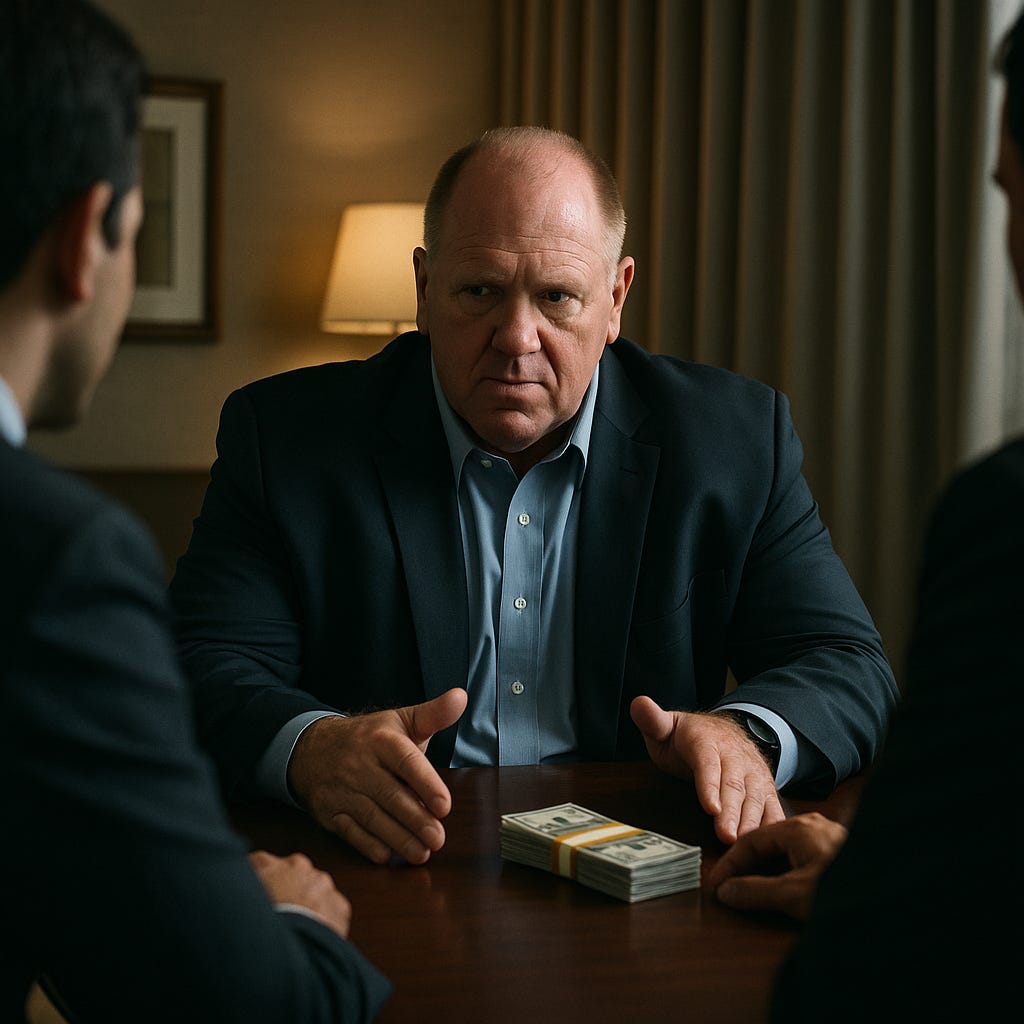
AI-generated image
Because democracy doesn’t defend itself, and neither does your sanity. Subscribe here to keep your eyes open and your sarcasm sharp.
Corruption Is Not Unique to Trump
Every administration in modern history has faced corruption probes. In the 1990s, Bill Clinton’s White House was shadowed by campaign finance scandals tied to foreign donations. George W. Bush presided over the Jack Abramoff lobbying scandal and the bribery conviction of Rep. Duke Cunningham, whose defense contracting schemes netted him $2.4 million. Even Barack Obama’s relatively “scandal-light” presidency overlapped with the case of Illinois governor Rod Blagojevich, convicted for trying to sell Obama’s vacated Senate seat.
Corruption is not new. It is not partisan. What sets Trump apart is scale.
Trumpworld: More Investigations, More Smoke
During Trump’s first term, cabinet officials like Scott Pruitt and Ryan Zinke were investigated for ethics violations and misuse of public funds. His campaign chair, Paul Manafort, was convicted of financial crimes. His political allies, from Roger Stone to Michael Flynn to Steve Bannon, were charged with various forms of corruption, fraud, or lying to investigators. Banker Stephen Calk was convicted of bribery after trying to secure a position in Trump’s administration by arranging loans for Manafort.
Watchdogs logged hundreds of ethics and corruption concerns over the four-year period. Inspectors general opened investigations into conflicts of interest, misuse of resources, and political interference. Congressional committees issued subpoenas. Journalists dug relentlessly.
The result: more investigations, more headlines, more suspicion than any presidency in recent memory.
Why So Few Convictions?
Despite all that smoke, the fire never caught. Trump’s first term ended with fewer corruption convictions at the highest levels than the scale of investigations suggested.
There are three reasons. First, proving bribery is hard. The law requires a clear quid pro quo, not just the appearance of influence-peddling or vague promises. Many Trump officials and allies were careful to hedge their statements.
Second, under Trump, the DOJ itself became a shield. Investigations into allies often fizzled or were quietly shut down. Career prosecutors and FBI agents were reassigned or overruled. Declination memos citing “no credible evidence” became common outcomes.
In this case, Kash Patel and Todd Blanche released a joint statement in which they stated “They found no credible evidence of any criminal wrongdoing. The Department’s resources must remain focused on real threats to the American people, not baseless investigations. As a result, the investigation has been closed.”
Third, Trump leaned on the pardon power as a safety net. Manafort, Stone, Flynn, and Bannon all benefited from clemency or dropped cases. Where the law might have delivered consequences, politics intervened.
See our reporting on Trump’s use of the pardon here:
Note: This article is more than 45 days old and now lives in our archive. Consider becoming a paid subscriber for exclusive perks including full access to our 1000+ articles.

The result was a presidency plagued by scandals and probes, yet short on actual convictions.
Homan as a Case Study
That paradox is why the Homan sting matters. It is not an outlier. It is a case study. A senior official suspected of being open to bribery is caught on tape and then allowed to walk away unscathed. The details remain hidden, but the pattern is clear.
Trump’s administrations have consistently produced more investigations and more red flags than their predecessors, but fewer consequences. That does not mean there is less corruption. It means the system has been warped to produce less accountability.
The Road Ahead
We are only eight months into Trump’s second term. Already, we have a bribery sting involving his border czar that closed without charges. If history is any guide, there will be more: more suspicions, more watchdog reports, more stings and subpoenas. And, if Trump’s first term is the model, there will also be more dropped cases, more pardons, and more stories swept under the rug.
The question is not whether there will be corruption in Trump 2.0. The question is whether anyone will face consequences.
Don’t let the bastards sneak anything past you. Subscribe and get your daily dose of rage and receipts delivered fresh, before the spin doctors can scrub it.
Sources:
“Border czar Tom Homan was investigated by DOJ for potential bribery, MSNBC reports” — Politico
“Did Tom Homan accept bribes? Report on FBI probe surfaces” — Hindustan Times
“Tom Homan” — Wikipedia
“Trump border czar Tom Homan reportedly accepted $50,000 in cash from undercover FBI agents” — The Guardian
“Navy’s former second-in-command sentenced to six years in bribery case” — Washington Post
“Stephen Calk” — Wikipedia

This is Trump’s America that MAGA voted for.
I'm sorry, I'm confused....
He was caught on video by the FBI making the transaction...yet we're told "there's no credible evidence."
How is this possible?
Explain this to me as if I'm a third gradee.