


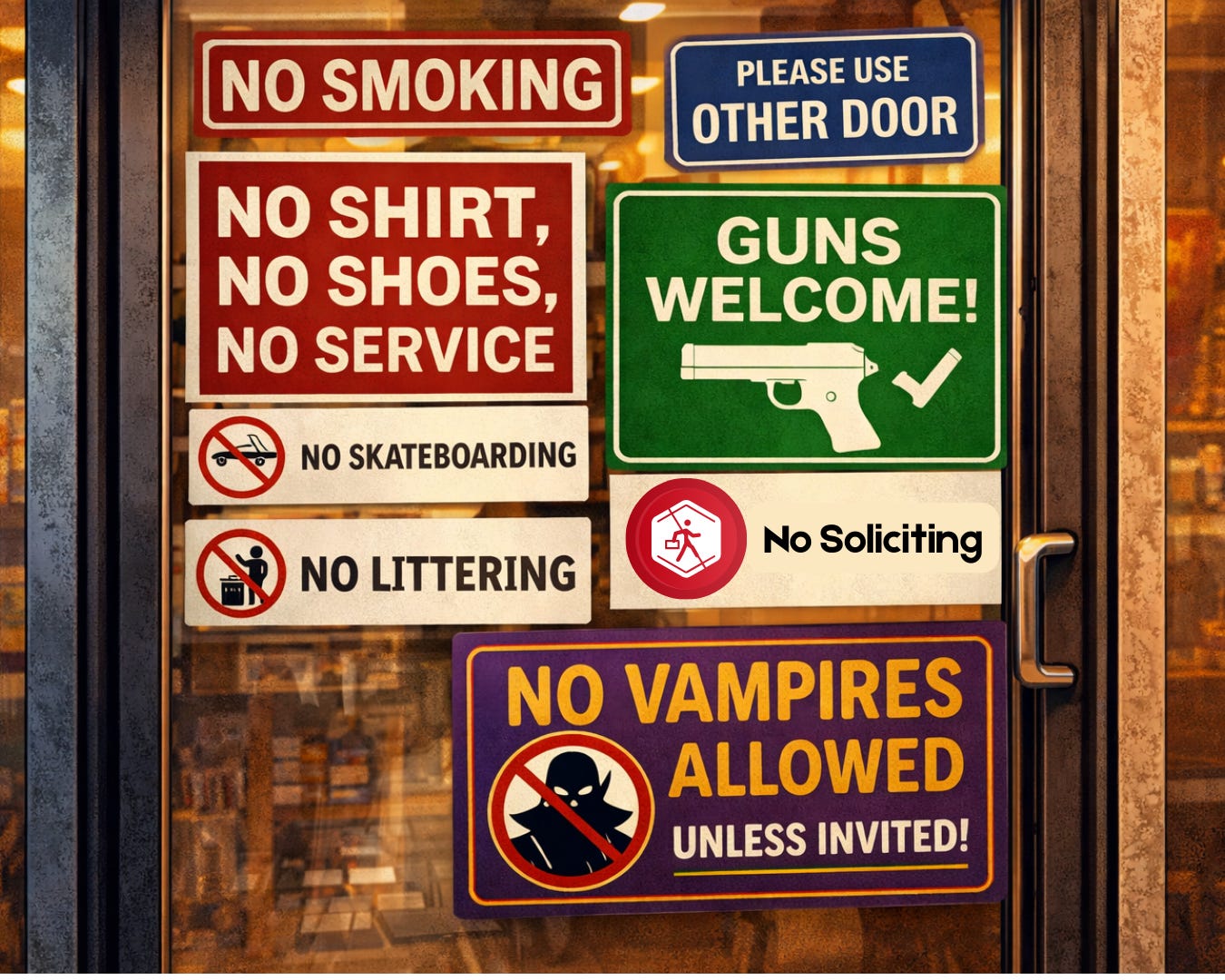
On January 20, 2026, the Supreme Court heard oral arguments in Wolford v. Lopez, a Second Amendment case out of Hawaii that has surprisingly flown under the radar, despite its potential to change how guns are carried in businesses across the country. At the center of the case is Hawaii’s so-called “vampire law,” a nickname given by gun rights activists because it requires a person to receive express permission before bringing a firearm onto private property that is open to the public. Just as a vampire must be invited in, gun owners in Hawaii cannot assume they are allowed to carry a weapon into a gas station, grocery store, or café unless the business has explicitly said yes.
This law was passed in the aftermath of SCOTUS’s 2022 decision in New York State Rifle & Pistol Association v. Bruen, which upended decades of precedent by striking down laws requiring a demonstrated need for concealed carry permits unless a historical precedent could be provided. In response, Hawaii lawmakers sought to clarify the boundaries of lawful carry in privately owned but publicly accessible spaces. The solution they arrived at was simple. If a business wants to allow guns, it can post a sign or provide verbal consent. Otherwise, firearms are not permitted by default.
Cue the outrage.
This Community Is Powered by You
What started as a small circle has grown into something much bigger, and it’s all because of readers like you.
Every time you forward this email, post it on socials, or bring someone new into the fold, you’re helping build one of the most passionate, independent political communities out there.
Want to keep the momentum going?
Share this newsletter with someone who should be part of this conversation.
Thank you for being here. It means everything.
Why This Is Now a Federal Case
In most states, the logic is reversed. Guns are allowed unless the property owner explicitly posts a sign saying otherwise. That signage, typically a “no guns” decal, is understood to carry legal weight in those states. Hawaii’s law flips the presumption. There is no need for a “no guns” sign because the baseline assumption is already that firearms are not allowed unless consent is given.
This difference has triggered a constitutional challenge. Gun rights advocates argue that Hawaii’s law infringes on their Second Amendment rights by requiring permission before carrying in spaces where the public is generally invited. They claim it creates a chilling effect, criminalizes otherwise lawful behavior, and deviates from historical norms.
That argument has made its way to the Supreme Court, which appears, based on oral arguments, inclined to side with the challengers. Several conservative justices questioned whether Hawaii’s law treats the Second Amendment as a second-class right by requiring affirmative consent when no such default restriction exists for other rights, such as speech or religion.
History, Property Rights, and Cultural Context
The irony of the challenge to Hawaii’s law is that it rests on an understanding of history that is neither consistent nor honest. Hawaii, long before it became a U.S. state in 1959, had traditions of weapons regulation. When it was a sovereign kingdom, the government imposed strict controls on the possession and public carrying of weapons. If the current legal standard is “text, history, and tradition,” as Bruen insists, then Hawaii has centuries of tradition to support its position.
However, the deeper problem with the conservative argument is its conflation of government power with private consent. The Second Amendment limits what the government can do. It does not require a gas station owner, a bookstore clerk, or a restaurant manager to allow armed customers into their space. Private property remains private, even when the public is invited to enter for commerce.
Imagine walking into someone’s home with an AK and claiming a constitutional right to be there. Light right up in the deli. Yell “FIRE!” at the movie theatre. That’s not how rights work. The government cannot unreasonably prevent you from owning or carrying a weapon, but it also cannot force private citizens to accept that weapon into their space.
Interestingly, the Second Amendment does not preclude federal spaces from prohibiting open carry either, so why would it prohibit private spaces from doing so? You can’t bring your gun to a courthouse, but the sandwich shop is violating your rights by telling you no? Sure, bruh.
The Problem of No Signs
At the heart of the Supreme Court case is a practical and philosophical question: what does it mean when there is no sign? Does the absence of a sign indicate passive consent? Or does it mean the default rules of private property apply, and thus entry with a weapon requires permission?
In most states, the absence of a sign is interpreted to mean you may carry a firearm. Hawaii says you may not. That difference is now the core of what the Court is being asked to decide: does the Constitution require the presumption of gun access unless otherwise stated, even on private property?
However, this logic falls apart under even the most basic public safety comparisons. In many states, smoking is prohibited indoors by default and permitted only in designated areas. If there is no “No Smoking” sign, that doesn’t mean you can spark up. It means the law already prohibits it, and signage simply reinforces the norm.
Guns, however, which can maim or kill far more quickly than secondhand smoke, are treated differently. The lack of a sign is somehow interpreted as passive permission. This inversion of logic makes no sense, especially when lives are at stake.
The Cultural Collision: Safety vs. Entitlement
There is a reason people feel uneasy when someone walks into a gas station wearing a rifle on their back. Most Americans are not anti-gun. Many were raised in gun-owning households, taught to shoot responsibly, and still choose not to keep firearms in their homes today. They are not afraid of guns, but rather of the normalization of guns in every space, regardless of context or consent.
When someone walks into a grocery store or coffee shop with a firearm, no one knows their intention. Not the clerk. Not the customers. Not law enforcement. In states where open carry is legal, the emotional and psychological burden shifts to everyone else in the room to assess whether this armed person is a threat. That’s not freedom. That’s a culture of intimidation disguised as liberty.
And when police arrive at a scene where multiple people are armed, as has happened in several real-world shootings, they cannot always distinguish between the criminal and the good guy with a gun. This creates deadly confusion not just for officers but also for bystanders caught in the crossfire.
However, none of that is relevant to this conversation because this case isn’t about the right to own or carry weapons. It is about how citizens are informed about whether they can carry in privately owned spaces that the public may frequent. That’s it. That’s the case. If there is no sign, how will you know if you can carry your emotional support pistol to pick up your lil treat myself iced pumpkin spice latte?
A Simple, National Solution
There is an easy, obvious fix. Congress could pass a federal law requiring that all publicly accessible businesses post a clear sign indicating whether firearms are permitted on the premises. These signs could be standardized and distributed by the Bureau of Alcohol, Tobacco, Firearms, and Explosives, just as the federal government already does for ADA compliance, smoking regulations, fire exits, capacity limits, and drinking age requirements.
Businesses would be required to choose one of three options:
Firearms permitted
Firearms prohibited
Concealed carry only permitted
Boom. No more confusion. No more gray areas. No more state-by-state guesswork about whether your weapon is welcome. If there’s a sign, you know the rule. If there’s no sign, the business is in violation, not the customer. Ignorance of the law isn’t a defense for theft, trespassing, or lighting up a cigarette in a daycare. Yet apparently, when it comes to guns, suddenly, ‘I didn’t see a sign’ is supposed to be a constitutional shield. There is also no sign prohibiting dropping a deuce on aisle 2, but there are consequences if you do.
We Already Do This
We regulate where people can smoke. We regulate who can drink and where. We regulate how many people can stand in a room or in an elevator, and where the exits must be. We even regulate the font size and placement of restroom signage, for Pete’s sake.
ADA accessibility is a federally protected right that is communicated through signage. Businesses post decals to indicate whether their entrances, bathrooms, and seating areas are accessible. This protects both patrons and business owners, reduces lawsuits, and communicates respect.
Why would guns be exempt from similar treatment? Sure, wheelchairs aren’t in the Constitution, but disabled people definitely existed (you do know what they did to them, right? Right?). Cars didn’t exist either, yet we still make rules about who can operate them and where. Drive your motocross bike down the cereal aisle. Try it. See what happens.
We’ve Got Bigger Problems
Let’s be honest. We are living through political chaos, social collapse, and ecological disaster. We are watching democratic institutions erode, public trust collapse, and mass shootings occur on an almost daily basis. We do not need the Supreme Court micromanaging signage policy.
We have real crises that demand national focus. This is not one of them.
There are a million things to fight over in this country. This ain’t it.
(Hey, we solved this in like, what, three minutes? Where’s my Supremes robe and salary??)
Enjoying this kind of grounded outrage?
If you made it this far, you’re probably tired of screaming into the void alone. Subscribe for more constitutional clarity, political deep dives, and the occasional well-aimed side-eye at the absurdity of it all. No doomscrolling required — just thoughtful analysis, historical receipts, and the occasional righteous rant, straight to your inbox.
This space is snarky and serious, liberal, but not lazy, and always written with both eyes open.
Subscribe below. Let’s keep our heads — and our standards — high.
Sources:
Court to hear oral argument on law banning guns on private property — SCOTUSblog, January 15, 2026.
Permission to enter, with a gun? Justices look to defang Hawaii’s ‘Vampire Rule’ — Courthouse News Service, January 20, 2026.
Supreme Court hears challenge to Hawaii’s ‘vampire rule’ gun law — Hawaii News Now, January 20, 2026.
US Supreme Court conservatives appear skeptical of Hawaii handgun limits — Reuters, January 20, 2026.
Supreme Court seems skeptical of Hawaii limits on carrying guns — The Washington Post, January 20, 2026.
SCOTUS Signals Hawaii “Vampire Law” May Fall — The Truth About Guns, January 29, 2026.
New York State Rifle & Pistol Ass’n v. Bruen — Supreme Court opinion, June 23, 2022.
New York State Rifle & Pistol Association, Inc. v. Bruen — Wikipedia
Understanding the Supreme Court’s Gun Control Decision (NYSRPA v. Bruen) — League of Women Voters, July 12, 2022.
Second Amendment in the spotlight — SCOTUSblog, November 13, 2025.
Second Amendment Challenges following the Supreme Court’s Bruen decision — Giffords Law Center analysis, June 21, 2023.
The Dead Hand of a Silent Past: Bruen, Gun Rights, and the Shackles of History — Firearms Law at Duke University, October 5, 2023.
Cherry‑picked history and ideology‑driven outcomes: Bruen’s originalist distortions — SCOTUSblog symposium post, June 27, 2022.
Holy hell hole!!!
Man did I learn a lot by reading your article, both about the issue and about human norms and behaviors and rights and not-so-much rights. We take so much behavior for granted; then you give us an example of “not that behavior” and we realize both how complex and how simple life is. Thank you. I am so glad there are good brains thinking about these things so that I don’t have to puzzle over my every move.