


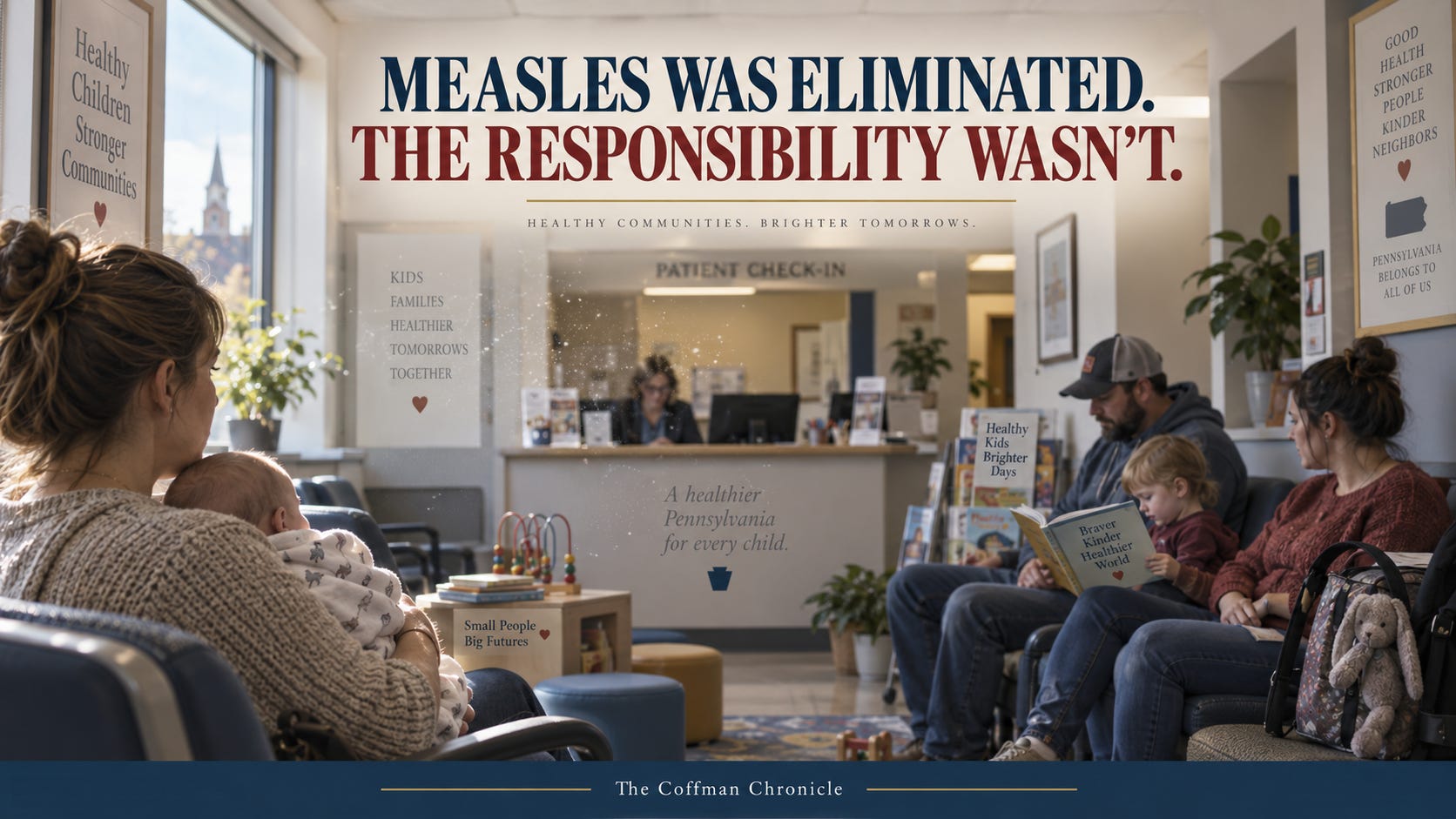
Pennsylvania did not know exactly when measles arrived in Lebanon County. By late April, when health officials recognized what was happening, three people had already been hospitalized, and investigators believed the virus was circulating in the community. Investigators could not trace the cases to known domestic or international travel. Somewhere before those hospital rooms filled, measles had found a way in and begun moving from person to person.
That should have been difficult. The United States declared measles eliminated from continuous domestic transmission more than twenty-five years ago. Generations of parents grew accustomed to thinking of it as a disease from another era, something encountered in history books or warnings about places far from home.
However, elimination never meant disappearance. By the time Pennsylvania realized measles was moving through one of its communities, the most important question was no longer how the first person became infected, but how much room the virus had already found.
This Community Is Powered by You
What started as a small circle has grown into something much bigger, and it’s all because of readers like you.
Every time you forward this email, post it on socials, or bring someone new into the fold, you’re helping build one of the most passionate, independent communities out there.
Want to keep the momentum going?
Share this newsletter with someone who should be part of this conversation.
Thank you for being here. It means everything.
From a Few Cases to a Statewide Outbreak
The numbers did not climb slowly. Pennsylvania reported 460 confirmed cases in 31 counties on August 28th. By September 11th, the total had reached 676 cases across 37 counties. Three days later, on September 14th, state health officials reported 693 confirmed cases across 38 counties and 133 hospitalizations.
Pennsylvania had officially confirmed two measles-associated deaths. Over the weekend, the Jefferson County coroner also reported that a 40-year-old unvaccinated woman had died from complications associated with measles. As of September 14th, the Pennsylvania Department of Health was investigating that death before adding it to the state’s official measles-associated death count.
What began as several cases around Lebanon County had become a statewide public-health problem. The important number was no longer three, or 100, or even 693. It was the number of opportunities measles had found to move from one person to another. The disease had not suddenly changed. Something around it had.
Elimination Was Something We Had to Maintain
When the United States declared measles eliminated in 2000, it did not mean the virus had vanished, but rather that continuous domestic transmission had been interrupted for at least twelve months. Measles could still arrive from elsewhere.
Keeping it from taking hold required more than a vaccine sitting in a refrigerator. It depended on parents vaccinating children, doctors recognizing symptoms, laboratories confirming cases, schools maintaining records, and public-health workers tracing exposures before one infection became dozens. The Centers for Disease Control and Prevention credits both high vaccination coverage and a strong public-health system with achieving elimination.
The system worked so well that many Americans eventually stopped thinking about measles at all. That is one of the strange dangers of successful prevention: when it works long enough, the threat can begin to look imaginary, and the infrastructure keeping it away can begin to look unnecessary.
Elimination was never a trophy we put on a shelf. It was infrastructure we had to maintain.
The Holes in the Firewall Were Measurable
Pennsylvania did not enter 2026 with every community equally protected. During the 2025–26 school year, 93.2% of Pennsylvania kindergarteners had received both required doses of the measles, mumps, and rubella vaccine. Public-health officials generally look for coverage around 95% to provide strong community protection against measles, and Pennsylvania officials reported that many schools were below that threshold.
The warning signs were visible locally, too. In Lebanon County, where health officials first recognized the spring outbreak, the kindergarten MMR vaccination rate had been 93.2% during the previous school year.
Statewide and county averages can still hide the vulnerability that matters most. Measles encounters classrooms, families, congregations, and neighborhoods. A state can look reasonably protected overall while individual communities contain enough susceptible people for the virus to spread.
Pennsylvania now publishes vaccination and exemption data at the individual-school level. The firewall was still standing, but some of its holes were already measurable.
An Exemption Does Not Exempt Your Neighbor
Pennsylvania requires certain vaccinations for school attendance, but it allows exemptions for medical reasons, religious beliefs, and strong moral, ethical, or philosophical convictions. Religious and philosophical exemption statements do not have to be renewed each year.
Medical exemptions belong in a different category. Some children cannot safely receive particular vaccines, and protecting them is one reason community immunity matters in the first place.
The bigger issue is people who could otherwise be vaccinated. One exemption in a highly vaccinated school may change very little. When unvaccinated people are concentrated in the same families, schools, congregations, or communities, however, individual decisions can combine into a vulnerability shared by everyone around them.
The government may exempt you from a vaccination requirement, but it cannot exempt your neighbors from the biological consequences.
Pennsylvania already recognizes that limit. A child with a lawful exemption may still be excluded from school during an outbreak of a vaccine-preventable disease. A legal exemption can protect a person’s choice, but it cannot guarantee that choice affects only that person.
Your Choice Doesn’t Always Stay Yours
Medical autonomy is important. Government should not casually assume the power to make intimate health decisions for people, and citizens are right to be wary whenever public authority reaches further into private life.
Infectious disease creates a problem that pure individualism cannot solve, however, because the consequences can leave your body. A person who contracts measles can carry it into a grocery store, a pediatrician’s waiting room, a school, a church, a courthouse, or a workplace. The next person exposed may be an infant too young for routine vaccination, someone receiving cancer treatment, or a neighbor whose immune system cannot provide full protection.
Those people did not make the original decision. They may have taken every reasonable precaution available to them and still find themselves carrying part of someone else’s risk.
A free society should protect individual choice whenever it reasonably can. Freedom does not, however, erase the effects our choices have on the people living beside us. That is where vaccination stops being only a medical question and becomes a question of citizenship.
The Social Contract Does Not End at Your Front Door
Citizenship is not simply a list of rights we can demand from government. It is also a relationship among people who have agreed, however imperfectly, to share a country.
We expect firefighters to come when the house burns. We expect clean water from the tap, courts to enforce contracts, roads to be maintained, and public-health workers to investigate when a dangerous disease begins moving through a community. None of those things exist because individuals act alone. They exist because a functioning republic depends on people accepting obligations to one another, including obligations to people they may never meet.
Citizenship is not merely a collection of rights we claim from one another. It is a social contract in which we accept reasonable responsibilities because our lives are connected to people we may never meet.
Vaccination is one of those responsibilities when a person can safely receive it. When a safe and effective vaccine can greatly reduce the chance that we become part of a transmission chain leading to a newborn, a cancer patient, or a neighbor whose immune system cannot protect them, vaccination becomes more than a private medical choice. It becomes an act of citizen stewardship.
A free society cannot survive on rights alone, and a republic cannot function if every citizen insists upon the protections of the social contract while refusing its obligations.
Government Has to Keep Its Side of the Contract
A social contract cannot demand responsibility from citizens while giving government permission to neglect its own. Pennsylvania has not stood still during this outbreak. By September 11th, state health officials had administered nearly 4,300 MMR vaccinations at 130 pop-up clinics in affected communities. State health centers had administered more than 6,300 MMR doses statewide during 2026, while health-care providers across Pennsylvania administered more than 46,000 doses in August alone, compared with approximately 25,000 in a typical month.
While that response deserves acknowledgment, an emergency response and a prevention system are not the same thing. The government’s responsibility begins before hundreds of people are sick. It means maintaining surveillance, laboratories, trained public-health workers, accessible vaccines, reliable school data, and relationships with communities where vaccination rates are falling. It also means helping doctors recognize a disease many had rarely encountered in practice.
The outbreak does not, by itself, prove Pennsylvania failed at those jobs, but it does raise the question: if citizens are expected to maintain their side of the public-health firewall, government must be able to show it maintained its side as well. Government cannot demand stewardship from citizens while neglecting its own.
The Social Contract Is Not a Blank Check for Government
None of this means government should be allowed to force every medical decision simply by invoking public health. The social contract runs in both directions, and constitutional restraint is part of it.
Government has a legitimate interest in preventing the spread of a highly contagious disease, but a legitimate purpose does not erase the need for limits. Public power should be justified, proportionate, and no more intrusive than necessary to accomplish the job.
There is considerable ground between doing nothing and compelling everything. Government can make vaccines easy to obtain. Schools can maintain vaccination requirements. Exemptions can be structured carefully and reconsidered when community risk changes. Health departments can publish vaccination data, trace contacts, work with trusted local physicians and community leaders, and exclude exempt students from school during an outbreak when state rules permit it.
The question is not whether government should have power, but how much power is actually necessary. That is the Square New Deal test: government should use the least intrusive power sufficient to accomplish the legitimate public purpose.
Citizens do not get to invoke freedom as a reason to ignore preventable harm to others, and government does not get to invoke safety as a reason to ignore constitutional restraint. A functioning social contract requires both sides to remember the difference.
The Firewall Is Us
America did not eliminate continuous measles transmission because government acted alone. Parents vaccinated children, doctors administered shots, schools maintained records, laboratories tested samples, public-health workers traced exposures, and communities maintained enough immunity that measles often struggled to find another susceptible person.
That collective effort became so ordinary that eventually many people stopped noticing it. However, that was the firewall: the government built part of it, and citizens built the rest.
That is what the social contract looks like when it works. Government accepts responsibility for maintaining the institutions, information, and capacity necessary to protect the public. Citizens accept reasonable responsibilities, so their choices do not unnecessarily place others at risk. Constitutional restraint keeps public power from becoming an excuse for doing whatever government finds convenient.
Those obligations do not cancel one another. They reinforce one another. That is citizen stewardship, government stewardship, and what a functioning republic requires when private choices can carry public consequences.
Pennsylvania’s outbreak reminds us that the protections we inherit do not maintain themselves, and neither do the obligations that created them. Measles was eliminated once in America. The responsibility that made that possible never was.
Support Independent Media-The Coffman Chronicle
If you believe citizenship means more than demanding your own rights, help us keep making the case for stewardship, accountability, and a republic that still belongs to the people.
Subscribe to the Coffman Chronicle, share this article with someone who needs to read it, and, if you can afford to, become a paid subscriber. Your support helps us keep doing independent work that asks not only what government owes us, but what we owe one another.
Sources
Centers for Disease Control and Prevention. “Questions About Measles.” Accessed September 14, 2026.
Gruver, Mead. “A Third Death Involving Measles Is Reported in Pennsylvania.” Associated Press, September 14, 2026.
Pennsylvania Department of Health. “Measles.” Accessed September 14, 2026.
Pennsylvania Department of Health. “Measles Alert: Guidance for Local Identification of New Measles Cases.” Pennsylvania Health Alert Network Advisory no. 822, May 1, 2026.
Pennsylvania Department of Health. “PA Department of Health Takes Action to Prevent Spread of Measles Cases, Hosts Vaccination Clinic and Outreach Efforts in Lebanon County.” May 6, 2026.
Pennsylvania Department of Health. “Pennsylvania School Immunization Rates, 2025–2026.” July 31, 2026.
Pennsylvania Department of Health. “Shapiro Administration Launches New Tool Making School-Level Vaccination Rates Available to Parents, Boosting Public Health Transparency.” August 3, 2026.
Pennsylvania Department of Health. “Shapiro Administration Expands Measles Response Efforts Following Pennsylvania’s First Measles-Associated Deaths in 35 Years.” August 25, 2026.
Pennsylvania Department of Health. “Pennsylvania Department of Health Provides Statewide Update on Measles Outbreak as Cases Reach 460 in 31 Counties.” August 28, 2026.
Pennsylvania Department of Health. “Pennsylvania Department of Health Provides Statewide Update on Measles Outbreak as Cases Reach 676 in 37 Counties.” September 11, 2026.
Pennsylvania Department of Health. “Health Requirements to Attend School in PA.” Accessed September 14, 2026.
Pennsylvania Department of Health. “School Frequently Asked Questions.” Accessed September 14, 2026.