


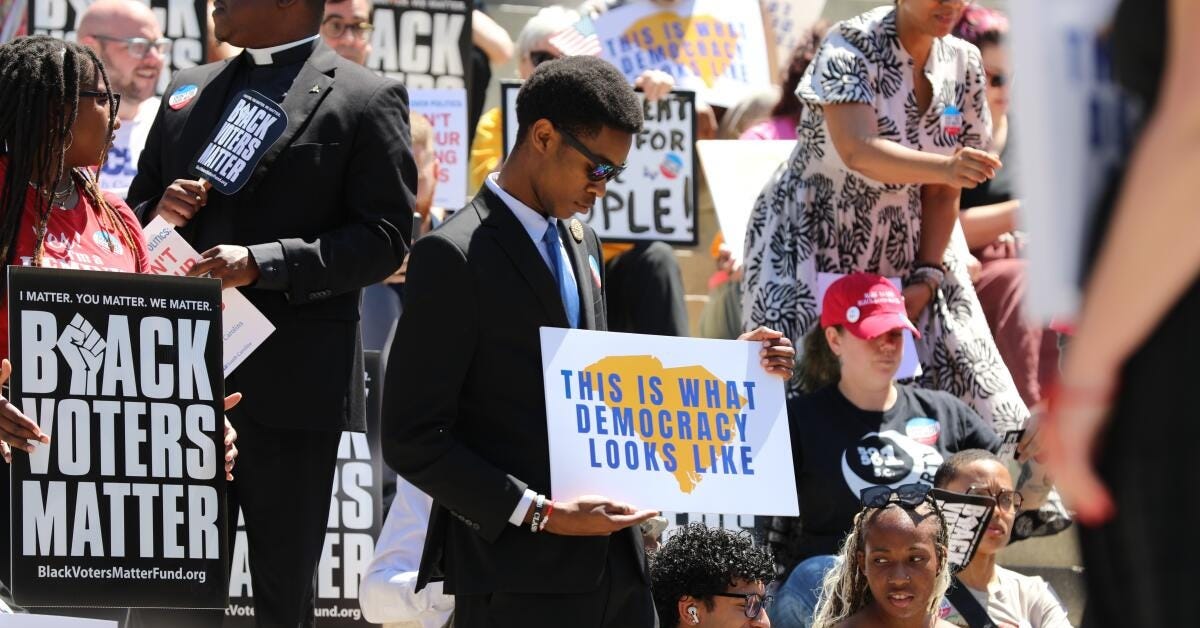
Redistricting battles across the South are emerging as a major political and legal flashpoint ahead of the next congressional midterm elections, with civil rights groups warning that new district maps could weaken Black voting influence in several key states.
The disputes involve congressional maps in states including Alabama, Georgia, Louisiana, Florida, and South Carolina, where lawsuits argue that Republican-led legislatures diluted Black voting power through district boundaries that either divide heavily Black communities or pack them into fewer districts.
The legal fights are unfolding against the backdrop of years of Voting Rights Act litigation and a changing Supreme Court landscape that has narrowed some federal oversight of state election laws while still preserving portions of minority voting protections.
Subscribe free for daily political analysis they won’t broadcast. Join 110K+ readers →
The practical stakes could be significant.
Several of the contested districts may become competitive battlegrounds in the next midterm elections, when control of the House could again hinge on only a few seats. Political strategists in both parties are closely watching whether courts force map redraws or allow disputed districts to remain in place.
Supporters of the state-led maps argue legislatures have constitutional authority to draw districts and deny accusations that the maps intentionally discriminate against Black voters. Civil rights advocates counter that the redraws weaken minority representation in states with large Black populations and long histories of voting-rights disputes.
The broader conflict reflects a growing national debate over how aggressively courts should intervene in election map disputes and what role the Voting Rights Act should continue to play in shaping congressional representation.
With campaign infrastructure already forming for the next federal election cycle, the outcomes of these cases could influence not only who wins individual districts, but how both parties allocate money, messaging, and voter outreach across the South.
Subscribe free for daily political analysis they won’t broadcast. Join 110K+ readers →