


On the surface, the story sounds like another round of painful budget cuts: NASA’s Science Mission Directorate, home to some of the agency’s most ambitious Earth and planetary science programs, is facing a near 50% reduction under the Trump administration’s proposed 2026 budget. The Astrogeology Science Center—a crucial arm responsible for mapping planetary surfaces and preparing for future Mars landings—is among the offices on the chopping block.
But dig deeper, and a pattern begins to emerge. These cuts are not isolated. They’re not random. They’re part of a coordinated, ideological effort to weaken America’s public infrastructure, centralize power in private hands, and erase the line between public service and corporate profit.
In this case, space exploration—once a symbol of collective ambition—is being sold to the highest bidder.

Independent News. Just $1/Week.
We just hit 10,000 subscribers—thank you! We’re offering full access to The Coffman Chronicle for just $1 a week ($52/year) to celebrate.
Get exclusive analysis and fearless reporting you won’t find in corporate media.
Support truth. Stay informed.
A Sudden Blow to NASA’s Core
The Department of Government Efficiency (DOGE), created during Trump’s second term and helmed by Elon Musk, proposed the cuts as part of a sweeping “streamlining” effort. The agency’s budget for the Science Mission Directorate would drop from $7.5 billion to $3.9 billion. The proposed budget axes or delays marquee projects like:
The Mars Sample Return Mission, a joint effort with the European Space Agency.
The Nancy Grace Roman Space Telescope, designed to probe dark matter and exoplanets.
The DAVINCI mission to Venus, which promised insights into Earth’s sister planet.
The Astrogeology Science Center, once central to Apollo-era moon landings and now instrumental in planning Martian surface operations, may soon be left without sufficient staff or support.
Public outcry has followed, but it's only scratched the surface of what’s truly happening.
Who's Behind It?
Let’s not be coy. This is not the work of some faceless budget committee. It’s a policy choice driven by:
Donald Trump's second-term priorities include weakening what he calls the “deep state” and handing more power to business leaders.
Elon Musk's company, SpaceX, stands to gain as NASA retreats from in-house capabilities and relies more heavily on private contractors.
Musk leads the Department of Government Efficiency (DOGE), which operates outside normal bureaucratic processes to recommend massive federal restructuring.
Right-wing think tanks like the Heritage Foundation and Cato Institute, which view public science as wasteful and favor privatization.
MAGA-aligned lawmakers consider climate science, planetary science, and even some aspects of space exploration as “leftist pet projects.”
What unites them isn’t just ideology; it’s strategy.
The Bigger Pattern: Starving the Public, Feeding the Private
NASA isn’t the first to be gutted. It’s only the latest. Consider the following pattern:
The CDC’s IVF and Assisted Reproductive Technology team was dismantled even as Trump branded himself the “fertilization president.”
USAID, NPR, and PBS are all threatened with elimination under the same $9 billion “rescission” package.
The ATF is being hollowed out by transferring 1,000 agents to the FBI.
Efforts to abolish federal courts, particularly the D.C. district court, have gained traction among Trump loyalists following legal challenges to his executive actions.
In each case, the institutions under attack are:
Public-facing and science- or evidence-based.
Non-partisan (or politically inconvenient).
Focused on long-term knowledge, not short-term gain.
Lacking direct profitability, but rich in public value.
The playbook is clear: defund the public good, shift its functions to loyal private hands, and call it “efficiency.”
See our previous reporting on the gutting of these agencies:


Elon Musk: Recusal, Reservations, and the Road to Privatization
Elon Musk, often the most visible face of DOGE’s radical restructuring efforts, plays an unusually muted role in this particular chapter. Though he heads the Department of Government Efficiency, he formally recused himself from DOGE’s recommendations on NASA’s 2026 budget, citing a conflict of interest due to his role as CEO of SpaceX. It’s the first known instance of Musk stepping aside from a DOGE decision, a fact that speaks volumes on its own.
Publicly, he has called the proposed cuts to NASA’s science programs “troubling.” Whether that concern is sincere or a political gesture is unclear. But even from the sidelines, Musk stands to benefit. As NASA’s internal scientific capacity is slashed, private firms like SpaceX become not just contractors, but inheritors of entire missions. Once publicly funded and publicly shared, scientific research is poised to shift into private hands, governed by proprietary interests and market logic rather than collective discovery.
It perfectly encapsulates the administration’s playbook: dismantle public infrastructure, outsource its functions, and allow those with the most influence to shape what remains. Musk's finding this particular moment ethically murky enough to warrant a recusal only underscores how stark the transformation really is.
Who Wins, Who Loses
Winners:
Private aerospace firms, especially those aligned with the Trump administration.
Defense contractors, likely to absorb funding redirected from science to security.
Ideological libertarians, who see this as a victory over “big government.”
Losers:
NASA scientists and researchers, many of whom will lose funding or jobs.
Students and early-career professionals who depend on NASA internships, fellowships, and partnerships.
International collaborators, who have invested years and billions into joint missions now likely to be canceled.
The American public, who funded these programs and will see little return on the investment.
Democratic accountability, as more public functions shift to private actors without obligation to the people.
Privatizing the Sky
This isn’t just about budgets. It’s about worldviews. The old NASA symbolized what public ambition could achieve: landing on the Moon, mapping Mars, launching probes into interstellar space.
The new vision—crafted by DOGE and cheered by privatization advocates—treats space as a commodity. In this world, exploration is driven by return on investment. Data is proprietary. Missions are no longer about discovery; they’re about disruption.
In this world, science becomes a service, sold to the highest bidder.
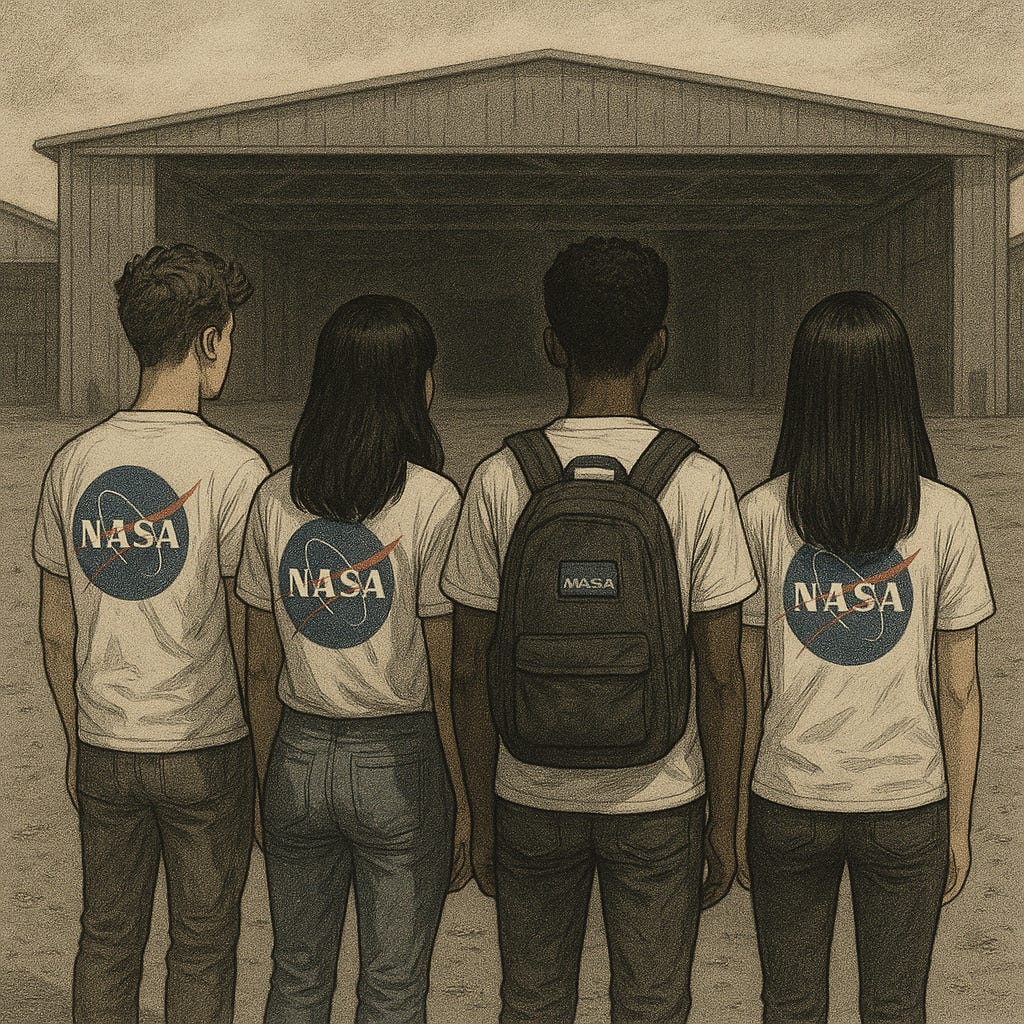
Starving the Future
If the budget passes in its current form, it won’t just delay missions. It will dismantle the infrastructure that makes them possible:
Mission planning teams will dissolve.
Data from past missions will go unanalyzed.
Students will seek careers elsewhere.
International trust will erode.
The American leadership role in space—and science—will fade.
This is how decline happens. Not with a bang, but with a spreadsheet.
We’ve Been Here Before
History offers warnings. In the early 1980s, Reagan-era budget cuts devastated NASA’s planetary science division. Entire missions were canceled, and scientists left the field. It took decades to recover.
The current cuts are worse, and they’re happening at a time of fierce competition. China is planning its own Mars sample return, Europe is investing in climate satellites, and India is scaling lunar ambitions.
If we step back now, others will step forward. And they may not share our values.
The Real Goal
Let’s be clear: the goal is not just budget savings. The goal is to redefine the government's role, strip it of the power to invest in the future, regulate the present, or protect the public.
In this vision, the government becomes a shell, outsourcing its missions, selling its assets, and letting billionaires set the course for civilization.
Today, it’s NASA. Tomorrow, it could be the EPA. Or the Department of Education. Or the Social Security Administration. All who have, notably, been gutted by DOGE.
When you view the pattern in full, one thing becomes clear:
This isn’t just about Mars. It’s about Earth and who gets to decide its future.
Call to Action
If you value public science, public service, and public truth, now is the time to act.
Call your representatives. Demand they reject the proposed cuts to NASA and other federal science agencies.
Support organizations like The Planetary Society, Union of Concerned Scientists, and public-sector unions fighting for transparency and research funding.
Share this article. The only way to break the cycle is to expose the pattern.
Because once we lose institutions like NASA’s Astrogeology Science Center, we may never get them back.
We just hit 10,000 subscribers—thank you! We’re offering full access to The Coffman Chronicle for just $1 a week ($52/year) to celebrate.
Get exclusive analysis and fearless reporting you won’t find in corporate media.
Bibliography:
“Proposed Nasa Budget Cuts Would Plunge Agency 'into a Dark Age'.” The Times, April 12, 2025.
“Trump Amenaza Con Recortar a La Mitad El Programa Científico de La NASA.” El País, April 16, 2025.
“Musk Calls Trump's Looming NASA Cuts 'Troubling'.” Politico, April 11, 2025.
“White House Proposal Would Slash NASA Science Budget and Cancel Major Missions.” SpaceNews, April 11, 2025.
“Trump White House Budget Proposal Eviscerates Science Funding at NASA.” Ars Technica, April 11, 2025.
“White House to Send Congress a Formal Request to Nix $9.3B for PBS, State Department.” Politico, April 14, 2025.
“Trump Plans Order to Cut Funding for NPR and PBS.” NPR, April 15, 2025.
“US House Speaker Johnson Says Congress Can 'Eliminate' District Courts.” Reuters, March 25, 2025.
“Speaker Mike Johnson Suggests Eliminating Federal Courts After Trump Rulings Blocked.” Truthout, March 26, 2025.
“Trump Administration Will Ask Congress to Cut Funding for NPR and PBS.” The Washington Post, April 15, 2025.
“FBI Director Kash Patel Removed as Director of Bureau of Alcohol, Tobacco, Firearms and Explosives.” The Guardian, April 9, 2025.
“Army Secretary, in Rare Move, Also Becomes ATF Head.” Politico, April 9, 2025.
“Trump Administration Wants to Nearly Halve State Dept Budget.” Reuters, April 14, 2025.
“DOGE Associate Is Made Acting Head of Foreign Assistance at the State Department, a US Official Says.” AP News, April 15, 2025.
“As Musk Polices His Own Conflicts, Some Agencies Hear Sirens Going Off.” The Washington Post, March 1, 2025.
“Elon Musk's Conflicts of Interest 'Should Scare Every American', Experts Say.” The Guardian, February 27, 2025.

They want to own everything!!!
Sure, just give the $$$ to the muskrat so that he can blow up more rocket 🚀 🙄 IJS