


The House GOP’s budget reconciliation bill, heralded by President Trump as “big and beautiful,” is neither. It’s sprawling, chaotic, and strategically devastating. With sweeping cuts to Medicaid, food assistance, and climate programs, paired with a fire sale of public lands and billions more for the Pentagon, this isn’t just a budget. It’s an attempt to rewrite what the government exists to do and for whom.
What makes it even more alarming is that even within the Republican Party, the cracks are showing. Deficit hawks warn that it blows a hole in the national debt. Immigration hardliners say it doesn’t go far enough. MAGA influencers are defending Medicaid (seriously, what even is this timeline?!). The incoherence isn’t just ideological. Yet, House leaders are pushing to pass it before July 4.
This post breaks down what’s in the bill, what it cuts and funds, and where the legal and political landmines lie. If this reconciliation package passes, it could lock in many of the most radical elements of Trump’s governance. But it isn’t too late. Yet.
We just hit 13,000 subscribers—thank you! To celebrate, we’re offering full access to The Coffman Chronicle at 50% off.
Get exclusive analysis and fearless reporting you won’t find in corporate media.
TL;DR (for your attention-deficient democracy):
Permanent tax cuts for the rich? Duh.
Slash Medicaid and food aid? F them peasants
Sell off public land? And let big fossil exploit!
Kill EV and green energy incentives? Absolutely.
Hand $ 500 B+ to the Pentagon and ICE? Hell yes.
Defund public agencies Trump already tried to kill? You bet.
All while the party that “hates big government” expands the surveillance state and bankrupts the future. Even Republicans are confused. Courts might block parts, but if this passes, it’ll take more than voting to fix what’s broken.
This has been your snarky, oh-my-god-I-can’t-with-these-people summary. You are welcome. Want deets? Keep reading.
GOP Fractures: In Their Own Words
Even within Republican ranks, this bill is far from universally embraced. For a bill so sweeping in scope and so clearly aligned with the priorities of Donald Trump, you’d expect Republican unity. Instead, the reconciliation bill has exposed rifts in the party that no one’s even trying to hide anymore.
Rep. David Valadao (R-CA) objected to the drastic Medicaid cuts: “We’re going through this partisan exercise to do what is supposed to be a tax bill, and it’s becoming a health care bill.”
Sen. Rand Paul (R-KY) blasted the debt implications: “I’m not for raising the debt ceiling $5 trillion, so I’m not for it.”
MAGA firebrand Laura Loomer criticized the Medicaid cuts: “You can’t claim to be populist and then cut the one healthcare program that covers millions of working-class Americans.”
Even the libertarian Cato Institute labeled the Pentagon spending spree and IRS enforcement proposals as “fiscally and strategically incoherent.”
One House GOP aide told Politico: “This thing is a Frankenstein monster. It tries to please everyone and ends up pissing off all of them.”
These aren’t Democratic talking points. They’re the fault lines inside the Republican coalition. And they’re not just rhetorical. They could shape whether this bill survives the coming weeks of negotiation and public scrutiny.
What the Budget Gives: Tax Cuts and Military Money
At the heart of the GOP's reconciliation bill is a simple formula: reward the wealthy, expand enforcement power, and call it economic growth.
Tax Cuts That Mostly Benefit the Top
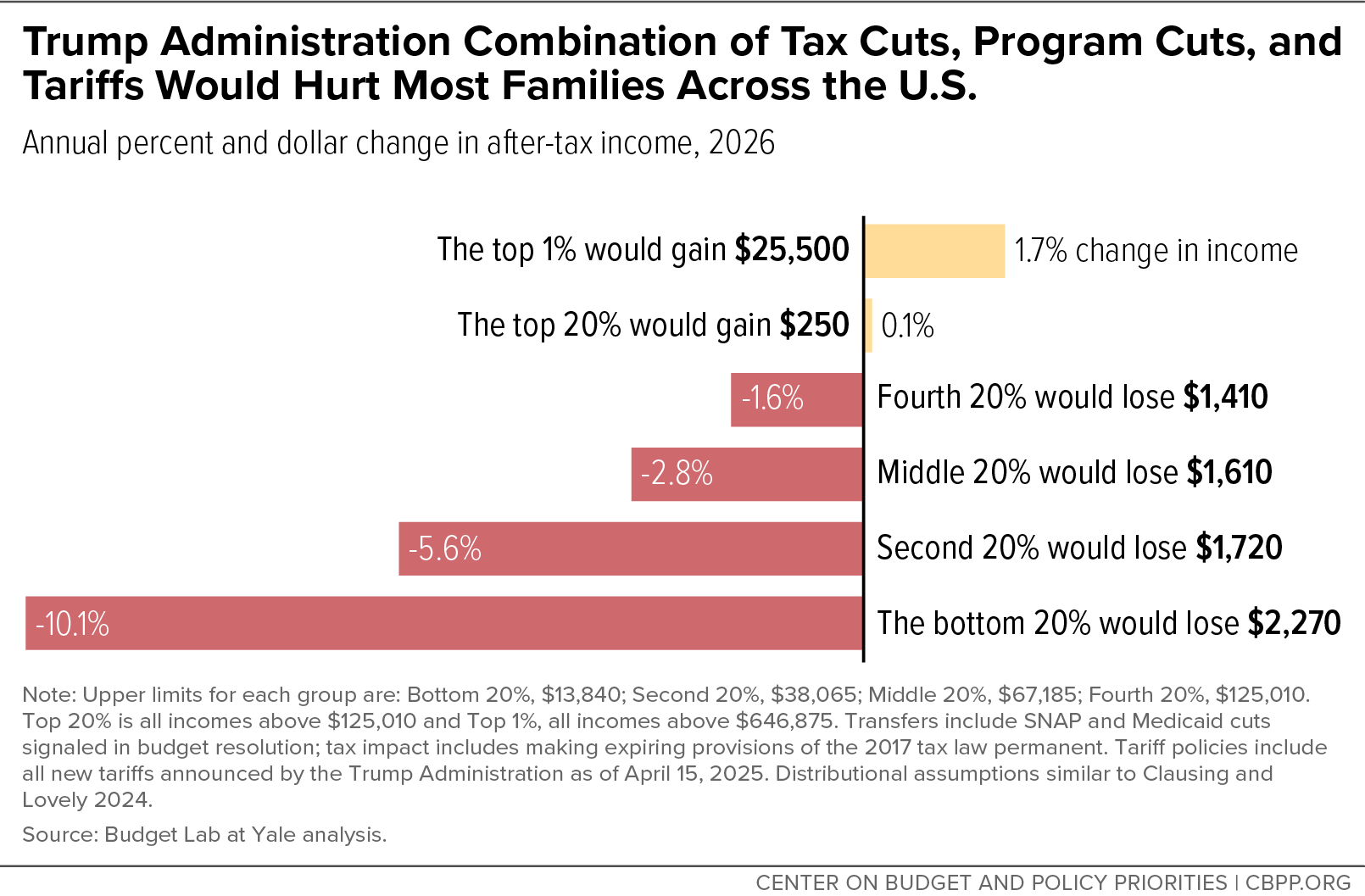
The bill permanently implements Trump’s 2017 tax cuts, delivering billions in benefits to the top 1% and large corporations. There are a few crumbs for workers, like a temporary bump to the Child Tax Credit and an exemption on federal taxes for tips and overtime pay. Still, these fleeting, headline-friendly gestures pale compared to the long-term revenue loss.
Then there’s the SALT cap change, a quiet but important detail. The bill raises the State and Local Tax deduction cap from $10,000 to $30,000. While this does benefit some middle-class earners in high-tax states like California and New York, the most significant savings disproportionately flow to wealthier households. It’s a calculated olive branch to blue-state Republicans and Democrats, but one that leaves working-class families mostly untouched.
“This isn’t fiscal conservatism,” said Rep. Bob Good (R-VA). “It’s spending borrowed money to give tax cuts we can’t afford.”
So far, the bill’s tax provisions are expected to blow a $4.5 trillion hole in the federal budget.
$150 Billion More for the Pentagon
Despite being one of the most opaque and poorly audited government institutions, the Department of Defense is set to receive a historic $150 billion funding increase. Despite five consecutive failed audits and persistent reports of waste, redundancy, and contractor abuse, this comes.
See our recently reporting on the DOD’s accounting issues here:

“Throwing more money at the Pentagon without accountability isn't strength—it's fiscal malpractice,” the Project on Government Oversight warned.
Yet the bill not only increases military funding, it shields it from scrutiny. Oversight mechanisms are either underfunded or outright stripped, further empowering an institution that already operates with extraordinary latitude.
$350 Billion for Immigration Enforcement
Even more striking, the bill allocates $350 billion to immigration enforcement, detention infrastructure, and mass deportation programs. This is nearly double the annual budget of the entire Department of Homeland Security.
Yet, the context undermines the claim. According to recent CBP data, unauthorized border crossings have dropped significantly since early 2025. There is no emergent surge demanding this spike in enforcement resources, only a political narrative that needs to be fed.
“It’s not about need,” said a former DHS official. “It’s about optics and deterrence—this is security theater, funded at scale.”
We covered several aspects of immigration policy in a recent multi-part deep dive. See the first in the series here:

This budget claims to cut waste, but when it comes to expanding surveillance, detention, and deportation—even in the face of declining migration—it seems there’s always room to spend more.
What the Budget Takes: Health, Food, Land, and Climate
If the budget is generous to the wealthy and the war machine, it’s ruthless toward the public good. Medicaid, food assistance, clean energy, and even federal land are all on the chopping block, not because the money isn’t there, but because the political will to protect them isn’t.
$715 Billion in Medicaid Cuts
The most significant single cut in the bill targets Medicaid: a $715 billion reduction over the next decade. That includes:
Imposing strict work requirements
Cutting retroactive coverage
Reducing eligibility verification windows, especially for immigrants
These changes would push millions off their health coverage, and could backfire fiscally, forcing emergency care costs onto state systems.
SNAP Reforms That Gut the Safety Net
The bill also tightens eligibility and imposes new administrative burdens on the Supplemental Nutrition Assistance Program, or SNAP. Over 40 million Americans rely on it, many of them children, seniors, and the working poor.
States would be forced to absorb more administrative costs, and benefits could be reduced in the process.
Food banks and state officials have called the proposal a “cruel cost shift,” warning it will create hunger while pretending to reduce fraud.
Selling Off Federal Lands
To offset tax cuts and fund military expansion, the bill authorizes the sale of over 11,000 acres of federal land in Utah and Nevada. It also ramps up oil, gas, and timber leases nationwide.
“Congress is considering selling off our public lands to pay for tax cuts to the wealthy,” said Tracy Stone-Manning of the Wilderness Society. “This isn’t budget policy—it’s short-term looting of shared resources.”
We recently covered Trump’s Executive Order regarding the extraction on federal lands here:

Green Energy Stripped for Fossil Fuel Subsidies
The bill also eliminates major tax credits for electric vehicles and renewable energy production, programs critical to the progress made under the Inflation Reduction Act.
Clean energy groups warn this could wipe out up to $1.9 trillion in private investment over the next decade, with job losses and project cancellations already in motion.
This isn't trimming the fat. It's a reversal of climate policy to feed an outdated energy economy, just as the science tells us we can't afford delay.
This move comes as no surprise, however, as we reported previously regarding Trump’s environmental deregulation efforts:
Note: This article is more than 45 days old and now lives in our archive. Consider becoming a paid subscriber to enjoy the full 500+ article archive, exclusive content, and occasional early access.

The EV Paradox: Musk, Money, and Messaging
One of the more puzzling aspects of the GOP budget is the proposal to eliminate electric vehicle tax credits. This move seems at odds with the interests of Elon Musk, one of the party’s most influential allies in the tech and business world.
But the contradiction is more theoretical than real.
While Musk built his empire with help from government-backed EV incentives, his current alignment with the GOP is shaped more by ideology and defense contracting than energy policy. Tesla is no longer the scrappy EV disruptor. Thanks to years of government subsidies, it’s the dominant player. Musk now draws billions from SpaceX government contracts, not just car sales.
Moreover, in today’s Republican politics, EVs have become a symbol in the culture war. They’re framed as elitist, coastal, and “woke.” Slashing green energy credits isn’t just a budget item. It’s a signal to a base that’s been told EVs are coming to take their trucks and jobs.
Let’s not forget who benefits from this rollback. This budget heavily favors oil and gas interests through expanded leases and reduced regulation. The fossil fuel lobby still carries far more weight in congressional corridors than Musk’s Twitter feed.
While Musk may lose a subsidy, the GOP gains a headline and a talking point. In the end, that’s the currency they care about most.
Judicial Minefields: The Legal Reckoning
For a party that often rails against activist judges, the GOP seems oddly comfortable drafting legislation that heavily relies on legally dubious executive actions. Several provisions in this budget may run aground not in the House or Senate but in the courts.
Medicaid Work Requirements: Already Rejected
Multiple federal courts struck down Trump’s previous push for Medicaid work requirements, ruling that they violated the Social Security Act’s goal of promoting health coverage. Yet this budget revives that exact approach, imposing strict employment criteria and reducing retroactive eligibility windows.
Should HHS try to implement these rules via administrative waivers again, legal challenges are virtually guaranteed, and this time they’ll have precedent on their side.
SNAP Reforms That May Violate Federal Mandates
The budget imposes tighter SNAP eligibility and shifts more administrative costs onto states. However, that cost-shifting could violate federal statutes requiring the federal government to shoulder primary responsibility for program delivery.
Expect lawsuits from states, especially those with Democratic governors, challenging the law as an “unfunded mandate.”
Land Sales and NEPA Evasion
The sale of over 11,000 acres of public land and expanded fossil fuel leases could violate the National Environmental Policy Act (NEPA), which mandates environmental review before major land use changes.
The Trump administration already faced—and lost—lawsuits when it tried to fast-track similar extraction projects without proper review. If this budget bypasses those requirements, environmental groups are poised to sue.
Defunding Agencies Closed by DOGE? Courts May Say “Too Late”
Here’s where the legal paradox deepens. If courts overturn executive actions taken by the Department of Government Efficiency, like the illegal closure of USAID or the Consumer Product Safety Commission, those rulings may be moot if Congress has already defunded the agencies through this budget.
“Congress controls the purse. If it refuses to fund an agency, even one ruled constitutionally intact, that agency is paralyzed,” noted a former OMB counsel.
It’s not just cynical. It’s strategic. By weaponizing the budget process, GOP leadership isn’t just rubber-stamping Trump’s executive orders; they’re making them irreversible, even if ruled illegal.
Political Outlook: Clock Ticking, House Divided
The House Republican leadership is racing to finalize the budget reconciliation bill before the July 4th recess. Speaker Mike Johnson has framed the deadline as urgent, citing fiscal cliffs and the need to “rein in out-of-control spending”, even as the bill would add trillions to the deficit.
Yet the closer they get to a vote, the more divided their own conference becomes.
Deficit Hawks vs. Tax Cut True Believers
A bloc of Freedom Caucus members is pushing back hard. Their red line? The bill’s failure to fully offset tax cuts with spending reductions. They want $2 trillion in additional cuts, including even deeper slashes to Medicaid, SNAP, and federal workforce protections.
Rep. Bob Good (R-VA) has threatened to vote no, warning: “This isn’t fiscal responsibility. This is economic fiction.”
Moderates vs. MAGA Hardliners
Lawmakers from Medicaid-expansion states like California, New York, and Ohio are balking at provisions that could strip coverage from thousands of their constituents.
At the same time, Trump-aligned hardliners want more aggressive immigration enforcement and fewer nods to bipartisan tax priorities like the Child Tax Credit or SALT relief.
Senate Uncertainty and Democratic Opposition
Even if the bill squeaks through the House, its path in the Senate is murky. With the Democratic caucus unified in opposition and a few Republican senators voicing concerns—particularly over Medicaid and green energy repeals—the reconciliation rules may not be enough to guarantee passage.
Outside the Capitol, legal challenges and public backlash are already mounting. Protests have begun, watchdogs are preparing lawsuits, and states are modeling budget shortfalls if the bill becomes law.
The clock is ticking, but the fuse may already be lit.
Austerity for the People, Opulence for Power
The GOP’s budget reconciliation bill is more than a fiscal document. It’s a governing philosophy made law. It doesn’t just reflect skewed priorities. It reflects a worldview where the role of government is to protect capital, punish the vulnerable, and place military and enforcement power beyond reach or reproach.
Health care, food assistance, environmental protection, public broadcasting, and the institutions overseeing corporate safety and democratic accountability are on the chopping block. Meanwhile, tax cuts are locked in for the rich, and billions more are handed to the Pentagon and ICE with no meaningful oversight.
Even if courts challenge the legality of Trump’s agency closures or executive overreach, this budget clarifies one thing: the real fight is over funding. And the GOP is betting that if they starve the state now, it won’t matter who wins the legal arguments later.
This isn’t austerity by necessity; it’s austerity by design. And it’s meant to outlast resistance.
But it’s not law yet.
The cracks inside the Republican coalition are real. The legal challenges are mounting. Public awareness—combined with pressure—can still shift the course.
Here’s How You Can Act Today:
Call Your Members of Congress
Find them here: house.gov/representatives/find-your-representative
or senate.gov/senators/senators-contact.htmSuggested script:
“I’m calling to urge [Rep./Sen. ___] to oppose the current budget reconciliation bill. Cutting Medicaid, SNAP, and environmental protections to fund tax cuts and defense overreach is unacceptable. This budget prioritizes the wealthy and military contractors over working families. Please vote no and publicly oppose it.”
Share this post widely
Especially with friends and family in GOP-controlled or swing districts.Support watchdog groups
Legal and advocacy groups are preparing to fight this—Earthjustice, CBPP, POGO, and more.Organize locally
Hold teach-ins, call-ins, or protests. Every bit of pressure counts.
The only thing more dangerous than a government that forgets its people is one that remembers and turns away anyway.
We just hit 13,000 subscribers—thank you! To celebrate, we’re offering full access to The Coffman Chronicle at 50% off.
Get exclusive analysis and fearless reporting you won’t find in corporate media.
Bibliography:
Barrons. "The GOP's Tax Cuts Would Fray America's Safety Net. Medicaid Is Up First." Barrons, May 13, 2025.
Breaking Defense. "Trump Administration to Request $1T Defense Budget Using Reconciliation Funds." Breaking Defense, May 13, 2025.
CBS News. "Trump's 'Big, Beautiful Bill' Faces a Major Test as House Committees Iron Out Details." CBS News, May 13, 2025.
Center on Budget and Policy Priorities. "Republican Agenda's 'Triple Threat' to Low- and Moderate-Income Family Well-Being." CBPP, May 13, 2025.
E&E News. "Republicans Add Public Land Sales to Reconciliation Bill." E&E News, May 13, 2025.
Federal News Network. "IRS Would Eliminate Direct File Under Trump-Backed Budget Reconciliation Bill." Federal News Network, May 13, 2025.
Forbes. "GOP Bill Raises Immigration Fees to Fund Mass Deportation." Forbes, May 13, 2025.
KFF. "Tracking the Medicaid Provisions in the 2025 Reconciliation Bill." KFF, May 13, 2025.
MarketWatch. "Crooks Steal Billions from Medicare and Medicaid. Can Stopping Fraud Pay for Trump's Tax Cuts?" MarketWatch, May 13, 2025.
NPR. "House Republicans Approve Amendment Authorizing the Sale of Federal Lands." NPR, May 13, 2025.
Politico. "House Republicans' Proposal to Cut SNAP Spending Would Save Roughly $300B." Politico, May 13, 2025.
Reuters. "US House Republicans Seek to Kill EV Tax Credit, Loan Program." Reuters, May 13, 2025.
Tax Foundation. "Budget Reconciliation: Tracking the 2025 Trump Tax Cuts." Tax Foundation, May 13, 2025.
The Washington Post. "GOP's Scaled-Back Medicaid Plan Still Threatens Coverage for Millions." The Washington Post, May 13, 2025.
The Washington Post. "What's in Trump and Republicans' Giant Tax and Immigration Bill?" The Washington Post, May 13, 2025.
WSJ. "GOP Mega Bill's Details Are Out. Now the Fighting Begins." The Wall Street Journal, May 13, 2025.

Declaring a war on the poor to fund the military industrial complex.
will the right wing states fair any better?