

The Make America Healthy Again (MAHA) Commission, led by Health and Human Services Secretary Robert F. Kennedy Jr., has put childhood nutrition and public health at the center of national policy. The Commission’s stated mission is to purge ultra-processed foods from schools and food assistance programs, promote whole foods, and root out what it sees as corruption in food science and policy.
At first glance, it sounds like common sense. We know processed foods are a key driver of obesity, diabetes, and heart disease, especially among children. Eliminating them from school cafeterias and federal food assistance could improve public health and save lives.
But this plan has a gaping hole. It does nothing to fix the deeper economic and corporate-driven forces that make processed food the default for millions of Americans. Without major federal investment in food access, infrastructure, and affordability, MAHA could end up starving the very people it claims to help.
The Coffman Chronicle is powered by YOU—no billionaires, no corporate overlords. Help us keep exposing the BS, delivering sharp insights, and keeping you informed.
For just $8 a month or $80 a year, you can fuel the fight and be part of the movement.
Not ready to subscribe? No worries, chaos loves company, and you're always welcome. But if you’re fired up to keep us loud, proud, and unfiltered, smash that subscribe button now!
A Long War Over School Meals: Same Battle, Different Fighters
School meal reform isn’t new. It’s been a political football for decades, bouncing between health advocates, corporate lobbyists, and budget hawks.
The National School Lunch Program (NSLP) was created in 1946 after World War II military recruiters found that too many young men were malnourished. The program was a win-win: it fed kids and gave farmers a stable market for their products.
Then came the Reagan years, when budget cuts slashed school meal funding so profoundly that the government literally classified ketchup as a vegetable to keep costs down. Schools outsourced meal prep to corporate food providers, shifting from fresh meals to frozen, pre-packaged, processed slop.
By 2010, Michelle Obama’s Healthy, Hunger-Free Kids Act tried to undo decades of damage by cutting sodium, boosting whole grains, and adding more fresh produce. The backlash was swift. Big Food lobbyists, conservative lawmakers, and even some cafeteria workers fought back hard. By 2017, Trump’s first term rolled back many of those reforms, putting flavored milk and processed foods back on the menu.
Now, in Trump’s second term, MAHA is taking an even harder stance against processed foods. However, unlike Michelle Obama’s initiative, it doesn’t have a plan to help schools actually afford these changes. Worse, Trump’s budget cuts to education funding could force schools to scale back or shut down meal programs.
🚨 Bottom line? MAHA wants to force schools to ditch processed food, but without extra funding, many schools will struggle, and some may stop serving meals altogether.
Food Deserts & the SNAP Crisis: When the Only Options Are Bad Ones
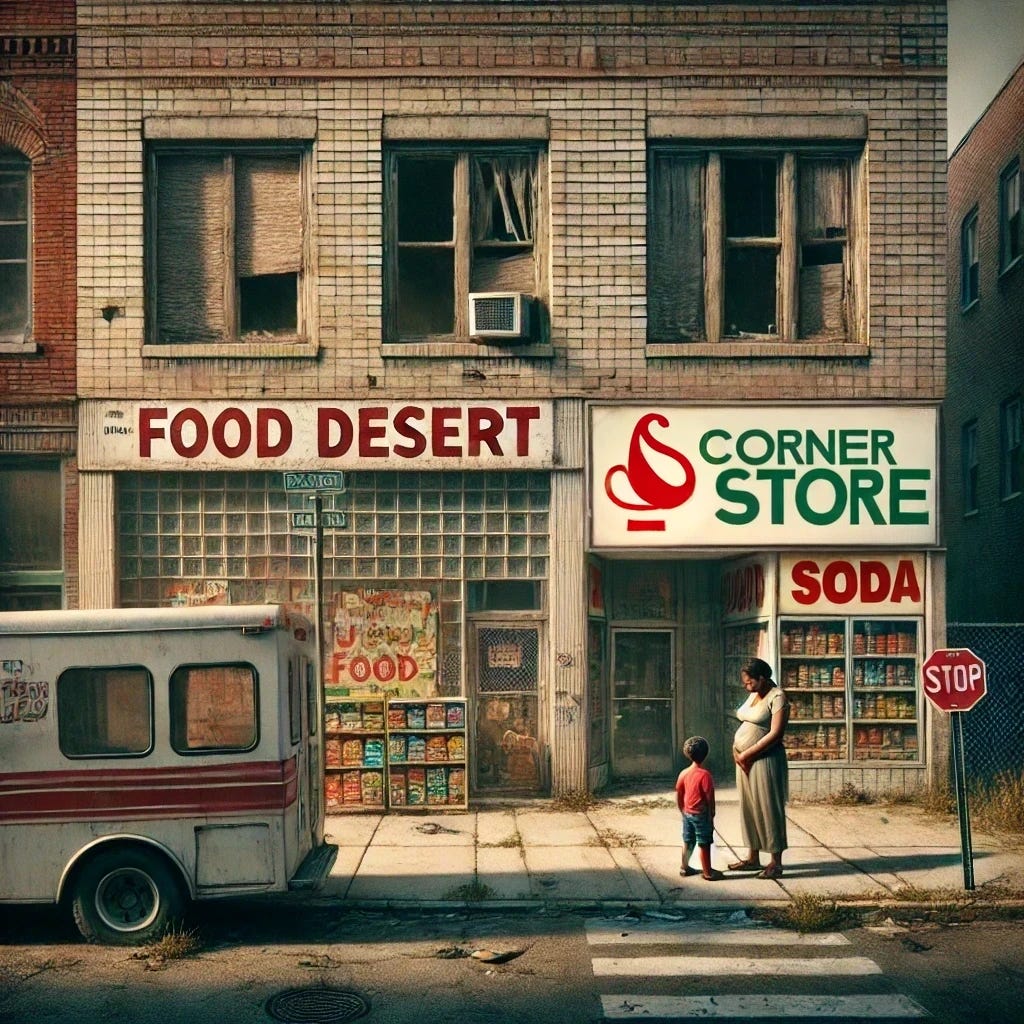
One in eight Americans lives in a food desert—a place where grocery stores are scarce, fresh produce is expensive, and the only nearby food options are fast-food joints and gas stations.
This didn’t happen by accident. Corporate grocery consolidation and urban planning failures deliberately created these food deserts. Big supermarket chains closed locations in low-income areas, chasing higher profits in wealthier, car-dependent suburbs. Meanwhile, Dollar Generals, 7-Elevens, and McDonald’s flooded these neighborhoods, offering calorie-dense, nutrient-poor food.
Now, the MAHA Commission wants to ban SNAP recipients from using food stamps to buy junk food and sugary drinks. Theoretically, this makes sense: if taxpayers are footing the bill, shouldn’t the food be healthy?
But here’s the problem: If you ban processed food without fixing food deserts, you’re not helping. You’re just making it even harder for struggling families to eat at all.
🚨 SNAP recipients don’t buy junk food because they want to be unhealthy. They buy it because it’s what’s available, affordable, and doesn’t spoil in a week. Additionally, many families have breadwinners working multiple jobs and have little time to prepare a healthy meal.
Who Gets Hit the Hardest?
These policies won’t hurt wealthy suburban families who shop at Whole Foods and send their kids to schools with well-funded cafeterias. The real casualties will be:
✔ Low-income families who already struggle to afford food.
✔ Rural communities where the nearest full-service grocery store is 30 miles away.
✔ Communities of color, which have been disproportionately pushed into food deserts by decades of economic discrimination.
✔ Small schools that can’t afford to overhaul their kitchens and buy farm-fresh ingredients.
✔ Small farmers, who could help solve the problem but are being squeezed out of existence by Big Ag and federal policy failures.
🚨 Without significant investments in food access, MAHA won’t make America healthier. It will make life harder for those already struggling.
What Needs to Happen Instead?
Listen, I’m not opposed to healthier food. American food has many additives and preservatives that other countries have banned. However, if MAHA is serious about making America healthy, it needs to pair its nutrition goals with real food access and affordability solutions.
✅ Expand grocery access in food deserts
Offer grants and tax incentives to grocery stores that open in underserved areas. Also, megacorporations that use their extreme buying power to drive small stores out of business should be broken up, and corporate price gouging must be stopped.
Invest in mobile farmers’ markets and food co-ops that bring fresh produce to food deserts. Fund and expand local urban community farming efforts.
✅ Fund schools to actually afford healthy meals
Give grants to upgrade school kitchens to prepare fresh meals instead of relying on processed food.
Expand farm-to-school programs so schools can buy fresh, local food directly from small farms.
✅ Fix SNAP so it works for real families
If processed food is banned, increase SNAP benefits so families can afford fresh food.
Expand Double Up Food Bucks, which matches SNAP spending on produce to make fresh food more affordable.
✅ Break Big Ag’s stranglehold on food production
Shift federal farm subsidies away from corporate megafarms and toward small, local farms.
Enforce anti-monopoly laws to stop corporate agriculture from crushing local food producers.
Final Thought: Food Justice Requires More Than Bans
MAHA’s mission sounds good in theory: Get rid of the processed junk that’s making Americans sick. But banning lousy food doesn’t magically make good food affordable and accessible.
If Trump and RFK Jr. really want to make America healthy, they need to invest in making fresh food available for everyone, not just those who can already afford it. Otherwise, they’re not solving the problem. They’re just making hunger harder.
Bibliography / Sources
USDA National School Lunch Program Overview: https://www.fns.usda.gov/nslp
Food Desert Statistics: https://www.ers.usda.gov/data-products/food-access-research-atlas/documentation/
SNAP Processed Food Ban Proposal: https://nypost.com/2025/02/14/us-news/americans-on-food-stamps-could-be-banned-from-buying-bad-food-and-sugary-drinks-trump-usda-chief-says/
Farm-to-School Program Overview: https://www.fns.usda.gov/f2s/farm-school-grant-program
Ketchup as a vegetable - Wikipedia
Obama-era school nutrition policy led to better diets for students but faces changes - UW School of Public Health
Why Michelle Obama Is Wrong on School Lunches - The Heritage Foundation
Obama’s Healthy, Hunger-Free Kids Act, 14 years later – The Reflector
Did the Healthy, Hunger-Free Kids Act of 2010 improve school nutrition? - Contemporary Pediatrics
SNAP Participants Improved Food Security And Diet After A Full-Service Supermarket Opened In An Urban Food Desert - Health Affairs
Farmers and rural businesses left without funds for their clean energy projects after federal freeze - AP News
These are not the kinds of people that Pres. Musk and V.P. Trump give the teeniest, tiniest rat’s ass about. The likely outcome that you describe would be perfectly fine with them. Donnie will still get to eat the junk food and the oligarchs will continue to rake in the cash. To them, if the “lesser people” die, so what? We are expendable and replaceable. To a large extent, government “of the people, by the people, and for the people” is already well on its way out. And Trump has another four years to finish the job.
Inner city food deserts are a huge problem.
Sometimes incremental changes to our existing crap processed foods can do a lot towards health instead of just outlawing processed foods. High Fructose Corn Syrup should be banned & a ton of chemicals. MSG type "natural flavor" addicts your brain to overeating which is a huge health epidemic. Rumsfeld pushed through aspartame to be ok'd by FDA decades ago and has prob contributed MS type symptoms in folks addicted to diet drinks... start there.