


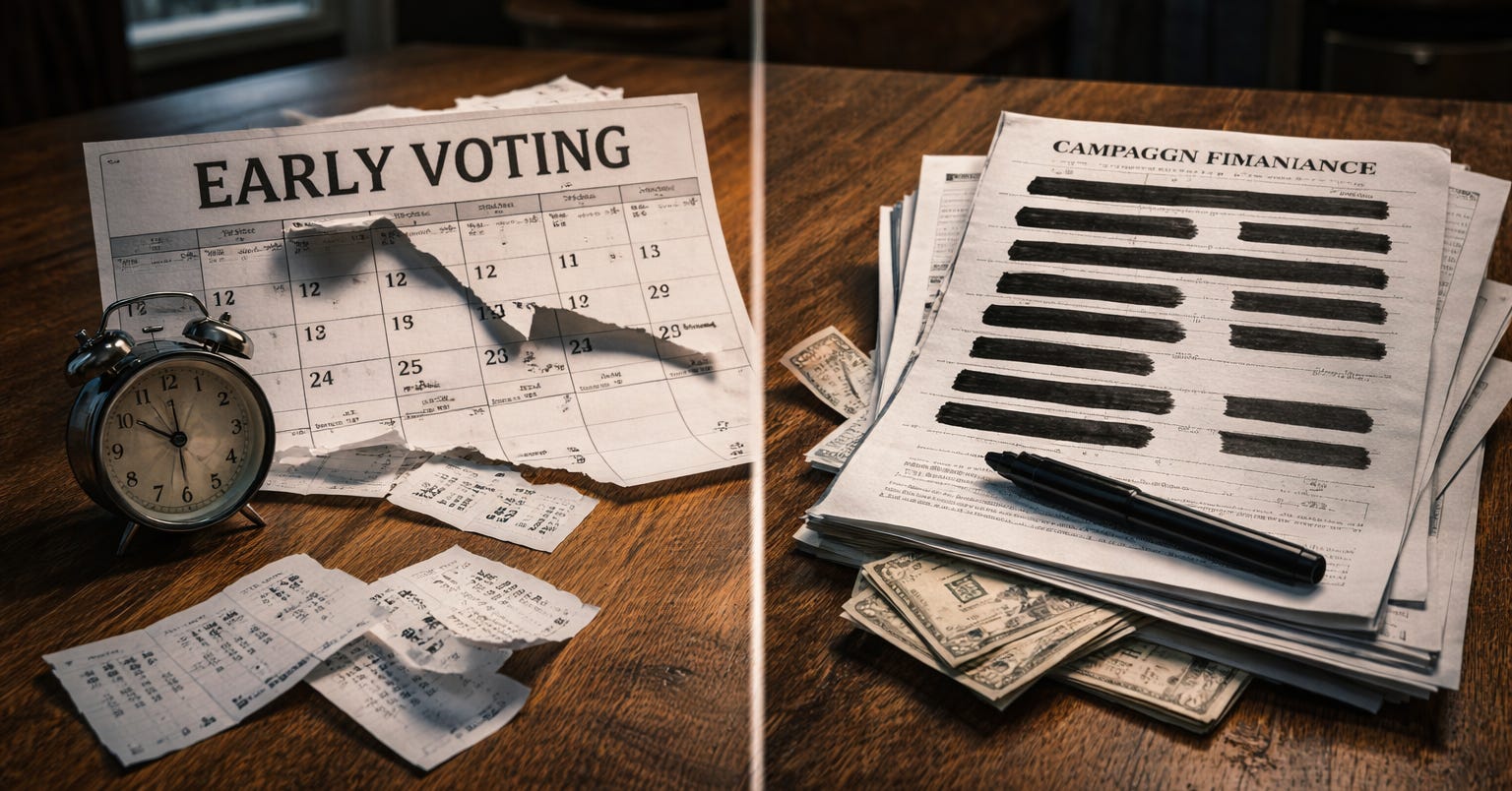
The Rules Change While You’re at Work
The scariest thing about losing a democracy is that it doesn’t feel like losing a democracy while it’s happening. It feels like another long week at work.
The danger isn’t a single coup, it’s a hundred quiet rule changes while you’re just trying to get through the week.
You’re at the kitchen table with one day off in the next two weeks, trying to figure out when you can vote. The early-voting window you used last time? It’s smaller now. Nobody asked you. No one sent a breaking-news alert. A handful of people on a statehouse committee just shaved days off and called it “efficiency.”
Somewhere else, another person is sitting in front of a laptop, trying to look up who’s bankrolling their local sheriff, school board member, or state legislator. The public records are still there, technically. The names are there, technically. But the employers are gone, the addresses are blurred, the patterns that used to jump off the page are now buried in a government office you’ll never see. Lawmakers say it’s about “privacy” and “safety.” Somehow, it always seems to make politics safer for them.
Countries don’t wake up fascist because one man gave a bad speech. They get there because people in power keep changing the rules in their own favor while everyone else is busy trying to survive. In state after state, the people who already hold office are quietly deciding when you’re allowed to vote and how much you’re allowed to know about who owns them. They don’t have to cancel elections to rig the system. They just have to keep stealing your time, dimming the lights on the money trail, and trusting that two political parties will blame each other while the rulebook is rewritten around you.
This Community Is Powered by You
What started as a small circle has grown into something much bigger, and it’s all because of readers like you.
Every time you forward this email, post it on socials, or bring someone new into the fold, you’re helping build one of the most passionate, independent political communities out there.
Want to keep the momentum going?
Share this newsletter with someone who should be part of this conversation.
Thank you for being here. It means everything.
Indiana: Stealing Power by Stealing Days
Start in Indiana, where the attack on democracy doesn’t look like a riot or a purge. It looks like a calendar change.
Lawmakers there moved to cut early in-person voting from 28 days to 16. It wasn’t after a months-long public debate, nor as a clearly labeled “voting rights” bill that everyone in the state could see coming. The cut showed up as a late amendment stapled onto an otherwise forgettable elections bill, pushed through a committee, and sent on its way. If you blinked, you missed the part where your options to vote were almost cut in half.
Shrinking early voting doesn’t erase your rights; it squeezes them until regular people can’t use them.
On paper, nothing dramatic has happened. Election Day is still there. The early-voting window still exists. The right to vote has not been repealed in a blaze of headlines. However, rights don’t vanish only when they’re erased; they also vanish when they’re squeezed into spaces that regular people can no longer fit their lives into. If you’re salaried with flexible hours and remote work, you can usually find a way to stand in line. If you’re an hourly worker with rigid shifts, a nurse on rotations, a single parent juggling child care, or a rural voter staring down an hour-long drive each way, those “extra” days aren’t a luxury. They’re the difference between voting and not voting at all.
The sales pitch is familiar: this is about “efficiency,” “cost savings,” and reminding people that Election Day is supposed to be a single day, not a month-long event. It sounds tidy and reasonable if you say it fast enough. Yet, when you strip away the talking points, you’re left with a simple truth: every day you remove from the early-voting period is a day that some group of voters will no longer be able to make it. The people with the least control over their schedules pay the highest price for someone else’s idea of efficiency.
You don’t have to ban voters you don’t like if logistics can do the dirty work for you.
This is how you tilt a system without ever banning an election. You make the people most likely to vote against you run an obstacle course just to reach the ballot. You don’t have to say “we don’t want these voters.” You just shorten the window, close a few polling places, keep the lines long in the wrong neighborhoods, and let logistics do the work that explicit discrimination used to handle. Every time a government narrows who can realistically vote, it moves one notch closer to the kind of “democracy” authoritarian regimes love, one where turnout is technically allowed, but practically rigged.
Democrats in Indiana have objected, voted no, and given quotes to reporters. That’s better than silence, but it’s not the same as a strategy. Indiana has spent years scraping the bottom of national turnout rankings, and the party that says it wants more people voting has never treated that as an all-hands emergency. National Democrats, who send out daily fundraising emails about “defending democracy,” barely register this kind of statehouse maneuver as more than a line in a talking-points memo. One party is using its power to move the goalposts. The other is mostly issuing statements from the sideline while the field gets smaller.
West Virginia: Turning Off the Lights on the Money Trail
In West Virginia, the assault on democracy doesn’t come through the calendar. It comes through the delete key.
Lawmakers there have decided that the public no longer needs to know where much of the political money actually comes from. Under their new rules, donors will still be listed on campaign-finance reports, but key details will disappear from public view: employers stripped out, full street addresses blurred away. The state will still collect that information. The Secretary of State will still see it. But you, the person trying to figure out who owns your local politics, will be handed a sanitized version and told that’s “transparency.”
The reports still exist, but the part that shows who owns your town doesn’t.
On paper, the reports look almost the same. There are still names, occupations, cities, and amounts. That’s just enough to claim nothing important has changed. However, if you’ve ever actually used these reports, you know the power is in the patterns. When you can see that half a dozen “managers” and “engineers” all work for the same coal company, pipeline builder, private prison outfit, or data center developer, the picture comes into focus. When you can’t, it doesn’t. That’s the point.
The justification, like in Indiana, sounds reasonable if you don’t touch it too hard. Lawmakers and their allies talk about donor “privacy” and “safety.” They warn about harassment, doxxing, and people being targeted at work because of their politics. In a polarized country with real threats, that argument is not made up out of thin air. There are absolutely people who have been harassed or worse for speaking up.
However, genuine safety doesn’t require blinding the public to systemic influence. There is a difference between shielding an individual’s home from being plastered online and hiding the fact that an entire industry is bankrolling a sheriff, a prosecutor, a judge, or a governor. The West Virginia approach doesn’t fine-tune that balance; it bulldozes it. It protects politicians and their benefactors from scrutiny far more than it protects regular people from harm.
When the money trail goes dark, you can feel the fix is in, but you can’t prove it.
Fascism doesn’t just love force; it adores secrecy. It thrives in the space between what people can feel and what they can prove. If you can sense that your town is being run for somebody else’s benefit, but you can’t pull the records to show who that somebody is, you’re easier to gaslight and easier to ignore. The message is trust us, the system is working, and if you don’t believe it, that’s your paranoia, not our donors.
Republicans are the ones pushing this bill across the line, and they deserve to be named for it. However, the comfort with dark money isn’t a purely Republican disease. Both parties have learned to live with super PACs and nonprofit fronts that move millions without clean, readable fingerprints. National Democrats will blast “dark money” in a presidential email and then go quiet when a state they don’t expect to win anyway decides to dim the lights a little further.
Once again, the pattern repeats: those already in power use their majority to edit the rules in ways that protect themselves. The opposition objects, sometimes sincerely, but rarely treats it as a five-alarm fire. And while the speeches fly and the press releases go out, what actually changes is simple and devastating. You wake up in a country where the money that shapes your life is still flowing, but harder to see, harder to trace, harder to challenge.
The Pattern: Changing the Rules While You Hold the Whistle
Taken together, Indiana and West Virginia don’t look like separate oddities. They look like a plan.
In one state, the people in power quietly shrink the window when you’re allowed to vote. In another, they quietly shrink the information you’re allowed to see about who’s buying your elections. On paper, nothing explosive happens. Election Day still exists. Campaign-finance reports still exist. The slogans—“efficiency,” “privacy,” “safety”—sound harmless enough in a vacuum.
But step back, and the shape is hard to miss. If you can decide who realistically has time to show up, and how clearly those voters can see the money behind the names on the ballot, you don’t need to rig voting machines or cancel elections. You’re already playing on a tilted field.
Authoritarians don’t start by canceling elections; they start by editing the rulebook.
This is how democracies slide, rather than just fall. When you study countries that drift into authoritarianism or full-blown fascism, it almost never starts with “No more elections.” It starts with quiet edits to the rulebook: who gets purged from the voter rolls, how hard it is to vote early or by mail, how districts are drawn, how much donor information the public is allowed to see, and how independent the referees really are. The strongman speeches, the uniforms, and the open violence usually come later. The paperwork comes first.
Call it authoritarian, illiberal, pre-fascist—argue about the label if you want. The method is what matters, and the method is always the same: narrow the electorate, hide the money, weaken the watchdogs, and then scold the public for not “trusting the system.” A government that truly believed in its own legitimacy wouldn’t need to make it harder for certain people to vote or easier for certain money to move in the dark.
One party rewrites the rules; the other treats it as a side plot.
This is not just a one-party story, even if one party is doing most of the damage. Republicans have been aggressively using state power to harden their advantages in places they already control, experimenting with soft forms of minority rule inside the lines of nominal democracy. Democrats, meanwhile, keep treating these fights as local process stories while they raise money on big-picture “democracy in peril” branding. They show up to vote no, they give the right quotes, and then the cameras move on while the new rules stay.
If one party is experimenting with soft fascism in the statehouses and the other party mostly sends fundraising emails about it, that isn’t a clash of visions. It’s a division of labor. One side rewrites the rules. The other side lowers your expectations and calls it the best we can do. Caught between them is everyone whose time, vote, and right to see who owns their government are being quietly negotiated away.
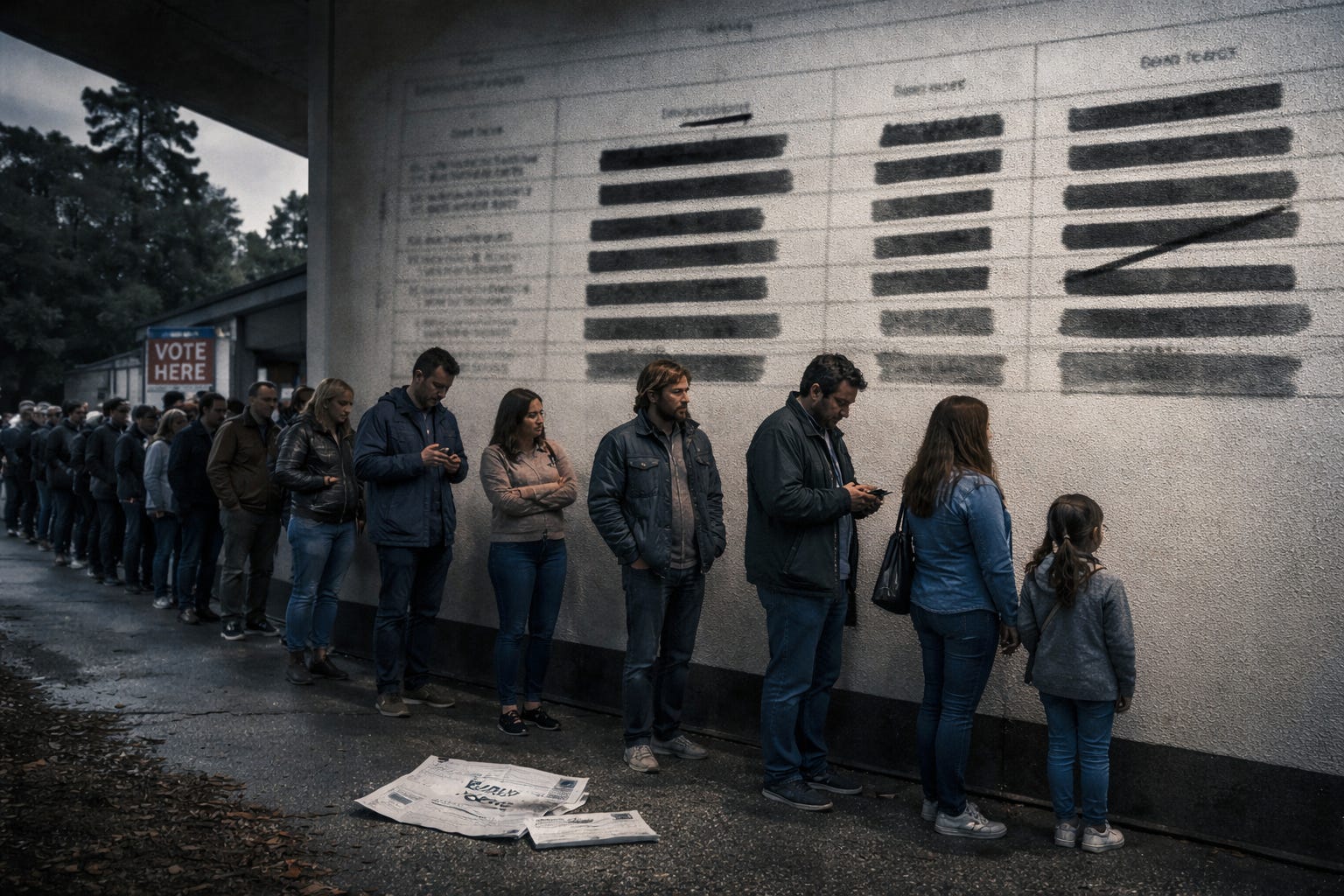
What the Slide Feels Like at the Kitchen Table
All of this can sound abstract until you drop it back into your own week.
A shorter voting window hits hardest where people have the least control over their time.
Start with your schedule. If you’re salaried, remote, or your boss lets you wander off for a couple of hours on Election Day, a shorter early-voting window is annoying but survivable. You move a meeting, shift a call, stand in line, post a selfie, and go home. If you’re an hourly worker, a caregiver, someone stacking two part-time jobs, or pulling swing shifts, the math is different. Voting means losing wages, begging for coverage, or bringing kids to stand in a line that already eats the only day off you’ll see that pay period. When lawmakers shave days off early voting, they are not trimming “fat.” They are cutting straight into the only windows where people with the least power can afford to show up.
Now zoom in on your town’s fights. Maybe it’s a school board race that decides which books your kid can read, or a sheriff race that decides how your community is policed, or a county commission race that decides where to put a new industrial site, jail, or data center. You hear rumors that one company or one ideological group is pouring money into the race, trying to buy the outcome. You go to look it up, and the trail stops short. Names with no employers. Addresses that tell you nothing. A donor list that looks like a phone book instead of a pattern. You’re left with vibes and hunches where receipts used to be.
The slide doesn’t feel like a coup; it feels like nothing you vote for ever sticks.
That’s what the slide toward fascism actually feels like for most people. It doesn’t arrive as jackboots on the porch. It arrives as a sense that nothing you vote for ever changes, that the same kinds of people always seem to win, that the rules keep shifting in ways you didn’t ask for and can’t track. You can feel the game is rigged, but every time you try to prove it, the hours are shorter, the lines are longer, and the data you need has been quietly edited out of the public record.
If We Don’t Watch the Rulebook, the Rulebook Will Watch Us
You don’t have to believe America is already fascist to see that we’re playing with the same tools. When the people in charge keep narrowing who can realistically vote and dimming how clearly you can see who owns them, that’s not routine housekeeping. That’s a government stress-testing how much soft authoritarianism voters will tolerate as long as the usual rituals stay intact.
The danger isn’t just that Republicans are writing and passing these bills. It’s that Democrats, in state after state, treat them as side plots instead of the main story. One party is using power to lock in an advantage, especially where it already dominates the map. The other talks about democracy like a brand but lets these statehouse edits slip by with a press release and a shrug. Between them, the basic terms of your citizenship become negotiable.
We can treat these bills as paperwork or as the early chapters of something much uglier.
This is the fork in the road. We can tell ourselves these are minor tweaks to election administration and record-keeping, trust that someone else is watching, and wake up one day in a country where the rules have quietly hardened around a permanent ruling bloc. Or we can call these bills what they are: early steps in a project that ends with fewer meaningful voters, less traceable money, and a democracy that exists mostly as a logo.
The good news is we are still in the part of the story where ordinary people can yank the wheel. These are laws, not natural disasters. They can be blocked, reversed, exposed, and punished at the ballot box. However, that only happens if we pay attention to the boring parts: the committee amendments, the statehouse calendars, the fine print where our rights are being slowly rewritten.
If you want any hope of stopping a slide toward fascism, you can’t just watch who wins the big races. You have to watch who’s changing the rules underneath them, and you have to decide that matters enough to fight over.
Coffman Chronicle: Support Independent Media
If this piece helped you see how “boring” statehouse bills can move a country closer to soft fascism, that’s not an accident. It’s the work most outlets don’t have time or incentive to do.
The Coffman Chronicle is fully reader-supported, so it can follow power where it actually moves: in state legislatures, rulebooks, and fine print most people never see. No corporate owners, no party line, no consultants telling us to stick to horse-race coverage while the rules of the race change underneath you.
Support independent media. Become a paid subscriber.
Sources:
Beck, Caroline. “Lawmakers Quietly Advance Plan to Reduce Early Voting Days.” WFYI (Indianapolis), February 16, 2026.
“Lawmakers Approve Amended Bill That Would Shorten Early Voting in Hoosier State.” WRTV Indianapolis, February 16, 2026.
“Cutting Early Voting Period (HB 1359).” ACLU of Indiana, February 17, 2026.
“IN HB1359 | 2026 | Regular Session.” LegiScan, February 16, 2026.
Baldwin, Stephen. “Senate Votes to Block Public Access to Certain Political Donor Info.” The Real WV, February 17, 2026.
Adams, Steven Allen. “Bill Decreases Transparency of Campaign Finance Reports.” Tribune Chronicle (Warren, OH), February 17, 2026.
Adams, Steven Allen. “Senate Passes Bill Decreasing Public Transparency for Campaign Finance Reports.” Weirton Daily Times, February 17, 2026.
“WV SB640 | 2026 | Regular Session.” LegiScan, February 16, 2026.
“HB5066: Relating to Prohibiting the Release of Addresses and Names of Employers of Persons Who Make Contributions to Political Elections.” TrackBill, 2026 Regular Session.
Early voting makes it easier for some people to vote. If you are going to be away on Election Day, or maybe have elective surgery or procedure that day, you can still vote. Maybe you can only physically get to the polls on certain days, you can still vote.
Changing the rules because you don't like the likely outcome - that's classic oligarchy. These changes are all happening amid a quantity of chaos that takes more than all of our attention. Then, 5 years from now, we all stand around and say "how did this happen?" - It's happening. Now. Stopping it requires calling attention to it - now.