


The One Big Beautiful Bill (OBBB) is now in the hands of the Senate. At 1,116 pages, it’s one of the most sweeping pieces of legislation to move this term and perhaps the most consequential. The House passed it narrowly, but without substantial revision. Despite national protests, lawsuits, and bipartisan discomfort with its scope, almost everything is still in it.
The permanent tax cuts for the wealthiest remain untouched, as do the historic increases to immigration enforcement and military spending, including funding for mass deportations, expanded detention, and new defense contracts. The deep cuts to Medicaid, SNAP, and education are intact, as are provisions to defund green energy, eliminate subsidized student loans, and cap borrowing for graduate and professional degrees.
Also still there is the 10-year ban on state AI regulations, which would tie the hands of local governments trying to respond to election manipulation or algorithmic discrimination. A provision limiting federal courts’ power to enforce rulings against the executive branch unless plaintiffs post a financial bond is also still there, a move legal scholars have called an outright threat to the separation of powers.
And yet, these are the pieces we are hearing about. What’s barely discussed in committee hearings, media coverage, and Senate press releases is what may be the bill’s most lasting legacy: the permanent legislative codification of the Department of Government Efficiency’s (DOGE) agency-cutting spree.
We just hit 14,000 subscribers—thank you!
Get exclusive access for just $1/week or $52 a year.
Get exclusive analysis and fearless reporting you won’t find in corporate media.
We’ve reported in depth on many of these provisions as they’ve moved through Congress, from immigration and military funding to AI rules and judicial power restrictions. You can find those stories here:


Today, we turn to what the bill does to the agencies themselves, and why almost no one is talking about it.
What No One Is Talking About
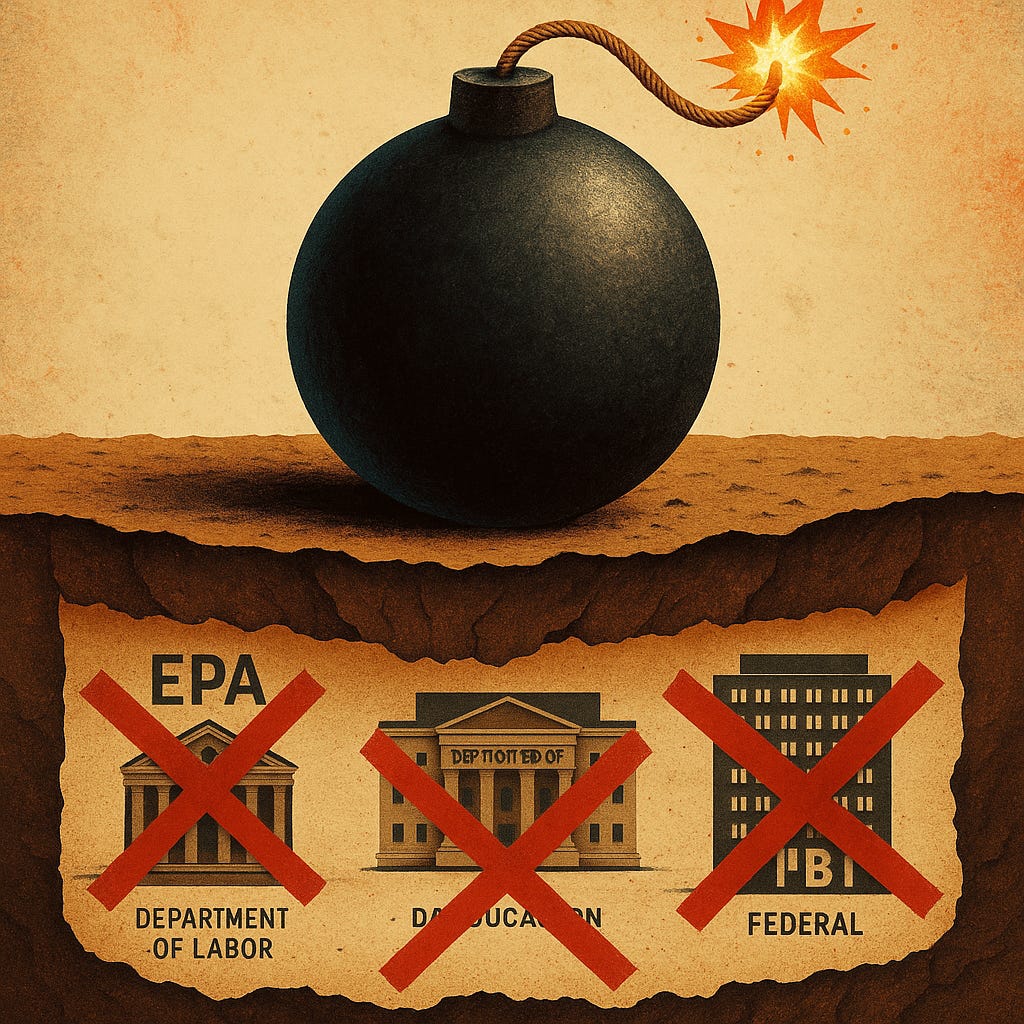
Amid all the noise — the tax cuts, the culture war amendments, the border wall money — one of the most significant provisions in the entire bill is going almost entirely undiscussed: the codification of DOGE cuts.
For months, the Department of Government Efficiency (DOGE) acted with sweeping authority, issuing “recommendations” that led to the largest reduction in the federal workforce in over a decade. Entire agencies were decimated. Programs vanished. Field offices shuttered. While legal challenges began to mount, and some courts moved to halt or reverse those changes, the OBBB would now render those rulings almost irrelevant.
By writing DOGE’s recommendations into law, the budget bill ensures that even if courts rule the cuts were illegal, the damage is permanent. This isn’t belt-tightening. It’s entrenchment. And it’s happening with barely a whisper on the Senate floor.
The DOGE Earthquake
From January through April, the Department of Government Efficiency moved like a shockwave through the federal government, more chainsaw than scalpel. What started as a “quiet advisory body” for the administration quickly became the de facto architect of a historic downsizing. In just three months, DOGE “recommendations” led to the elimination of 279,445 federal jobs across 27 agencies, the largest mass layoff in the public sector since the Great Recession.
Entire departments were hollowed out.
At USAID, over 10,000 employees were placed on administrative leave, leaving behind a skeletal staff of 300.
The EPA lost hundreds of scientists and enforcement staff in a matter of days.
Health and Human Services, including the CDC and NIH, saw thousands of staff disappear mid-program.
The Department of the Interior, Social Security, Veterans Affairs, and frontline education offices were hit just as hard.
DOGE said it was only advising, but when federal workers were told they were being let go, and no one from above stepped in to say, “this isn’t final,” they left. They packed their desks. They filed for unemployment. They began the work of rebuilding their lives.
The courts would later intervene. Judges blocked terminations at 22 agencies, citing violations of civil service protections. Over 15,000 federal workers were ordered reinstated. But by then, the disruption was already irreversible. Buyouts hadn’t been paid. Reinstated workers weren’t returned to their roles, and many were placed on administrative leave, given no assignments, or told they’d be reassigned at a later, unspecified date.
And those who never left? They remained behind, trying to hold entire departments together on shoestring budgets, gutted teams, and no guidance.
We reported extensively on DOGE. Please see our archive for more coverage.
From Temporary to Permanent
In theory, the mass layoffs and program shutdowns were reversible. In practice, this bill ensures they won’t be.
The OBBB doesn’t just fail to fund recovery. It goes further. It codifies collapse. Agencies stripped of their workforces and budgets this spring now find themselves written out of the legislation entirely. No new appropriations. No rehiring mandates. No language restoring functions that the courts ruled must be preserved.
The legal wins, such as they were, are rendered meaningless when no funding exists to support the jobs. A reinstatement order is a hollow gesture when no team, program, or office is left to return to.
This isn’t just fiscal policy. It’s structural abandonment. If this budget passes, it will not be a political failure but a permanent feature of American governance.
The Fallout
Let’s be blunt.
Many workers who accepted buyouts, often under pressure, were promised pay through September. Many still haven’t received it. Some say they never even got confirmation of their terms. Others turned to legal clinics in desperation.
The ones who stayed were fired, often illegally, and when the courts told agencies to bring them back, they returned to find their jobs were gone in everything but name.
"There were definitely moments when I felt defeated," said a Social Security Administration employee. "It turned your world upside down."
"We're now just incredibly terrified and scrambling to find new jobs to keep the roof over our head and feed our little one," said Daniel Leckie, a former GSA employee.
And those who survived both waves, who neither quit nor were fired, are still showing up, still trying to do the work of entire teams, and still logging in with no clear mandate, in a workplace where morale is nonexistent and fear is constant.
This isn’t a hiring freeze. The government is deliberately bleeding itself out and pretending it’s about efficiency.
DOGE Never Left
Though its public profile has faded, DOGE remains deeply embedded in government. According to Executive Order 14158, DOGE teams are still present in all federal agencies, issuing hiring recommendations, accessing internal systems, and influencing budgets.
At the Department of the Interior, DOGE teams recently sought access to payroll and credentialing systems. At Veterans Affairs, their “recommendations” have led to staff reductions that directly impacted patient services. While no longer executing mass firings, DOGE is still shaping operations quietly, persistently.
And with the OBBB, DOGE’s work doesn’t even need to continue. Congress is finishing it.
The Silence Is the Strategy
There are 100 senators. Fewer than five have said anything about the budget bill, and practically none have said a word about the codification of DOGE cuts. There has been no meaningful public debate about enshrining agency collapse into law, and there is no reckoning with what it means for democratic governance when appropriations nullify court rulings.
This silence is not accidental; it’s strategic. If the OBBB passes, the loss of government will not be a glitch; it will be the new normal.
What You Can Do
The Senate is debating this bill right now. If you believe the OBBB should not make the damage DOGE has already inflicted permanent, if you think federal agencies should function, and if you feel the courts should be obeyed, you need to speak up.
Call the Capitol Switchboard:
(202) 224-3121 — Ask to be connected to your senator’s office.Sample Script:
"Hi, my name is [Your Name], and I’m a constituent from [Your City]. I’m calling to urge Senator [Name] to oppose the OBBB in its current form. I’m especially concerned about the provisions that make permanent the DOGE cuts to federal agencies, even those under active court review. I believe in functional government and in checks and balances. Please vote no unless these provisions are removed."
Email Your Senator: https://www.senate.gov/senators/senators-contact.htm
Support the Organizations Fighting Back
ACLU – Leading lawsuits and advocacy to protect civil service.
Rise Up: Federal Workers Legal Defense Network – Legal support for displaced workers.
NTEU – Defending federal workers in court.
AFGE – Fighting to restore fair labor practices.
Working America – Organizing for worker protections.
Share this post. Talk about it.
Silence is how this bill survives. Visibility is how we fight it.
We just hit 14,000 subscribers—thank you!
Get exclusive analysis and fearless reporting you won’t find in corporate media.
Bibliography:
“ACLU Urges Congress to Prevent Illegal Mass Layoff of Federal Workers.” ACLU of the District of Columbia, May 2025.
“AFGE Sues Over Illegal Layoffs and Demands Reinstatement.” Associated Press, March 2025.
“Call to Reinstate Federal Workers Now: Rally for Justice.” ACLU of the District of Columbia.
Leckie, Daniel. Interview by Libby Cathey. “Federal Workers Laid Off by DOGE Sound Off on New Budget Bill.” ABC News, May 15, 2025.
National Treasury Employees Union. “NTEU Responds to Federal Workforce Layoffs.” Wikipedia. Accessed May 26, 2025.
“Rise Up: Federal Workers Legal Defense Network Launched by AFL-CIO, We The Action.” Reuters, April 16, 2025.
“Trump’s Mass Layoff Threat Drives U.S. Government Workers to Resign.” Reuters, May 20, 2025.
U.S. Congress. One Big Beautiful Bill Act, H.R. 1, 119th Cong., 1st.
