


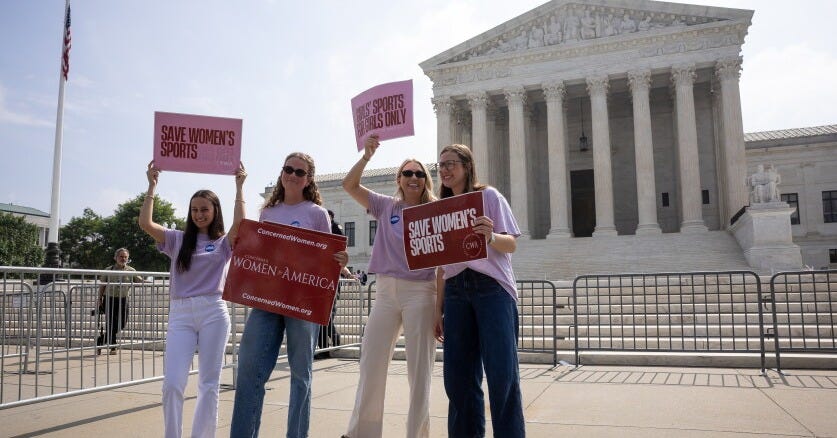
The Supreme Court upheld state laws in Idaho and West Virginia that restrict girls’ and women’s school sports teams to biological females, a ruling that gives states broad authority to enforce transgender athlete bans.
The decision came in two cases, West Virginia v. B.P.J. and Little v. Hecox, involving transgender student-athletes who challenged the laws under Title IX and the Equal Protection Clause. The Court held that Title IX allows schools to provide separate women’s and men’s sports teams defined by biological sex.
The Court also rejected the Equal Protection challenges. Writing for the majority, Justice Brett Kavanaugh said states have important interests in safety and competitive fairness and may determine eligibility for girls’ and women’s sports based on biological sex.
Subscribe free for daily political analysis they won’t broadcast. Join 110K+ readers →
The practical consequence is significant: states with similar laws now have stronger legal footing to enforce them. Reuters reported that 25 other states have similar laws on the books.
The ruling does not create a federal nationwide ban. The Court said it was not deciding whether schools may allow transgender girls and women to compete on girls’ and women’s teams where state law or school policy permits it.
Reaction split quickly. Trump celebrated the ruling as a win, while West Virginia officials called it a victory for fair competition. Civil-rights groups representing the athletes condemned the decision, with Lambda Legal, the ACLU and Legal Voice saying transgender students are being denied equal opportunity in school sports.
The decision is likely to shape future litigation over Title IX, school athletics and state power to regulate eligibility rules.
Subscribe free for daily political analysis they won’t broadcast. Join 110K+ readers →