

Tariffs, Trump, and a 50-Year-Old Mistake
The Court Draws a Line and Trump Pulls Out a Loophole. Will Congress Respond?

The Supreme Court did something Friday that Congress should have done decades ago: it told a president that emergency powers are not a blank check.
On February 20, 2026, in Learning Resources, Inc. v. Trump, the Court ruled that the International Emergency Economic Powers Act (IEEPA), a Cold War statute meant for targeted financial sanctions, does not authorize the president to impose broad tariffs on imports. Tariffs are effectively taxes on foreign goods, and the Constitution gives Congress the power to levy taxes and duties. Presidents can exercise that power only when Congress clearly and explicitly delegates it to them. The administration’s attempt to turn IEEPA into a universal tariff switch was, in the Court’s view, an overreach.
For a brief moment, the ruling felt like a genuine rebalancing of power. The Court — this Court — drew a clear line and reminded everyone that tariffs are Congress’s lane. If the country wants a president to have sweeping tariff authority, then Congress has to say so in plain language. If the country does not want that, then Congress has to fix its statutes.
That should have been the end of the story.
It was not.
This Community Is Powered by You
What started as a small circle has grown into something much bigger, and it’s all because of readers like you.
Every time you forward this email, post it on socials, or bring someone new into the fold, you’re helping build one of the most passionate, independent political communities out there.
Want to keep the momentum going?
Share this newsletter with someone who should be part of this conversation.
Thank you for being here. It means everything.
Trump’s Fast Pivot
Within about a day of losing at the Court, Donald Trump appeared and announced that a new global tariff was coming. The legal justification was different in name only. Instead of invoking IEEPA, Trump claimed authority under “Section 122 of the Trade Act of 1974” and promised a 15% surcharge on a wide range of imports.
The pivot's speed made one thing obvious. This was not a panicked scramble for a statute. The administration had a backup plan ready. If Plan A under IEEPA died at the Court, Plan B under Section 122 would roll out immediately.
On paper, Section 122 allows the president to impose a temporary surcharge on imports of up to 15% for up to 150 days when the United States faces “fundamental international payments problems.” In the 1970s, that phrase referred to things like balance-of-payments deficits and pressure on the dollar in a fixed-exchange-rate system. The authority was meant to be narrow and time-limited, a defined channel for emergency surcharges rather than an open invitation to rewrite trade policy from the Oval Office.
In practice, Section 122 had never been used in modern memory. Trade lawyers and Congressional researchers described it as “historically unused.” It sat in the statute books as a relic of a very different economic era, technically available but politically dormant.
Until now.
A 1970s Compromise Comes Back to Bite
To understand how we arrived at this moment, it helps to remember why Section 122 exists in the first place.
In 1971, President Richard Nixon used an emergency law to impose a sudden 10% surcharge on imports. It was a dramatic assertion of presidential power over tariffs. Congress, understandably, was not amused. Lawmakers could have responded with a clear constitutional rejection and insisted that tariffs remain a legislative power. Instead, they chose a more complicated path.
In the Trade Act of 1974, Congress enacted Section 122 as a controlled outlet for that behavior. If a president felt compelled to impose a temporary surcharge in a genuine payments crisis, the law would allow it, but only up to 15% and only for 150 days. Congress did not say, “You may not overreach.” Congress said, in effect, “If you are going overreach, you must do it here, under these rules.”
That choice looks very different 50 years later. Rather than closing the door on presidential tariff grabs, Congress built a smaller door inside its own wall and labeled it Section 122. Then it walked away. The law included a time limit on each surcharge but no expiration date on the authority itself. There was no requirement that Congress revisit the provision as the global financial system changed. There was no scheduled check-in to ask whether the logic of a 1970s emergency still made sense in a world of floating exchange rates and globalized capital.
For roughly half a century, no one touched Section 122. It became part of the legal wallpaper, mentioned in treatises and reports but never actually invoked. That dormancy made it feel harmless. It was not harmless. It was waiting.
When the Supreme Court finally told a president that IEEPA could not be used as a general tariff engine, that old compromise suddenly mattered again. Trump did exactly what Congress should have anticipated. He walked past the closed IEEPA door, reached for Section 122, and announced that the law Congress wrote in the 1970s gave him everything he needed.
Now we are living inside the consequences of that fifty-year-old bargain.
One Hundred Fifty Days in the Penalty Box
Section 122 does not authorize a permanent tariff regime. It authorizes a temporary surcharge for a defined period. The new global tariff, therefore, comes with a built-in clock. It can run for up to 150 days unless Congress passes a law to extend it.
That sounds reassuring until you think about how slowly our system tends to respond. Those 150 days are not abstract. During that time, imported goods become more expensive. Companies that rely on foreign inputs have to decide whether to absorb the cost, pass it on to consumers, or cut elsewhere. Supply chains that were already stretched by years of shocks take another hit. Lawsuits begin, but courts move at the pace of briefing schedules and dockets, not at the pace of a presidential press conference.
Realistically, unless a lower court issues an unusually swift and sweeping injunction and higher courts refuse to stay it, the first 150-day tariff window will happen. When that window closes, the law forces a very stark choice. Congress can act to extend the surcharge. Congress can do nothing and let it expire. Or Congress can finally admit that the statute itself is the problem and move to rewrite or repeal it.
The fact that the Supreme Court has already said, in essence, “this is your lane,” makes the stakes even more obvious. The judiciary has done what it can. It has interpreted IEEPA narrowly and refused to invent a new tariff power where Congress did not clearly grant one. It cannot rewrite Section 122 from the bench. Only Congress can clean up its own old compromises.
That is where this becomes not just a Trump story but a Congress story.
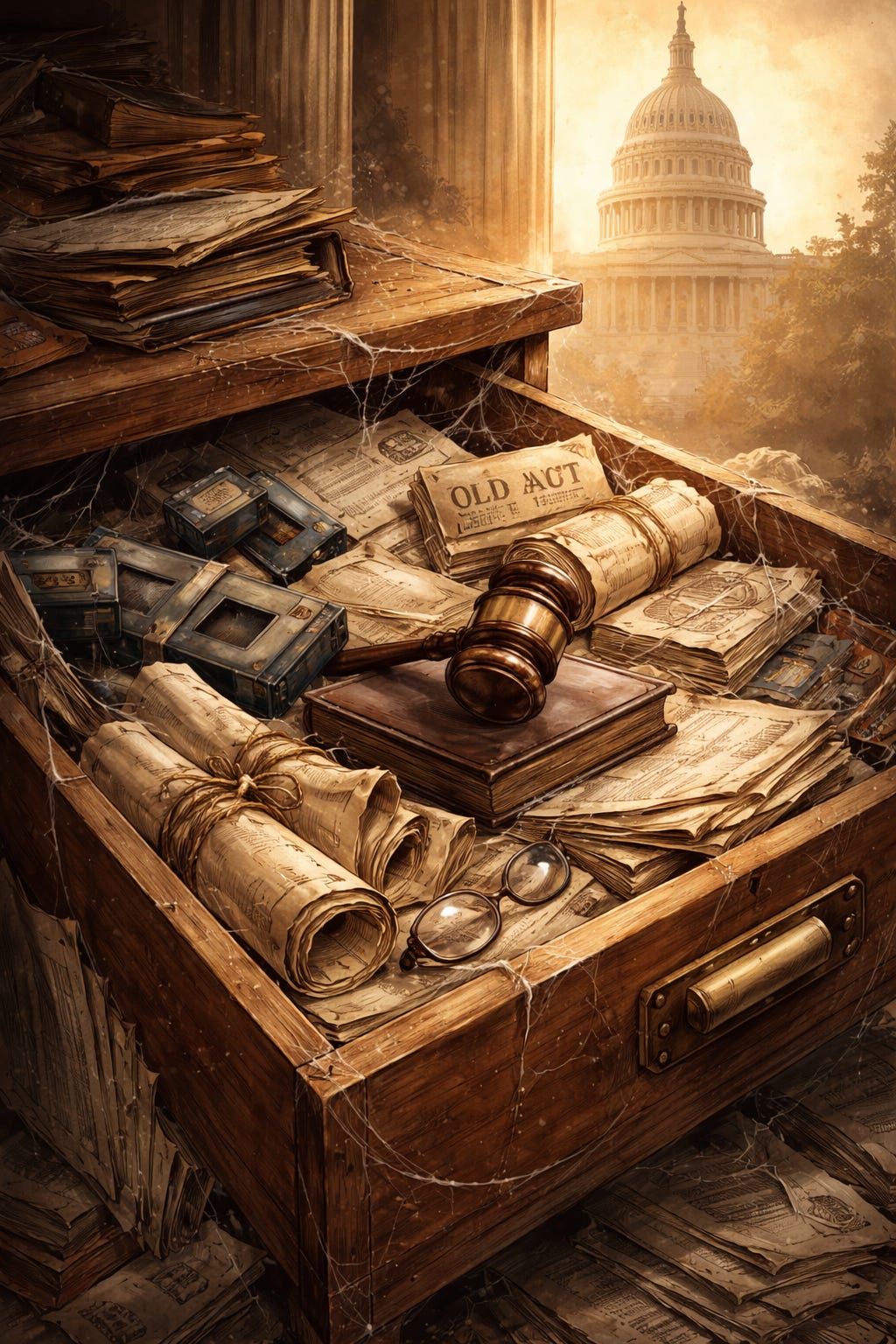
The Junk Drawer of Old Laws
American law has a hoarding problem. We are very good at adding statutes and very bad at cleaning them out.
Over time, the United States Code has accumulated rules written for worlds that no longer exist. We have federal privacy rules written for video rental records from the VHS era, even as streaming services and apps track viewing habits in ways those lawmakers could not have imagined. We have obscure state provisions governing the movement of specific farm animals along roads that have long since changed function or jurisdiction. We have Cold War trade provisions designed for fixed exchange rates and a very different global financial architecture.
Each of these laws made a certain kind of sense when it was written. Almost none of them have been systematically revisited. They simply remain in force unless someone expends the effort and political capital to repeal or update them. That effort rarely happens because there is no obvious payoff. No member of Congress wins a re-election campaign by announcing that they successfully removed a dusty trade authority from 1974 that no one has heard of.
In the meantime, all of those old laws continue to exist as potential tools. Each one is a lever that a determined executive, lawyer, or litigant can discover and pull. Each one is also a potential landmine for new legislation, because every new statute has to coexist with thousands of old ones drafted with different assumptions, technologies, and politics in mind.
Section 122 is a textbook example of that problem. It was written for a particular moment and then left untouched. It might have quietly aged into irrelevance, but the law does not do that on its own. Someone has to decide to prune it. No one did. So here we are, 50 years later, watching a president swing a tool that most Americans had never heard of until he picked it up.
The Worst-Case President Test
There is a basic principle that healthy institutions in other sectors understand and follow. Rules are not written for the best-case actor. Rules are written to guard against the worst.
In workplaces, in nonprofits, in retail and finance, policies are drafted with the assumption that somewhere, at some point, someone will test the limits. If a handbook does not say that staff cannot take home unsold or expired product without permission, an employee will eventually do it and claim that no one ever told them otherwise. If a code of conduct does not make tipping rules clear, someone will eventually start accepting tips and insist that the policy was silent. When new forms of abuse emerge, organizations do not simply address a single bad incident. They review the surrounding rules, identify similar vulnerabilities, and revise them. They treat their policies as living documents that must keep up with both human behavior and external change.
Congress rarely operates that way. Too often, it writes statutes that make sense only if interpreted by responsible actors in good faith. It relies on norms and expectations instead of hard rules. It tells itself that no president would ever push things that far, and then acts surprised when one does. When abuse finally occurs, Congress tends to respond to the specific incident and then move on, rather than asking what other provisions could be exploited in the same way.
The tariff saga is what happens when that habit collides with a determined executive. Congress watched Nixon reach for emergency tariff power and responded by encoding a narrow way to do the same thing rather than prohibiting it clearly. Later Congresses watched presidents stretch other statutes and comforted themselves with the idea that the courts would sort it out. Now, a president has tried to use IEEPA as a general tariff engine, been told no by the Supreme Court, and immediately turned to a different statute that Congress itself built as a compromise with overreach.
If a law can only be safely wielded by the most responsible, restrained president, it is not a good law. It is a time bomb. The only meaningful test for any delegation of power is not whether this president can be trusted, or whether the next one can be. The test is whether you would be comfortable letting the worst, most reckless imaginable future president use that authority exactly as written. If the answer is no, then the law has to change.
By that measure, Section 122 never should have been written, much less left alone for 50 years.
The Court as the Exhausted Friend
One of the saddest elements of this story is that the only branch clearly acknowledging the problem is the judiciary. The Supreme Court did not manufacture a new presidential power in this case. It did the opposite. It cut back an attempted reach under IEEPA and pointed unmistakably at Congress. This is your lane, the justices said. If you want this kind of tariff, own it. If you do not, say so in your statutes.
It is hard not to see the Court as the exhausted friend watching someone stay in a bad relationship. The justices are not perfect, and they are hardly neutral referees in every case, but in this narrow context, they are the person on the couch saying, “You know that is not how this is supposed to work, right?” Congress is the one nodding, changing the subject, and hoping things will somehow improve without any uncomfortable confrontation.
This dynamic is backwards. The legislature should not be waiting for the judiciary to remind it of its own constitutional powers. The legislature should be the one jealously guarding those powers, pruning old delegations, updating statutes as the world changes, and writing every law with the worst-case president firmly in mind.
One Hundred Fifty Days for Congress to Decide What It Is
The next 150 days are not just an economic trial. They are a test of whether Congress still intends to function as a coequal branch of government.
At the end of this tariff’s statutory lifespan, Congress will face a simple but telling decision. It can do nothing and allow the surcharge to expire, while pretending that passivity counts as prudence. It can actively extend the tariff and become a full partner in Trump’s global import tax. Or it can finally confront the deeper issue, admit that a law written in response to Nixon for a financial system that no longer exists has become a weapon in 2026, and move to take that weapon away.
Pruning dead laws, updating old ones for new realities, and planning for the worst possible actor are not glamorous tasks. They will never generate campaign slogans. They are, however, at the core of what Congress is supposed to do. The Court has already delivered the message that should have come from inside the Capitol: this is your job. The only real question now is whether Congress will hear it and act, or leave the rest of us to keep living under the shadow of its fifty-year-old compromises.
If you want more pieces that dig into how power actually works in Washington, not just the headlines about who yelled at whom, we hope you will subscribe. We write about the quiet choices in law and governance that shape what presidents can get away with and what Congress keeps avoiding. Your subscription helps us keep doing slow, careful work in a news cycle that usually rewards the opposite.
Sources:
Learning Resources, Inc. v. Trump, 607 U.S. ___ (2026), opinion of the Court issued February 20, 2026, Supreme Court of the United States.
“US Supreme Court strikes down Trump’s global tariffs,” Feb. 20, 2026, Reuters.
“Supreme Court strikes down tariffs,” Feb. 20, 2026, SCOTUSblog.
“Trump pivots to new 10% global tariff, new probes after Supreme Court setback,” Feb. 20, 2026, Reuters.
“After court ruling, Trump says US global tariff rate will rise from 10% to 15%,” Feb. 21, 2026, Reuters.
“Trade Act of 1974”, Wikipedia.
In all seriousness, surely, but I can't think of anything at this precise moment.
After 150 days expire, does this law prevent Trump from imposing a "new" 16% tariff?