


Texas is bigger than most countries, with an economy larger than Russia’s, more land than France, and a population nearing 30 million. It’s a cultural engine, a business magnet, a political force. However, underneath all that power and growth is a truth few want to admit:
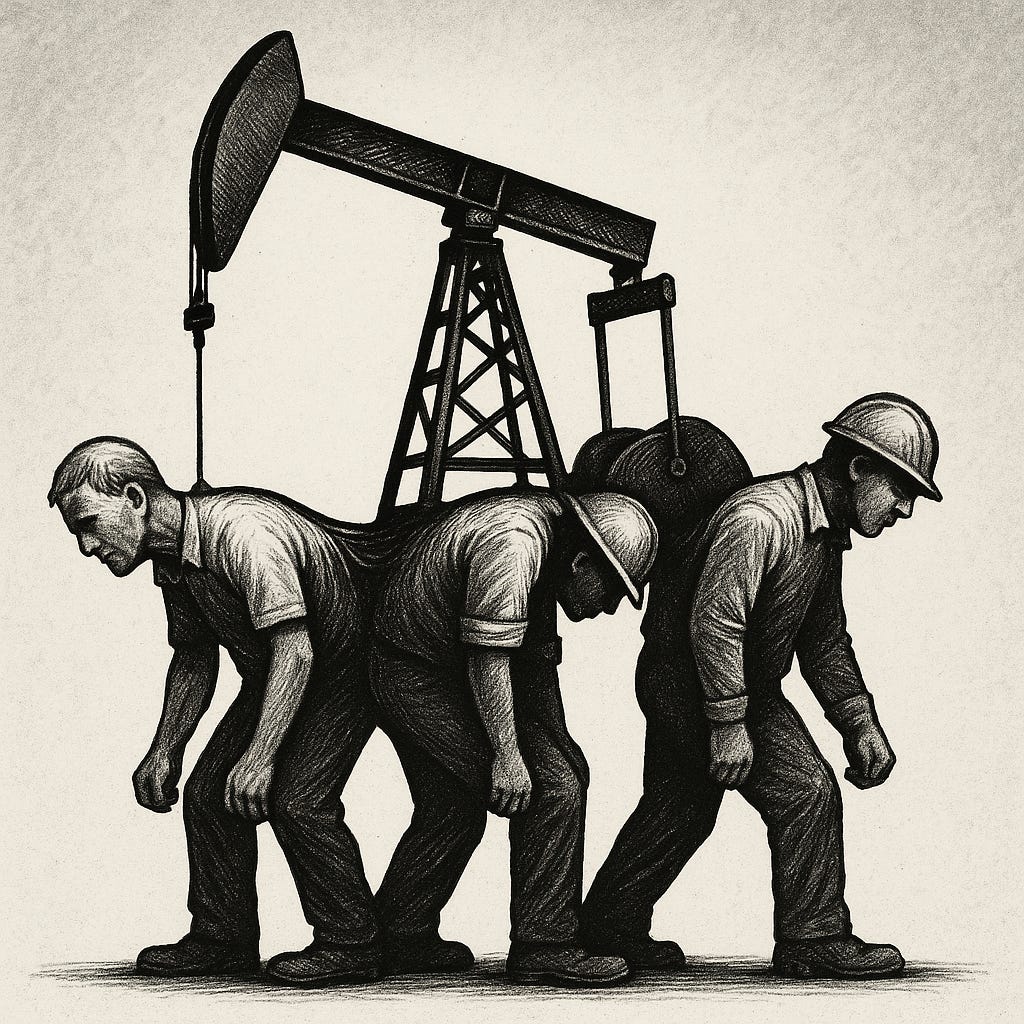
Texas doesn’t function like a democracy. It functions like an extraction site.
Run by a 19th-century constitution and governed by a modern-day monarch, Texas has hollowed out its democratic institutions and replaced them with something colder, more efficient, and far more dangerous. This isn’t just about partisan politics or red-versus-blue narratives. It’s about how the state uses its people the same way it uses its land: to extract labor, power, and compliance, with no promise of reinvestment.
The result is a political economy that feels less like a republic and more like a rig, pumping resources from communities while silencing their ability to resist.
Stay Informed. Stay Loud.
Subscribe to The Coffman Chronicle for no-BS political analysis, action guides, and weekly truth bombs you won’t get from corporate media.
The Constitution That Froze Democracy
The Texas Constitution was born in 1876, written by men who had survived the Civil War and feared both centralized authority and Reconstruction’s reforms. They designed a government to be weak, slow, and deeply suspicious of itself. What they left behind is not just outdated — it’s anti-democratic by design.
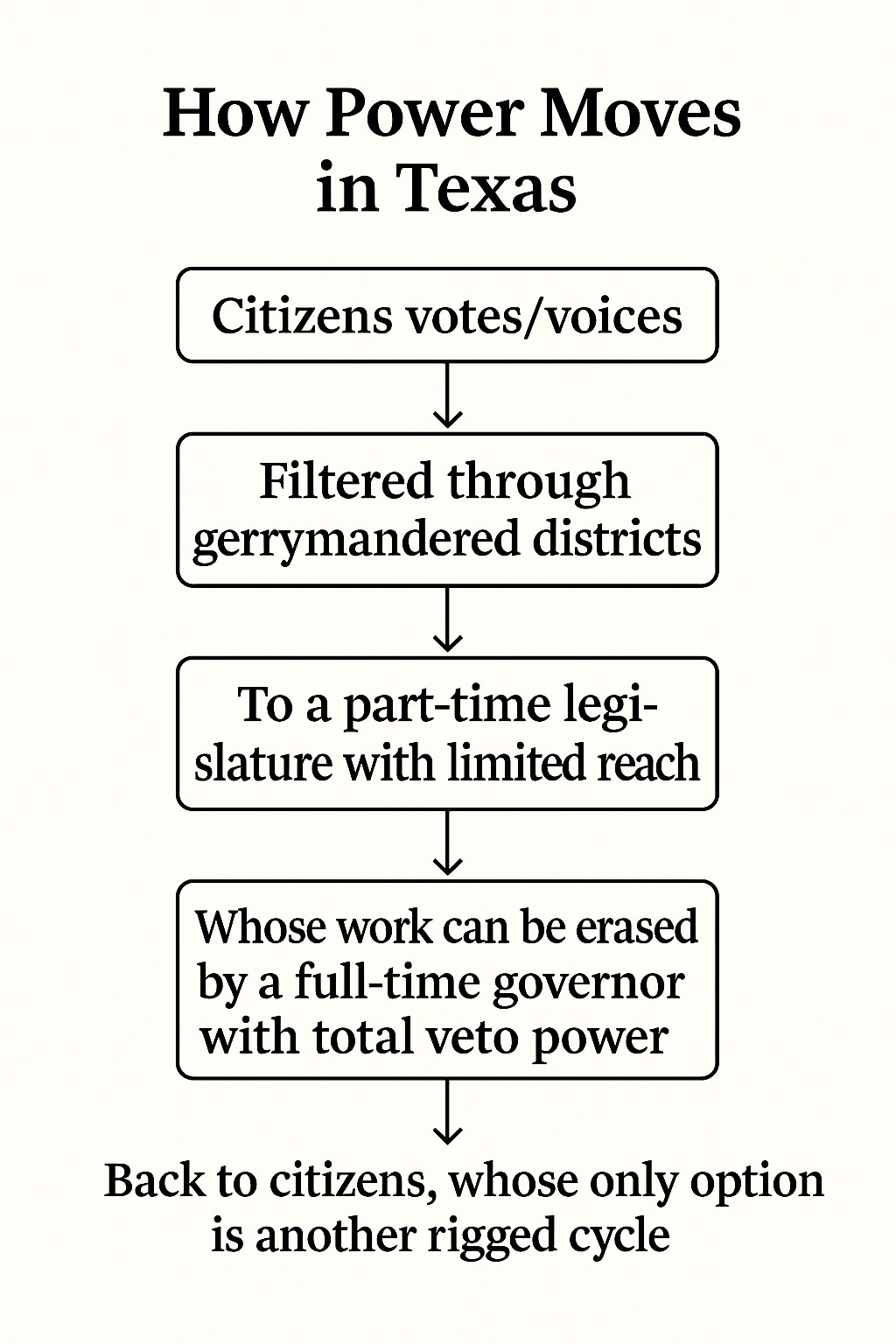
Texas’s Legislature meets once every two years, for just 140 days. That’s not a scheduling quirk. It’s a structural bottleneck. The governor holds the sole power to call special sessions, and even then, decides what lawmakers are allowed to discuss.
That would be dangerous on its own. But the real leverage lies in what happens after the session ends. Once legislators leave Austin, they can’t override a veto. There’s no mechanism for recall, no emergency override, no legislative check. The governor’s pen becomes the final word, even on bipartisan bills passed unanimously.
It shows. Texas has not successfully overridden a gubernatorial veto since 1979. Not once in over four decades.
This isn’t small government. It’s executive rule dressed in the language of liberty. It’s not theoretical. In 2023, Governor Greg Abbott issued 76 vetoes after the Legislature had adjourned. There’s no debate, no override, and no recourse. The Texas House and Senate have long enjoyed a GOP majority, yet Abbott has regularly punished those he finds disloyal by vetoing the legislation they have championed, even if it fits nicely within the party platform.
However, the irony runs deeper. Texas didn’t join the United States to embrace federal unity. It became a state in 1845 not out of ideological alignment, but out of desperation, seeking debt relief and military protection after its brief and shaky run as an independent republic. Even then, its leaders ensured that any future governance would protect the state’s power, not the people’s.
The Texas Constitution doesn’t just limit power; it hoards it. And it hands the key to the one person least accountable to the people between elections.
Rigged Maps: The Redistricting Preemption
If the Texas Constitution is the lock, redistricting is the deadbolt.
Every ten years, after the census, states redraw their political maps. In Texas, this isn’t a civic duty. It’s an arms race. The GOP-led Legislature used the 2021 redistricting cycle to engineer districts that squeezed Democratic votes into as few pockets as possible while padding Republican majorities across the board.
But even that wasn’t enough. In 2025, despite holding every statewide office and a growing share of the vote in some communities, Republicans launched another push to redraw the maps, just four years after the last overhaul.
Why? Because they see what’s coming.
Urban counties are experiencing a surge in new residents. Suburbs are shifting left. Latino and youth turnout is inching up. Transplants from blue states are bringing new political expectations. Demographic gravity is pulling Texas toward competitive elections, prompting the redrawing of maps to prevent this shift.
Mid-decade redistricting isn’t about representation. It’s about preservation. It’s a preemptive strike to secure power against a population they no longer trust to vote the "right" way.
And it’s legal. The Texas Constitution doesn’t prohibit redistricting more than once a decade, so long as the party in power controls the Legislature, they can redraw the lines as often as needed to stay ahead of the electorate.
This isn’t democracy adjusting to change. It’s leadership redrawing the rules to avoid it.
The Extraction Metaphor: Citizens as Land, Labor as Oil
Texas doesn’t just extract oil from its soil. It extracts labor, power, and obedience from its people. And like any extraction economy, it offers little in return once the resource has been tapped.
Start with the basics: nearly one in five children in Texas lives in poverty. That is over 1.3 million kids, more than the population of Dallas. The overall poverty rate remains stubbornly high at 14%, above the national average. Yet the minimum wage hasn’t moved in more than fourteen years. It sits frozen at $7.25 an hour, a number that hasn’t kept pace with inflation, housing costs, or dignity.
Healthcare outcomes are even worse. Texas leads the nation in uninsured residents. Roughly 22% of adults lack health coverage, and nearly 12% of children (close to a million) go without it, even as the state leaves billions in federal Medicaid funds for expansion on the table. Hospitals in rural counties are shuttering. Parents drive hours for pediatric care. Emergencies become catastrophes.
Education, too, reflects the imbalance. Texas ranks 43rd in overall child well-being, including economic stability, access to education, and health indicators. In rural districts, teacher shortages stretch schools to the brink. Infrastructure crumbles. Students are left behind — not as a failure of effort, but by design.
And yet, the economy grows. Corporations relocate. GDP soars. Texas is rich, but only for some. The state’s vaunted “no income tax” status masks a more insidious truth. Funding comes instead from regressive sales and property taxes, hitting working families hardest while allowing the wealthy to glide untouched.
The system extracts. It drills communities for labor. It taxes consumption and calls it freedom. It suppresses votes and calls it fairness. And when it's done draining a district, it redraws the map to make sure the voices left behind don’t count next time.
This isn’t democracy in decline. It’s democracy in retreat, a state run not for its people, but off of them.
You work the system, but it owns the harvest.
The Rural/Suburban Divide: Feudalism by Another Name
Texas sells itself as a land of freedom, but it governs more like a patchwork of feudal estates, with a single power center in Austin and a vast, divided landscape beneath it.
Suburbs are swelling with new voters, new wealth, and new political attitudes. Many of them are shifting left or at least demanding policies that the current regime won’t touch. Meanwhile, rural Texas remains locked in a cycle of underinvestment and decline, with fewer doctors, fewer schools, and fewer job opportunities. In many rural counties, there is no primary care provider or local hospital. In some, there is also no broadband.
What both regions share is a lack of power.
Local governments can pass ordinances on policing, housing, climate, and labor, but if they run afoul of the governor’s priorities, they’ll be blocked. Texas has some of the most aggressive preemption laws in the country. The state routinely intervenes to overturn city policies it dislikes. In 2023, a sweeping “Death Star” law tried to gut municipal authority altogether, banning cities from regulating entire categories of business.
This isn’t small government. It’s targeted authoritarianism.
The result is a state where both suburbs and rural communities are governed not by the people who live there, but by the executive in Austin, one who may not even let their representatives legislate for more than 140 days every two years.
It’s not a commonwealth of equals. It’s a network of fiefs ruled from above, modern feudalism wrapped in the language of liberty.
The Wealth Gap: Designed, Not Accidental
Texas is often held up as a pro-business paradise. It has no income tax, low regulation, cheap land, and cheaper labor. But the wealth it generates doesn’t circulate. It concentrates.
The rich in Texas don’t just benefit from economic policy; they shape it. Corporate lobbyists have front-row access in Austin. Political action committees tied to energy giants, real estate developers, and private equity firms funnel millions into campaigns. And once in office, lawmakers return the favor with subsidies, tax abatements, and deregulation that keep the machine humming for the few at the top.
See our recent reporting here:

Meanwhile, the same system imposes burdens on everyone else. Without an income tax, the state relies heavily on regressive sales taxes, property taxes, and fees. These hit working families the hardest, especially in low-income and rural areas where wages are stagnant and services are thin.
Add in the refusal to expand Medicaid, the chronic underfunding of public schools, and the political hostility to labor protections, and the result is clear: Inequality in Texas isn’t just an outcome. It’s an operating principle. Rugged individualism? Or sharecropper mentality?
The system is designed to preserve wealth at the top and extract compliance from the bottom, ensuring those at the bottom never get close enough to change it.
This isn’t an accident of policy. It’s the point of the structure.
What Reform Would Look Like (and Why It’s Blocked)
Fixing Texas isn’t hard. Structurally, it would take only a handful of changes to restore basic balance to governance:
Hold legislative sessions annually, not every other year.
Give the Legislature the power to override a veto even after adjournment.
Allow legislators to call themselves into special session in extraordinary cases.
Create an independent redistricting commission to draw fair maps.
Reinforce local control, preventing the state from overturning city policies on labor, housing, or climate.
None of these reforms are radical. Most are standard in functioning democracies. Some have even been proposed by bipartisan coalitions within the Texas Legislature. In 2023, lawmakers floated a fix, a constitutional amendment that would allow the Legislature to reconvene and override vetoes after adjournment. It didn’t make it out of committee. But in 2025, they tried again. Senate Joint Resolution 39 passed unanimously, clearing both chambers with the required two-thirds majority.
As Senator Brian Birdwell, the Republican author of SJR 39, put it: “My intent here is to restore the checks and balances of Texas government, and legislation that was passed by an overwhelming majority such as two‑thirds reflects the importance of that issue to the constituents of the state.”
Even his Democratic co-author, Senator Sarah Eckhardt, saw the stakes not as partisan but systemic. Referring to Governor Abbott’s 2023 veto spree, she warned: “The massacre of bills was so broad, and it was all about retribution … I don’t believe that’s what the framers of the Texas Constitution intended.”
We recently reported on another rising voice here:

Because constitutional amendments in Texas don’t require the governor’s signature, SJR 39 is now scheduled to appear on the November 2025 ballot. For the first time in over four decades, Texans may get a chance to close the veto loophole that has turned their Legislature into a 140-day suggestion box. However, this depends on voters knowing and understanding what they are voting for, having access to the ballot box, and being willing to participate.
In Texas, power doesn’t just resist reform. It makes reform nearly impossible without public intervention.
The Well Is Running Dry
Texas has been sold as a model of freedom — low taxes, light regulation, rugged individualism. However, beneath that myth is a system designed not to empower its people, but to extract from them. Power flows upward, not outward. Votes are reshaped, not respected. Labor is drained, not rewarded. Communities are governed not by themselves, but by a distant executive with a veto pen and a short temper.
This is not democracy. It’s extraction — political, economic, and constitutional.
And like all extraction economies, it has a limit. You can only drill so deep. You can only silence for so long. You can only redraw the lines so many times before the people you govern stop recognizing the system as theirs.
The 2025 override amendment is a crack in the structure, a small, long-overdue opportunity to shift power back toward the people. But it’s just one step. The deeper problem remains. Texas has built a political machine that treats its citizens like a resource, not a constituency.
You can’t build a future on that. You can only burn what’s left until there’s nothing to pull from the ground.
The Power Texans Still Hold
Texas didn’t become an extraction state overnight, and it won’t reform itself without pressure.
This November, Texans have a rare chance to push back. SJR 39, the constitutional amendment to let the Legislature override a governor’s veto after session, will be on the ballot. It won’t fix everything, but it could end decades of unchecked executive power.
That means:
Talk to your neighbors. This amendment won’t come with flashy campaigns. You must explain what’s at stake.
Support grassroots organizers who are tracking this, educating voters, and fighting daily for structural reform.
Show up in November. Turnout for constitutional amendments is historically low. That’s what those in power count on.
If they can redraw the maps to rig the future, you can redraw the story they think they control.
You still have power. Use it.
Stay Informed. Stay Loud.
Subscribe to The Coffman Chronicle for no-BS political analysis, action guides, and daily truth bombs you won’t get from corporate media.
Bibliography:
“Capitol Update (1‑30‑25).” Brian Birdwell Texas State Senator Dist. 22, February 14, 2025.
“Give Texas Voters a Chance to Plug Gubernatorial Loophole for Evading Veto Overrides.” San Antonio Express‑News, May 6, 2025.
“Greg Abbott Went on a Veto Spree Last Session. Now Lawmakers Are Trying to Rein Him In.” Houston Chronicle, April 30, 2025.
“2024 Texas Kids Count National Data Book: Texas Still Fails Its Children.” Every Texan, June 12, 2024.
“Texas Has the Highest Rate of Uninsured Children, and It’s Getting Worse.” Public Health Watch, March 16, 2025.
“SJR 39 – Proposing a Constitutional Amendment to Allow the Legislature to Override a Veto of the Governor Following a Regular Session.” Texas Policy Research, accessed July 2025.
Texas Constitution. The Constitution of the State of Texas, 1876. Accessed July 30, 2025.
Texas Constitution, Article III, Section 40. The Constitution of the State of Texas (1876). Accessed July 30, 2025.
Texas Constitution, Article IV, Section 14. The Constitution of the State of Texas (1876). Accessed July 30, 2025.

Greg Abbott needs to be Prosecuted & thrown in a Dungeon! Where the Light of Day never Shines. Might i add Castrate the no good SOB!
Texas is ruled by a Republican troika that runs rough-shod over the state. A Democrat hasn't won a statewide office since 1994. When I was younger, the roles were reversed; in our small town, there might've been two or three Republican "families" and elected Republicans were rare as hen's teeth in any office. It was as much of a one-party state then as It is now. Of course, the switching began with Reagan's election and by the time Barak Obama came along, the changeover was pretty much complete. It's a damned shame that our beautiful state is controlled by such unlikable and corrupt people and certainly the lack of perception demonstrated by Texas voters is directly linked to the dearth of critical thinking skills in the general population. Ask me how I know...well, I taught public school for 17 years, trying to change that dynamic.
"Farewell and adieu to you fair Spanish ladies...farewell and adieu you ladies of Spain..."