


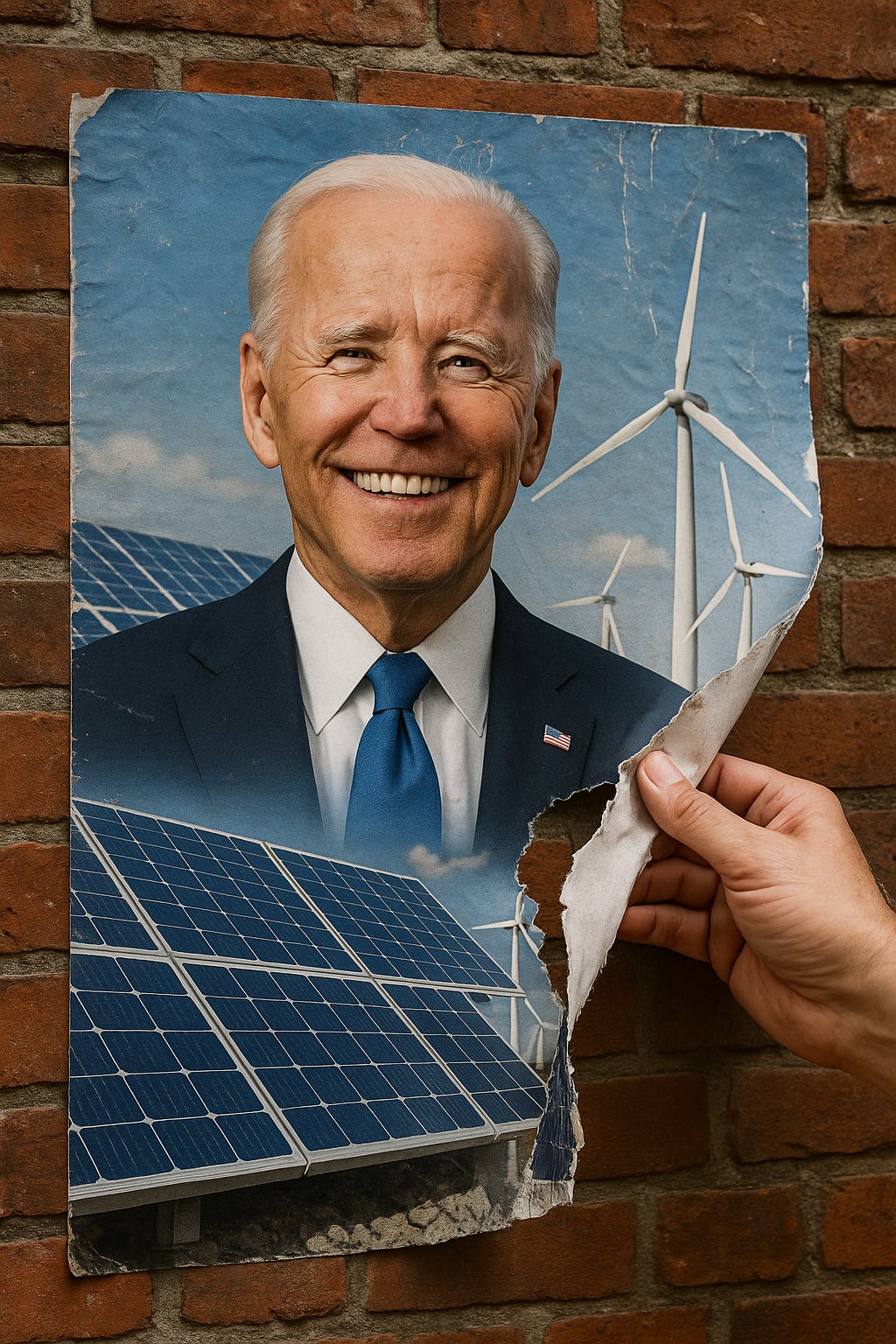
Eight billion dollars. That’s how much the Trump administration just yanked away from communities counting on clean-energy projects to bring jobs, lower bills, and modernize their infrastructure. In a single move, more than 220 projects across 16 states were canceled, from hydrogen hubs in California and Washington to solar buildouts in Pennsylvania and efficiency upgrades in the Midwest.
The White House refers to it as “fiscal discipline.” But strip away the talking points, and it looks like something else entirely: political payback. Many of the hardest-hit states are the same ones that voted against Trump in the 2024 election. These weren’t vanity projects or “green experiments.” They were shovel-ready investments that would have put tens of thousands of people to work and pumped billions into local economies.
And here’s the kicker: most of these programs weren’t Trump’s to begin with. They came from Biden’s biggest climate and infrastructure wins — the Inflation Reduction Act and the Bipartisan Infrastructure Act — which had already started delivering federal money to states and cities. By killing them, Trump isn’t just cutting costs. He’s erasing Biden’s legacy, and with it, the paychecks and opportunities families were counting on.
We just hit 20,000 subscribers, 1,000 articles, and 1,000 podcast episodes. To celebrate, paid subscriptions are 20% off for two weeks only. That’s just $64/year—less than $1.25 a week.
The Cuts in Brief
The Department of Energy confirmed what the headlines hinted: this wasn’t a trim around the edges. It was a wholesale cancellation. In one announcement, DOE terminated $7.56 billion in federal awards across 223 projects in 16 states. That’s 321 separate agreements — gone.
The cuts struck right at the heart of Biden’s clean-energy agenda. Programs designed to modernize the grid, build hydrogen hubs, scale up solar energy, expand energy efficiency, and accelerate carbon capture were all thrown into limbo. These weren’t just research grants. They were federal investments that had already been negotiated, announced, and in some cases were entering early stages of construction or contracting.
A few examples show the scale:
California lost $1.2 billion due to the cancellation of the ARCHES hydrogen hub, as well as major grid modernization efforts.
Washington State saw about $1.0–$1.1 billion vanish, tied to the Pacific Northwest hydrogen hub.
Minnesota was stripped of more than $400 million in renewable and clean-tech awards.
Pennsylvania lost solar and grid projects that were supposed to boost its struggling industrial corridor.
Michigan had battery manufacturing and EV-related supply-chain projects pulled back, leaving factories idled before they ever opened.
Illinois was hit with canceled energy-efficiency upgrades in schools and public housing, denying families lower energy bills.
In all, the administration’s rollback disproportionately hit Democratic-leaning and battleground states, while some Republican-leaning states with similar awards appear to have been spared. The official line is that these projects “did not align with national priorities” or “show sufficient economic returns.” But the map of where the ax fell tells a story about power, not economics.
What’s on the Chopping Block
Total Cuts:
$7.56B in funding canceled
223 projects across 16 states
321 awards terminated
Economic Impact:
Jobs lost: ~60,000–75,000 job-years
GDP foregone: ≈ $11.3B in economic activity
State Examples:
California – $1.2B hydrogen hub + grid modernization projects
Washington – ~$1.0–$1.1B, Pacific Northwest hydrogen hub
Minnesota – $400M+ in renewables & clean-tech awards
Pennsylvania – solar and grid modernization projects
Michigan – EV battery and supply-chain projects canceled
Illinois – energy-efficiency retrofits scrapped
Who Gets Hit Most:
Many Democratic-leaning and swing states
Some Republican-leaning states were spared despite similar awards
Sources: DOE; Reuters; Washington Post; Politico
Who Gets Hurt
Numbers on a spreadsheet don’t tell the whole story. When Washington cancels $7.56 billion in projects, it doesn’t just zero out a budget line. It zeroes out people’s paychecks. It halts construction in mid-stride, puts contractors on hold, and tells local suppliers and workers the promise they were counting on just evaporated.
By conservative estimates, these canceled projects would have supported 60,000 to 75,000 job-years. That’s electricians, welders, engineers, truck drivers, and factory workers who will no longer be called up. Each of those jobs would have rippled outward: to diners feeding crews, landlords renting apartments, and mom-and-pop shops supplying materials. That’s how public investment works — it multiplies. Instead, the multiplier here is negative.
The GDP hit is just as stark. Economists calculate that every dollar spent on clean-energy infrastructure generates roughly $1.50 in economic activity. By killing $7.56 billion in spending, the administration isn’t saving money; it’s denying communities an estimated $11.3 billion in growth. That’s money that won’t cycle through local banks, state tax revenues, or family budgets.
And then there’s the household level — the part politicians rarely talk about but voters always feel. Grid modernization projects in Pennsylvania were intended to reduce blackouts and lower utility bills. The hydrogen hub in California aimed to create an industrial backbone for clean fuel jobs. EV supply-chain projects in Michigan would have anchored new factories in struggling towns. Efficiency retrofits in Illinois would have meant lower heating and cooling costs for working families.
Instead, communities get higher bills, fewer paychecks, and a message from Washington that their futures are expendable.
The Politics of Retaliation
But after the damage was tallied, the White House insisted these cuts were about “fiscal discipline” and “economic viability.” The problem is, the map of what got canceled tells a different story. The bulk of the losses fall in Democratic-leaning and battleground states — California, Washington, Minnesota, Pennsylvania, Michigan, Illinois — while some red states with similar clean-energy projects appear untouched.
That’s not an accident. It’s politics, pure and simple.
Trump has never hidden his disdain for Biden’s Inflation Reduction Act or the infrastructure spending that followed. On the campaign trail, he referred to them as “Green New Scam” programs. In office, his budget team has rebranded them as “wasteful spending” ripe for clawbacks. And now, in practice, they’re targeting the very communities that benefited most from Biden’s clean-energy push.
This is more than just budget trimming. It’s a strategy of retaliation. By cutting funding in blue states, Trump gets to claim he’s saving taxpayer money while simultaneously punishing his political opponents. It plays to his base, stokes resentment, and weakens the economies of states that didn’t vote for him.
The administration’s justification — that these projects lacked “return on investment” — falls apart under scrutiny. Independent assessments revealed that hydrogen hubs, grid upgrades, and solar expansions would have generated robust job pipelines and long-term energy savings. Yet those projects were axed, while others in Trump-friendly states sailed on.
This is the pattern: reward your allies, starve your rivals. We’ve seen it before in Trump’s threats to withhold disaster relief from Democratic governors, and in his use of tariffs as a political weapon. The $8 billion climate rollback isn’t just an energy story. It’s the weaponization of federal spending for partisan gain.
Erasing Biden’s Legacy
Make no mistake: this isn’t about saving money. It’s about erasing Joe Biden.
The Inflation Reduction Act and the Bipartisan Infrastructure Act were Biden’s crown jewels — the biggest climate and energy investments in U.S. history. They were already reshaping America’s industrial base, pulling billions into clean-tech manufacturing, and proving that climate action could mean jobs in every state. That was Biden’s promise: show voters that going green meant going prosperous.
Trump is determined to ensure that promise never comes to fruition. By canceling billions in awards tied to those laws, he’s not just cutting projects — he’s cutting out the political proof that Biden’s agenda worked. If the jobs never arrive, if the factories never open, if the bills never go down, then Biden’s legacy fades into what Trump can mock as “another liberal fantasy.” That’s the point.
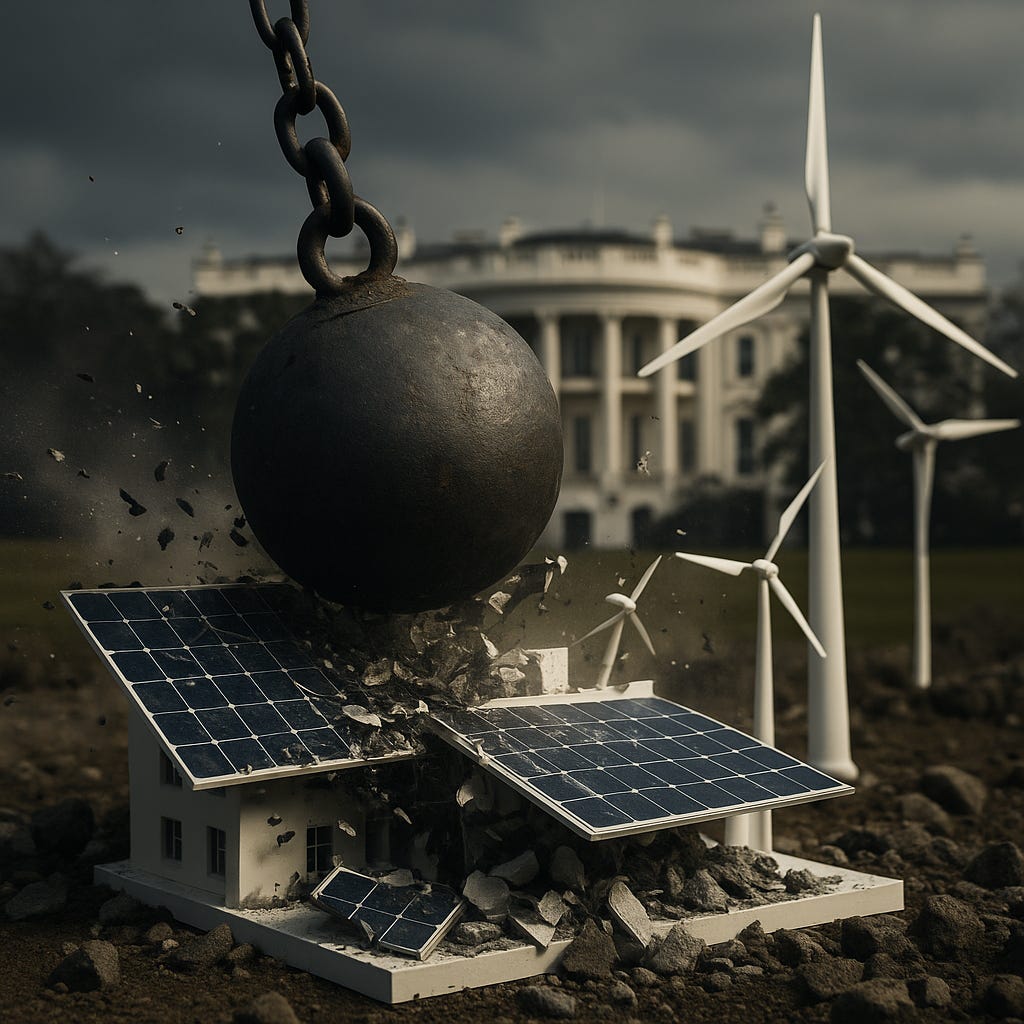
We’ve seen this playbook before. When Ronald Reagan took office, one of his first moves was to gut Jimmy Carter’s renewable energy programs. Carter had installed solar panels on the White House roof as a symbol of America’s energy future. Reagan had them ripped down and stored away, as if to say: this history never happened. The result? America lost decades in renewable energy development, ceding ground to Europe and Asia.
Trump is running the same demolition project. The difference is scale. Instead of a few solar panels, it’s $8 billion in clean-energy hubs, efficiency upgrades, and grid modernization. Instead of symbolic erasure, it’s economic sabotage — tens of thousands of paychecks wiped out and billions in community growth stripped away.
And it won’t stop here. Climate is just the opening target. Health care, infrastructure, and even semiconductor manufacturing are already in the crosshairs. The pattern is unmistakable: dismantle Biden’s wins, no matter how many families or communities get caught in the wreckage.
This isn’t fiscal policy. It’s legacy warfare.
Closing / Call to Action
The White House will sell these cuts as tough choices, but don’t be fooled: Washington didn’t save money. It stole opportunity. Jobs that would have built communities are gone. Billions in growth that would have lifted families are erased.
This isn’t fiscal prudence. It’s sabotage. It’s the deliberate dismantling of progress, carried out not for the country’s good, but to score points in a partisan war.
And here’s the danger: once investments like these are killed, they don’t come back quickly. Communities lose years. Innovation stalls. Whole regions fall behind. The United States has lived through this before — and we’re still paying the price.
So don’t let this story vanish under the spin cycle. Share it. Talk about it at the dinner table, at the job site, on the picket line. Contact your representatives and urge them to advocate for the projects your community was promised.
Because the truth is simple: these aren’t just cuts. They’re stolen futures. Don’t let them erase ours.
Stay Informed. Stay Loud.
Subscribe to The Coffman Chronicle for no-BS political analysis, action guides, and daily truth bombs you won’t get from corporate media.
Bibliography:
“Energy Department Announces Termination of 223 Projects, Saving Over $7.5 Billion.” The Department of Energy’s Energy.gov, October 2, 2025.
“DOE cancels $7.6B in clean energy awards in states that voted against Trump.” Utility Dive, October 2, 2025.
“DOE funding cuts hit 223 blue state energy projects.” E&E News by POLITICO, October 2, 2025.
“Trump officials cancel $7.6 billion in clean energy projects.” The Washington Post, October 2, 2025.
“Trump administration cuts nearly $8 billion in clean energy projects in states that backed Harris.” AP News, October 2, 2025.
“Damage from Trump’s $8B energy hit list would spill into GOP districts.” Politico, October 2, 2025.
“Department of Energy cancels more than $608 million for Colorado projects.” Colorado Public Radio, October 2, 2025.
“Trump administration cuts nearly $8B in clean energy projects in states that backed Harris, including Mass.” WBUR, October 3, 2025.
“Trump admin targets blue-state grants meant to ease US electricity woes.” Canary Media, October 2025.
I have never understood the logic in blocking non-fossil fuel energy when the "clean green" energy sources can be just as financially beneficial to work forces. Of course, those who own, for example, oil companies are trying their damnedest to outlaw clean energy, but that's still illogical. The could make just as much money from solar, wind, and even updated hydraulic systems.
Like everything else this current administration has done, this illegal cancellation of already-congressionally-approved funding represents attempts to turn the USA into a third-world country.