


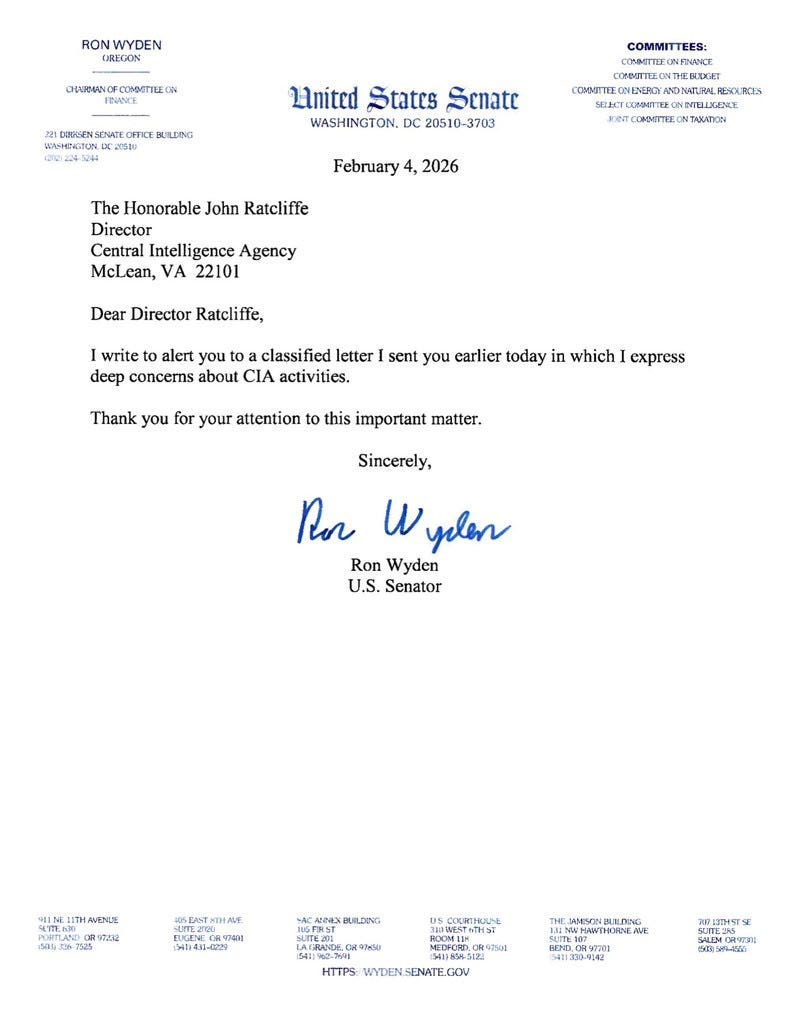
On February 4, 2026, Senator Ron Wyden took an unusual step. He released a public statement confirming that earlier that day, he had sent a classified letter to CIA Director John Ratcliffe. In the statement, Wyden said only that the letter “expresses deep concerns about CIA activities.” He offered no further elaboration. By law, he couldn’t.
In the highly restricted world of intelligence oversight, this kind of move is rare. The existence of classified communications between Congress and an intelligence agency is typically secret. Publicly confirming that a classified warning has been issued is not only out of the ordinary but also a signal. Notably, from Wyden, it means something is wrong.
His language was careful, his statement short, but the implications were enormous. If a sitting member of the Senate Intelligence Committee is going out of his way to tell the public that he just warned the CIA about something serious, and if he’s using the term “deep concerns” to describe it, then the problem isn’t theoretical. It’s already in motion.
Wyden’s public alert is startling on its own. However, it did not arrive in isolation.
This Community Is Powered by You
What started as a small circle has grown into something much bigger, and it’s all because of readers like you.
Every time you forward this email, post it on socials, or bring someone new into the fold, you’re helping build one of the most passionate, independent political communities out there.
Want to keep the momentum going?
Share this newsletter with someone who should be part of this conversation.
Thank you for being here. It means everything.
A Parallel Breakdown
Around the same time Wyden’s letter became public, a second story — quieter but no less significant — began to gain traction inside Congress. A classified whistleblower complaint, reportedly filed in May 2025, had only just reached lawmakers in February 2026. The complaint, according to multiple sources, alleged misconduct within the Office of the Director of National Intelligence, possibly including criminal activity, and implicated the leadership of the DNI itself.
The director in question is Tulsi Gabbard, appointed by President Trump at the start of his second term. Her office has confirmed that the complaint exists but denies wrongdoing. Yet the timeline speaks for itself. Under the Intelligence Community Whistleblower Protection Act, once a complaint is deemed both urgent and credible by the Intelligence Community Inspector General, it must be forwarded to the congressional intelligence committees within seven days. In this case, it took more than eight months.
See some of our reporting here:


That delay alone raises serious legal and ethical questions. Yet the story doesn’t stop at a missed deadline. It leads to the Inspector General's office and to the man who occupies it.
The Wyden Pattern
Senator Ron Wyden has served on the Senate Select Committee on Intelligence since 2001. Over the years, he has built a reputation not as a bomb-thrower, but as a deliberate, careful institutionalist. Importantly, he has emerged as the only one inside the system who seems willing to sound the alarm before it’s too late.
In 2006, Wyden began warning — without violating classification — that the NSA was interpreting surveillance law in ways the public would find shocking. Years later, Edward Snowden’s disclosures confirmed that the government had been collecting the phone records of millions of Americans in bulk. In 2013, Wyden famously asked DNI James Clapper during open testimony whether the NSA collected “any type of data at all on millions or hundreds of millions of Americans.” Clapper said no. The truth, as Wyden already knew, was yes.
He did the same with CIA torture programs, years before the Senate’s report was declassified. He raised red flags about secret interpretations of the Patriot Act, the abuse of FISA powers, and backdoor surveillance loopholes. Each time, his warnings were cryptic, cautious, and correct.
Now Wyden has done something he’s never done before. He hasn’t just hinted at a problem in open session. He hasn’t just submitted a classified letter. He has told the public that he sent one, and that its subject is the CIA.
This isn’t the start of a pattern. It’s the climax of one.
The Delayed Complaint
In contrast to Wyden’s consistent push for transparency, the system responsible for handling internal complaints appears to have done the opposite.
The whistleblower complaint that took eight months to reach Congress originated within the intelligence community and was reportedly related to actions or knowledge held within the Office of the Director of National Intelligence. Multiple sources familiar with the classified version of the complaint have said it includes allegations of criminal wrongdoing, or at a minimum, the failure to report potential crimes up the chain, as required by law.
It was filed in May 2025. Congress was informed in February 2026. We still do not know whether the Intelligence Community Inspector General determined it to be urgent and credible. If the IG did, then the law was broken when the complaint was not forwarded within the statutory seven-day period. If the IG did not, then he was required to notify the whistleblower within three days and inform them of their right to approach Congress directly through secure channels. That did not happen either, or if it did, the whistleblower evidently lacked confidence in the process.
Where the Oversight System Broke Step by Step
To understand how a classified whistleblower complaint about the Director of National Intelligence could sit unresolved for eight months, it’s necessary to understand who was responsible for oversight at each stage — and who wasn’t.
The Complaint Was Filed Into a Leadership Vacuum
The whistleblower complaint concerning the Office of the Director of National Intelligence was filed in May 2025. At that moment, there was no Senate‑confirmed Inspector General of the Intelligence Community in place.
The previous ICIG, Thomas Monheim, had left office in January 2025, just as President Trump’s second term began. His departure came amid a broader administration effort to remove or sideline inspectors general across the federal government, weakening independent oversight at precisely the moment it was most needed.
In the months that followed, the ICIG office was led by an acting inspector general, Tamara Johnson. Acting officials, by definition, lack Senate confirmation, job security, and institutional authority. They are more vulnerable to pressure from agency leadership and less able to force confrontations over classification or misconduct. This matters because the complaint concerned the head of the intelligence community itself.
In other words, when the whistleblower came forward, the system designed to protect them was already compromised.
Accusations of Interference Followed Quickly
As the whistleblower complaint remained bottled up inside the intelligence community, members of Congress independently began raising alarms about interference with the ICIG’s independence.
Reports and congressional criticism about Director of National Intelligence Tulsi Gabbard’s interference with the inspector general’s office date back to mid‑2025, notably around June 9, 2025. At that time, senior Democrats publicly accused Gabbard of undermining the ICIG’s independence by placing a close adviser inside the office and firing key personnel in that watchdog agency.
While Gabbard’s office denied wrongdoing, the timing is difficult to ignore. A whistleblower complaint involving the DNI was filed in May. The inspector general position was vacant. Oversight was being handled by an acting official, and lawmakers warned that the DNI was exerting pressure on the very office meant to check her power, even before they learned of the whistleblower report.
During this period, the complaint was neither forwarded to Congress nor, as far as public reporting shows, resolved internally.
A New Inspector General Arrives
It was not until October 2025 that Christopher Fox was confirmed by the Senate as the permanent Inspector General of the Intelligence Community.
Fox did not receive the complaint when it was filed. By the time he took office, the delay had already stretched for months. However, that does not absolve his office of responsibility. By the time Congress was finally notified in February 2026, Fox was the sitting ICIG, and the complaint was still classified, still unresolved publicly, and still surrounded by unanswered questions about process failures.
Fox’s background as a career intelligence lawyer and his long‑standing defense of expansive executive secrecy have only heightened concerns that the final stages of the delay were shaped by institutional loyalty rather than aggressive oversight.
What This Timeline Tells Us
This sequence matters because it shows that the failure was not a single bad decision, but a systemic collapse across time.
First, there was the resignation of an independent inspector general. This was followed by months of acting leadership with limited authority. Then, accusations emerged that the DNI interfered with oversight. Finally, there was the confirmation of a permanent ICIG aligned with executive secrecy, after the damage was already done.
At no point did the system function as the law intended.
If the complaint was deemed urgent and credible, Congress should have been notified within seven days. If it were not, the whistleblower should have been informed within three days of their right to approach Congress directly. Neither appears to have happened in a timely way.
That is not an oversight failure at the margins. It is a failure at every safeguard the system claims to have.
A Closed Ecosystem
Two separate events. Two different agencies. One week.
In isolation, either of these developments would be concerning. Together, they suggest something far more serious. Both stories involve classified warnings. Both involve delayed or suppressed information. Both involve internal systems that failed or were manipulated to prevent oversight. And both are happening inside the same structure: the federal intelligence apparatus.
We do not know whether Wyden’s concerns relate to the whistleblower complaint about Gabbard. There is no confirmed connection. However, we do know that both cases point to the same failing ecosystem, an intelligence system in which watchdogs are appointed by the very leaders they are supposed to oversee, a whistleblower process that can be blocked, rerouted, or quietly suffocated, and a Congress that has to learn — late — that something has gone wrong.
This is not oversight. This is insulation.
The Broader Context
These cases do not arise in a vacuum. Over the past year, we’ve reported on several stories pointing to a dangerous consolidation of intelligence power and a weakening of democratic safeguards.
Palantir, the surveillance and data analytics company with deep ties to law enforcement and intelligence, has expanded its footprint across federal agencies, including contracts with DHS, ICE, and the Department of Veterans Affairs. Its predictive modeling systems, once controversial even within the military, are now being deployed on domestic data streams.
See our previous reporting here:
Note: Articles move into our archive after 45 days. Consider becoming a paid subscriber for full access to our extensive archive.


At the same time, members of the press have been investigated, detained, or had their devices searched under vague national security justifications. These incidents are no longer isolated. They reflect a shifting threshold for what constitutes permissible scrutiny of journalists.
See our reporting here:
Note: Articles over 45 days roll into our archive. Become a paid subscriber for full access.


And in the case of DOGE — the Department of Government Efficiency — we’ve already documented how at least two operatives improperly accessed Social Security data, including location metadata, and shared it with third-party servers. The administration has since acknowledged that this access was unauthorized.
See our recent reporting here:

None of these stories, on their own, tells us what’s in Wyden’s letter or what the whistleblower alleged about the DNI. However, taken together, they create a context in which the public has every reason to be skeptical and concerned.
What We Know and What We Don’t
We do not know the contents of Wyden’s classified letter to the CIA.
We do not know the full substance of the whistleblower complaint about Tulsi Gabbard, or whether it directly implicates her.
We do not know why it was delayed, or whether laws were broken to keep it out of Congress’s hands.
However, we know that both of these warnings are real. We know that both emerged at the same time, in the same system, under an administration that has already moved to weaken oversight at every level. And we know they are both pointing to the same structure, a national intelligence ecosystem that appears to be consolidating its power behind walls even lawmakers can no longer penetrate.
This isn’t a conspiracy. It’s a pattern.
And when Ron Wyden breaks the silence, we should listen, not because of what we know, but because of what he already does.
Stay With the Story
If you found this reporting useful, subscribe to follow where it leads.
We investigate the systems behind the headlines, the power structures, the failures of oversight, and the signals the institutions don’t want you to notice.
This story isn’t over. Make sure you see what comes next.
Sources:
Wyden Expresses “Deep Concerns about CIA Activities” in Classified Letter (Sen. Wyden press release) — February 4, 2026
Wyden Expresses ‘Deep Concerns about CIA Activities’ in Classified Letter (KPIC) — February 4, 2026
Senator Ron Wyden Sends Chilling Letter to CIA (Charlotte Clymer analysis) — February 4, 2026
Intelligence watchdog shares whistleblower complaint involving Gabbard with Congress after monthslong delay (CBS News) — February 3, 2026
Congress Receives Redacted Version of Whistleblower Complaint Against Gabbard (Wall Street Journal) — February 4, 2026
Complaint accuses Gabbard of playing politics with intelligence, which spy agency rejects (Associated Press) — February 3, 2026
Attorney says Gabbard is holding up a complaint about her actions (Associated Press) — February 2, 2026
Tulsi Gabbard’s Whistleblower Complaint Stalls Inside Her Agency (The Daily Beast) — February 4, 2026
What Is Tulsi Gabbard Hiding? A Whistleblower Keeps Pushing a Secret Complaint Congress Hasn’t Seen (Times of India) — February 2, 2026
Intelligence Community Whistleblower Protection Act (ICWPA) Explanation (Wikipedia)
This IS IMPORTANT! I DON'T HAVE THE PULL TO DO MUCH🥴 But PLEASE someone rattle cages and get GABBARD OUTTA THERE ASAP
The ENTIRE Trump Administration must be REMOVED, IMPEACHED....