


Imagine this: you post a meme, a protest photo, or share a video critical of U.S. foreign policy. You’re a nurse on a visa. A graduate student. A professor. Months later, you apply to renew your visa, or you land back in the U.S. after visiting family abroad, and you’re stopped. Your phone is taken. You’re questioned. You’re told you can’t come back.
This isn’t a thought experiment. It’s real. And it’s happening right now, under President Trump’s administration.
Two incidents earlier this year made headlines — barely. A French scientist traveling to Houston for a conference was refused entry after U.S. agents found messages criticizing U.S. politics on his phone. A Lebanese American professor from Brown University was denied reentry after agents flagged photos from a religious funeral on her device. These weren’t security threats. These were speech-based exclusions.
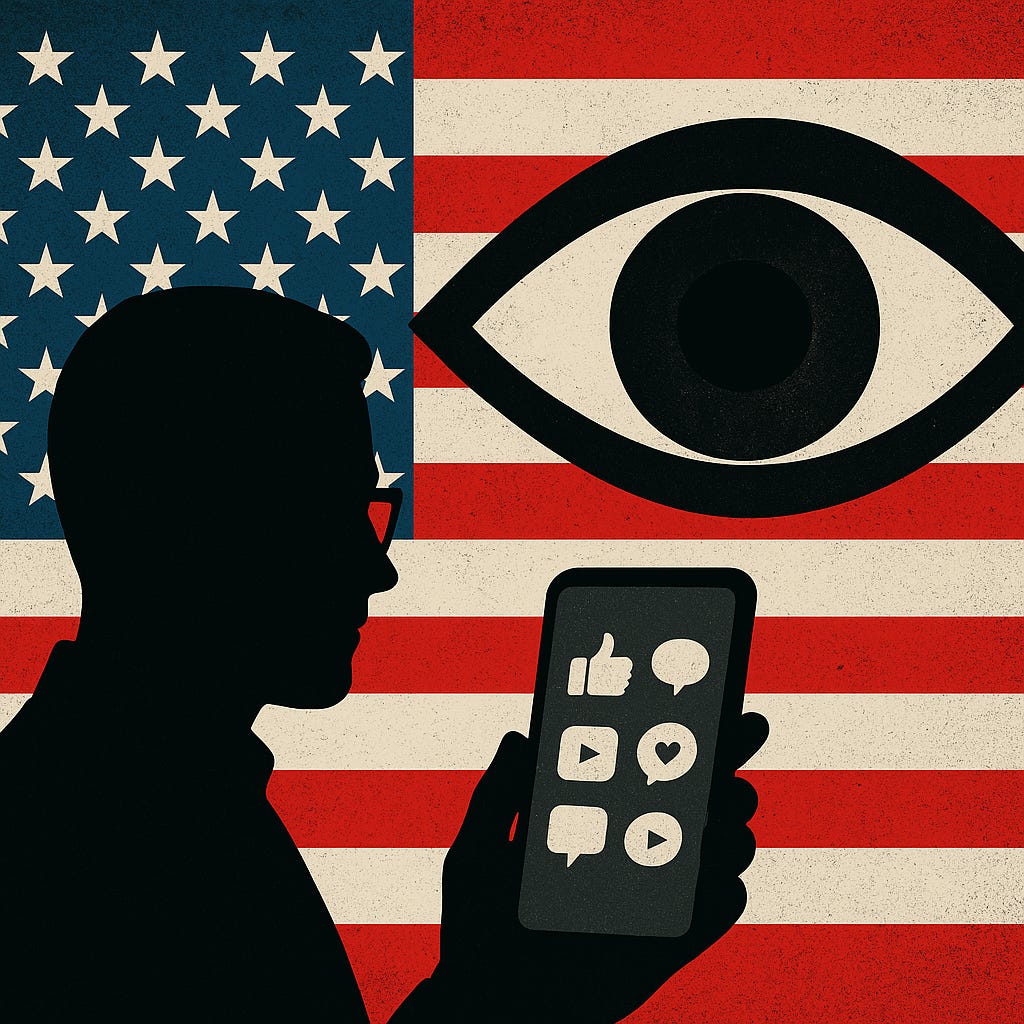
Now, a federal lawsuit says these weren’t isolated decisions, but part of a larger, secretive surveillance policy.
Because democracy doesn’t defend itself, and neither does your sanity. Subscribe here to keep your eyes open and your sarcasm sharp.
The unions that said “enough”
On October 16, three of the country’s largest labor unions — the United Auto Workers (UAW), the Communications Workers of America (CWA), and the American Federation of Teachers (AFT) — filed suit against the U.S. government. Their claim is that federal agencies are using AI-driven surveillance to monitor the social media activity of visa holders, green card applicants, and other lawful noncitizens.
Posts flagged for “hostile attitudes” or criticism of U.S. policy, especially toward Israel, are reportedly being used to deny visa renewals, block entry, or strip legal status.
According to the lawsuit, union members have begun censoring themselves online, deleting posts, avoiding political content, quitting activist groups, just to avoid being targeted.
This is more than a free speech issue. It’s an immigration rights issue, a labor rights issue, and a democratic issue.
Surveillance isn’t new. But this moment is different.
Until now, ideological screening happened mostly at the border — device searches, social media checks during customs. That’s how the French scientist and the Brown professor were stopped. But this lawsuit reveals something much broader: the shift from manual, case-by-case discretion to a systematic, AI-powered program of political surveillance.
And it’s happening under a Trump administration that has already made loyalty a litmus test, not just for who gets to govern, but for who gets to stay.
This isn’t the leftover policy of a post-9/11 era. This is present-day, active Trump policy. This is what authoritarian creep looks like when it’s wearing the suit of immigration enforcement.
The Patriot Act never left
If you’re wondering how any of this is legal, you’re not alone. The short answer: the Patriot Act.
Passed just weeks after 9/11, the law gave the U.S. government sweeping powers to surveil, detain, and exclude people based not on what they’ve done, but on what they believe. It enabled warrantless surveillance, ideological screening, and secret courts. And although parts of it were allowed to expire, its core principles have been folded into other laws and policies that remain fully operational.
What this new lawsuit shows is that the same logic — suspicion is enough, speech is evidence, and safety justifies anything — is now being applied with machine speed and algorithmic reach.
And once we’ve accepted it for immigrants, the next target isn’t hard to predict.
“They don’t have rights” — but that’s not quite true
The government’s defense is predictable: visa holders aren’t citizens, and immigration is discretionary. It’s a claim courts have often supported, but not without limits.
While it’s true that noncitizens have fewer constitutional protections, courts have long held that those already inside the U.S. — including workers, students, and green card applicants — do have First Amendment protections, especially when it comes to peaceful political expression.
In other words: the government cannot condition your right to stay on your willingness to stay silent.
This lawsuit isn’t just trying to stop surveillance. It’s trying to reassert that the Constitution still means something, even for those who weren’t born here.
Letting this slide opens the door to your feed being next
Here’s the part we can’t pretend isn’t coming: if this becomes normalized, if we let the government sort people by politics, exclude them by algorithm, and punish them for posts, it won’t stop with noncitizens.
Your citizenship won’t protect you if the infrastructure is already built. It didn’t protect whistleblowers. It didn’t protect journalists. It won’t protect you.
This is how authoritarianism advances in a democracy: not with tanks, but with terms of service, not with bans, but with denial notices.
What the unions are doing now may not win in court — at least not yet, but they’re drawing a line. They’re saying: speech is not a crime. Dissent is not disloyalty. And democracy doesn’t mean much if you’re afraid to speak.
Don’t let the bastards sneak anything past you. Subscribe and get your daily dose of rage and receipts delivered fresh, before the spin doctors can scrub it.
Sources:
“Labor unions sue U.S. over monitoring social media of visa holders” — Reuters
“Trump Admin Sued Over Social Media ‘Surveillance’ of Visa Holders” — Newsweek
“Labor unions, EFF sue Trump administration to stop ideological surveillance of free speech online” — Electronic Frontier Foundation (EFF) Press Release
“Unions sue Trump over surveillance and allege First Amendment breach” — Axios
“Unions are trying to stop Trump from kicking out immigrants over social media posts” — The Verge
“US revokes six foreigners’ visas over social media comments criticizing Charlie Kirk” — The Guardian

ANY LAW AGAINST OUR CONSTITUTION IS "NULL AND VOID" ACCORDING TO OUR CONSTITUTION!
Excellent commentary.
Spell it out. 👺👹🎃
The 👻 ghost in the machine