


In early 2025, when the Trump administration began dismantling the U.S. Agency for International Development (USAID), it should have been a national turning point. For decades, USAID had symbolized America’s global conscience. It provided famine relief, life-saving medication, maternal healthcare, and support for democracy in fragile states. It was not controversial. It was not expensive. It was simply American.
Or at least, it used to be.
The administration’s move to fold USAID into a defanged arm of the State Department, under Executive Order 14204, was not a restructuring. It was a targeted euthanization. Field offices were closed. Grant programs were frozen. Staff were reassigned, silenced, or laid off. Humanitarian operations came to a halt not because of failure, but because they no longer aligned with the administration’s vision of what America should stand for.
The public response was fiery and intense at first. Some protests emerged. A few headlines captured the scale of the policy shift. Yet the sustained moral outrage that might have followed such a decision in another era never came. The country moved on. The administration took note.
Want to Know Your Rights?
Download a free digital copy of the U.S. Constitution, the same document Trump is trying to bulldoze. Learn exactly what he’s breaking, and how to fight back.
100,000+ strong — and counting.
This winter of our discontent, become a paid subscriber for just $1 a week and help us keep the truth alive.
Join The Coffman Chronicle — $1/Week
What Happens When You Stop Helping Strangers
The dismantling of USAID was not just about foreign aid. It was about dismantling the idea that Americans have a role in helping people they do not know. Once that principle was successfully weakened abroad, it became easier to challenge it at home.
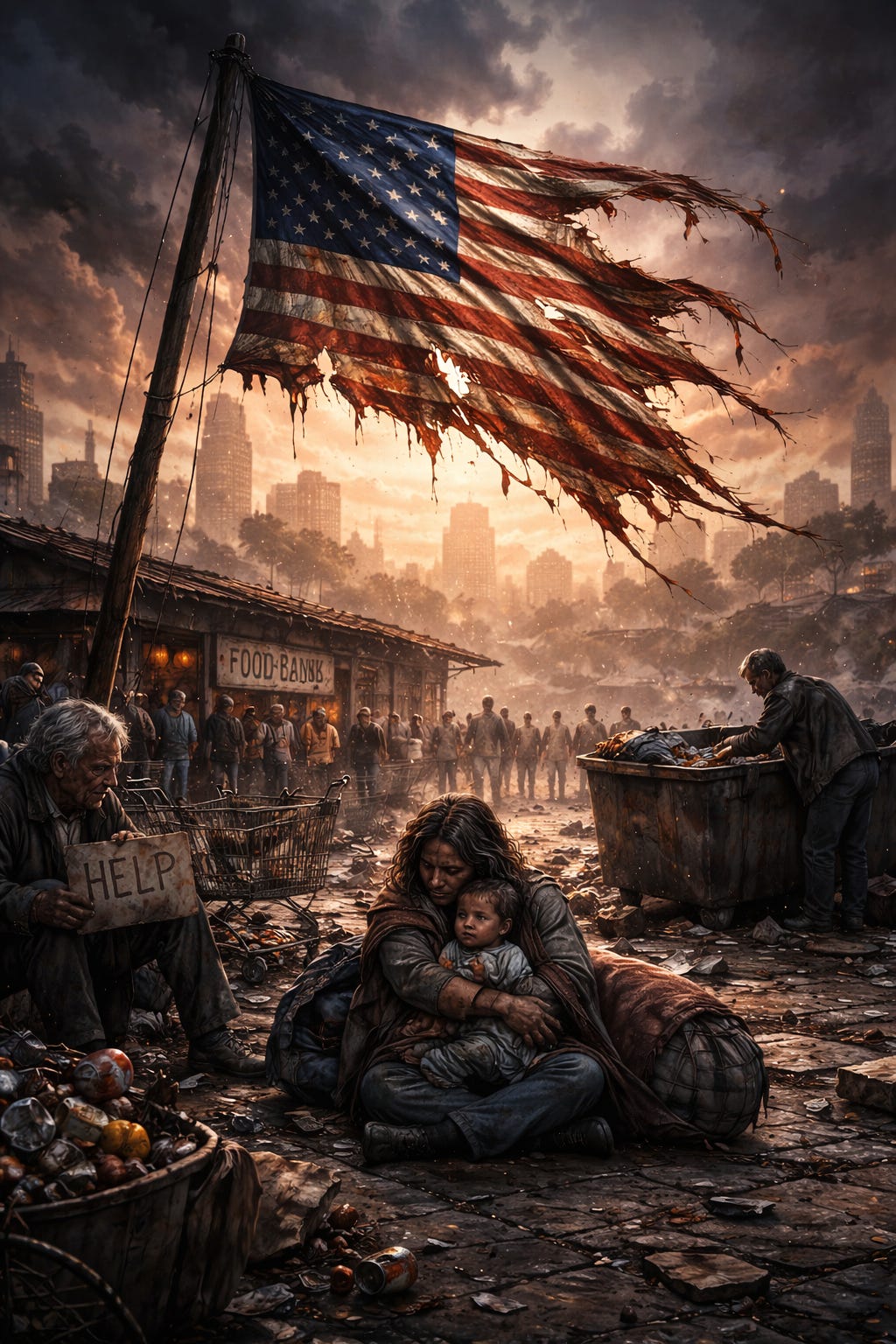
Today, the United States is no longer debating how best to deliver aid. We are debating whether people deserve help at all. Cuts to the Supplemental Nutrition Assistance Program (SNAP) have already taken effect in multiple states and were included in the One Big Beautiful Bill. Federal Medicaid work requirements, long proven to be punitive and ineffective, have been reimposed. Subsidies under the Affordable Care Act were allowed to expire, hitting rural and working-class communities especially hard. Emergency response capacity under FEMA has been curtailed without formal announcements, replaced by rhetoric encouraging “self-reliance.”
See our reporting here:
Note: Articles roll into our archive over time. Become a paid subscriber for full access and exclusive perks.


What began as a rejection of international obligation has turned into a rejection of national responsibility. It is now common to hear policymakers and pundits suggest that poverty, illness, or disaster relief should be conditional on merit, work history, or political loyalty. The social contract has not been amended. It has been torn up.
The New Ethic: Deservedness Over Dignity
We are witnessing the rise of a new moral framework in American politics. Under this model, dignity is no longer presumed. It must be earned. Need is no longer a reason to help, but a reason to ask what someone did wrong.
The logic is chillingly consistent. If you need insulin but can’t afford it, you should have chosen a better job. If you lost your home in a flood, you should have moved to another place. If you need food assistance, you should have made different choices. It is a worldview that converts every misfortune into a moral failure and every public good into a private luxury.
This framework did not appear overnight. It was cultivated through years of rhetoric that framed compassion as weakness and dependency as vice. However, it has been supercharged by an administration that openly equates empathy with treason and public service with waste. What was once dog whistle politics is now official policy.
From First Responder to Abandonment
USAID was not just a foreign aid agency. It was a symbol of America’s self-image, one that said we had something to offer the world beyond our military. Its collapse represents a rejection of that image.
What has followed is not just the withdrawal of aid. It is a normalization of neglect. As we reported in “It Started with a Map”, the authoritarian arc does not always begin with tanks in the street. Instead, it begins with silence, subtle erasures, and the quiet redefinition of who deserves help. Today, that redefinition is complete.
The same logic that shuttered health clinics in Ethiopia is now closing food programs in Kentucky. The same strategy that justified ending maternal health programs in Honduras is now being used to deny prenatal care to uninsured women in Mississippi. The administration learned that it could stop helping strangers without consequence, so it has moved on to stop helping our own.
This Was Never About Budget
There has always been a fiction that austerity is about fiscal responsibility. Yet the numbers have never added up. USAID represented a fraction of a fraction of the federal budget. SNAP, Medicaid, and housing support are dwarfed by military spending and corporate subsidies. The issue was never money. It was ideology.
The dismantling of aid—foreign and domestic—has been pursued not for efficiency, but for purity. A government that helps is a government that affirms collective responsibility. That is what is truly being dismantled— not programs, but values.
Once the belief in collective responsibility is gone, the path to authoritarianism is open. What replaces it is not rugged individualism, but selective survival. Power decides who gets helped. The rest are left behind.
The Collapse Is Not Theoretical
In 2020, Americans of all political affiliations watched the pandemic expose every crack in the national safety net. For a moment, there was consensus: this should never happen again.
Yet just a few years later, it is happening again, this time, by design.
We are not unprepared. We are unwilling.
Disaster relief now comes with delays and political caveats. Federal food aid is being denied in counties deemed “noncompliant.” Housing programs are drying up while rents skyrocket. The government still has the capacity to act. It is simply choosing not to.
That choice, like the dismantling of USAID, is not a budgetary decision. It is a declaration. It says clearly: if you are vulnerable, you are expendable, and if you are waiting for help, you are already too late.
The End of Empathy
This is not just a shift in policy. It is a transformation of the national soul.
We once believed that feeding a starving child—whether in Alabama or Sudan—was a moral good. We once believed that medical care should not be a death sentence. We once believed that disaster was met with relief, not lectures.
Now, those beliefs are fading. They are being replaced by something colder, something crueler, and something profoundly un-American.
From foreign aid to famine at home, the disavowal is complete.
Unless we fight to restore empathy as a core American value, we will wake up in a nation that no longer cares who suffers, only whether it is politically useful to let them.
If this story made you feel something, don’t scroll past it.
If it made you angry, good. Do something. Change the trajectory.
Subscribe to The Coffman Chronicle for reporting that tracks not just what’s happening, but what it means, and what it’s costing us.
We cover what others ignore. We name what others dilute. We write for those who still believe empathy is worth defending.
Sources:
Watchdog warns Trump’s gutting of USAID leaves $8.2 billion unspent aid with no oversight — Reuters, February 11, 2025
Rubio says 83% of USAID programs terminated after six‑week purge — The Guardian, March 10, 2025
USAID to keep on fewer than 300 staff, as thousands placed on leave — Politico, February 6, 2025
USAID cuts may cause 14 million more deaths in next five years, study says — The Washington Post, July 1, 2025
U.S. Foreign Aid Freeze & Dissolution of USAID: Timeline of Events — Kaiser Family Foundation, October 24, 2025
Executive Order 14169: Reevaluating and Realigning United States Foreign Aid — White House Presidential Actions, January 20, 2025
SNAP Provisions of the One Big Beautiful Bill Act of 2025 — U.S. Department of Agriculture/FNS, September 4, 2025
Supplemental Nutrition Assistance Program (SNAP) and One Big Beautiful Bill Act policies — Congress.gov (CRS Report), 2025
One Big Beautiful Bill Act (OBBB Act) summary — Wikipedia
Deep Food Cuts are Coming for Millions of Americans — University of Pennsylvania/LDI, November 3, 2025
How Medicaid, SNAP cutbacks would trigger job losses and state impact — Commonwealth Fund, June 23, 2025
SNAP work requirement changes impacting Pennsylvania residents — Community Legal Services of Philadelphia, December 16, 2025
Fact Sheet: Trump’s Rescission Request Would Slash Spending on Foreign Assistance Programs — Center for American Progress, June 30, 2025
I cannot begin to express my appreciation to you for doing this piece. I was sickened and horrified when they cut funding for USAID. I could not believe America would really do this. I have to this day been unable to come to a comfortable place of acceptance with this. I have read articles, seen news stories and heard interviews involving the effects of these cuts. I knew it was tragic, but hearing the voices and seeing the images (burned in my memory forever, sadly) made it personal, drove it home.
You really explained the whole process - the way of thinking, the ultimate goal and the complete lack of empathy and conscience. They eased into the roll back of all public assistance at home by desensitizing us with the cuts abroad. People are people, here or across oceans. Hunger is hunger, illness is illness and suffering is suffering. This is so difficult for me to deal with, it haunts me and gnaws at my brain and heart. We are a brotherhood of man with an obligation to each brother. America is better than this. People, babies and children included, are suffering, while we have the ability to help and refuse to give it. I see no mercy for that.
I am asking this question and will probably post it a lot because I really am interested in the answer. " If a human being has no decency, no morals, no conscience, and no humanity should they still be considered a human being???
There is absolutely no therapy to fix Trump's mental situation, even if he recognized it and was agreeable to treatment.