


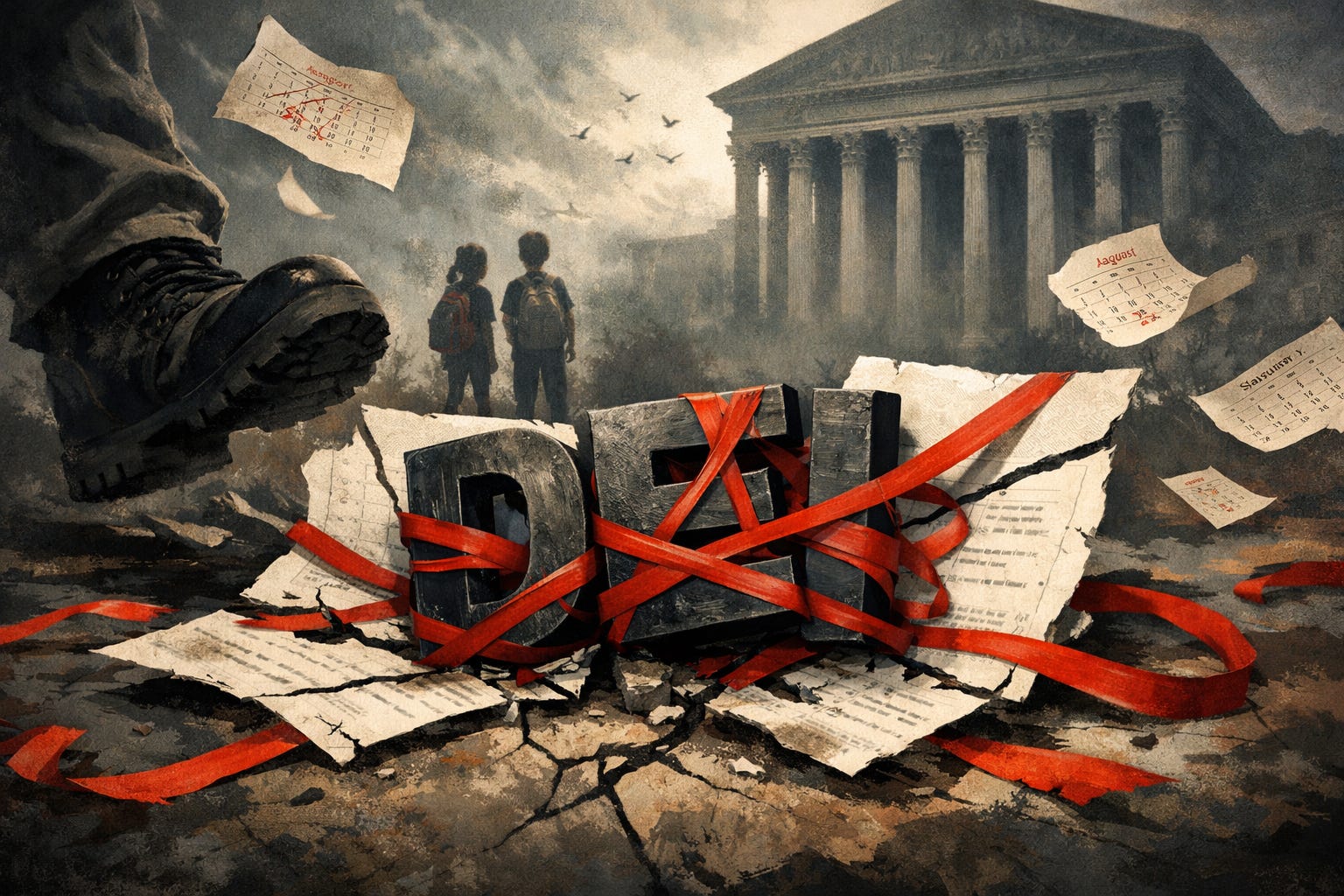
On January 21, 2026, almost a year after the U.S. Department of Education tried to make diversity, equity, and inclusion sound like a crime, the Trump administration quietly backed away.
There was no triumphant press conference or public admission that the policy had been an overreach. Instead, the Department simply filed a joint motion in federal court to dismiss its own appeal in the main case challenging its anti-DEI “Dear Colleague” letter. The Fourth Circuit granted the request. With that procedural move, the administration left in place a lower-court ruling that had already struck down the policy and its companion certification regime, effectively ending the much-discussed letter.
Legal organizations that had challenged the directive did not mince words. The American Civil Liberties Union and National Education Association described the February 14, 2025, Dear Colleague letter and its April 3 certification requirement as “vacated and abandoned,” stressing that the government could no longer enforce the directive “against anyone, anywhere.” Law firms advising schools and colleges now summarize the situation in the same way: the guidance remains vacated and unenforceable nationwide.
That is the headline, but it is not the whole story. To understand what this moment means, and why it is a victory with very real limits, it helps to retrace how we got here and what has happened in the months since that letter first landed.
This Community Is Powered by You
What started as a small circle has grown into something much bigger, and it’s all because of readers like you.
Every time you forward this email, post it on socials, or bring someone new into the fold, you’re helping build one of the most passionate, independent political communities out there.
Want to keep the momentum going?
Share this newsletter with someone who should be part of this conversation.
Thank you for being here. It means everything.
How the administration tried to outlaw DEI by memo
The campaign against DEI in federal education policy did not start with a letter. It started with an executive order.
On January 20, 2025, Donald Trump signed Executive Order 14151, titled “Ending Radical and Wasteful Government DEI Programs and Preferencing.” The order declared diversity, equity, inclusion, and accessibility initiatives to be “illegal and immoral discrimination” and instructed federal agencies to dismantle them.
Less than a month later, the U.S. Department of Education translated that posture into a sweeping reinterpretation of civil-rights law. On February 14, 2025, its Office for Civil Rights issued a “Dear Colleague” letter announcing that a broad range of DEI-related practices in schools and colleges would now be treated as presumptively unlawful discrimination under Title VI of the Civil Rights Act.
The letter warned that any federally funded institution that continued certain DEI practices could face swift investigations and loss of federal funds. The definition of suspect activity was so broad that it swept in race-conscious scholarships, identity-based support programs and centers, many faculty hiring practices, some student organizations, and even some teaching about systemic racism and bias. The document framed all of this as a straightforward enforcement of existing law, but in practice, it was an attempt to make longstanding DEI work sound like a civil-rights violation.
On April 3, the Department escalated further, issuing a “Reminder of Legal Obligations” and a new certification requirement. School districts, colleges, and universities were asked to affirm that they did not engage in the kinds of DEI activities described in the letter, in exchange for continued federal funding. A federal judge would later note that this certification demand was, in itself, a final agency action carrying the force of law.
Formal rulemaking—public notice, comment, revisions—never happened. Instead, the Department attempted to remake the meaning of Title VI via guidance and an online certification form.
Immediate fallout: fear, confusion, and the chill
The strategy worked exactly as one might expect when a federal agency ties sweeping, vague warnings to the threat of losing essential money. Even before any court weighed in, the Dear Colleague letter sent a shock wave through K–12 systems and higher education. Law firm advisories described “shockwaves in the higher education community” and warned that nearly any race-conscious practice might now be treated as suspect.
Public school districts and colleges depend heavily on federal funding, whether through Title I dollars, special education support, Pell Grants, or research money. Administrators and general counsels read the letter and saw risk everywhere. Some institutions moved quickly to rename or restructure DEI offices. Others canceled or scaled back trainings and programs that had any explicit focus on race, gender, or marginalized identities. Still others quietly shelved grant proposals that foregrounded “equity” in their design. The University of Pittsburgh’s own reporting, for example, notes that the Chronicle of Higher Education has tracked DEI-related changes at 437 campuses across 48 states and the District of Columbia, including the elimination or downgrading of DEI offices and the removal of diversity statements from hiring and promotion.
It is difficult to prove causation in every case because the anti-DEI campaign has been multi-front, with state laws, board politics, donor pressure, and media narratives all feeding into the same current. However, the Department’s directive undeniably amplified that current. The official stance from Washington was that DEI itself might now be illegal discrimination, and that message alone was enough to make many institutions flinch.
Lawsuits and the first judicial brakes
The legal challenges arrived quickly. On March 5, 2025, the National Education Association, joined by NEA–New Hampshire and the Center for Black Educator Development, filed suit in federal court, arguing that the February 14 letter unlawfully treated DEI efforts as illegal, threatened to cut off federal funding, and violated both the First Amendment and basic administrative procedure.
A parallel case followed in Maryland, brought by the American Federation of Teachers and other plaintiffs. Both lawsuits made similar claims: that the Department had no authority to dictate curriculum or broadly prohibit educational programs it disliked; that it was attempting an extreme reversal of civil rights protections without justification; and that the guidance imposed broad, vague restrictions on speech about race and inequality.
On April 24, 2025, three separate federal judges in New Hampshire, Maryland, and the District of Columbia issued preliminary injunctions that temporarily blocked enforcement of the directives. Reporting at the time noted that Judge Landya McCafferty in New Hampshire criticized the Department’s letter as vague and beyond its statutory authority. Judge Stephanie Gallagher in Maryland faulted the Department for failing to complete required rulemaking. Judge Dabney Friedrich in D.C. found that the compliance threats likely violated the Constitution.
Those orders stopped formal enforcement. They did not, however, erase the lingering sense that DEI had just been formally placed under suspicion by the federal government, or that a future appeal could still validate the Department’s approach.
August 2025: A federal judge vacates the letter
The turning point came on August 14, 2025. In a 76-page memorandum opinion in American Federation of Teachers et al. v. U.S. Department of Education, Judge Gallagher ruled that the February 14 Dear Colleague letter and the April 3 certification requirement were unlawful and must be vacated.
Gallagher held that the Department had violated the Administrative Procedure Act by attempting a “sea change” in Title VI enforcement through guidance rather than formal regulations, and that the certification demand was a final agency action adopted without the process federal law requires. She also agreed that the guidance raised serious First Amendment concerns, noting that it attempted to restrict particular viewpoints, including discussions of systemic racism, in ways that were likely unconstitutional.
From that moment, at least on paper, the letter and certification were undone nationwide. They were treated, in legal terms, as if they had never validly taken effect.
The administration, however, chose to appeal to the Fourth Circuit. As long as that appeal was pending, a question hung over schools and colleges: would a higher court revive the guidance and its aggressive reinterpretation of DEI as discrimination?
January 2026: the quiet retreat
That question was answered quietly in January 2026. On January 21, the Trump administration agreed to dismiss its appeal in the Fourth Circuit. The court granted the motion the following day.
Legal commentators described the effect succinctly. The Department’s decision left the Maryland ruling intact, which means the Dear Colleague letter and certification remain vacated and unenforceable. The Washington Post reported that the administration had officially dropped its appeal, “effectively nullifying” the directive that had warned schools they could be violating federal law by considering race in hiring, scholarships, discipline, or programming.
The NEA hailed the outcome as a “major victory for academic freedom and education equity,” stressing that “the Trump administration’s unlawful Dear Colleague Letter and certification requirement have now been vacated and abandoned.” Democracy Forward, which represented plaintiffs in the Maryland case, called the withdrawal “a major victory for public education” and “the end of the administration’s unlawful rewriting of civil rights law” via this particular tactic.
On the narrow legal question, whether this specific anti-DEI guidance can be enforced, the answer is now clear: it cannot.
What this outcome actually changes
The obvious change is that the February 14 Dear Colleague letter and April 3 certification requirement are off the table. Institutions are no longer legally obligated to treat those documents as binding. The Department of Education cannot rely on them as an authority to demand certifications or threaten funding cuts. When a dean or superintendent cites “the Dear Colleague letter” as a reason something cannot be done, they are invoking a directive that courts have declared unlawful, and the agency has stopped defending it.
Beyond that, the court opinions in these cases draw a line against similar attempts to govern by sudden guidance. Gallagher’s ruling in particular makes clear that an agency cannot dramatically expand or invert the meaning of a statute like Title VI through a letter and FAQ, especially when it attaches existential funding threats while skipping formal rulemaking.
The decisions also signal that using civil-rights law as a vehicle to suppress certain ways of talking about race, racism, or equity is not a neutral act. Judges in multiple districts took seriously the argument that the guidance amounted to viewpoint discrimination and placed “broad and vague restrictions on every facet of education” in ways that violated due process and the First Amendment.
Finally, this outcome demonstrates that resistance still works. Teacher unions, civil-rights organizations, and advocacy groups did not accept the Dear Colleague letter as a fait accompli. They filed lawsuits within weeks, secured preliminary injunctions within months, and ultimately won a nationwide vacatur. The administration did not voluntarily reform itself. It retreated after losing in court and facing the likelihood of losing again on appeal.
Those are real gains. However, even taken together, they do not fully repair the damage done in the year this guidance existed.
The campaign against DEI did not end
Even as the Dear Colleague letter and its certification requirement have been struck down and abandoned, the broader administration effort to dismantle DEI in education continues on several fronts.
The starting point is still Executive Order 14151, signed on the first day of Trump’s second term. That order commands federal agencies to terminate “all activities relating to ‘diversity, equity, inclusion, and accessibility’” across the executive branch and to root out anything that looks like “DEI or DEIA mandates, policies, programs, preferences and activities,” under whatever name they appear. A companion order the following day instructs every agency not only to purge its own DEI efforts but also to “combat illegal private-sector DEI preferences” in the name of “merit-based opportunity.” The Dear Colleague letter was one expression of that posture inside the Education Department, but it was never the only one.
Since early 2025, the Department’s Office for Civil Rights has been using Title VI investigations to push universities away from race-conscious partnerships and programs, even without issuing a letter. One of the most striking examples is the campaign against The PhD Project, a nonprofit that has spent decades helping Black, Latino, and Native American students pursue doctorates in business. After OCR opened a Title VI investigation into university partnerships with the group, arguing that a past conference unlawfully limited participation based on race, 31 colleges and universities signed resolution agreements promising to cut ties. Many of them had only minimal involvement, such as attending conferences or using an applicant database, but still chose to disengage rather than risk their federal funding.
The federal government has also shown a willingness to use financial resources and monitoring as leverage in broader civil rights fights that intersect with DEI. In July 2025, Columbia University agreed to pay more than $220 million to resolve multiple federal investigations into alleged civil-rights violations, in what the White House touted as a “historic settlement” to “restore fairness, merit, and safety in higher education.” The administration had already demonstrated its readiness to cancel hundreds of millions of dollars in grants and contracts to the university over alleged antisemitism on campus, sending a clear signal to other institutions that losing federal money is not an idle threat.
Other federal programs have been quietly rewritten in the same spirit. Earlier this month, the Department of Education agreed to scrap race-based eligibility language from the Ronald E. McNair Post-Baccalaureate Achievement Program, a federal grant initiative designed to increase doctoral attainment among underrepresented students, following a lawsuit that challenged those provisions as unlawful preferences. Meanwhile, analysts note that the Department’s civil-rights enforcement agenda has narrowed sharply, resolving virtually no racial harassment cases brought by Black or Latino students while dedicating disproportionate energy to “reverse discrimination” and antisemitism complaints that often intersect with campus DEI debates.
Taken together, these moves make clear that the end of the Dear Colleague letter is not the end of the administration’s attempt to stigmatize and dismantle DEI. The memo is gone, but the machinery that produced it is still running. The Department of Education retains enormous power through grant conditions, investigations, and settlement agreements, and it has shown it is willing to use that power to pressure institutions away from race-conscious support structures even without a formal guidance letter in place.
What it does not repair: the chill, the lost time, the whiplash
It is due to these ongoing efforts that we have waited over a month to write this update. We fully expected the Department of Education to attempt an alternative route to further attack DEI, particularly in K-12. We had also hoped for more movement in the judiciary regarding other challenges to anti-DEI efforts.
The withdrawal of the appeal regarding the Dear Colleague Letter does not automatically reverse the chilling effect that the letter produced. Even though enforcement was preliminarily blocked as early as April 2025, the initial shock, followed by months of legal uncertainty, taught many institutions that explicit DEI branding carries real risk. The University of Pittsburgh’s own account of the past year notes that the Dear Colleague letter “did lead to several Title VI investigations at universities and changes to many diversity, equity and inclusion programs,” and it points to the Chronicle’s tally of DEI dismantling efforts at hundreds of campuses.
When schools and colleges respond to a directive like this by dissolving DEI offices, renaming units, removing diversity statements from hiring, or quietly narrowing their ambitions, those decisions are not easily undone. Staff leave roles, budgets are reallocated, and boards grow accustomed to lower-visibility, lower-risk approaches. The letter is gone, but the institutional memory of being targeted for doing more is not.
Most importantly, nothing in this outcome gives back the year that students and educators spent in the shadow of this guidance. The Department of Education issued its letter in February 2025 and abandoned its appeal in January 2026. That is almost exactly one school year. In that time, students who could have benefited from robust DEI infrastructure experienced programs that were paused, rebranded into something thinner, or never launched. Grants that might have funded ambitious equity-focused work were never written or were diluted to avoid attention. The cohorts who moved through that year do not get a replay simply because a court later declared the policy illegal.
The deeper structural problem also remains. So long as changes in administrations can produce radical shifts in agency interpretation, delivered via memos that take effect immediately while the school year is already underway, education systems will live with what can only be called policy whiplash. The administration attempted to flip the script from “DEI as compliance” to “DEI as discrimination” almost overnight. Courts did push back, and relatively quickly by judicial standards. Yet even “fast” litigation moves on a scale of months and years, not on a nine-week grading period.
Telling the truth about a partial victory
It is possible, and necessary, to hold two truths at once.
The first is that this is genuinely a victory. A sweeping attempt to redefine DEI as a Title VI violation through a guidance letter has been struck down, vacated, and abandoned. Courts have reaffirmed that agencies cannot quietly repurpose civil-rights law to silence discussions of racism and equity, and that they cannot massively alter schools’ obligations without going through the democratic machinery of rulemaking. The people and organizations that fought for that outcome deserve credit.
The second is that this victory does not restore what was lost. It does not rebuild the dismantled DEI infrastructure. It does not automatically embolden cautious institutions to do the work they quietly decided was too dangerous to attempt last year. It does not change the fact that students lived through a year of reduced support and heightened fear under a directive that should never have existed.
For readers trying to make sense of this moment, the story is not “the bad policy is gone, everything is fine now.” It is closer to this: an administration tried to outlaw DEI in education through a memo and a funding threat. Courts stopped it, in part because the process was sloppy and the First Amendment problems were too obvious to ignore. The administration abandoned its appeal when the legal terrain turned against it. In the meantime, schools and colleges absorbed another lesson about how swiftly the ground can shift under their feet, and students absorbed the cost of another year spent under a government that openly framed efforts to support them as inherently suspect.
The letter is dead. The damage isn’t. The real work lies in making it harder—procedurally, politically, and culturally—for any future administration to weaponize federal power against equity in this way again, and in rebuilding the programs and trust that were lost while this one lived.
If you found this useful and want more slow, pattern-focused dives into how education, law, and “DEI” fights actually work on the ground, you can subscribe to get future pieces straight to your inbox. No hot takes, no both-sidesism—just careful storytelling, receipts, and context about how we got here and what it means for the people living through it.
Sources:
“Trump letter banning DEI in schools is dead after legal appeal is dropped” — January 24, 2026 — The Washington Post
“The U.S. Department of Education Agrees to Dismiss Dear Colleague Letter Appeal: What This Means for Your Campus” — January 29, 2026 — Saul Ewing LLP
“U.S. Department of Education Voluntarily Dismisses Appeal, Leaving DEI Dear Colleague Letter Vacated and Unenforceable” — January 30, 2026 — Cullen and Dykman LLP
“Department of Education Backs Down on Unlawful Directive Targeting Educational Equity” — February 18, 2026 — American Civil Liberties Union
“Federal Court Vacates Education Department’s Dear Colleague Letter on DEI: What Schools, Colleges, and Contractors Need to Know” — September 10, 2025 — Pillsbury Winthrop Shaw Pittman LLP
“Executive Order 14151” (Ending Radical and Wasteful Government DEI Programs and Preferencing) — Wikipedia
“Diversity, equity, and inclusion policies of the second Trump administration” — Wikipedia
Yes, we are still in the trenches of Trump and the GOP's war on reality. We can acknowledge that this battle was won by the organizations and lawyers who continue to fight for our constitution.
This what SHITler's joke of an Administration is about: hold entities hostage with the threat of 'no funding,' to get what they want. Thankfully it has NOT worked this time!